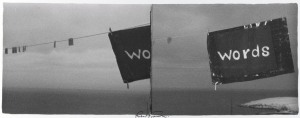

Talk about “prompting” photos! If there aren’t thousands of stories in photos like these…the eye, the mood and the technique combine to provide worlds to discover and invent. Thankful for this work.
Tag: Writers Resources
Writing: the Blocks

Writing: the Blocks
“and everything here like an incomprehensible explanation”
-Arkadii Dragomoshchenko-
There are those times of overwhelm. Edit? Create? Organize? Submit? Wander about (for “inspiration”)? or sit and stare (“meditation”)?
There are those times. So much written, nothing sold. Years of working, thinking, learning, feeling…orphaned. Turned away. Left out. Sent back.
Rejection.
Here’s the open field and some more ever-uncertain time. Feels fragile. I feel I should be making, arranging words toward unknown meanings or inferences, but I’m also drowning in them – so many of my own, millions of others as well. Approved words, theirs, successful words, words now “bound,” where mine (I try the positive) are “free,” “independent,” “loose”… not owned by any other hands or minds.
But the words seem to want it. They emit their own desires. For partners, for dances, for strolls. Attachment. They even like to work! Anything at all – they just want to be, active.
Mine aren’t. They jimmied their way around my emotions and spleen; infested every nook, cranny and fold of my brain; strained my throat and cramped my hand…but once I’d rid myself of them – sealed them between the bars of blue lines, they began to wither and starve. Atrophy. My words – these voiceless victims.
They’ve got plenty of company all lined up and folded together – hell, they’re stacked on top of each other…but they need human parts for life. Need eyes and mouths, lungs and ears, hands and minds, perceptors, receivers and nerves. I look down on them all like leaves from last winter, or hidden away in mausoleum-like drawers. I feel sorrow.
There are zillions of others – exactly the same as mine but for their order – speeding all over the world – through wires and lights – through voices, canals – held gently in hands – slick and shiny on mags – proclaimed on billboards and signs. But not mine. Not these innumerable identical versions but for my script, my experience, my faulty manipulation.
What gives?
What gives at these moments, these gulag-ish terms of withholding and stasis?
A letter or email perhaps. A talk with my wife or my sons or my daughter. A glance at a spine or a page. Some music with lyrics. A friend. They are moving, alert. Every-ready for use. In use. Wording their function. My continued submissions might be jail-breaks for them. My blogs and my posts and my readings. The phone calls. We could try it? See how they still work?
Or even something like this. This query of what do they want? Working them into myself. Materializing them.
I don’t know. I don’t know if it helps. I can’t tell at this moment. They seem stuck. And yet not. Here they are, ever coming, ever becoming, nothing.
Like us. Maybe I’m stuck. Becoming nothing (inevitably) but becoming nonetheless, all the while.
I guess I’m suggesting that there’s really no such thing as stasis or block in living beings. Regardless what or who or how, we’re becoming (the 5 Ws all taken care of). Now & Here all five essential questions are active whether I write down answers or not. As long as we breathe. Work is going on.
And words, so eagerly activated.
N Filbert 2012
Places
The Essence of Place
“To record the essence of a place, so that it can be inhabited by something outside itself, is to start a story. This means searching for a language, one that we know intuitively but cannot spell out.”
-Lukas Felzmann, Landfall–
“The time has come to talk of whatever we want”
-Arkadii Dragomoshchenko, Xenia–
“the work drives beyond promise, craving and time”
-Louis Zukofsky, Prepositions–
Sometimes there were birds there. They passed through in groups, in swoops.
I’ve seen people there too, but not swooping or grouping. It just isn’t that kind of place.
It felt large and open yet cloistered, contained. There were large trees all around and throughout. Somehow it seemed level.
I don’t recall there being water, but I believe it staid nearby. As if it were ready for when it was needed.
I’ve no memory of critters or pets, cycles or frogs. Only birds that might swarm like the leaves filling trees as they swayed.
Oh my, but the blur! The soft focus in apprehending! It rocks and it waves, it flows through you while sitting, I say!
I wonder the eyelids of storms. I leap lying down. I silently sing out the shrieking of birds. I love in this place. As wild or as calm as is needed, a respondent surround.
When I’m here I try to tell you, by searching for words or the making of pictures. That don’t capture.
Have you wandered here before? To the essence of a place?
Please do tell me or show me what’s yours…
N Filbert 2012
Writing: the Characters
Writing: the Characters (1)
Not beginning from anywhere but here.
Here being where I am looking for a character, a someone, and specific, with a mind, a body, and particular knowledge and actions, whom I might observe and record. On whom I might test out my language. Whom I create.
Exercise in perception, then. To see what I could see, perhaps, if I looked a certain way, at or into a certain person. What I might hear, and how to say it. What would be felt and its work of translation. The smells and the tastes and the histories, for both of us. Or perhaps even all. No, that’s too far.
Right here, though, investigating perception, that preform vehicle, formed by our surroundings – imagination – the multiplex of learning structures allowing me to sense, to perceive. That also, is here.
Imagination and perception – their invention we call world, and a character, a subject/object like my hand I might observe, hold aside of me while attached by nerves and cells, tissues and blood, by life, its embodiment.
Non-abstract abstracted – that conundrum – here. The truthfulness of experiencing becoming honest lies. The words, the print of hand, what tells (or who), and how.
Perhaps another thinks this way? Well, not exactly, but shares concerns with idiomatic nuances? Perhaps his education (or hers) was difficult, or pleasurably a breeze, they mastered information like a large and thirsty sponge? Absorbed and were absorbed in such interstitial structures. Or not. Not at all.
An uneducated person with adaptive gifts for resonance. A mimicking trickster riddling what is heard into naïve and complex wisdoms? That would be fun.
Perhaps another world – country, continent, planet? Someone observed for years suddenly inserted in a strange context, situation. How do they behave, react, manage and survive? I could use myself in a planet of clouds, or the tunnels of worms, what would characterize me? How would I change? What might I effect? If I were made of clay or had a thousand lovers in a desert?
The only edge to possibility is what experience brings.
But pretending to begin right now, I see him clear. There is a woman he is watching he finds beautiful. When she works he sees the curve of her small breast which he desires. He is ruddy yet refined, of middling age. He’d like to court her but fears all pain that can’t be bandaged. He’s afraid of words and their millions of ropes and anchors. Reality feels like conflict, for him, a continual coming-against, and adjustment. Adaptation he experiences as loss. Of unrealized ideals. And so he walks, spinning narratives in his head.
Here, that possible visitor handmade. But who? And how would I know him? And where was he from? How was he formed? Who does he belive? And so forth…
One way to be here.
One way to press your hand against the wall.
Another Pause, Another Someday
“Words give clothing to hide our nakedness”
“But a word is a bottomless pit”
And then it arrives, unexpectedly, another gap. She sees a magician in bright jester’s garb, seated on a branch in a tree. Amid the traffic. Amid a swarm of bees, of thrumming crows and starlings. A bat lies in labored breathing on the sidewalk.
Lightning- and Lady- bugs.
Like that, like both.
There is no goal to it in the beginning. At first. The seconds’ glow catches you off guard. “What was that?” neon spot moving in the night. Imperceptible polka-dotted red creeping carefully over your toe. Structures pause. Structures moment. When realized, when you bring your own accident: awareness.
What pressures turns out to be necessity. Of deadline, of assignment, of transactional fulfillment – relationship or vocation, even health. Without apparent choice. Or ever so long ago. Why markings called parentheses are shields. What gives pause. And stays the pressuring. For the moment.
An extended kiss.
A lapse in volume.
An ignored alarm.
You find yourself there : (YOU).
The rest of the world lining up, encroaching, exerting itself, themselves, your other selves, against the slender boundaries, the slick curving walls – they can’t be climbed, nor be toppled, only inverted )if you accept the pressures(, or erased as if they’d never happened. Become brackets. Prison versus asylum (in its native safety-seeking sense).
(YOU)? )YOU(? [YOU]? ]YOU[?
Now and then. Another pause. Another Sabbath. A so-called rest. Time is not the issue (as duration). Time is at issue in its momentary absence. Glancing the lightning-bug, bird-call, ladybug feeling out the stem.
“Another pause” with pressures all around. Expectations or chores. But no one calling, not this now. Last week too, unexpected, unprepared, cage door left awry, or finding key in hand. Parentheses. And then you sleep that active way we call “rest.” For a moment. You make, for the joy of making, or not. Either way is pleasure. Or pleasant at the most.
Such as now, another pause, this day, another Someday that arrived.
Writing: Resonance and Quotation
Resonance: Reverberations: The Nature of Quotation
“Awake O sleeper!…”
(Ephesians 5)
“…life is but a dream”
(children’s rhyme)
“The Tao that can be spoken…”
(Tao te Ching)
“From the way I say your name I always know…”
(???)
“In the beginning was the Word…”
(John 1)
“To be or not to be”
(Hamlet)
“Try again. Fail again. Try again. Fail better.”
(Sam Beckett)
“I went to the word to make it my gesture. I went, and I am going”
(Edmond Jabes)
Color stained into fabric woven into rug. Of a piece, as they say, indistinguishable from the object itself. So the words flow into us, saturate and stain us, are absorbed and resurface as we ourselves. Like echoes in the cranium, or instinctual responses of the body. Resonant reverberations.
“And so it was…” (A.A. Milne?)
“Once upon a time..” “In the beginning…”
Countless appearances, an abyss of sources, the word lives on.
Who first used “love” or “light”? “To be” or “not”? “Hello,” “yes,” “a”?
Our life is quotation, interpretation, paraphrase.
We shelter in a common blanket.
We’re covered with a shared snow.
We drink of one great water.
Languages one to another, stained and woven rug.
N Filbert 2012
Writing: the Margins
Writing: the Margins
“All words run along the margins of their secrets”
– Susan Howe –
Now we are getting somewhere. Now we can go ahead and believe in telling and in being told. If “every word runs along the margins of its secrets.” If so, (and it feels truthful, even if untrue) then…
there might be other margins, or perhaps every margin limns its contents and its secrets? Perhaps, then, our senses, and every limit of our perceptions “run along the margins of their secrets,” like our cells and bodies do.
That “perhaps” means here “possible” – an enormous margin full of stuff and secrets. I.e. seen and unseen, known and unknown, believed and unbelievable, etc.
And if “Limits/are what any of us/are inside of” is truthful of Charles Olsen to utter, then we might be everywhere up against the margins of the limitless.
Speaking practically, a margin is variable, and bodies and language (synonyms of a sort) are more variable than variables.
So to say, we may indeed (in our actions of doing and making, saying and thinking – signing and gesturing) be communicating. That is, it is possible. Words running along their margins of secrets, senses apprehending along their own secret margins, the boundaries porous and variable: something might be meeting there, might be weaving, might be, as it were, com-prehended (apprehended together in some so-called secret way)…co-mmunication?
If language, in its way, defines the social, our context, like skin, for participation in world…connectivity, sharing in common, is not only possible, but necessary, and the secrets, the ineffables, the private, what we thought of as incommunicable, is clinging there, infused with the margins, the borders where we interact, transact, have (as it were) our being.
Therefore
“it is not infinite. Even infinite is a term”
-Louis Zukofsky-
by which I mean all our words signifying –lessness: limitless, timeless, meaningless, objectless, and so forth, limn their mysteries as much as the constant traction we enact with our names.
Lines wide enough for all of us to traffic in, and obviously very thin, perhaps transparent – we are dancing here.
Feet and minds, hands and mouths ever each right where they seem to be and also where they’re not…marginal movements…co-here-ence, always presently together, secret and exposed.
Perhaps and possibly.
N Filbert 2012
Writing: the Apparatus
Writing: the Apparatus
“one can think of the work (of writing) as a dialogue between the two distinct demands bearing on it (the demand of possibility, the demand of the impossible). Or between its two poles (measured form, measureless disintegration) or between the embodiments of these two ‘centers of gravity,’ if you will: reader and writer…two come together in a place where neither can be found…One of them keeps dragging it into the light of day as a completed oeuvre, a realized whole, something that has actually taken form and come to be (read, that is, or, you could say, heard), while the other pulls it back into the dark whence nothing ever springs (but where there is a chance that, coming to pieces, something might come to be written or said)”
– Anne Smock, What is There to Say? –
-the demand of possibility, the demand of the impossible-
The tools the writer possesses.
That there must be something to say…that it is impossible to completely say. Finally, definitively, to have done with, saying experience.
What does one make of this? With this? Paradoxical demand, desire, exigency – imperative, self-generating, uncaused and ineffectual, drive?
Our tools: awareness. Attention. Passion. We observe and take note, feel-with, and seek to spell it out (for ourselves, for world).
Our tools: available language, sound, gesture. Entering the woven barrier and thoroughfare of what is shared, common, constitutive, we act, operate, select, arrange, choose, rearrange from this quilted information of the world, our saying of it. Or singing, or stating, shouting or whispering and mumbles.
It seeks into fact. We construct an object, made up of nothing, of airwaves, scratch-marks, designs. Barely effable cues, hints, notions and signs. We begin again with that. With what it fails to say, to communicate or reveal. We tinker with and tamper, excise and expand. Ever the remainder. Inexact invention. Something there, some things not.
We pursue what is not. What fell aside or seeped away. The evaporate. The unknown (here I adore the French: je ne sais quoi – that feeling that one knows it, and knows it so well and so deeply, and yet is unable to say what it is that one knows!).
Endless anticipation, expectation, a lusted desiring…
Endless frustration, falling short or to the side, inevitable (inherent even?) failing, shortcoming, irresolution.
These are the tools of the trade. The writer’s apparatus.
A caveat: from time to time I’ll wager to say we all of us take in some language or sound, vision or world that seems “just,” feels ripe, adequate, full and exact to the perception of our experience. This is wondrous, thrilling, satiating, “ecstatic,” a moment’s completion, wholeness, perhaps.
Yet is it? What does the masterful painting, the pregnant poem, the echoing song or fulfilling experience result toward? Yes, toward, not “in.” Not arrival but generation, bursts of multiplications of words, sounds, sights and movements now invigoratingly fueled and stimulated – fecund to go on…for more…fuller…richer…or even repeat!?
“Such then, would be my task, to respond to…speech that passes my understanding, to respond to it without having really heard it, and to respond to it in repeating it, in making it speak…To name the possible, to respond to the impossible. I remember that we had designated in this way the two centers of gravity of all language…Why two to say one thing? – Because the one who says it is always the other…”
– Maurice Blanchot, The Infinite Conversation –
Heroes Ringing True
On “the writer type”:
“One can describe this type as the person in whom the irredeemable solitude of the self in the world and among people comes most forcefully to mind: as the sensitive person who is never given his due; whose emotions react more to imponderable reasons than to compelling ones; who despises people of strong character with the anxious superiority a child has over an adult who will die half a lifetime before he will; who feels even in friendship and love that breath of antipathy that keeps every being distant from others and constitutes the painful, nihilistic secret of individuality; who is even able to hate his own ideals because they appear to him not as goals but as the products of the decay of his idealism. These are only isolated and individual instances, but corresponding to all of them, or rather underlying them, is a specific attitude toward and experience of knowledge, as well as of the material world that corresponds to it.”
On the writer’s region (“nonratioid”):
“There is no better way to characterize this region than to point out that it is the area of the individual’s reactivity to the world and other individuals, the realm of values and valuations, of ethical and aesthetic relationships, the realm of the idea…in this region facts do not submit, laws are sieves, events do not repeat themselves but are infinitely variable and individual…there is in the writer’s territory from the start no end of unknowns, of equations, and of possible solutions. The task is to discover ever new solutions, connections, constellations, variables, to set up prototypes of an order of events, appealing models of how one can be human, to invent the inner person…which then nevertheless branches out somewhere into a boundless thicket, although not without somehow fulfilling its purpose…”
These quotes come from his exceptional small essay Sketch of What the Writer Knows
which I desperately wanted to reproduce here…
if it “rings true” for you – please find a mentor and friend in Robert Musil:
 All my Words are Silent