The Heart and its Branches

“I do not want to know about the human heart.  I do not desire to speak at all about those indwelling, intimate reaches of the heart in which anguish is an undiminishing personal interrogation, much less to analytically enfetter those reaches.

I have the sense, the good sense, the decency, to have nothing to say.”

“Sick of all the you be’s?  Well, what do you say, you be you and I’ll be me?  What do you say?  We can fall asleep in a room full of the snoring dead.  We can sleep while an old woman twangs away on a bad piano while rain keeps time in the empty street.  We can listen to and count the closings of a child’s fist as he tries to catch a fruit fly.  We can listen to the whistling of the bombs.  We can listen to each other.

I do not want to know about the human heart.”

“I am not a man of science.  I am not proficient in any branch of nature study.  I do not know the difference between an amphibian and a reptile.  I have no yearning for hard knowledge about the hard world.  And yet I have no affinity for anything spiritual.  In fact, I have a pronounced, conspicuous, and striking absence of an affinity for anything spiritual.

I know but one hard thing about the hard world and it is this:  from the sum of all theories, as arranged in accordance with ascertained facts, we make a few assumptions, that we have actually ascertained facts, that we are actually here to ascertain them, and that there is actually a here.”

-Percival Everett-

“The literary word resembles a person who roams at will” – Robert Musil

“The sentence not only derives its meaning from the words: the words derive their meaning from the sentence, and the relationship between page and sentence, whole work and page, is no different…the embracing and the embraced develop their meaning mutually out of each other, and the structure of a page of good prose is, analyzed logically, not something frozen but the vibrating of a bridge, which changes with every step one takes on it…”

“One can only explain that it is from all the details taken together, and through their mutual interpenetration, that the whole arises in a way that remains mysterious…a transformation of sense that eludes logic…but the meanings are related to each other, and when one grasps one meaning the others peep through beneath it…”

-Robert Musil – “Literati & Literature” –

“It is only meaningful to speak of originality where there is a tradition” – Robert Musil

“thus one could probably ‘dissect’ any writer whatever (formally, or according to subject matter, or even according to the intended meaning), and would find in him nothing but bits and pieces of his predecessors; by no means completely ‘taken apart’ and ‘newly assimilated,’ but preserved in broken shards”

“Thus in serious literature the peculiar situation emerges that the general ongoing tradition and the personal contribution of the individual cannot be separated from each other.  In this process the continuum does not grow in any dimension other than extent, nor does the personal element gain a solid position.  The whole consists of variations that randomly come to rest on each other.”

-Robert Musil, “Literati & Literature”-

Sent from a friend…

…passed along for Tocksin

(and other grammar afficianados)

<iframe width=”640″ height=”360″ src=”http://www.youtube.com/embed/w5R8gduPZw4?feature=player_embedded&#8221; frameborder=”0″ allowfullscreen>

The Writer: a context out of context

author sketch by Holly Suzanne

.

Faced with the blank page, Writer runs.

Confronting the white spaces, Writer enters.

Emptiness indicating gaps.  The writer attempts to cross.

In theory this is “bridging” – the ability to construct a bridge.

In practice, Writer uses words like rope.

Without them he would fall.

Plummet.

.

In the presence of what infers silence, Writer hears patterns and rhythms.

Sometimes also sees.

Constructing shapes of nothing, this is sometimes called.

Creatio ex nihilo referring to no context.

In absence of recognizable sound – the infinite conversation.

Writer holds there and eavesdrops.

Writing is a device.

.

Responsibility ends where opportunity begins, which invokes responsibility.

Writer fills the margins.

Working at the edge of labor.

.

If the tracks are laid, Writer composes rails.

The network is for nothing – conversation going on.

Creatio in contextus refers to complex emergence, a result of adaptation

and leftovers causally unexplained.

Writer is compelled into absence.

Children skipping cracks, stuntmen leaping canyons.

.

Writer is friend to correspondence

ecstatic moments

the distance in between

threading disconnections

shooting gaps.

.

Setting aside is opening doors

in land without land a Writer’s building.

Writing represents a reference

context woven out of context

Writer spins.

.

Portrayal is errant copy.

Narrative a fabrication.

Sentencing – destruction.

Every symbol plugs the whole

cluttering conduits

Writer can’t escape.

.

Writing is abiding time.

Never yet, always almost.

Writer leaps

with nothing there

into now + here

which equals…..

 N Filbert 2013


Relevant

Attempting an entire academic paper in one day.  To the tunes of:

Perambulating

photograph - Jennifer Koe

Perambulating.

Disjunctive Cartography – Our Propensities, Asking after the Nature of Nobody, cont’d

“The map is not the territory.  That’s an expression which  means

the world does not match the picture in our heads”

-Lemony Snicket, All the Wrong Questions, vol. 1

            It thinks.  It considers that it has not done with it.  It reasons that I will know more tomorrow.  Its hope of reading, of selecting and organizing, of patterning and arranging toward some partial whole, toward an item, an element, a concept or thought (any Other) that it might also become (or have been, an “I”).

In other words, it requires difference.

Yesterday I played soccer with  my son, it concocts.  I was the Other experiencing, moving, tripping-shouting-laughing – discretelyother than the ball or grassy ground, other than the leafy trees and wind, the boy (the one I called son), it was anOther yesterday, and therefore it may refer to that example of human-in-a-context (a surround of not-it) by a meaningful (adequately functional) pronoun (name-toward), namely “he” or “I.”

I gained definition by my surroundings, it conjures.  Any object will do (it’s perceiving assorted matter and energy, its limbs rest on some as “desk,” the 10” fence as “books” and the process of sensing, transforming to perception as “time” and mediates “it” as separate-though-connected – of the same stuff (matter) but in motion and of a unique form (relating to) – and names its organized system “self,” “me,” “I”).

It meditates (categorizes, classifies, identifies, compares and contrasts) on these sensations/percpetions/affectations and wonders.  “It was I,” it hears without sound – a confession aimed at a photo of a boy-child near against an aged man I knew as “grandpa.”  I looked so different – of different cells and height and weight, blood pressure and vision, facial contours, bones, hair and skin – so very different (it looks at a reflection) – how is it the “same” (identical to) “I” it is now?

Or might be tomorrow – through an utterly unknowable future of events, weather, interactivities, sensations, affectations and cognitions.  Will it be me tomorrow?  It wonders how identity can withstand such difference – variance, change, even replacement and erasure – and still meaningfully or validly considered “same”?

It places its’ head on its’ wrists.  It writes these words (is writing) in order to create (or craft) a recognizable trace, an effect, communally learned, socially agreed-upon marks that construct a momentary reflexivity its’ own existence.  A sort of extrinsic, partial it, to feel like also an I, at a moment.

It in-scribes in a medium, borrowed from others – borrowed, acquired, manipulated, stolen – a kind of proof to it that it is, and is unique, separatively connected, yea, conjoined seamlessly, molecularly, and yet… distinguishable… therefore I-able.  Referable.  Nominal.

It senses discomfort in parts labeled (categorized, classified, i.e. generalized and lumped indiscriminately/arbitrarily or learned) “head” and “neck” and “shoulders.”  It shuts its eyes.  I slept well last night, that is, I woke refreshed, my discomforts (aches) diminished.  It remembers I went to bed dry-eyed and suffering allergic responses to Springtime.  It drinks coffee.  It is not the same.

This is a portion of a map that does not represent the territory.  There are, perhaps, moments – instances – in which I fit with my surround – but usually it is organizing a mapping conference of sensation, affect, percept and infinite inputs coupling to pre-formed acquired categories and classes, fuzzy generalizations to stencil lines and rivers, mounds and fissures with very little correspondence to the world.

It writes this as “my world,” or “the world that I in-habit.”

-Becoming Human: Asking after the Nature of Nobody pt. 1
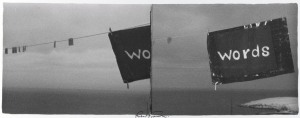
The Direction of Dreams

a la Friday Fictioneers – everybody should give it a go!  Thank you Rochelle Wisoff-Fields for keeping us prompted…

copyright - Jennifer Pendergast

The Direction of Dreams

My son says he always dreams the same house, strangely enough.  Except with a spiral staircase.  The cartoon girl runs jerkily past.  Perhaps she trips, perhaps there’s a dog in the way, perhaps a lady walking with a stroller.  He doesn’t know the house, he says, but it’s always the same house.  With a spiral staircase, but not a cartoon girl.  I know she’s running though, in fits and starts, with urgency.  Something depends on her speed.  There’s a trying to get somewhere, in any direction.  And direction needs a context.  Something about dreams, spirals and speed.

N Filbert 2013

What I Was Meaning To…

“Abandoned Writing Projects” by R. M. Berry, from: