Fumbling toward FICTION

Okay, here goes.  I’ve been diddling my way into another attempt at a longer go of writing, and today have decided, (largely by the courage of company – Tocksin has also begun posting portions of a novelistic go) to post a few rudimentary fragments.  Up until yesterday  the working title was simply FICTION.  I’ve written 3-5 chapters over the past month or two and in seeking an orientation for the work certain symbols and recurrences have led to an inquiry.  “Write about what you want to know” Lance Olsen says, and I can see I’m searching after something in these words.  The epigraphs that shoot me on are the following…

“Reality is the motif”

-Wallace Stevens-

“The universe was the glue that held him together”

-Jonathan Lethem-

“I only care about fiction that raises the question of what fiction is…”

-R. M. Berry-

“The line is only a shadow cast by one (memory or fiction) over the other (fiction or memory).  Once I place memory into language, memory becomes a rumor that makes room for uncertainty.  Memory slips into fiction but then fiction becomes memory once again in an/other way…It is difficult to separate fiction from memory, which is different from separating truth from lying.”

-Doug Rice-

and so it begins…

Family 1

Family 12Family 13

Plunder

Items arriving today:

This slideshow requires JavaScript.

and how I stay in school:

This slideshow requires JavaScript.

keeping on keeping on

“Write about what you want to know”

-Lance Olsen-

Aspects of Writing: The Beginnings – Conception. Inception.


The Beginnings: Conception, Inception

To be thinking about thinking about thinking the origins, the inception, where/when/how the movement-act, a specific verbal urge – that is, to write – conceives.

“To form or develop in the mind.”  “To become pregnant (with child); to grasp seed.”  No when, no how.  No description.  What? – it is a verb, it is verbal.  Con– implying, for inference, a with-ness.  Form requires relation in order to.  Something grasped, taking shape, coming to be.  Wombed – a gathering and a nurturing growth.  Where? – the mind, the gut – of imagination and body.

Inception, then, a beginning, a change, necessarily requiring an other, an outside – entity or energy, movement/matter, to be taken, grasped, to form and develop.   WITH.

Lodged “under the skin,” catching “in the throat,”  sticking “in the mind.”  Festers and swells.  Obstructs and impedes.  Reminds and welcomes or avoids.  Alters, morphs, catalyzing change in and with the host.

Conception: to take with, grasp with, grow and develop with.  To begin is to become.

Alter your position, feel what meets your body, even if only air.  Step forward or back, turn – ceiling, sky.  Nuzzle your nose inside of your neckline – inhale.  Be with all that you are with.  Take it in, work to grasp it, and let it grow and develop, in and with you.  Change.  Begin.  Become.

Conceive.

Otherwise inception, impossible.

 other Aspects of Writing

Aspects of Writing: Writing the Impetus. The Self-Reflexive.

The Self-Reflexive.  Impetus.

The urgency, that is, the urging I feel in setting forth to compose, is dismantling.

In other words, the forcings that encroach, impinge and unleash within me when I’m ‘of a mind’ (experiencing the intention of) ‘to create’ is one of destruction, a defensive attack.

I am thus synonymed by sculptor, woodcarver, archaeologist.

One wants to undo the stories before they reach the page.

In order to find, discover, the figure of them, a more lasting (perhaps) form or shape.

To strip them of their ‘qualities’ or ‘style.’  Their manipulations.  Creation as a straining of the weak, the falsifiable…a process in survival of the fittest, the more “true”(?) or apt.

Chiseling personal explanations and perspectival descriptions down to possibilities.  Unraveling myths toward oracles.  Discounting proofs into theories.

The impetus of writing evokes the motivation of doubt, the landscape is struggle.

“To be inspired” might mean to be activated by an experience accurately called “perfink” (David Krech), or, “perceiving, feeling and thinking at once” (Jerome Bruner).

Regurgitant feeling: investigation, analysis, interpretation – meanings attacking meanings, in hopes.  In hopes that a perfink of “meaning” (a satiation of anxiety, terror, doubt) might prove indestructible – as a possibility.

The narrative, then (the verbal expression of a perfink), is a traffic jam of conventions, presuppositions, reality-views and solipsistic Gnosticism forged within the forging self; writing – as apparatus, activity, function – reflexes: brings self-world to bear on self-worlds in attempts to deconstruct automatic (as it were) constructions of perceiving/feeling/thinking – fighting, clawing, tearing against it with the information and energy of shared resources: language, “knowledge,” the usable past.

Clashings of systems, perfinking perfinks, violent internal skirmishes and acts of terror(ism) – a doing that attempts the undoings of doings – an otherwise endlessly insular, of unverifiable and infinite traces, activity known as self-reflexive

– producing stalemates of exhaustion, individual paucities of supply and reinforcement, ourobourosian

offering only extrinsic chances for momentary cease-fires – the artifact, figure, form of the battlefield, photographed in process and thus submitted – to critics, to readers, to colleagues, to shadows (i.e. to genuine Others) that it might become real (exist in relation, to be directly experienced), corroborated or dismissed by equally limited and idiosyncratic perfinking, outside – both in the world, and of it.

“the contest any artist has with his or her art: working toward a perception that is his or her mind’s peace.”

-Louis Zukofsky-

“the mind carries an austere

inwardness that will not put out its eyes”

-Laurie Sheck-

“Writing is a lonely business’ is both a dull myth and a material fact of the profession, one I happen to be temperamentally suited to endure but which doesn’t gratify my sense of what it’s for.”

-Jonathan Lethem-

Creeley

-Robert Creeley-

see Aspects of Writing
Entanglement

Getting back into A swing of things, I’ve missed the past couple of prompts for the wonderful mixed company of creatives that take part in the Friday Fictioneers (yes, please DO join us!).  So here’s to restarting refreshed…

Copyright-Roger Cohen

Entanglement

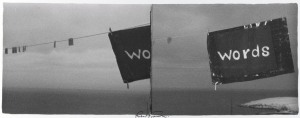
So this is our journey.  No way out of it.  Bound together, bound apart, bounded in.  We call it “Situation.”  Shared in common.  Held by circumstance.  Anything might bow us, but both will be effected.  The cords behind, some measures of rest, and whatever comes next – it all impacts the song.  Lucky for an other – no sound can be heard if there is only one, if our strings never touch.  Though sometimes cross and crossed over, at others we vibrate one another to the sweetest hum. It happens together in our ever-bordered context – the space of our entanglement.

N Filbert 2013

A strong mid-section

OCTOBER 2011

POSTMODERNISM AS LIBERTY VALANCE: NOTES ON AN EXECUTION

THE RITUAL KILLING OF POSTMODERN LITERATURE IS A THREE-MAN GUNFIGHT AT THE O.K. CORRAL (ALLEGORICALLY SPEAKING)

Finding a lot of resonances and curiosities in this collection that I’d like to recommend – a fruitful pattering of words to engage – I especially have liked the introduction (can’t find pdf of online) and then I thought the midsection of the essay linked above (click anywhere on the opening titles to read) was strong and productive.

Metamorphosis: 2013: Insect Intensity

Termite Art

Working the edges and angles.  “Part of the woodwork,” they say, though not in a structural sense – rather more a destructural or deconstructional way, one should probably add.  We’re usually fairly quiet, but work is constant, at times involving even groups or clans.  What we create looks like a whole full of holes.  Feeding on the solid, reducing it to doubtful tunnels, leaving some beautiful patterns.  Rhythmic, at least.  Once in a while you can hear the hum of our work, but more often than not our efforts are simply stumbled upon.

What you once thought sturdy enough to lean upon often crumbles out from under.  Usually we’ve been there first and found the flaws.  We scramble and burrow, many even fly.  Keeping mostly to ourselves, gnawing and chawing away at the things we all believe in and trust, things assumed to hold fast and true, the shapes that give substance to lives.

Of course many consider us sinister nuisances, think we work to undermine, but we really don’t take much – just leave it considerably different than when we first come upon it and passage our way through.  Left to ourselves we accomplish a lot, are industrious, but we’re more often pestered, hampered, sealed-off, even (and yes, I’m serious!) exterminated!  Treated as pests or threats or dangers.

We might be admired, theoretically, but we’re never welcomed as guests.  Not invited in houses where public or money are smelled.  There we’re only talked about – as worming and wriggling our ways through the infrastructures – “fluttery, ephemeral critters” we’re called – parasitic to power and ultimately debilitating if left unconfronted.

Harmless enough as ourselves, simple units to squash, but we happen to be many.  Think: ants.  Think: pestilent plague.

We can be quite beautiful in the light (as a specimen!) – translucent and fine and opaque, exhibiting a powerful delicacy.  But given free reign we undo the foundations, and therefore, it is feared, the whole edifice too.  An elephant, for instance, might be trained – used for tricks or for jokes – is easy to keep an eye on, but not us “weasly and scuttling creatures,” no, no.

All I’m saying is that some of us are always eating away at the edges and bounds, plundering thresholds, slobbering the barriers and gates – they’ll acknowledge us if forced to – but with a mind to be rid of.  If featured, we watch out for the shadows and sprays, closed quarters and boots.  They’ll let us have slush piles and compost, a few trimmings or what’s already abandoned, but it’s always in hopes – always – of keeping us OUT.  Mark my words, no one really loves a thriving insect but itself.  Grind and tear with all you’ve got, our lives are short and there’s much to do.

Requiring so little, any medium will do, only to find access…and…wizzle inside…

“A peculiar fact about termite-tapeworm-fungus-moss art is that it goes always forward eating its own boundaries, and, likely as not, leaves nothing in its path other than the signs of eager, industrious, unkempt activity.

The most inclusive description of the art is that, termite-like, it feels its way through walls of particularization, with no sign that the artist has any object in mind other than eating away the immediate boundaries of his art, and turning these boundaries into conditions of the next achievement.”

-Manny Farber-

“It’s always a question of beginnings”

Another year.  The title of this post comes from Helene Cixous’ introduction to Clarice Lispector’s The Stream of Life, both books being part of the tight reliable necessities of each of my own repeated beginnings.  No matter how I try otherwise, when the first of a calendrical year comes around with its socio-cultural aura-like atmospheric influence of the idea of new beginnings…I find myself tracking to the shelves for these few cellular texts like the body seeks to breathe.  This has been my inalterable habit for so many years now, that I can not avoid recommending them (with the highest deepest forms of  loving attachment), to all of you.

“evoking the incommunicable realms of the spirit,

where dream becomes thought,

where trace becomes existence…

I write you because I do not understand myself…

it is always a question of beginnings.”

“And for many years I have been writing,

borne by writing,

this book that book;

and now, suddenly, I sense it:

among all these books is the book I haven’t written;

haven’t ceased not to write.”

and additionally, today:

“What I mean is, if you have ink in your blood it’s hard to get it out of your hands…

Our reputation for excellence is unexcelled, in every part of the world.

And will be maintained until the destruction of our art in some other art which is just as good but which,

I am happy to say, has not yet been invented.”

“Samuel Beckett: Try again.  Fail again.  Fail better…

to conceive of writing as a possibility space where everything can and should be considered, attempted, and troubled.”

May your 2013 be filled with incredible texts and integral growth and development!

All That & More : 2012 in Review (w/musical moods and interludes)

Evincing

The term is evincing.  That word that stands for the complex of tangled strands stuck and striated into a confrontation with blankness.  You know what I mean?

Balled up like a sap-thickened snot-slickened hardening knot of twine, all strung together, unruly, but wadded and crushed, like a snowball – a large icy one – but dirtied – clodded thick and gluey-thready – distasteful, a kind of impossible object – something like the idea of the innards of a self – what one sees in a mirror – like a melancholy music – tunes that you love that empty and sicken you – help you to feel more alive – all that.  More.  The unaccountable enormity that feeds into a stream called entity.  All that.  More.  Horrible, beautiful things.

            The fact that we are far more than we are able to surmise, and far less than we hope or wish to be.  Messy.  Contents of a dump.  A lifelong of it.  From every here and there that has ever counted as “around” us.  All that.  More.

It comes to bear.  In its confusing ways.  Its overwhelm, that is not too much, indeed, we hang together by its incredible pressure.  All that.  More.  We are composed of far more than we can consciously carry or categorize.  Too much.  All that.  More.  The too-much encroaches, suffocates, immerses us in such a way as to individuate and differentiate us as misshapen identities, figures in rubbled ground, that which we spy in mirrored surfaces and the reflections of others’ faces.

That is what I bring to blankness.  And stare.  All that.  More.  Scrambled and disturbing.  Flustercucked and discombobulating.  Lost in the morass that makes me, that I am unable to peek through, even glance.  Life.  All that.  More.  Too much.  What cannot possibly be organized.  All that.  More.

            This is my life.  Such a jumble of grandeur, goodness, glorious juiciness and jubilant joyeux, with dark twisting tunnels of termiting fear, incapacitate fogs too bleary to count quite as fog – glaucous and cataracted visions.  Too much.  All that.  More.

I heave and haul it to blankness.  These pages.  I set it on fire, collecting the ashes.  Or pick at a corner, scabrous and stubborn, until a smidgen unravels and I can trouble it.  Or simply collapse on the paper, clod-like and unstable, leaving crumbs.  Thank you paper.  All that.  More.

            If you took all that was life-sustaining precious to me in this world and stacked it on top, I would die quickly, crushed under its weight like a sparrow cracked under boot.  That which breaks us makes us stronger?  Comes out of the mouth through the pen and returns through the tubes in my ear-throat to gag me.

I buckle under it like an aged Prometheus and slog, spilling it onto the blankness.  All that.  More.  I love what survives me.

“with no sign that the artist has any object in mind other than eating away the immediate boundaries of his art, and turning these boundaries into conditions of the next achievement.”

-Manny Farber-

All that and more.  It evinces.  I am thankful for the whole god-damned and gloriously blessed mass.  I gnaw.  It evinces a spittle, which falls on this blankness.

HAPPY NEW YEAR – HERE’S TO IT!

TO EVERYTHING…AND MORE!

Architectures of Possibility

“Writing is a manner of reading.  It is a mode of engaging with other texts in the world, which itself is a kind of text.  And reading is a manner of writing, interpretation, meaning-making.  Which is to say that writing and reading are variants of the same activity.  Existence comes to us in bright, disconnected splinters of experience.  We narrativize those splinters so our lives feel as if they make sense – as if they possess things like beginnings, muddles, ends, and reasons.  The word narrative is ultimately derived, through the Latin narrare, from the Proto-Indo-European root gno-, which comes into our language as the verb to know.  At some profoundly deep stratum, we conceptualize narrative as a means of understanding, of creating cosmos out of chaos.”

“Yet in many cultural loci these days we are asked to read and write easier, more naively, less rigorously.  We are asked to understand by not taking the time and energy to understand.  One difference between art and entertainment has to do with the speed of perception.  Art deliberately slows and complicates reading, hearing, and/or viewing so that we are challenged to re-think and re-feel form and experience.  Entertainment deliberately accelerates and simplifies them so we don’t have to think about or feel very much of anything at all except, maybe, the adrenalin rush before spectacle.”

-Lance Olsen-

“Literature is the question minus the answer.”

-Roland Barthes-