Endurance and the Profession – Lyotard
(replete with approximations of my own markings and highlights – N Filbert)

What I’m buried in this week or this moment
(replete with approximations of my own markings and highlights – N Filbert)
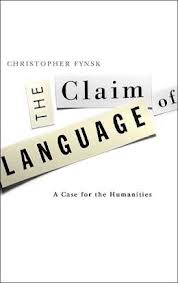 “Here, I will observe simply that fundamental research (in the humanities) diverges from much theory in that it is always seeking the limits of its language in responding to that to which it seeks to answer: those dimensions of experience and symbolic expression that summon it (as a kind of exigency for thought) and to which no concept will ever be quite adequate. Such research is impelled by its own neediness and its sense of being answerable, whereas theory, governed by the concept, proceeds with ever-expanding appropriations; fundamental research proceeds from encounter (always from a sense that something has happened to which it must answer), and it seeks encounter. In theory, there are no encounters.”
– Christopher Fynsk –
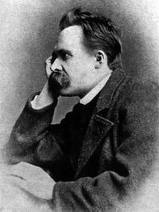
“Nietzsche is the most sarcastic son of a bitch ever to set foot on this
earth. Just say that; then write whatever else you want, like he would.” —
— So my friend Werner Timmermann tells me, with a gleam in his eye.
He helped with my translation of Thus Spake Zarathustra, a four-year-long
labor of love, so he knows what he is talking about. Zarathustra (1885)
was Nietzsche’s magnum opus; everything before it was preparation,
everything after it expatiation and elucidation.
But, for some, the question remains: Why Nietzsche? Friedrich
Nietzsche (1844-1900) was quite simply one of the most original and
influential philosophers who ever lived; in addition, his writing style was
brilliant, epigrammatic, idiosyncratic [“It is my ambition to say in ten
sentences what everyone else says in a book — what everyone else does
not say in a book.”] The language dances, prances, whirls and twirls; it
ranges from ghetto-verbalizations and vulgarizations to high art, from
lyricism to sardonicism, from satyr-play to passion play. No one really
writes like Nietzsche, though the number of his stylistic apes and
imitators is legion (especially in the ranks of academe).
-from the introduction 2004 translation of Ecce Homo & The Antichrist
sympatico-ally discovered via Time’s Flow Stemmed (take a look!)
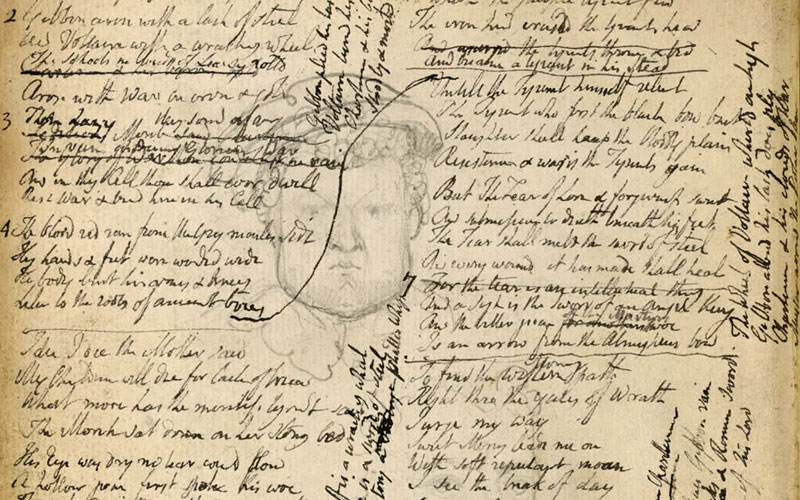
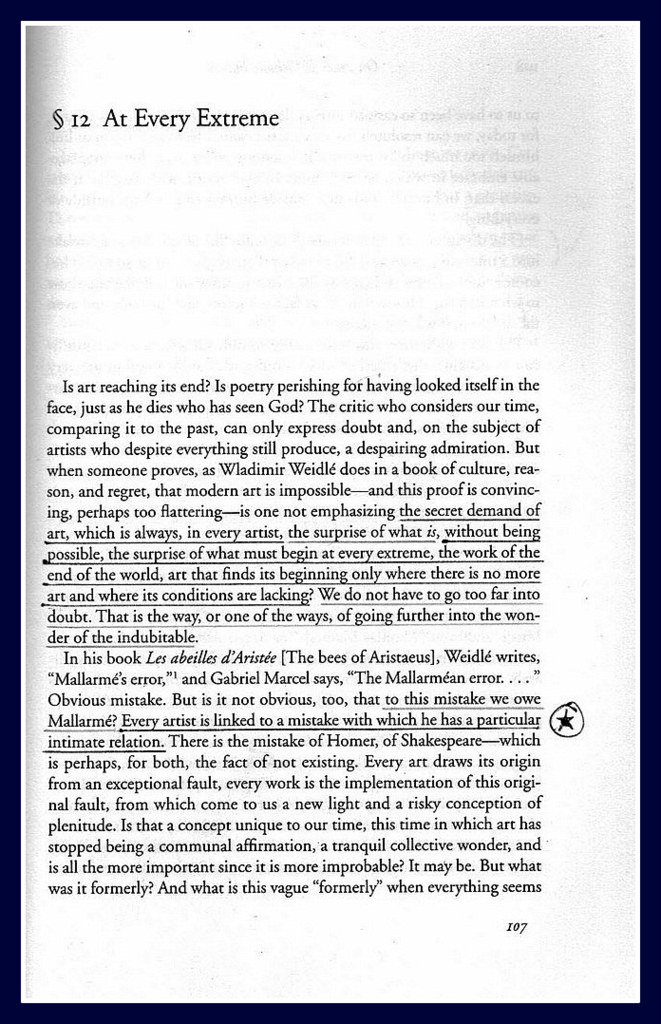
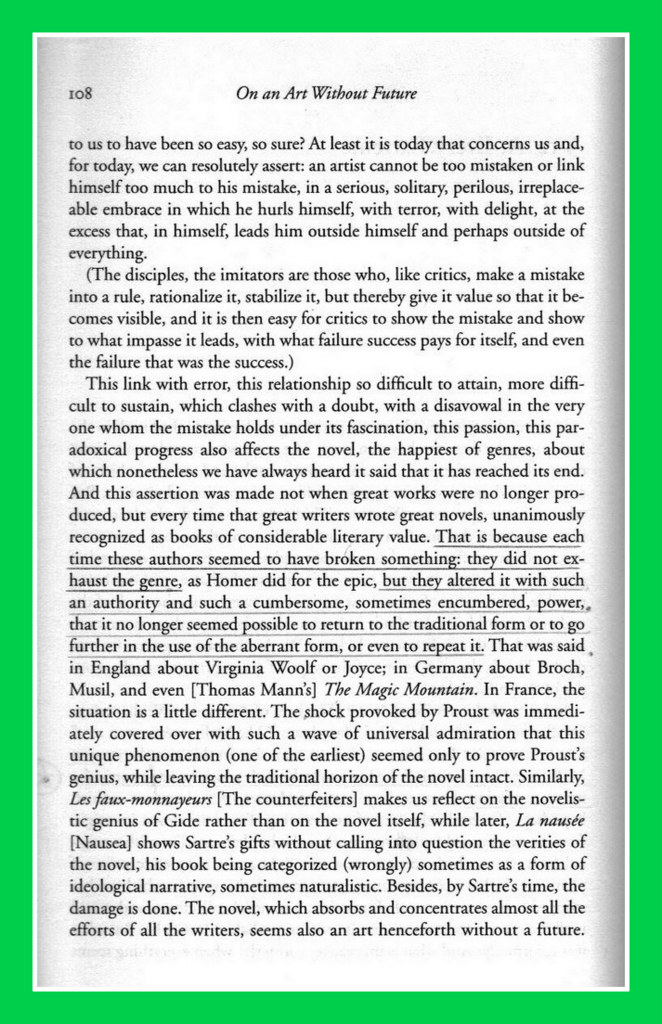
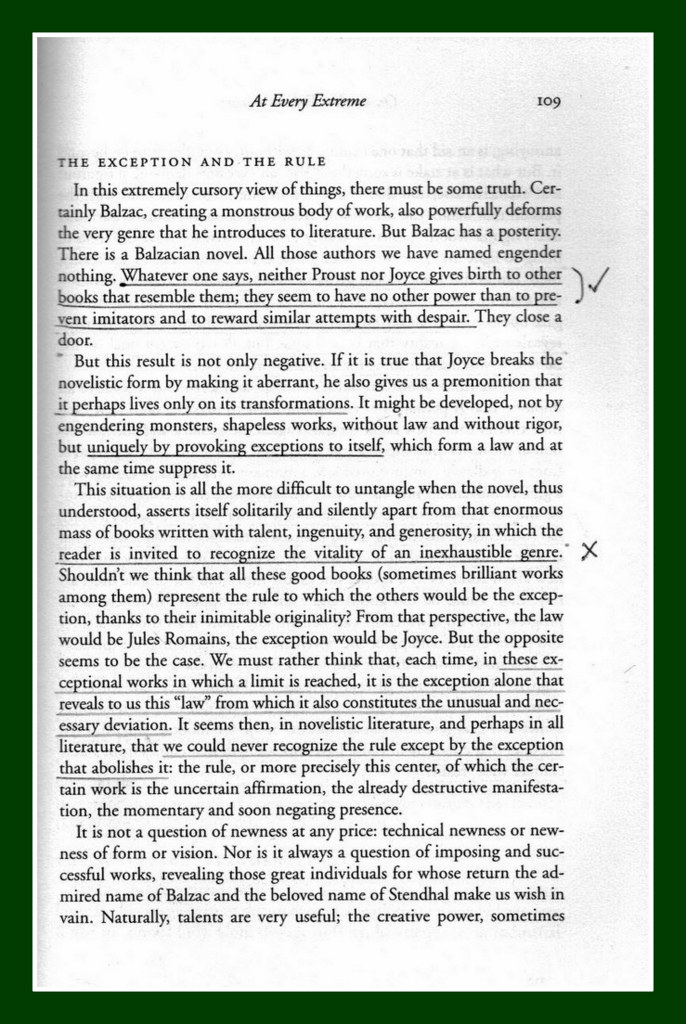
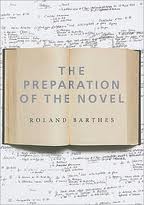
“The novelistic ‘drive’ (the love of the material) is not directed toward my past. It’s not that I don’t like my past; it’s rather that I don’t like the past (perhaps because it rends the heart), and my resistance takes the form of the mist i spoke of – a kind of general resistance to rehearsing, to narrating what will never happen again (the dreaming, the cruising, the life of the past). The affective link is with the present, my present, in its affective, relational, intellectual dimensions = the material I’m hoping for (cf. ‘to depict whom I love’).”
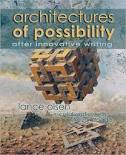
Recently, I have received several queries into either how I read as much as I read, or how I find or know what to read. As I respond to these inquiries, it has interested me how in fact, I account for my reading history. “E.L. Doctorow explained he rarely knew what he believed until he had written about it. Dostoevsky would start authoring a given scene, assuming he understood precisely what he believed about the issue discussed in it, only to have one of his characters convince him otherwise. Frequently it is only through the actual act of creation that we locate what we really feel and think about a subject.” (Olsen, architectures of possibility). That, coupled with “Authors frequently say things they are unaware of; only after they have gotten the reactions of their readers do they discover what they have said” – Umberto Eco…resulted in these self-observations:
Even from persons I deem much more knowledgeable than myself I often hear “you’ve read more than anyone I know…” and I have spent many hours a day for many decades – reading. I was raised in a fundamentalist Christian home, so the concern for truth, authority and canon were socio-culturally inculcated in me from an early age. When I began exploring music, philosophy and literature I found this concern ruling my approach: what is deemed canonical (attested by authorities), what came first?, and what rings true? I remember beginning with anthologies of classical poets, then ancient scriptures, Homer and so forth. Beginning with Plato/Aristotle then forward through those who claimed their influence. Beginning with Bach, Brahms, Beethoven and then forward and back to origins and influences. That has been my habit in exploring cultural artifacts. Find references. Correspondence. Claims. Follow them out. And follow those out. And follow those. And….so on.
As to achieving the absorption of piles of books at a time – when pushed to claim a process – I was surprised at the simple methodologies. I have referred to “transductive reading” from time to time in these posts – the interaction and co-constitutive commentaries that work provides to work. So I read large amounts of materials over large amounts of time (though my wife insists I read speedily) – I find I read sections / chapters / pages from a multitude of books and let them interact in me forming tissues and connections, rather than singular voices or ideas straight through. I read for differences – turns of phrase, terminologies, rhythms, in persons approaches to subjects, rather than reading for topical content or idea-information as data. Where a voice, approach, or technique is unique is often what particular works have to offer, I have come to think. And, depending on genre or reason for reading – as overlaps increase as the volume of “have-read” grows – one can often browse for summarizing sections to find the nuances each thinker or creator proffers.

Then there’s my personal history and approach to things. Hard-pressed to learning from youth=26 straight years of education + 17 years working in or managing retail bookstores – in an effort to be an “excellent” bookseller – implying to me I had to know something of everything a reader might desire (first hand). Publisher’s catalogs, reviews, recommendations, lists, histories, from the development of language to its variation in forms and contents. And always that uncanny recognition of Grenzsituationen – or “Limit Texts.”
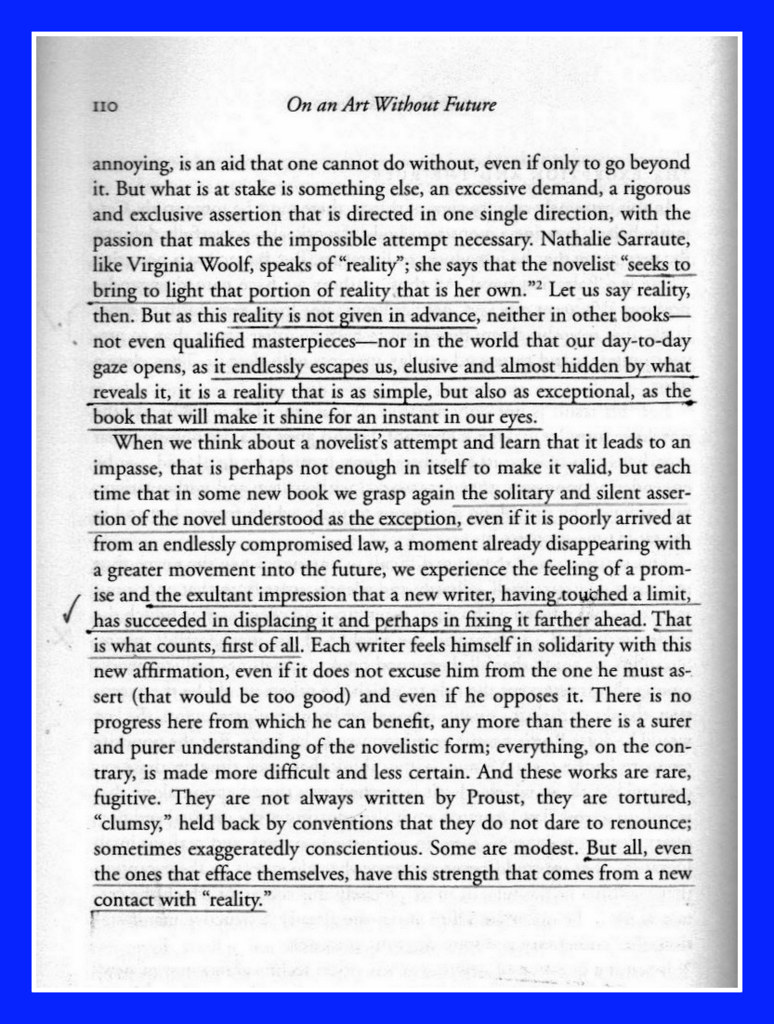
“It might be helpful to conceive of certain texts as Limit Texts – a variety of writing disturbance that carries various elements of narrativity to their brink so the reader can never quite think of them in the same terms again. To the brink, and then (for most readers, at least) over. Karl Jaspers coined the word Grenzsituationen (border/limit situations) to describe existential moments accompanied by anxiety in which the human mind is forced to confront the restrictions of its existing forms – moments, in other words, that make us abandon, fleetingly, the securities of our limitedness and enter new realms of self-consciousness. Death, for example.”
“If we carry this notion of Grenzsituationen into the literary domain, we find ourselves thinking about the sorts of books that, once you’ve taken them down from the shelf, you’ll never be able to put back up again. They won’t leave you alone. They will continue to work on your imagination long after you’ve read them. Merely by being in the world, Limit Texts ask us to embrace possibility spaces, difficulty, freedom, radical skepticism. Which writings make up the category will, naturally, vary from reader to reader, depending on what the reader has already encountered by way of innovative projects, his or her background, assumptions and so on…but the more Limit Texts one reads, the less one tends to feel the impulse to return to more conventional narrativity…”
-Lance Olsen, architectures of possibility
These situations are tattooed on my body (literally)…and include:
Samuel Beckett – Macedonio Fernandez – Paul Celan – Fyodor Dostoevsky – Ludwig Wittgenstein – Maurice Blanchot – Helene Cixous – Clarice Lispector – Franz Kafka – Fernando Pessoa – David Foster Wallace – Mikhail Bakhtin – Rainer Maria Rilke – Edmond Jabes – Federico Garcia Lorca – William Stafford – Egon Schiele – Vincent van Gogh – Johannes Brahms – Alberto Giacometti – Robert Musil – Friedrich Nietzsche – C.F. Peirce…
as you uncover these (your own personal) writers – your pantheon
of those who change your view of the possibilities of language and who you can return to again and again
without really feeling you’ve been there before – they become coordinates – network nodes – whereby you
evaluate and expand, extend and engage new writings you are exposed to – forever altering your patience and expectations of literature or whatever cultural artifact-type you crave and are pleasured by…thus making your reading more efficient and your selections increasingly more challenging and compelling to you – as long as you continue to leap out and expose yourself to things that might be unexpected
Ben Marcus – Ronald Sukenick – Laurie Sheck – Mei-Mei Berssenbrugge – Lyn Hejinian – Denis Johnson – Laurence Sterne – William James – C.F. Peirce – Michel Serres – Bruno Latour – Jorge Luis Borges – Cervantes – Immanuel Kant –
your lists will spawn as you follow their correspondences, admirations, criticisms, references, citations,
and you develop your literary canon
more on that another time
**More than a decade on, to update my Grenzsituationen, I’d need to add:
the Philokalia – John Moriarty – St. Isaac the Syrian – George MacDonald’s Sermons – Martin Heidegger – St. John Cassian – Sayings of the Desert Fathers & Mothers – Arkadii Dragomoschenko – Elder Aimilianos – Optina Elders – Haida Myths & Songs – Jim Harrison – St. Ephrem the Syrian – I Ching – Dreamsongs from Australia – St. Theophan the Recluse – Jan Zwicky – Martin Shaw – St. John Climacus – Marguerite Duras, and more…

“One of the wonderful things about word processors is they transform all composition into continuous process. You can rearrange, rewrite, tinker, copy, cut, paste, open separate files for separate chapters or story sections or poem fragments, a window for notes, another for your outline, and still another for your list of characters and their attributes, and have them all on your screen simultaneously so you can flip among them as necessary while your web browser provides you with a dictionary, a thesaurus, a Wikipedia page, a website to aid you checking this fact or that…
(The less than wonderful thing about word processors is they make every draft look like a final draft, sloppy writing look as polished as just-published. Careful about being duped by the sheen, and don’t disregard the notion of trying to compose on a lined tablet unless you’ve already tried it and found it lacking; it is a method that both slows perception and increases conscientiousness).”
-Lance Olsen-
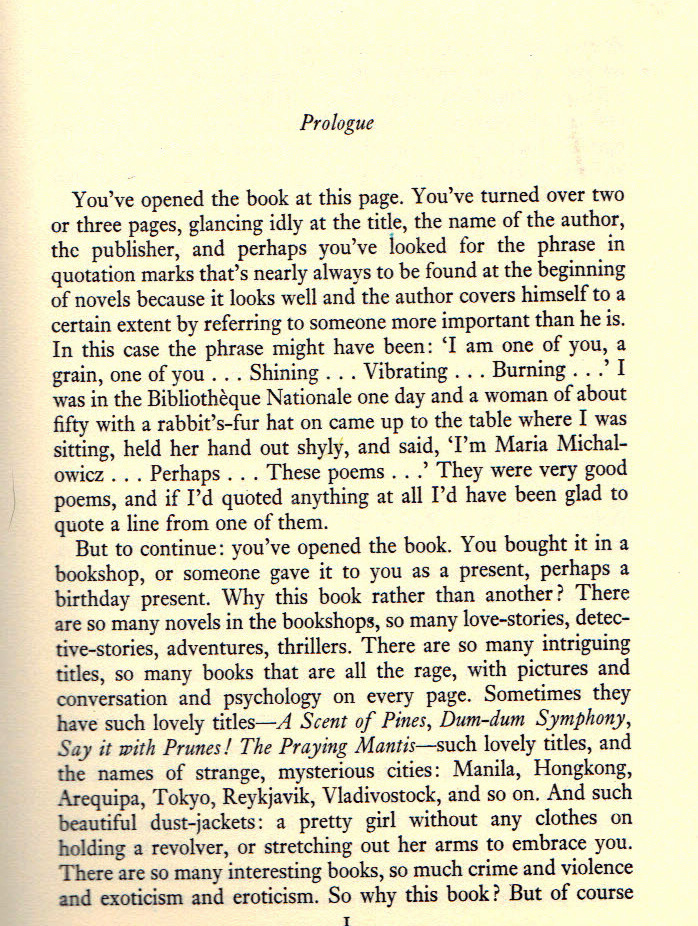
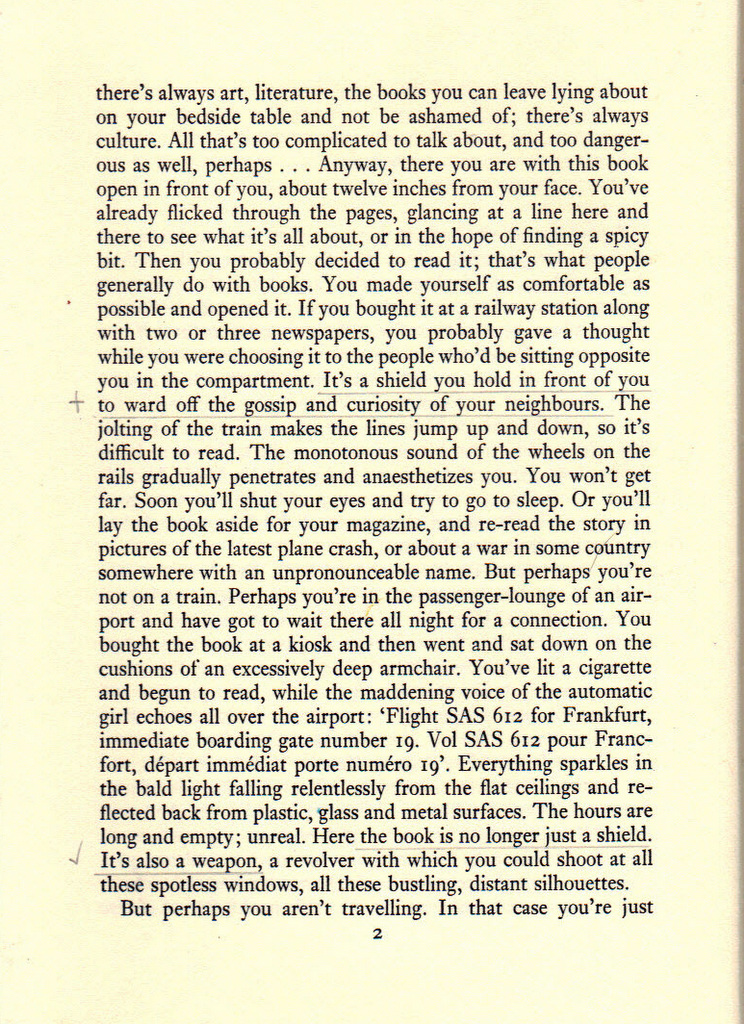
via J.M.G. Le Clezio


“every thing is a parliament of lines”
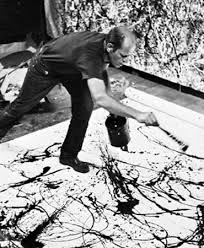
I think many people sense a difference between typing, printing, and writing. But very few, I surmise, might be able to speak clearly about what those differences are. There’s the kinesthetic difference, the disjunction of flow between thought forming through the body into theories of letters on paper. There’s a temporal difference, between the stenography of lightning-thought tapped like Morse code onto a keyboard, versus the individuated pacing of each writers body, hand, and facility of digits. Some may even say there’s a personality difference between interpreting standardized typography as a communication, and the erratics and imperfections of the same terms from a writing hand.
My desk is dominated by books with titles like Chaos, Incompleteness, Complexity, Information, Emergence, Touch, Telling, Lines and Erasure. Aspects of being human that glance across gaps or dawdle on edges – where knowledge isn’t comprehensive (and where might it be?) – are the processes and activities that fascinate my fancy.
Coupling an article I chanced upon (thank you Scholarly Kitchen) about Technology and Cursive Writing, with my current readings in Tim Ingold’s Lines: A brief history, I begin to slowly realize that how we interact with lines, with writing, is sourced far beyond and beneath our immediate experience.


Ingold begins with the consideration of what we understand by the words “song” and “music.” How “music has become wordless; language has been silenced.” In the past music referred to sonorous words set to harmony and rhythm, sounds alone were an embellishment to language, but not the principle purpose. Language was the sound-filled reality, like animal chirps or barks, the human’s vocal verbality. With inscription, language began to silence. Sound encountered a gap with meaning, or took on meaning of a different kind.
Similar worldview realities are exhibited in ways of inscribing. “In typing and printing, the intimate link between the manual gesture and the inscriptive trace is broken. The author conveys feeling by his choice of words, not by the expressiveness of his lines.” And writing experienced gaps in relation to drawing, language further abstracted.
“Yet whether encountered as a woven thread or as a written trace, the line is still perceived as one of movement and growth. How come, then, that so many of the lines we come up against today seem so static? Why does the very mention of the word ‘line’ or ‘linearity’, for so many contemporary thinkers conjure up an image of the alleged narrow-mindedness and sterility, as well as the single-track logic, of modern analytic thought?”
“It seems that what modern thought has done to place – fixing it to spatial locations – it has also done to people, wrapping their lives into temporal moments…If we were but to reverse this procedure, and to imagine life itself not as a fan of dotted lines – but as a manifold woven from the countless threads spun by beings of all sorts, both human and non-human, as they find their ways through the tangle of relationships in which they are enmeshed, then our entire understanding of evolution would be irrevocably altered…It would lead us to an open-ended view of the evolutionary process, and of our own history within that process, as one in which inhabitants, through their own activities, continually forge the conditions for their own and each other’s lives. Indeed, lines have the power to change the world!” (Ingold)
Bringing it back to the inscription of language, it is easy to see the bias of expression in the meaning of signs – but that meaning abstracted into disconnected idea-banks of terms, rather than the entire gesture of activity of inscribing. My talent diminishing to equational finesse – the fiddling and play or arrangement of alphabets like numbers – rather than a being expressing its thought through gesture and individuated agreed-upon symbols and signs. Perhaps our sense of difference betwixt the typescript and handwritten is that there is a little less of ourselves as individuated organism, and a lot more of standardized general practices and beliefs. Perhaps we feel a little less in- when our scripts are preformed? I do not know, I am foraging the questions…


“every thing is a parliament of lines”
-Tim Ingold
Student Magazine of IISER Mohali
Music, Musicology, and related Matters
a photographic pilgrimage to Orthodox Christian monasteries across the continent
Meandering Through a Literary Life
Orthodox Christianity, Culture and Religion, Making the Journey of Faith
Erik Kwakkel blogging about medieval manuscripts
"That's the big what happened."
Networking the complexity community since 1999
 All my Words are Silent