Scrambling… Scattering Notes

note in a bottle

Scattered experience.  Over the past 90 days my life has been characterized by necessities.  Scrambling to find sustainable work, scrambling to keep up with coursework.  Scrambling to assist as best I can in the psychological health and stability of my family, children.  Scrambling to keep my head above water in grief, loss, confusion, self-care and healing.

In these currents – their exhaustion, their novelty, their large and compounded emotions of helplessness, anger, frustration, anguish and fear, their realms of bewilderment – my last ditch scramble has been to note, feel, soak and pay attention to as much as I can, filling notebooks full of journalings, lists, to-dos, scenarios, something like prayers or wishes, something like tomes of notes intended for bottles and no one / anyone.  My best last chance seemed to be to try to MAP things – maintain access to whole regions of variant experience, conflicts, desperations and strengths, plans and disappointments, resumes and rejections, therapy appointments and dependents-events, multiple employment schedules and deadlines, and so on…SCRAMBLING…but at least with some scattered semblance of shapes and places and events…

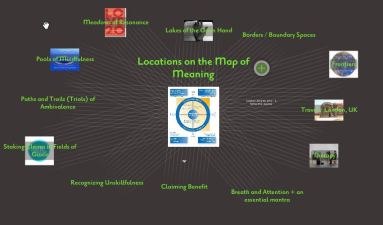
Locations on the Map of Meaning

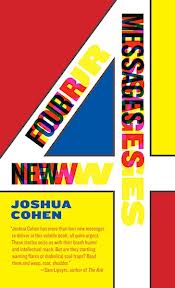
Recently reading through Joshua Cohen’s Four New Messages, I encountered a story in which the story is being drafted simultaneous to the story being the story of the difficulty of its drafting, messages to mother or father about how stuck and stunted the process of managing multiple lives (or roles), composing fiction, processing life, and maintaining the presence of mind to embody created worlds and encountered worlds...living.

Cohen - Four New Messages

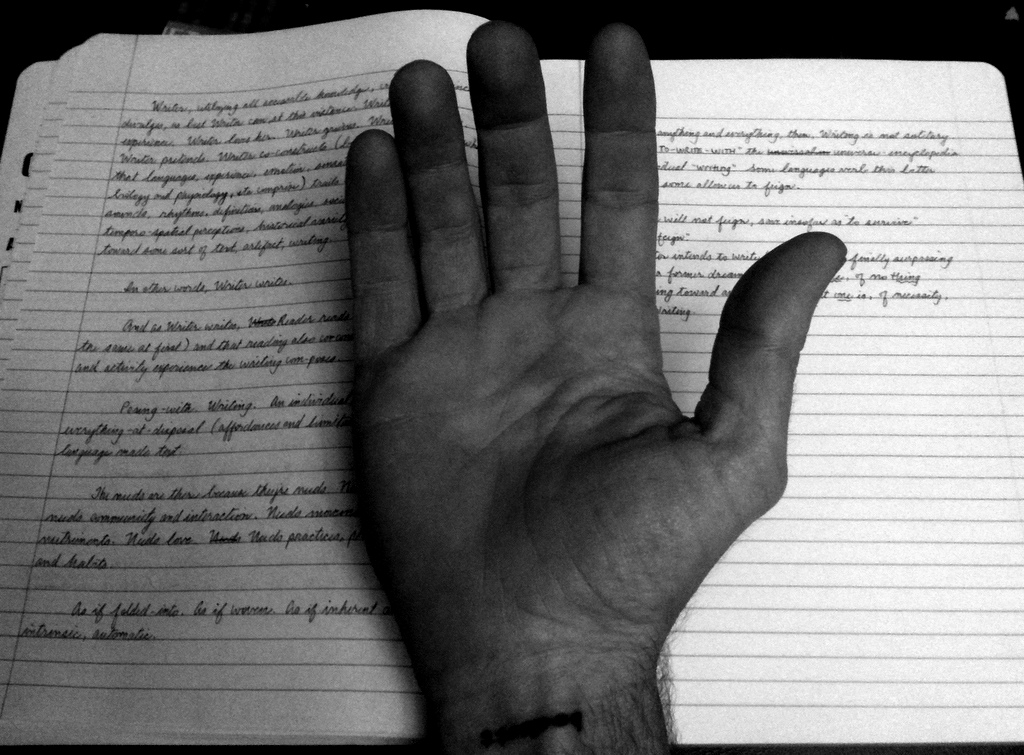
It is curious to me that the intention of “Opening the Hand” : (“All of this is to say that I plan a series of posts that will be intensely personal, self-revelant, my own way of reaching toward my experience, my being, and selecting language with which to mark it down – for re-memory, re-cognition, observation, reception, attention, account.  These are journal entries, frankly.  They are what I have to write.  I am calling them “Mapping the Meaning.”  Since I know very few of you personally, in your whole presence, I expect confession, inquiry, and its self-circular expression to genuinely interest or benefit very few of you.  For me, it is writing with an open hand“).  should end up resulting in the very scrambled scatter that, indeed, my current lived experience is.  Where I had hoped constructing, reflecting, composing and attending might result in some fabricating shape – some possibly effective mapping that might help me feel a “place” or “terrain” in which I am existing – provide a possible view of a larger whole.

Jumbled Language

It hasn’t worked out that way.  As I’ve delved into depths of my history, experience, perceptions as cracked open by the recent grief, loss and confusion; as I’ve purposed more presentness with my children and family and friends; as I’ve filled my days with job searches – statements of my identity, skills, education and worth; as I’ve learned new labor and institutions and expectations; as I’ve rewritten survivable budgets, forged opportunities to keep some semblance of self-care about what I want to be about (art, literature, learning, meaning); as I’ve sought to stay fit, attend to my body; as I’ve filled pockets of moments with music and writings that nurture or comfort me… things have NOT found any design… but are scrambled, scattered, disparate, paradoxical, bewildering.  For the notebooks of language I have emitted during these months… there is hardly a snippet that makes literary sense, is bloggable, expresses.  Thus the erratic entries, the confusing sentiments, the uncertainty and unknowing…

For now… here are the texts I’m hanging on…

This slideshow requires JavaScript.

Hopefully something will form… for now, scattered blurbs and reports, survival and bewilderment… SCRAMBLING…

photo 2-001

Waking the Invisible…with Jack Gilbert

Waking at Night

The blue river is gray at morning

and evening.  There is twilight

at dawn and dusk.  I lie in the dark

wondering if this quiet in me now

is a beginning or an end.

.

Cherishing What Isn’t

Ah, you three women whom I have loved in this

long life, along with the few others.

And the four I may have loved, or stopped short

of loving.  I wander through these woods

making songs of you.  Some of regret, some

of longing, and a terrible one of death.

I carry the privacy of your bodies

and hearts in me.  The shameful ardor

and the shameless intimacy, the secret kinds

of happiness and the walled-up childhoods.

I carol loudly of you among trees emptied

of winter and rejoice quietly in summer.

A score of women if you count love both large

and small, real ones that were brief

and those that lasted.  Gentle love and some

almost like an animal with its prey.

What is left is what’s alive in me.  The failing

of your beauty and its remaining.

You are like countries in which my love

took place.  Like a bell in the trees

that makes your music in each wind that moves.

A music composed of what you have forgotten.

That will end with my ending.

.

Suddenly Adult

The train’s stopping wakes me.

Weeds in the gully are white

with the year’s first snow.

A lighted train goes

slowly past absolutely empty.

Also going to Fukuoka.

I feel around in myself

to see if I mind.  Maybe

I am lonely.  It is hard

to know.  It could be

hidden in familiarity.

.

To Know the Invisible

The Americans tried and tried to see

the invisible Indians in the deeper jungle

of Brazil.  They waited for months,

maybe for years.  Until a knife and a pot

disappeared.  They put out other things

and some of those vanished.  Then one morning

there was a jungle offering sitting on the ground.

Gradually they began to know the invisible

by the jungle’s choices.  Even when nothing

replaced the gifts, it was a kind of seeing.

Like the woman you camp outside of, at the five portals.

Attending the conduits that tunnel from the apparatus

down to the capital of her.  Through the body

and its weather, to the mind and heart, to the spirit

beyond.  To the mystery.  And gradually to the ghosts

coming and leaving.  To the difference between

the nightingale and the Japanese nightingale

which is not a nightingale.  Getting lost in the treachery

of language, waylaid by the rain dancing its pavane

in the bruised light of winter afternoons.

By the flesh, luminous and transparent in the silent

clearing of her.  Love as two spirits flickering

at the edge of meeting.  An apartment on the third

floor without an elevator, white walls and almost

no furniture.  Water seen through pine trees.

Love like the smell of basil.  Richness beyond

anyone’s ability to cope with.  The way love is after fifty.

– Jack Gilbert, The Dance Most of All

Jack Gilbert


Where we exist…how

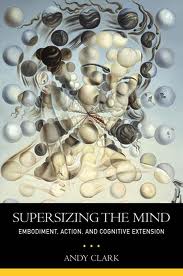
I was going to type a long set of excerpts…but so much nicer for you to get some of the full sense yourselves… if you have the time… it’s worth it – to interact with a resource external to yourself and see how that creates what we commonly think of as “cognition”… like my hands typing this message that you are going ‘outside’ of yourself to utilize toward meanings….

Clark - Supersizing(click on the picture for extended excerpts…and extending your world)

Promise

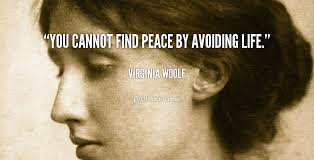
“Life is not susceptible perhaps to the treatment we give it when we try to tell it.”

-Virginia Woolf-

Woolf quote

+

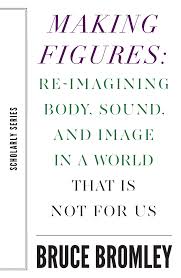
2 Books that generate promise…

Ruiz - Four Cold Chapters


Bromley - Making Figures

(click covers for summaries)


The Idea of Maturity (continued) – “Have a ‘good enough’ day”

“Since early years I have been cursed or blessed with a habit of mind – a character defect it may be – that likes to turn over problems that have no solution, or at least no solution that can be provided outside of thought itself (if there).”

– John Deely, Four Ages of Understanding

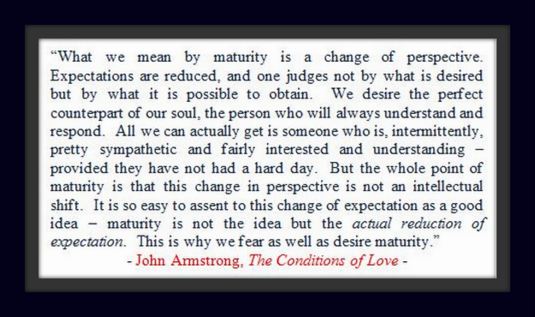
This concept of “maturity” as I encountered it in John Armstrong’s Conditions of Love is caught like a burl in my system.  Maturity as “not the idea, but the actual reduction of expectation.”  Maturity is reductive.  Is that so?  Is the process of human living a progress of delimitation, scoping the range of experience to our actual organismic potentials?  Process, progress, growth not expansive, extending operations, but boundarying and restraining limitations to our hopes?

I take my “problems” to my therapist.  They always come back to me changed.  “And what are the sources of expectation?” he asked.  “Expectation is sourced in the past / oriented toward the future,” he answered.  “If you reduce it – “YOU. ARE. HERE.”

YOU ARE HERE


Whenever I “get” something like that, I noticed I want to take off with it.  Like a skipping stone, I feel inspired and start leaping the surface of things – making connections with this concept and that image, this thinker and that artist, that idea and this experience… activating PATTERNS from my past and projecting POSSIBILITIES toward the future… LEAVING THE PRESENT.

My therapist/guru(?) has been investigating the neuroscience of enlightenment – or being awake to reality / the actual…


…and working with the brain and body to (perhaps) soak or sink there

rather than skip along the surface from PAST toward FUTURE

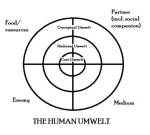
My helpmeet described this as an interesting and fascinating capacity of brains excited by the ineffable to apply TOP-DOWN (or metacognitive, reflective, intentional attention, interpretive) strategies to BOTTOM-UP (automatic, subconscious, pattern-oriented, limbic or reactionary, survival-based) strategies in order to, in a way, burl them – mesh them – unite them with WHAT IS – the Umwelt – our actual EXPERIENCE of BEING a living organism PRESENTLY.

We NEED both strategies to survive, and thrive.  Much of our life-world is uncertain and unknown to us – much we will never KNOW in any sense like “understand” or “comprehend.”  Life constantly HAPPENS.  We are quite limited, reduced, in our capacity to TAKE-IN, ABSORB, “com-prehend” (apprehend-with) all that our life-bubbles afford us and confront us with each moment… We NEED the emotive, reactive, pattern-based knee-jerk reactions to navigate much that could be life threatening (thought not much IS these days – WHAT IF something IS?)…no time to reflect or discourse or meta-cognize it if a car or snake or fire is about to strike you… but we also NEED the reflective, metacognitive capacities to distinguish between what is ACTUALLY life-threatening and what is ONGOING EXPERIENCE – opportunity – potential to comprehend, learn, understand, adapt, adjust, in-corporate, BE WITH.

That middle-point : tension-place : meeting-space (“like the appropriate tension of a string on a violin” he said) is perhaps where Armstrong’s maturity IS.  Reduced to the present, what’s happening, our actualizing experience – NOT skipping the surface of automated connections drawn from past experience and projected toward possible futures…

In other words (again, in his words)

Lord - Motto

On Change, Perception and the Idea of Maturity

John Armstrong’s The Conditions of Love is obviously far from through with me, and I with it.  My encounter with this writing has challenged me in so many ways.  Principally, I think, in querying my bases of knowledge in neuroscience, literature, philosophy, psychology and art – and struggling what is known (or supposed, or observed) in these disciplines toward our lived experience of love, of loss, of change, of survival.  Our brains, our stories, our bodies are all so very highly attuned to patterns in our world, perception, experience…how does that work itself out in our lives of loving and losing, changing and adapting?  What is difficult, what is beautiful in such behavior and practice?  What do domain-specific, developed human disciplines offer us in our mind/body organismic goings-on?

Maturity - John Armstrong

Enormous changes…you could say…REQUIRE all sorts of perspectival changes.

If only, simply, to adapt to the new WORLDS initiated by the universe-altering adjustments that major life changes (positive, negative, or, usually, BOTH) introduce:  couplings and separations / relocations / employment, vocation, education / grief, loss, birth, reduction, addition / success and failure and so on…

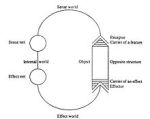
Our experiential/perceptual “worlds” have been aptly described and ascribed as Umwelten (see also – Paul Bains, Primacy of Semiosis).  In drastically simplified form: the concept that we are (each sort of organism) evolved in such a way as to perceive and engage with that in our environments that pertains to our survival and flourishing, our continuance of existence.  Those elements or that structuring and interacting with what we select out of our replete environments and surroundings – including ourselves – constitutes our Umwelt – our little “life-world” – species-specific bubble of “reality” (what is real to us, for us).

The sorts of change(s) that provoke potential for maturity tend (I think) to be changes that evince larger (or larger-scaled) patterns of experience and events (although all the minute alterations ever occurring – to the attentive and aware – also constitute mature adaptations for the human – the meditator recognizes the flux in each moment and works to adapt to this flux with openness and acceptance) – in other words, such things as by their very occurrence create/disrupt/introduce significant and substantial structural alterations – profoundly unavoidable – changes to the content AND context of the individual organisms perceptual/experiential SURROUND.

Changes (like those listed above) that, if NOT adapted or adjusted to, evidence a socially recognizable UNreality – a person clearly maladapted to the realities of their situations.  An example would be CHANGE or DIE; ADAPT or FAIL in some socially undeniable sense.

ADAPTING – in a “to-obvious-Umwelt-alteration-sense” is what I comprehend as an instance of maturity (a la Armstrong).

The loss of a child or spouse or health or limb.  New employment, habitat, geography.  Freshly developed abilities, knowledge, or lost capacities or income.  New love, memory, trauma – and so on – all represent an altered human Umwelt – adaptation to the ever-changing “reality” would be an instance of maturity – while maladaptation/denial/resistance would be a kind of instantiation of insanity – dis- or mis-alignment/-integration/-accordance to the altered Umwelt/environment/world-circumstance/perceivable “reality.”

Maturity then is our relatively accurate adjustment and adaptation to – our expectations and perceptions – to the “realities” of our ALWAYS-changing life-world.

I think Armstrong is right that we have a love/hate relationship to maturity.  It is something I (we?) HATE and HOPE for – the changes in our personal and public worlds so mostly beyond our control – air quality, abandonment, accident, reward, attention, ignor-ance, and so on.  As he puts it: “maturity is not the idea but the actual reduction of expectation.  That is why we fear as well as desire maturity.”  I question whether the adaptation is always “reductive” – in some cases, where we tend to be ruled by “patterns” (our past, our available information, our individual perceptions, our nature/culture development, etc.) maturity would constitute expanding, extending and opening our perceptions to the wider, complex and dynamic possibilities of an ever-changing life-world (I think).

For myself:  I HATE it (the death and loss implied in honest, authentic reductive maturity – mapping my individuality to my actual surroundings and situations) – I often resent and resist the ongoing change – erosion and eruptions – of the world I’m embedded in.  AND I WELCOME it – the reality-check of it, the alteration, breath, fresh potentials of “new worlding” that constant change instigates and offers.

As if our “realities” were 1000 plateaus – layered, indistinct, overlapping, vague and enmeshed.  As if “reality” were only (for me) what is perceivable (to me) and a dramatically altered Umwelt STRIKES into me whole new wild conceptions of what the world might be.  Reduction / Expansion.  Every change offers this.  The death (amputation, loss, etc.) and birth (regeneration, appendices, new growth).  Every vacancy corresponds with potential and unknown occupancy and vice-versa…

Or so I’m thinking…at this moment in this circumstance…

“Questioning places us in relation with what evades every question and exceeds all power of questioning…it seems that we question more than we are able to question”

-Maurice Blanchot-

…and so it goes…

17. Find Beauty – YouTube

Today’s “One Thing…”

17. Find Beauty – YouTube.

Hanson - just one thing

On Love

I will be up front with you:  this post is a failure.  If I were able to comprehend, understand or express what it is I have been struggling with myself to grasp and communicate – I would also have the expressive powers to irresistibly beckon my love.

Like many poets and artists, I am not a stranger to great expressions of love.  Tales of romance, of idealism, of sacrifice and charity.  Of endurance, persistence, obstacles and joy.  Of passion, beauty, devotion and charm.  Many of us spend the bulk of our lives searching it, attempting to become both loving and lovable, generous and worthy.

What I have wrestled with this past week is how I might convince all of you who have an interest in its meaning, its practice, its enjoyment and its pain that a book I have spent much time reading and reflecting over the past two weeks is worth your full attention.  It is entitled The Conditions of Love: the philosophy of intimacy and is written by John Armstrong.
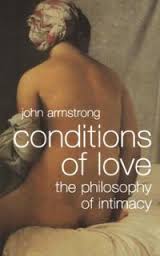
Armstrong - Conditions of Love

For a while now I have been making effort at examining the “intolerable vulnerabilities” that intimacy evokes in us.  Armstrong addresses these in a deep variety of ways, such as “love craves closeness, and closeness always brings us face to face with something other than we expected.”  Upon meditating my way through his profound expository book, I have added “incalculable equation” to my sense of love.  “Most people are, it goes without saying, sometimes pathetic and sometimes quite competent…reciprocity requires us to hold in mind a complex image of our own nature.”  My felt sense upon concluding his words (and those of so many others he includes ever so skillfully) – was a strange sense that love combines the profound gravity of grief and the profound levity of hope.  

It is instructive to understand what Armstrong intends by a philosophical account of intimacy:  “One of the things which philosophy can do is to try to flesh out, with as much precision as the case allows, just what is at stake in the concepts we use.”  And he performs this so deftly.  “Hence the more subtle our thinking about love, the more intelligently we discriminate ideals from reality, the more interesting our autobiography becomes.”  His is the thinking of the ‘pandoxist.’  “A pandoxist doesn’t locate all the important insights and truths about life in a single system, but tries to seize upon the multitude of truths and insights which are located in many distinct – and often antagonistic – positions…most great systems of thought are founded upon lasting insights…but we generally don’t need to be completely consistent in our thinking…we are attempting to enrich our repertoire of ideas…thoughts which will be helpful at different times and in different situations.”  The Conditions of Love satisfies this expertly.

The book has been written.  I cannot possibly improve on it, and, although I’d dream of trying – what I most desire is that more humans will engage it toward the extension and enrichment of their lives and the relations they involve .  With that in mind I will simply copy some of my underscored passages from Armstrong’s writing – hopefully to successfully convince you that it could benefit you, too.

“The suggestion that love is deep carries the implication that it emerges from deep within us and that it reaches something deep within us.  It carries with it an image of the personality as layered.”

“Love isn’t a single thing but a complex of different concerns gives rise to a vision of some of the problems of love.  When we try to love we are not actually trying to undertake a single endeavour; rather, we are trying to do a whole range of different, and sometimes not very compatible, things simultaneously.”

“We need love, we have an inbuilt need to love and be loved, yet the two sexes have divergent evolutionary and genetic notions of how love works.  The unhappiness of love is the fault of the evolution of the species…which undertakes to show how extremely complex emotions and thoughts are enacted in material processes.”

“to show that love is natural is not in fact to show anything very important…what is given by nature is not necessarily good, and what is achieved by artifice is not necessarily worthless…the experience of love is open to change, but only in some ways.”

“Compatibility is an achievement of love, not a precondition for love…there is no such thing as perfect compatibility, therefore all loving relationships must accomodate some degree of incompatibility.”

“Perhaps the most fundamental fact of human experience is that the experience of being oneself differs radically from the experience we have of others…no other person can complete us…this is something we have to do for ourselves, even if we are lucky enough to find another person who is helpful and supportive and whose character tends to bring out the best in us.”

“friendship is a species of love…there is something about their mode of being, about the texture of their inner life, which seems familiar…it is when we discover, or suspect, some intimate correspondence between our own secret self and that of the other that we begin to move from liking to loving.”

“the very needs which take us into love play a role in the souring of love.”

“love involves a reorientation of our concerns.  We are in the habit of being immensely preoccupied by what immediately concerns our own well-being…yet caring for something, or someone, other than oneself can be immensely liberating.”

“the irony is that the more we invest in love, the harder it can be to love successfully.  To love another person often requires that we have further and independent sources of satisfaction and security in our lives.”

“of course it can be disturbing, even terrifying, to admit insufficiency to ourselves.  ‘Why do I need another person? Because I cannot be happy on my own?’  For some people at least, that is too painful an admission.  We sometimes avoid our need for love because it casts us in a vulnerable role…It suggests how deep the need for love goes in us, how hard it sometimes is for us to recognize what it is we are looking for, and how hard it is going to be for someone else to satisfy those needs.”

“infatuation – can be driven not just by a mistake about the other person (thinking they are nicer than they really are) but by a mistake about oneself (wanting to be other than one is)…in infatuation, we use another person as a prop in a fantasy about ourselves.”

“many persons imagine that it is the quality of current feeling that matters; in fact, current feeling is no guide for behaviour under multiple strains and stresses.  What infatuation does is to consecrate the present feeling and protect it from serious investigation.  Imagination paints a charming view of the future, conveniently adapted to the demands of our current situation.”

“Cupid is the name of whatever it is in us which, without our consent or recognition, provokes the intense longing for attachment which we call falling in love…the fear of love as irrational is not simply the fear that love is in its genesis outside of our control, but that it is not amenable to reason once it is up and running.”

“the forces which make us long for another person to love – loneliness, the need for warmth and tenderness – can be so great that we behave as if we were starving…desperation overrides discrimination…the process of falling in love may be governed not by the intelligent sense of what is good for us but by unconscious forces which cause us to get attached to someone with whom we can – like an addict – repeat a self-harming pleasure – ‘this person is for me’ may be, ironically, true and yet true only in that we have identified a potential source of our preferred misery…a relationship does not start the day two people meet; it starts in the childhood of each partner.  for it is long before they meet that the template of their relationship is established.  We learn to love as children.  Or, more accurately, we learn a style of relating which governs our adult behaviour when it comes to love.”

“much depends on the way in which we find in them someone with whom we can continue the unfinished business of childhood…there is something about this person which coheres with an earlier pattern…Falling in love, then, is a result of two thing coming together: the longings which we have and the workings of our imagination.”

“Our sense of who another person really is is massively inflected by our own concerns…what it is to understand a person – involves having a clear conception of what that person’s real needs and qualities are – a conception which can be radically at variance with the self-image of that person.”

“Love alone can’t make another adult intelligent, generous, courageous, persistent and sociable – unless they are very close to possessing these qualities in the first place…it is axiomatic that people can be wrong about what is good for them; that is, they can be wrong about what will make them happy.  This is one of the key reasons why there is so much unhappiness in the world.”

“To love is to interpret another person with charity…of course we habitually go beyond the facts when we find fault with or condemn another…Anger and resentment are frequently founded upon what we suppose another person has intended, rather than on what we actually know about their motives.  Charity, therefore, need not ascribe benign motives, but keeps open the possibility that one doesn’t know what really goes on in another’s heart of hearts…to step aside is human…a charitable interpretation seeks out good qualities underneath evident failings and inadequacies – and take a sympathetic view of those failings..requiring a complex image of our own nature.”

“Most accounts of existence place love at the centre of life.  We live in order to grow in love – that is the meaning and purpose of each individual life.”

“Love requires the integration of all our powers: we have to be sensual, but also understanding; we need to be able to relax with our beloved, but must equally exercise self-control; we have to mix spontaneity with foresight; passionate, devouring sexual desire has to be tempered with respect…”

“What is wrong with capitalism is not so much that it fosters an unjust distribution of wealth but rather that it damages the personalities of all those who live within it, cutting each individual off from the realization of the true nature, giving rise to internal – as well as external – obstacles to love…If we have to devote our best energies, almost all of our time, to making a living, and if in doing so we have to become competitive, or ruthless, we don’t have much of ourselves left over for love.  We can only love on the margins of our lives and with the residue of our capacities…Love, which stands as the natural goal of living, is massively subordinated to the pursuit of the means of living.”

“the reality, here, is that we invest the people we encounter – particularly those we get close to – with characteristics which are not really their own but which derive from our own earlier relationships…construction and transference is an unconscious process – one which we are not only unaware of but which we positively resist becoming aware of.”

“Love, then, can never be the coming together of two perfectly compatible creatures.  We are not like jigsaw pieces which can, if only we find the correct piece, lock together in perfect accord.  It is as if each person actually belongs to several jigsaws at once and hence fits perfectly into none.”

“Much of the resulting pain of adult life can be traced back to the ways in which the child deals with ambivalence…it is impossible to have a loving relationship which does not involve negative aspects…because a perfectly right partner will still evoke fears and anxieties in us, will still – because of connections back to the roots of love and fear in childhood – become an object of envy or jealousy, will still be the privileged object of our aggression and disappointment…”

“Sex is direct, whereas love is diffuse.  Sometimes we need love to be made obvious – and sex is one of the most powerful ways in which this can happen…the troubling fact is that two positions are correct: we are inherently jealous and sexual desire is distinct from love.  To accept both claims is to admit a degree of incoherence in human nature…this is an invitation to be more imaginative about dignity.”

“Recuperation is essential to the survival of love because it is inevitable that love will come up against serious difficulties…the point is that even within a good relationship there are continual sources of hurt and disappointment which have to be overcome if love is to survive…their overcoming is actually the growth and development of loving…it is, therefore, extremely important that we work with a vision of love which sees problems not as the end of love, not as a sign that love is over, but as the ground upon which love operates.

“This is the internal tragedy of love.  If love is successful, if our love is returned and develops into a relationship, the person we are with must turn out to be other than we imagined them to be…security can put us off our guard…the notion of maturity is humanity’s attempt to retain an optimistic picture of love in the face of disappointment and difficulty.”

“Maturity is our name for the hopeful strategy which is open to us when faced with something which is both an object of high value (a source of happiness) and, at the same time, threatening, difficult, disturbing..the very things which draw us into love and enable us to invest so highly in another person, to wish to bind our lives together, themselves give rise to disillusionment, frustration, disappointment, and evoke some of our deepest fears and most primitive defences.  What we mean by maturity is a change of perspective.”

“In this book I have tried to argue two things…Firstly, the need to love and be loved is deeply placed in human nature – we long to be understood, to be close to another person, to matter in another’s life…the factors which draw us into love also constitute the roots of love’s difficulties.  We long to be understood, but it is often awkward to have another see too much of one’s inner troubles…we do not go through life with a coherent set of desires, and anyone who charms us in one frame of mind may be annoying or threatening in another.  Secondly, love is an achievement, it is something we create, individually, not something which we just find…and yet it cannot be forced simply by effort…it is dependent on many other achievements – kindness of interpretations, sympathy and understanding, a sense of our own needs, and terrible vulnerability…each requires patient cultivation – we have to take whatever fragile presence each has in our lives and build upon that…in order to unlock our passions, recognize our need for another, and see our present loneliness…”

and so on – i simply took a quote or two from each chapter – hopefully you can imagine the depth of the whole…and will enjoy it for yourselves….!

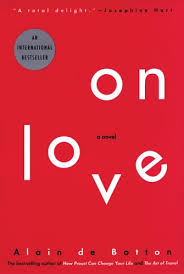
see also:de Botton - On Love
http://www.youtube.com/watch?v=uDGGAC10mtc
 

Meaning is Molecular…

compliments of Percival Everett