Words are Misleading (an addenda)

The “Time” Machine (or, Words can be Misleading)

They pronounced the words

and pointed at the face

the face with the hands.

They announced the words

as terms and math and concepts.

Other things they had named and gestured:

Squirrel

Tree

Water

Me

But these hands, this face

they designated “time.”

So that it might be lost

or found

gained or squandered

like a toy, a friend

or the contents of a wallet.

But it is not like that.

Time cannot be “there.”

Is not a nearness or distance

It does not take up space

It is no thing

And so the words were all wrong

full of pasts, presents, futures

rather than nows or occurings

manifestings or become.

I misunderstood

as do we all, it seems

at least us who greet

the great face of numbers

with plans and regrets

and false concepts called speed

I am tired of our language

listening now to Hopi & Shawnee

to Far East and Far South

signs accounting for Einstein

and Heisenberg

not abstracted like equations

or metaphysical symbol

but present in all its various forms

and modes of meaning(s)

faceless globes without hands

and pointing in every direction

N Filbert 2012

one of many addenda (effluvia?) to the Word(s)

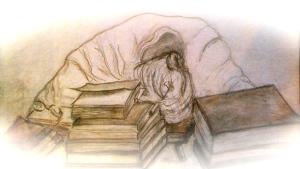
drawing by Holly Suzanne

On Reading


It adds up

it weighs down

this unknowing of things

without being

what they say

to each other

once inside

reaching

the angle of repose

adding up

weighing down

like an ocean

its surf

and its merciless drowning


N Filbert 2012

Up Against the Word(s) : Part the Second

Up Against the Word(s)

– a philosophy of language series –

in the sociology of knowledge

[if this book were a book and shaped like a rectangle, it would be redundant among other things and so on, but perhaps it is a circle and therefore repetition is therefore]

(one of many disclaimers)

Part the Second: True to your word(s)

And so one must wonder over/about how to shape or forge a writing that might be “true.” True to what? is the question that first comes to my mind. Immediately I sense an answer along the lines of “true to experience, human experience, living.”

Okay. But the options are many, perhaps limitless, no? It is easy to imagine someone setting out using language in hopes to be true to a theory, or a memory, an historical event, a relationship or a dream, a feeling or a painting one has seen. Some may intend to be true to the present (as it’s occurring) or to the past as it’s been recounted or remade in language or impression? To be true to ideas or previously languaged things (obviously involving so very many removes and hypotheses about what the previous tellers were attempting to be “true” to, or not). Or how about language itself, theis malleable system of signs, communication – how it works, what it references, invents, incites, depending on the terms selected, their organization, pronunciation, punctuation, etymologies, contexts and ideologies?

All would apparently boil down to the experience of the one implementing the signs: how that one has acquired the forms, contents, vocabularies, grammars and syntaxes of the utilized signs, or, beyond that, their singular perception and interpretation of their own memories, relations, readings, hearsay, acquisition of data and so forth. All to say “truth,” if one means by that some objective correlative to actuality, to “things as they are,” seems highly suspect, even as in this case, I might attempt to be “true” to the highly suspect meaning of the word and signified concept (ideology) “truth.”

So, if correlation to actuality becomes a highly individualized affair of each language-user, that a human, in fact, cannot hope to use words in any fashion directly translatable or apprehensible to another…why the setting out to inscribe?

One might suggest it’s a relative thing – like space and time – that communication takes place in fields of overlap between the flexible meanings of signs. That one hopes for difference and therefore the requisite similarities, to provide and provoke comprehensions limiting and expanding but somewhat assimilable – conversational – texting-with, vocalizing-with, another or others…some active reduction and proliferation of possibilities between multiple language-users and their contexts of situations.

Fair enough. A hope for convergences in a commonly based palette and culturation. Generalized and individualized from all sides.

Is this what the “writer” is after? Some correspondence (between themselves and their experience, between that relational complex and others)? Perhaps. Or maybe more accurately the languaging impulse fluctuates along a vast scale of minute gradations of aims and intentions, including, always, the relational effects of using (participating, knowing) language itself. It’s a mud pie! And so beautiful it looks like chocolate mousse sometimes.

And just became so, in the metaphoring of a kind of pie some persons will recognize, depending on their own experience and the culture they come from.

In part.

new blog series…in parts…Up With the Words

UP WITH THE WORDS

– a philosophy-of-language series –

in the sociology of knowledge

In handwriting, the relation of Being to man, namely the word, is inscribed in beings themselves”

-Martin Heidegger-

Saying ceases to signify: it reveals realities that are unintelligible and untranslatable

but not incomprehensible. It does not signify, yet at the same time

it is impregnated with meaning.”

-Octavio Paz-

I’ and not-‘I’…one projecting the outer world to the inside,

the other projecting the inside to the outer world [perception],

as a result of mutual conditioning…

language creation occurs where new layers of reality and insight

are opened up.”

-Hermann Broch-

full of you’ll never know what will turn up”

-Madeline Gins-

Part 1: Writing at Hand (Drawing from drawing, sketches of the word)

To be rigorously true to real life (living, forming, becoming, always changing, and “full of you’ll never know what will turn up” –Gins) – its core, its essence, an identity or style: FLEXIBILITY.

To be: artifacts in space and time, “beings themselves,” words : inscribed with fullness of life, as fullness of life, into the arena of malleable life.

Object and action. Content informed. Activity and expression. Artifact and energy. Verb-al and signifying. Image and text.

Fluid like air bordering, permeating all things

Substantial like raindrops and rocks – objective presences, assimilable and distinct.

Energy and stasis. Reduced and expansive.

Sign and signifiant.

subject and object.

WORD.

medium and matter

conveyor and creator

virus and vaccine

WORD

symbiosis and annihilation of Either/Or

inherent argument against Both/And

Presence and/in/with/through Absence

WORD

a thing, an action, a subject, an object, a without-which-perhaps-nothing,

a with-which-very-little

almost nothing

WORD

possibility and elimination / among and without

the difference

WORD

bridge and abyss, rift and synthesis

cleft

WORD

perception and preconception. observant and observed. verbal and nominal.

comprehensible and ineffable

WORD

High on Words

Again with the word-thing!  I feel immersed and splendored with what language is and does!  Books like Ernesto Sabato’s Angel of Darkness and Macedonio Fernandez’s The Museum of Eterna’s Novel.  Adam Thirlwell’s Delighted States and Octavio Paz’ Convergences.  Eugenio Montale’s The Poet in Our Time and Jacques Roubaud’s Loop.  J.R. Firth’s Papers in Linguistics and Kierkegaard’s Philosophical Fragments.  Madeline Gins’ Helen Keller or Arakawa or C.S. Peirce on signs.  The verbal object astounds and amazes me in its flexibility and invention, its capacities and catalystics.  Simply holds me enthralled!

For instance:  I draw a line (scribble a text) and immediately there are two parts which are inseparable.  How describe that activity?  Did I separate or unite?  Both.  The difference.  Bridge and abyss.  Rift and collapse.  Reduction and expansion.  All in this active solution, signs gestures language.  Yeesh!

Celebrate today!  Ingest and create!  Read and speak!  See what words do and ask what would there be without them, whether inner speech or conversation, engagement with the world or invention of the self.  See how far words go!

Improv

one looks…

As one improvises, on the piano”

-Wallace Stevens-

I journaled to myself how very much I enjoy the rain.

Change of key: rainy weather.

I trilled on it – from the meteorological phenomenon of the conditions of precipitation, I inevitably wake in the highest spirits, with good courage, a sense of personal human value and a fair share of blessing and luck.

Turn the page: I treat cloudy skies and falling water as if someone is being good to me.

A modulating moment, kind of pregnant pause, then a new left-hand rhythm: Why?

The previously clear melody of childhood and adolescent memories – softness and solitude, safety and comfort that raininess or “inclement” (my ass!) weather emits – enabling isolation, self-direction, personal space and a muted blurring outer world – became difficult to follow to its source.

The phrase “all’s right with the world – it’s raining!” came to mind along with a tune by Nils Frahm and the musics of Max Richter and George Winston, remote mountains and valleys and trees.

My fingers played.

My mind drummed along, the feelings were there leading the charge.

Passion piece – movement two.

Right-hand flourishing: ’cause I feel blessed, like Someone’s giving me something I want, that I like, that I wish for. Like when the sun shines down Somebody don’t like me, is a-keeping it from me, that ol’ world’s against me all those dry clear days, no matter how Springy and delicious or moderate and breezy, no, without precip It don’t like me, It don’t give a damn – but while raining I’m in love

Transition and bridge: How can weather be for or against you man? Dem skies is neutral, and repeat.

Chorus breaks in with bravura: Rain is for me, the clouds protect; the sun it rapes my ass

Staccato cries harsh in the bass, high notes tinkling down: grace grace grace

Key-change beginning in bass triads: but I thought you don’t believe no god

Clustered dissonance in treble: strange isn’t it, as if deities controlled the weather – blessing/ withholding; assuaging or punishing me

Rachmaninoff chords: meteorology and Fate

Scrap it…

New tune, tender and self-reflective: why would I place my power of mood in the maw of Kansas sky? Impetuous forces, schizophrenic fronts – determining my well-being?

Dominant fifths, arpeggiated: it’s crazy, it’s crazy, insane

affirmed acknowledged and chosen by rain

which has no will or intention

no character or personhood to blame

persecuted disciplined intruded by sun

helpless victimization without perpetrator

Sforzando: the Self!

Resolution: ah shit what am I? do I do? How come I elevate personal responsibility, candor and value to elements under no one’s control?

Strange Brew syncopations: it ain’t right, ain’t sensible, but I’ve lived this way so long

world as some gigantic force

for me or against me

and with my will

I interpret against

Hornlike dash scattered be-bop treble:

I call it I name it – AFRAID!

I feel so small in the face of things

powerless helpless confused

I get nothing but the space that It gives

and it hurts and it wounds and it alters

Arbitrary cadenza:

but it make no sense in the world

of people and places and things

I could choose I could feel I could be yes and say

but I give up the power to You

(nothing nothing nothing)

NO WAY!

That ain’t no kinda life – depending on the weather

no wonder they call you crazymaker

manic

depressive

mood

you gots to get it in there and say what’s what

and sing

not only when it’s raining!

If’n you love that rain – you takes it with you

make it your own gray way

I say

because it’s raining

and everything

feels possible

fading out….

N Filbert 2012

Play

Dialectical Encounter

And how do you find me? he asks, beautiful in a tragically worn way? he hopes, suggestingly

Perhaps, she thinks to herself, perhaps there is beauty there somewhere, that would be heroinic of me to uncover amid the smell and dissheveled nature of the facts, after all, he is well-spoken

At least well-spoken, reflectively thoughtful, of subtle interest? he asks as if planting tiny seeds

I want to give him that, she muses, that he’s not dangerous or threatening in his approach, aside from his appearance, which one might surmise cannot be helped but were his lot

Ah the world a fickle thing so often colluding beauty and beast as if ’twere a fairy tale, so prominent and prevalent as to be romantic ideal, like myth

He is saying – ? Is he asking something of me? she wonders, is this monologue intended dialogue or am I giving benefit where none is due?

Bewildering collisions, he mumbles, quite obviously mistakes in the arrangements of things yet so common and continual that contingencies might point to odds, advantaging abnormal

He’s losing me, occluding, incantation, I wish to return, reorganize, retreat

I can see you’ve no further thoughts on the matter though, clearly, many there be at the tip of your every apparently avid brain, the adroitness of your eyes

The looks, the looks, always with the looks, ugh

I’d rather you think on your own, as accidents are unfortunate and impertinent. Grace be to you for peaceful easy feelings and times that would allow. No use beating bush without berries – enjoy and be oh so well, as I would be, arranged just so (grief entering his breath like tenacious little office clips)

I believe that is adieu, a baffled contradictory sort of bon voyage with accompanying melancholy of the beleaguered and accustomed to wary entertainments, he who knows where limits turn distress or ill-humored, thank god, she sighs, letting blood flow a little more freely

He turns to go and takes steps mumbling about the bizarrity of mice and their traps, cute haggard mini-rodents lured by bait, offered and tasty, but with secret intentions of pain, even elimination, not even a slap by the hand that feeds, but an almost complicit lure, disorganism’d, wonders if that’s a metaphor for public masking, to judge by appearances, he thinks

Whew, that was taxing without effort, she deflates, only now realizing how long her breath had held. What is it about hideous beauty that so spasmodically intrigues? Neither heads nor tails but the effect of the toss that unsettles, a perturbance and half-feigned interest in outcome, that it fall behind or ahead, only not now, she thinks, only be done, that is, outside present

As the pebbles tumble into cracks, inner speech hums, so encounter, his feet drudging loose bits of gravel on sidewalk, heart hoping else, legs sure of circular motion, a traveled sphere, a hamster’s wheel of wish after wish after a further furthering, each stepping distance, he whistles, he hums

Returning to the matter at hand, so distinct from what happens, she works to regain her fiction of what she was doing, but it’s those singular cracks that cause the walls to give, eventually, it turns out concentration and illusion are sometimes hard, headphones help

like the chatter of birds, the way the moments rush in and evolve noise, a void, his memory already blurred and rascally, the foregoing of who’s who and where’s that and what’s what, just some numb direction that becomes a track or path, he believes, or once thought he believed as he began, beginning again wishing the mind were silent, absent like the deafening city, submersible

as if there were an assignment, an order submitted to or taken, what remind could provide, arbitrary instruction, a purposing, a matter, at hand, only the same things as before, which were there to fill time, promote process, becoming ends

and fades

sits, and stares

N Filbert 2012
This fictional life

Turning, Turnings Back


He (neuter) sets out.

In the world where “to know is to be,” he sets out.

Something changes.

In another world, “to be is to know” must pertain.

He turns back.


He sets out.

Into the webbing of things.

A world made of “being and having.”

He does not have. He will not be.

He turns back.

Into a world of “being and nothingness”

laid over “being and time.”

His time full of nothingness,

he ceases to be.

He turns back.


He sets out.

He enters a way

through a veil

marked “Nirvana.”

He is now/here.

He turns back.


He sets out.

He encounters.

A lover, a friend, a parent, a child.

He sets out.

He encounters.

A mountain, vocation, a suffering, a tree.

He turns back.

Part of the way.

He sets out.

Into starry realms

where “life is but a dream.”

He sings and believes.

He loves and he grieves.

He turns back.


He sets out. Numerically.

Where one is always one.

And one plus two is anything.

He stands at the ocean.

He turns back.

Setting out.


He’s set out.

He’s been seen.

He cannot forget

what he became

in that look.

Turning in.


He sets out.

Finding nothing in being

having the time

knowing a being

being the knowing.

He turns back.

A little way.


He sets out.

Underground

and pressed from all sides.

He takes space

and needs air.

He tunnels

turning back

always setting forth.

He sets out

carrying experience

in so many hands,

turning back

and all around

to set out

settling in.


He turns back,

holding hands,

they set out

and remain

turning about

and setting out.

N Filbert 2012

The Philosopher’s Stone?

Philosophy of Language: On the Nature of Signs

This slideshow requires JavaScript.

In my hand I have a rock.

In the palm of my hand a rounded rock, cool and hard to the touch.

The rock means nothing.

For no reason it feels pleasant in my hand.

Because it seems to “fit”?

A rock is not a sign. A rock is a sign.

This particular rock has been shaped by human hands.

Tumbled with other types of hard materials.

Polished, but without glaze or chemical.

Rubbed by many hands, and time.

This rock was a gift to me.

It came with a story.

The story goes like this:

“In some human cultures objects are granted significance (that is, they are made participatory in the nature of signs: objects that carry ideological import, symbolizing ideas and ideologies, thoughts or beliefs – become participants in consciousness). Specific cultures embue certain rocks (geological formations) with such significance. In the culture (social community) this rock originates from, it is designated a “lingam rock,” a rock arbitrarily filled with gendered and generative signification. In Hindu religion it represents a beginning and endless pillar, signing infinity and male creative energy. Its correspondent form, the “yoni rock” form symbolizes the goddess, female creative energies. Together, the inseparable principles of gendered existence, the totality of creative forces. It is smoothly oblong, roughly the shape of a woman’s vagina, and an elongated sphere differently colored at one end, something like a man’s penis. The signification of the object “fits” given the signage (or images) already existing in our human experience. It is believed by some that those who pocket and finger this rock regularly will garner sexual vitality and increased generative activity.”

Periodically I handle this rock.

Mostly I keep it on the surface of my writing desk as a reminder of the strangeness and possibilities of semiotic realities.

That, given my physical form, a body that stands for itself and contains particular matters, but also a complete surface ever open to an external world, that what is interior and what is perceived to be exterior are constantly referencing one another in uncountable ways.

That making words on paper is an objectification of signs. As is speech, or uttering.

That “experience” takes place in this no-place, some liminal border between internal and external, coequally shaping and inventing, structuring and expanding or diminishing one another, ever in flux.

In my hand I have a rock.

In the palm of my hand, a rounded rock, cool and hard on my skin.

The rock means nothing or anything.

For no reason it feels pleasant there.

Or perhaps because it “fits.” With anything else.

We devise. With.                                                                                                                                                                                    N. Filbert 2012

Isolation

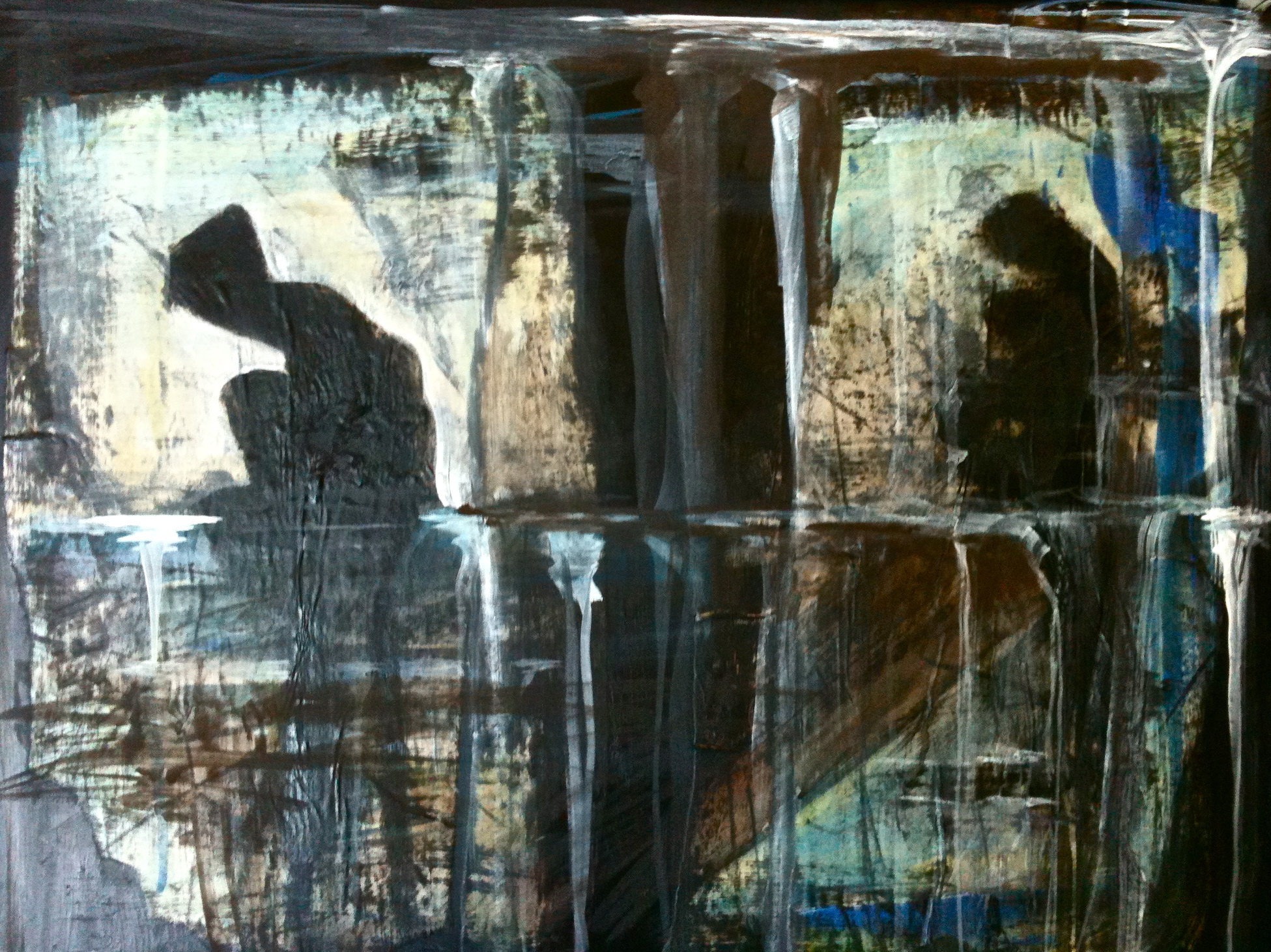
courtesy Holly Suzanne

Isolation

There are horrible things

that are beauty

we brood over them

in the dark.

I go to my tower

and you weep at your tree

I am blue –

just outside me, the rain.

I’ve made us this plank

as a bridge

I curl over;

ideology

pray to my mind

you weep

at the tree

near the water

your scars

are reflected

and wave

you huddle and rock

and grow sleepy

the weight of a storm

like a fog

it is clouded.

I sit on a stele

one sheer line

of unworth,

disappointment

but that is beneath me

light boxes me in.

you are folded on land

in the sky

near the water

grounded

and adding

your pain.

a tree grows

and is fed

like the lake

by your tears

light is around you

in pools.

you’re defined

i’m unclear.

I hold something

unknown

impossible object

a commitment to blue

and it shapes me.

you stretch your neck out –

you yearn –

you look up and about

I turn in

to the mass

of the well

I get lost there

my thoughts draining way

confounding

black blood

rushes down

the between.

our rooms

are inseparable.

N Filbert 2012