Springing Forward: Jump, Fall, Explore


Stringing Forward: Driven by Confusing Desire


“In the beginning was the Word.”  It’s plausible, but it doesn’t sit right with me.  Still I return to this phrase with remarkable regularity, as if it were gospel, as if my life revolved on it.

Yet I think there must be something beyond it.  Perhaps breathing, or wriggling, some pulse or shimmer?  Of course we wouldn’t have a word for it or be able to address it in any way before the coming of language…but watch a baby in its crib.

It squirms, breathes, flails, even instinctually utters interjective noises – perhaps of pain or hunger, fear or glee – can’t know for sure until its incorporated into our codes and systems, but I’ve no doubt they’re there before they speak.

Take reptiles or cockroaches.  I buy the idea that they predate us, and their communicative activity (if there is any) certainly isn’t verbal, or “logocentric.”

Perhaps Scripture would have been more accurate to say “In the beginning was movement” or “In the beginning was act.”  I don’t know.  Whatever it would state would be a word, now.  There’s a conundrum for me:  once language, is there anything prior except it’s name or description?  Maybe “beginning” means source, and word-acquisition is totalizing to human experience?  We can’t go beyond our alphabets (Alpha, Omega) – and even if we feel a beyond to be there (verbal or no) we logo-lize it?  Our “non-verbals” “immaterial” “void” “absence” “infinite” “time” “space” “god” “love” language and so forth?

We do have a word for it, after all: pre-verbal.

It does seem that (for humans anyway) awareness begins with communication, interaction.  And any system of recognition and difference must qualify as “language.”  Maybe “Language is constitutive to our experience” might have been a truer statement, though the original does have quite a ring to it.

Why do I fiddle with it anyway, what this compulsion to know?  “Beginnings” (a word) or “words” (a word)?  That I can’t verbalize.  Which is perhaps the origin of my desperate and agitating quest: desire and confusion?  And how come having words for it doesn’t help me understand?

“In the beginning was the Word.”

Well it certainly was the beginning of something! (a word)

“He who knows not language serves idols…

he who could see his language would see his god”

-Philippe Sollers-

The Lay of the Land

Lifeline by Holly Suzanne

Mapping the Landscape

Some say that everything happens for a reason.  What could/would that reason be?  Even for the statement itself?  (This is not rhetorical).  Others say: “Who says?”  “Who they?”  (I’m sure they have their “reasons”).

None I can decipher.

Maybe truth is horizontal, “as the culminating reinterpretation of our predecessor’s reinterpretation of their predecessor’s reinterpretations…this tradition does not ask how representations are related to non-representations, but how representations can be seen as hanging together.”  As in a map or chart.  Relative, relational.  I could see that.  But, like zealous learners in their youth, dependent on a belief in cause and effect, or attempts to substantiate or materialize emotions – no map is large or long enough.

There’s always a horizon, at which limit no vision is of use, the beyond imperceptible.

So we take the reinterpretations and test them, thereby reinterpreting…what more can we do?  Walk the maps they give you at birth, try them against each step, each new landscape or trail.  “That’s where Foster’s barn used to be.”  “There once was a great old tree here signaling the upcoming swerve in the road.”  “This land used to be glacial, giant sheets of ice.”  “Where you’re standing was once a mountain.”  And so on.

“It is the difference between regarding truth, goodness and beauty as eternal objects which we try to locate and reveal, and regarding them as artifacts whose fundamental design we often have to alter.”

Go smaller, tighten your horizon.  Analyze your own skin.  This freckle, that wart, this scar, that mole.  My son was identifiable by his long blonde hair blowing in Kansas wind – last week – now he runs in a pack of crew-cut kindergartners indistinguishable from a distance, but for his red coat.  My voice changed.  Eyesight.  Posture and laugh.  The contents of my “mind.”

It’s a long erratic affair – his unreasonable search for certainty.

Take up a dictionary or go online and pick any word – then add “etymology.”  Where did your term “come from”?  What’s it mean – then, now?  How many common uses, nuances, ironies?  Multiply that by users plus gestures plus intonation plus context = what certainty have you got?  What’s the reason for that?  Why?

In other words, explanations are no reason.  They’re either well-informed observations, careful descriptions or wishful hypotheses (in which case they even cease to explain anything but may fuel observations – of imagination or psychology, sociology, philosophy – so-called ‘human sciences.’)

Look, I’m just trying to get the lay of the land here.  From my vantage point it’s extremely varied and multi-layered.  Everywhere I dig or fly, seek or describe, the horizon recedes as I advance.  I leave marks along the way, but they seem different when I come back around, sometimes they’ve vanished altogether like the old cottonwood or Foster’s barn.

Within/without my horizontal globe is ever limited by me, so I “take your word for it” – perhaps there’s something beyond it…I’ll tell you when I get there.  Perhaps I’ll send a map.  (Perhaps we are a map, floating in a sea of them?)

(quotations from Jacques Derrida and Richard Rorty, in that order)

Springing Forward? Let’s Say “He Jumps”

The Flight
Robert Parke-Harrison


Springing Forward? – Let’s Say “He Jumps”

I breathe in.  Drawn-long, held as if full of some essential substance, then let leak, some as a rush, some hardly – again signifying a value – a perhaps-last or at-long-last.  I’ve breathed out.

I breathe in.  My children, my wife, my house and its yard.  Strange concoctions of scents – some floral, some stench; some earthy, some fume – through my fingers, my beard, my innermost emotions and mind, the surfaces of skin.  I let them come through, I chase them, I hold…they pass…through cells, through nerves, through blood and muscle, snap of tendon and ache of bone.  I’ve breathed out.

I breathe in.  Sun-saturate and gleaming after the exceptional days of steady dark rain.  The fans are whirring, windows propped.  It is night.  The wet has passed.  The inside.  Full with smoke of dry leaf and lung, I exhale.  I’ve breathed out.

One day: 50sish chill and thick drizzle; the next: 82 degrees warm and nary a cloud.  It is Kansas, not uncommon to span thirty degrees in either direction in its differences of highs and lows from day to day, multiple seasons endured every 36 hours, a place my wife (Oregon-bred) names “schizophrenic”…change, its speed and accrual.

I breathe in.  We left him either building on what he already had or starting something new, something fresh (building on all he already had) in the Spring, a wet-now-dry, unimaginably rainy and verdant-now-bright and vibrating in the sun’s Spring rays of a year, a year that for reasons unsurmised seems to him enormous – open and glaring, great obstacles of blank.  Without directions or directives, at an edge, a frontier, an expanse…like a blind man blindfolded (thus muffling the ears) and hog-tied in the trunk of a vehicle on a plane or placed in the hull of a rocket, drugged to dream, awakened and set forth…where he could not know, but only, if gutsy or desperate enough, might grope, or set out…or double over, hunker down, spin himself and see what he has, what he brings wherever he goes…

a fragile little egg on a continent-sized glacier, endlessness behind, indeterminate ahead and a recklessly rattling now…change, motion, flow,

no where (as a placedness)

no when (as a fixed moment)

no how (as a correct path, replete with map and supply)

no why (as a genuine reason)

no what (of comprehended identities, complete entities)

nothing but movement and emptiness, finitude and frontier.  Stunned, deranged, nearly catatonic, nervous, breathless…I’ve breathed out.

I breathe in.  Fosse, Wallace, Bernhard.  Celan, Derrida, Bakhtin.  Kafka, Montale and Blanchot.  Languages – songs, poems and signs.  Beckett, Jabes and Walser.  Rilke, Roubaud and Gertrude Stein.  Stevens, Thirlwell, Stafford.  Cixous.  Clement.  Tillman.  The sounds, textures, silent emphases and vocabularies, grammars and syntaxes whirl about in whispers…blurs and hues, a beauty; cacophony, melody, consonant percussion…shushing out the ears…I’ve breathed out.

I breathe in.  Grains and grandparents, livestock and faith.  Institutions and knowledge and parents, their arms.  A sibling and a thousand loves.  Culture and geography, politics and verbs, losses and gains, failure’s success: atoms making webs of sick knots and health, betters and worse and could-be-worser-stills…a fabric?  a substance?  some tissue?…it snaps…I’ve breathed out.

Facing an unseeable void, we left him.  In shock, exultant, with unimagined possibility.  Either I build on what I already have or I start something new, something fresh (building on all that’s passing through), I think to myself, on this clear near-summer’s night, at this edge, this vast expanse, this outer space, just breathing first, first breathing.  I’ve breathed in.  I’ve breathed out.

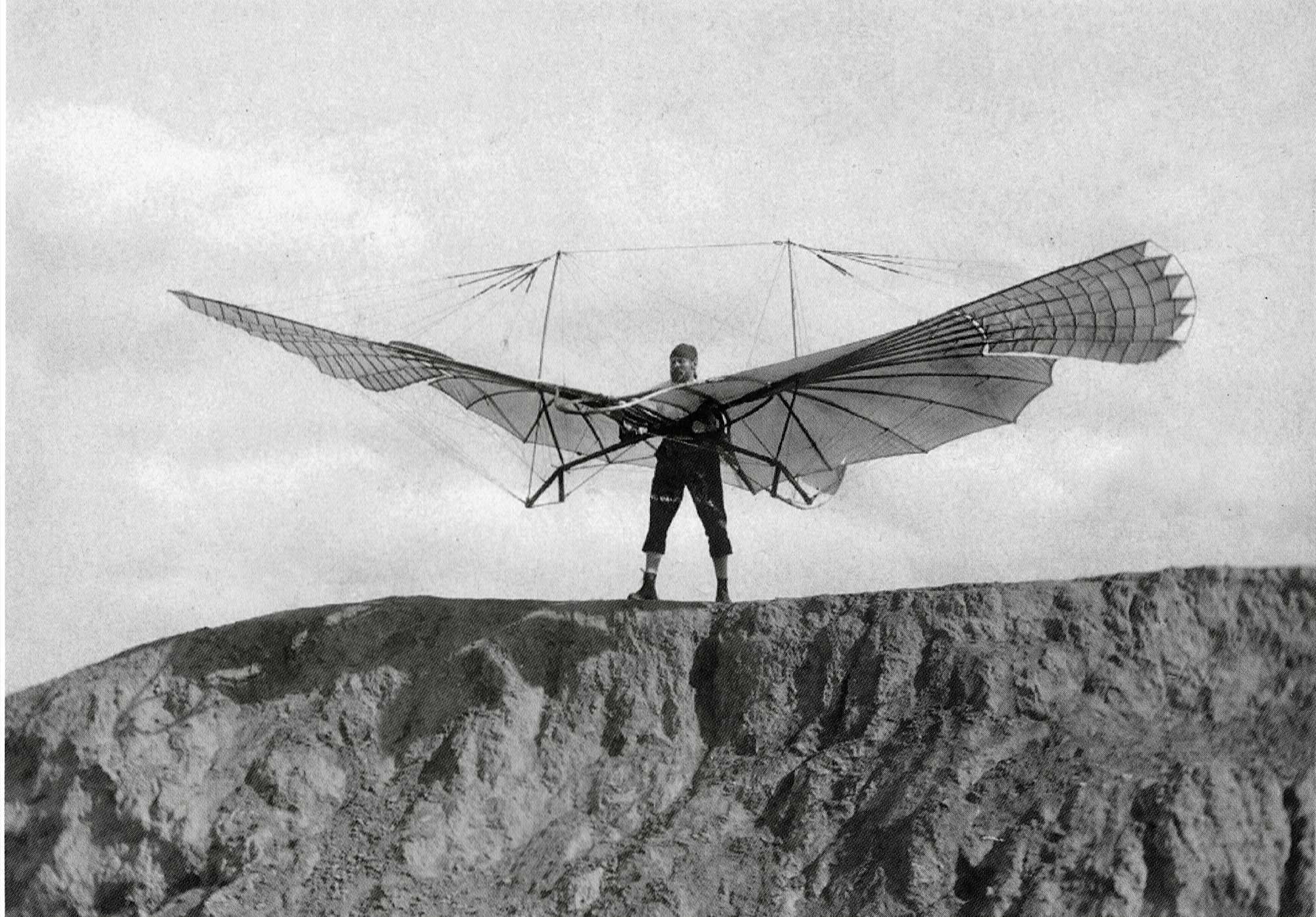
Let’s say “He jumps.”

Otto Lilienthal on Fliegeberg
by Ottomar Anschutz 1884

Springing…forward??

Either you build on what you already have or you start something new, something fresh (building on what you already have), I thought to myself as it was raining that day, that wonderful unimaginable and rainy wet first virile fertile day of Spring of that year, that crazy, tremendous ice block glacier of a year full of so many things I couldn’t keep up with, so many changes happening like quicksand, or coming upon the Great North, vast tracts of undiscovered frontier, snowy land, gargantuan and open, that year, that future, the future of the end of the world.

I was, you see, attempting to make my way there – to find my way, feeling about like a blind man frightened in the dark (why should that matter? I thought, why should it matter to the blind if it were dark?  Still, things are more ominous in the night, more unknown, seeing or not, more uncertain, more uncertain indeed, I thought).

And perhaps that’s it.  Perhaps that’s the whole story right there, a little library card-sized description, my now, that now-past experience dragging on as a present unopened, some blinding night setting at what seemed a foreboding and wide-open end of the world?

Let’s revisit where we’re at here, it will help me get my bearings, help me decide how to proceed – do I build, do I set out?  In one case I work with what’s already there (here) all my work and toil and worry, all my whereabouts and wherewithal; on the other I construct, invent, create, here in my whereabouts and utilizing my wherewithal, I craft something not already here around and within me, make something occur, I act or continue, by acting continuing, in what direction, that is the question, how here now, this interminable present situation I am coming to find myself in, how shall I go on, proceed, in what manner?

Where am I, for starters, and am I alone?  I find myself wanting, quite naturally, spontaneously even, it seems, to be inclusive here, to desire (apparently) inclusion, to say “let’s” and “where are we” to establish a location, a whereabouts, a “situation,” as if the feeling of lostness of untrammeled terrain will forever be my sitz em leben as long as left to myself alone, as long as I can espy no reference points, no company, no where-with-al to my whereabouts.

Where were we, then, I’ll assume we’re together, that there are many of us in similar straits, coterminous, co-traveling, travailing, up into up against up toward this vast unknown expanse, this blankness, empty landscape thick as ice and night, as blindness.  We should reach out our hands perhaps.  Extend our arms, get a feel for things, touch what might be there in this dark, or rather this milky grey of blindness, this lack of distinction of specificity of landmarks, with no map, nothing we could read, could decipher or chart.  I grope.

First day of Spring, did I say?  Is that a location though?  A place?  A place in time perhaps, discoverable square on a grid, a 21st, an equinox in things, in elements cycling and shifting about one another, out into the galaxy, some enormous imaginative gyre, it is raining, blind or not, on this first day of Spring of this particular year, haunted and mystical year, it is raining – we can hear it, can feel it on our skin, we are wet.  I am wet.

Determing then, our whereabouts: it is wet, it is Spring, let me describe it for you this thick endless open night of a year –

It is blinding – a glaring brightness that equals blackest night – one imagines it with the help of images – photos and films of discoveries of the glinting scintillant wastelands of the Poles…a disorienting everywhere one must forge ahead through, one needs ropes and flagpoles, say Everest in storm, say outer space, say vertiginous void, perhaps one’s own mind in nightmare, or depression, shock, grief.

This is where we are, some of us, in a saturating rain at the edge of a great blank expanse, blinding in its sheer whiteness, its big empty, darkening the brain, cancelling out the signposts, fogging the familiars, there is rain there is blindness and void.

I love the rain.

Maybe we love the vast expanse – the future – the unknown?  Perhaps we feel ourselves at the edge of tremendous, breathtaking, thrill-seeking adventure?  Perhaps it calls for a hurtling, what do they call this?  A point of no return, of lift-off, all systems go?

Either I build on what I already have or I start something new, something fresh (building with what I already have), I think to myself in this rain on this day, this wonderful unimaginable and rainy wet first virile and fertile day of Spring this year, this crazy and breathtaking, frightening ominous glacier of a year full of so many changes and detours, jagged peaks and harrowing cliffs, quicksand and mountain range and all at once undiscovered future frontier, scintillant, open, glaring and flood-drenched and dark, my blindness, my groping here at the edge of the future of the end of the world

This slideshow requires JavaScript.
Blogging Reality – stumbling upon an addenda

This slideshow requires JavaScript.
Blogging Reality – Other’s Thoughts

After completing some thinking-in-action-in-words-as-blog earlier this week, I took up a book and read…the section following where I’d left off in the illustrious and continually praised and most highly recommended text (now in my seventh turn…) Dust by Arkadii Dragomoshchenko, I stumbled upon this smattering of letters:


“In reality, the logic of these changing textures and modes of writing bear witness to something altogether different, and applies to their various manifestations.  Generally speaking, each new mode seems richer than the preceding one; and while the new one does indeed repress what came before it, it also adds new possibilities to what already exists…the means by which new forms of writing subsequently influence ‘writers’ is a history of a different kind.

“In the course of the last decades, with the creation of the Internet and the Web, we have seen not only a gradual revolution in the perception of time and space, and consequently of the possibilities of expression, but also – strange as it may seem – one other fundamental phenomenon: a return to writing, perhaps to virtual writing, but nevertheless to writing.  It turns out that we have unconsciously come full circle, returning to ‘paper’ in spite of all the ardent speeches in defense of the new, digital order of things.  Indeed the Internet has turned us back toward the past because, as Adam Gopnik has written, the Internet is a kind of writing, given that it is literally written ‘from beginning to end.’

“This can of course be refuted: even assuming that you’re right, what is the ‘carrier’ then of this writing?  Can it still be considered ‘writing’?  Paper can be touched.  A book is a tangible, physical object; moreover, it has a smell: printers’ ink, manufacturing chemicals, etc.  And how priceless is writing paper itself, its special, unique odor and color, to which literature has paid much homage so often!  Finally, what separates the first, primordial sign etched in stonen from the image on a computer screen?  To this imaginary question I give the following answer: what is most important to consider are the changes in the concept of materiality, as well in the system of concepts – a process stretching back over the last hundred years – relating to the very possibility of describing any material object whatsoever.  This object, the description of which previously relied on the coordination of the concepts ‘beginning and end’ (every object had both), is now conceived as some kind of oscillating point of a perpetual ‘now,’ a definitive account of which is extremely difficult, if not impossible, to obtain.  Indeed, isn’t it rather naïve to claim that we can feel a sign, as if it were a slab of painted, reinforced concrete that could be dragged up to the forty-fourth floor?

“All in all, ‘to be online’ signifies, on the one hand, a perpetual ‘now,’ real time, but on the other hand it means reading words written by others, no less than typing out one’s own words, addressed to someone else…

            “…writing.  Written language has the inherent ability to create a salutary barrier, a kind of second skin or distance that allows one to disappear from sight whenever one wants.  This is a space in which no one can deprive you of the right to instantaneous solitude on this otherwise all too overcrowded, unlivable island.”                                                    –Arkadii Dragomoshchenko


So…skin, perpetual ‘now,’ “real time,” without beginning or end, a “salutary barrier,” “textures,” “changing forms” and so on….writing

What we do.  What we love.  What we need / depend on.  How we “touch,” of a barrier like skin…flexible, moving, light and air and signs…

Flow on bloggers!  Flow on!

The Fine Line

This slideshow requires JavaScript.

The elusive and ever-present “fine line”

So-and-So comments on my poem “Corpus:”

“Gratitude.  Yes, without flesh, our emptiness would show – more than it already does”

Soooo…what if we stripped it all down?  If we could see through the surfaces and veneers?  Could X-ray skins and masks, barriers and betweens?  What would we find?  What would be there?

I’m not certain I know what Arkadii Dragomoshchenko was writing when, in sort of remembering a painting by Edward Hopper while looking at, listening to, and thinking of other things, he said he caught something the artist had “kept silent about” – “I saw the fine line that separates emptiness from plenitude…like the memory of something that never happened, and which sinks then to the cunning bottom of words…” he says,

which suddenly plunged my own mind/imagination into a fictional mind and body of Alberto Giacometti, strafing and violently thumbing and stripping at sloppy wet clay glopping off wires, or scratching scattering lines upon lines upon lines around toward across and through the densities of a head’s face, a skull’s gaze, to – “get at it,” “down to it”…it, it, it.

Beckett writing round after round, chicken scratching sludgy paths, barnyard maneuvers after…it…

anyone obsessed…the idea of North, a perfect composition, to say something truly or clearly, the search for love, for that specific yellow, for shadow, emotion…anything,

that craving driving hounding driving us after “it”…limned so elastically with emptiness…plenitude apparently (possibly?) impossibly just the other side, just “through,” beyond, “it.”

So let’s Giacometti the flesh, tear it away to tendons and strips, resistant clumps and stains clinging to the fresh gruelly bones.  Empty the organs, scoop out the brains and guts…get rid of the extras, trim the fat, we’re after the core…”it.”  The “plenitude” just the other side of skin, of bone, somewhere…it must be somewhere in all this mess of in-between the structuring holds, no?

Dig to the center of the earth.  Scoot on out of the galaxy.  Find “it”, “it,” “it” – the plenitude…what will it be?  What will you swallow, cuddle, absorb, grasp, “obtain”?

I can’t remember if “empty space” is an oxymoron now or not, akin to the wonderfully wise and riddled aphorism of Wallace Stevens: “Nothing is itself taken alone” – STOP.  Think of it.  “It.”  Is he right?  Anything “taken alone,” “in itself,” is NOTHING?

In other words – pursuing some “essence,” some “right” or singular universal (or personal) “truth” is destined to leave us empty-handed?  Grasping “nothing”?  “Absence”? “Empty space”?  “Void”?

Or the human (we, us, you, I), body stripped apart in a search for a “soul”…

             On the other hand…sometimes Giacometti added.  Put wire together with string together with plaster, clay and cloth, plus chisel and hammer and hands, also paint; and sometimes he kept tracing more and more and more furious lines, strokes, deepening (thickening) eye sockets, figured shapes…

sometimes Wittgenstein multiplied words after word after symbol and equation, sign upon mark attempting to scratch them away…

And there’s the other half of Stevens’ aphorism: “Things are because of interrelations and interactions.”

Perhaps the “fine line” separating (or incorporating?) emptiness and plenitude is the very mess of glop of surface and structure, blood and mud, skin and bone and tangled nerves, oil and pigment, letters and lines, sounds and shapes, all the mixed-up pieces and parts, mushy impurities, congruences and convergences, masses and movements smeary and ever-so-tenuous…

perhaps that’s “it”?  Emptiness and plenitude mutually dependent like each side of this sheet of paper?  Indistinguishable?  The same-different “it”?

So put the body together, love the skin and the noises and fluids that issue from beneath it.  Slap words and songs, shapes and colors, space and time and breadth and depth, subject object, idea emotion and everything you’re able to in your quest for…

well, perhaps actually, your experience of…”it

Everything composes this line.

Blogging Reality

Blogging Reality

“we should start from the notion of actuality as in its essence a process”

-A.N. Whitehead-

“there is only one thing you can do about the kinetic, reenact it…which..is why art is the only twin life has – its only valid metaphysic.  Art does not seek to describe but to enact.”

-Charles Olson-

“life is preoccupation with itself”

-Robert Creeley-

            If indeed “reality is continuous, not separable, and cannot be objectified [read “stopped” or “paused”].  We cannot stand aside to see it” (Robert Creeley), as our sciences and philosophies have come to speak of it.  If language is an enormous fluid complex of systems, of ideologies and referents, socio-physico-psychological sounds and gestures always forming their contents and functioning their forms, as it is currently prevalently demonstrated to be.

In other words:  if life is a process we are unable to abstract ourselves from without thereby ceasing to live.  And “the reality of life is organized around the ‘here’ of my body and the ‘now’ of my present” (Peter Berger) our organizational notions of space and time, or mass and motion…and therefore all existing things are moving about, around, against, in or through one another (“Nothing is itself taken alone.  Things are because of interrelations and interactions” – Wallace Stevens).

“If” these faith-based-in-observational-perceptive-categories are anything like “on the right” (correlative, coherent fluctuating track) “path,” saying something functional or “meaningful” (say here “true”) about humans and the world – how might we be conscious of it?  How align ourselves mind and body with an unceasing flow we are unable to “step aside” or “back” from in order to observe or reflect, remember, recount or experiment “on,” but can only, in reality/actuality act “in”?

Another version:  how might we have some idea or “knowledge,” apprehension of what we “do” living?  (“we do what we know before we know what we do” – Charles Olson).

One possibility is to enact our own forming processes in/into the motion of all things.

i.e. “everything, always, in life just as much as art, is precarious – since it is mutable, everything is a disappearing act.  Things only survive if given an artistic form.  Art is, therefore, in a way, more real than life.  It is only art which is not mutable, which does not disappear: everything else is transient.  Only art, with its passion for form, makes up a permanent version from the made-up things of this world” (Nabokov as termed through Adam Thirlwell).

But art does disappear.  It is mutated by translation and new readings in different times and languages and contexts, different versions/pictures of the world held by each and every member of its audience.  Is worn away, stolen, lost, damaged.  Art is also part of the fluid precarious flow of actuality/reality.

And yet, perhaps, the work of art, the making process itself, provides us with something like a “knowing” or apprehending process within the process life is?  Adding rivulets to the river in the river, additional possible processes in process.  If the artist seeks to make from the full experiencing of its present motion, the many layers and currents a human touches, senses, perceives (and imagines to themselves – a “putting-together,” “drawing,” “enacting presentation”) converting them through one’s self into text, paint, clay, dance, song and so forth…

…no “product,” like no “event” is immutable, spaceless, timeless or immobile, any more than a stone or the earth or sun or moon is, and yet…

“electronic writing will give us a deeper understanding of the instability of texts, of worlds” (Carole Maso)

“What I seek is an active seriality…I write because it is there to be written…it keeps happening and the way the world then enters, or how I’m also then known to myself, is a deeply fascinating circumstance…a deeper fact of revelation I feel very actual in writing, a realization, reification, of what is” (Robert Creeley)

In other words, art-making, enacting in paint, in text, in images, sound and movement, is activity, not a “subject.”  We cannot complete a story or poem or song about what is, because what is always keeps occurring, to blog, to write in such an unstable, ephemeral and mutable medium as light and electricity is, perhaps, an extremely mimetic, representational forming of life itself.

It’s there, it’s gone, it’s always in process, revision, adjustment, open to alteration, deletion, disappearance.  Arising and passing, like thoughts, emotions, utterances and sensations.  Like beliefs and love, wars and peace.  Nothing is stable…blog it so!  The medium chosen, like film, like music, like the fluids of paint and possibilities of stone, paper, clay – themselves are our activity and process of being.

Precarious, mutable and disappearing…and important (to us) and beautiful (at moments)…instants processed in the flow, circumstances in the ongoing situation, new contents and obstructions in the river.

Flow on bloggers!  Flow on!

“You’re simply stuck with the original visionary experience of having been you, which is a hell of a thing…

that which exists through itself is what is called meaning”

-Charles Olson-

and facts are just points of departure


On Friendship: dialogue, conversation and becoming

A Letter to Friends (far and near, now and future):

On Friendship, Dialogue and Conversation

(even those “silenced to pieces” – Paul Celan)


Addressing an interminable oath, a perhaps-always, perhaps-never, but surely an “only.”  Friendship.

Either there runs an essential conversation, in the realm of the impossible, that is, the meaningless, or there does not.  Meaningless, like infinity, like being, like love – each lying somewhere beyond rationality, or knots of multiplicity, that is, items we are capable of naming, or calling (calling-out toward) but which do not, ever, add up.

Things that are, that are unable to be explained.  At times we call out to them as “paradoxes,” “mysteries,” “ideas,” “sensations,” “beliefs,” and so on, these “entities”(?) “concepts” (?) – “observable creations” that require one another to be, but cannot be identified in themselves (e.g. “same”/”different”; “self”/”other”; “silence”/”noise”; “presence”/”absence”; and so on).  “Things” (?? – but what to name them?) impossible to know/comprehend/understand (even simply perceive!) as themselves, rather only and ever with; each “it” requiring, to be perceived/conceived, “not-it.”

In human relations, when this reciprocal necessity is “felt,” “per-/con-ceived,” “experienced” – when I, in some layered mixture of reason, emotion, situation and manufacture determine that the “I” which I hope/select/choose/desire to be does not exist, is unable to manifest or become without the “not-I” which is you, and You, likewise have this experience/sensation…we call out toward it – “Friendship.”

It is this deep reciprocation, this sensation of “identification”-without-which-not identifiable as such I am naming essential dialogue, through conversation – the activity of friendship.  “Dialogue” I conceive of as a process of speaking and listening, a taking-turns enabled by agreed-upon, co-crafted understandings (co-mmunication), filling the inherent gap between, accentuating and bridging this “lapse” between you and I as individuals…become/ing friends.  “Conversation” I am considering as entering into speech with unknowns…hesitantly and impatiently concocting utterances and responding, languages inviting, striving toward, asking for…dialogue (its possibility).

Friends:  I hope you recognize yourself in this address – you I sincerely hope I have communicated with in some form of dialogue, an ongoing essential conversation – that I would not be, or be able to become, that which I impossibly wish to be, without your specific “not-Is” founding, grounding, in-forming and co-rrelating with me through what experience, encounter, and engagement we share.

This is for you.  For many of you I am no longer in dialogue with, in fact I currently enjoy dialogue with so very few, two or three “friends,” but you are not the less essential, less becoming – we for that.  I am saying that the conversation goes on in me, the calling-it, calling-out, the naming and mystery of our initial and originary correspondences through, across, greater and lesser gaps and lapses.

I believe the conversation-toward-dialogue, the deep and ongoing querying after what is unknown in/beyond those whom one has ever had the intimate understanding of reciprocated dialogue, in general is or is not.  There must be changes chosen or lived through that indeed have the possibility of so altering an individual’s-becoming-I that those corresponding partnerships of dialogic interaction no longer serve their becoming, but I find personally, as I review you who have so significantly shaped me, that my calling-out really does not waver, only the directness of my voice.

I want to thank you each (and in advance those possible future friends out ahead of me) for engaging mutual becomings with me, opening and becoming always being process and present in silent infinite impossible conversation between known unknowns.  At some point we found our paths to dialogue(s), intimate paradox, and that does not come undone, but remains as fact and experience and fuel for our becomings.

Without-you-each : not-I.

Thank you.

For long lapses and enormous gaps I call out: may dialogue be reached yet again, somewhere, someday.

And above all…to become.

Today

A steady, raining day (rare) for Kansas.  Filling it with Blanchot, Kafka, Beckett, Jabes, fervent standbys, companions in favorite times.  Stumbled across this while playing around with making a business card for myself (for a “Writer for Sustenance” – a “Heteroglossic Hominid”)…

for bloggers, then…

“right near the center lies a choice: to speak – a swift, unhesitating, irrevocable choice that leaves everything undecided…to choose speech turns out not to consist in choosing so much as in maintaining the wavering, undecided movement of the either-or (self-other)…What is it that must be said but not the only way it can be?…All that counts is to play; that means seriously.  Without reserve.”

-Ann Smock, What is There to Say?-

Scripting the Photographer, Pt. 6

Scripting the Photographer: The Photographer Discusses His Many Eyes

I did not choose the square, I merely direct it, I “aim” it, what philosophers refer to as “intention.”  The rectangl’d eye limits me, but also sees things I’m unable to.  I need extra eyes, to see.  As you know, my vision has been bad from birth, have required many assistants.  Left to my own body I see a fuzzy swollen version of a clear night sky lain over transparencies of its negative.  Clouds and pom-poms.

I’ve turned to lenses.  They transcribe the world to me.  They record for me, cross-writing the world through direct impressions of light bounding off objects.  My boxed eye evidences existence and matter I might never know.  Where my vision is rounded and illusory, darting and fluid, my extra eyes, borrowed eyes freeze it a moment, show me distinctions and planes, colors and forms, what, perhaps, is really there?  Or also there?  Out there, out beyond the gauzy curtains draping my own eyeballs, spotted and stained and all warbly.

My four-eye captures shapes, tones, responds rather than interprets or occludes.  Perhaps mine is not a misfortune?  Perhaps multiple visions would benefit everyone?  Perhaps all human eyes inherently skew to their shapes, their veils, the thoughts and feelings of the bodies that house them, now constricting, now expanding what they perceive?  Smearing discrete objects and occurrences into a wash of associations, altering what they take in into an image of what they actually apprehend?

Sunset seen, described into a version of sunset seen, concocted over said sunset, compared to still other forms, visions, images of “sunset”?

I cannot speak for those of us boasting the proverbial 20/20, clear in-sight, for this I’ve never experienced, enjoyed?  I only know my many apparati that combine to provide, present, re-present an interesting show of the “world.”

Including myself.  Snapshots and Polaroids taken of me and those I know rarely reflect the image we have of ourselves, like hearing my own voice through a machine or over a wire or recording.  I never “feel” identical to what I see or hear.  I notice those around me (more reliant on other eyes than they might think) repeatedly and continually (constantly?) comparing what they are seeing to images, other visions – “that looks like a photograph!” (which photograph?), or “if only I had my camera” (how would that change, signify, preserve?), or “I don’t remember it like this” and so on.

My many eyes help expose each other’s deficiencies, particularities, distortions, additives and deletions.  I’m not certain I can ascribe purpose to any of the various visions, it seems that the blurs and framings, foci and subjects/objects chosen are particular to each kind and moment of eye.

But its why I listen to the speech of eyes, listening also to my own (“reading” – listening with the eye?).  The eyes of children and foreigners, the aged or disabled, the rich or the poor, males, females, video, color, black & white.  Every eye seeing its own reality, even from camera to camera, lens to lens, light to light to photograph (after all, once developed and materialized, the print has gone through processes replete with adjustments and accidents, alterations and mediums becoming yet another subject/object to be variously, multifariously “seen”).

Nothing exists unchanged or unaltered.  This is the message of my many eyes.  “Original” is an illusion – a manifestation of disappearance – a mirage.  This is part of the reason I suggest you grab for eyes, multiply eyes, hear eyes out from any direction or make – to “see what you can see.”  For each and every I/eye reports individually, uniquely, distinctly.  Layering and unlayering veils of vision, the optics demonstrate convergences and separations, agreements and arguments that help me, at least, to “see” what might possibly be “being seen” of this fluid process we call “world,” call “vision,” call “life.”

“But them…they’ve got…no eyes.  More precisely: they’ve got eyes, even they do, but there’s a veil hanging in front, not in front, no, behind, a movable veil; no sooner does an image go in than it catches a web, and right away there’s a thread spinning there, it spins itself around the image, a thread in the veil; spins around the image and spawns a child with it, half-image and half-veil…and in my eye the veil is hanging, the movable one, the veils are hanging, the movable ones, you lift one and the second one’s already hanging there…”

-Paul Celan-

“the camera may be thought of as comparable to the eye.  The difference is that the camera is not more than an eye.  It does not think.  Any connection with judging, choosing, arranging, including, excluding, and snapping has to be with the photographer…what the picture is of limits meaning while it encourages the exploration of meaning”

-Mary Price-