I did it anyway

CREDO

art is not a mode of faith, it’s a way of thinking. In fact, it’s better than thinking because it’s easier and more rooted in experience, only we don’t have another name for it, other than art…

the easy way out that’s hard to find”

-Ronald Sukenick-

 I think beliefs are mobile manifestos

I believe we invent experience as we go along

I am uncomfortable with creeds

I believe in thinking it through

I think we feel toward thought

I believe that art is utilitarian

I think that being is ambiguous and ambivalent

I believe in art as relationship

I think language functions

I believe making is interactive

I think we are made as we make

I believe in the nothing between

I think everything is medium

I believe to do is to be

I think we are

I am looking for words

The Join

The Join”

Ms. Mann had made a landscape I simply could not decipher. I had a picture like that. Charcoal and paint and wax on a large canvas made by a woman I assuredly knew but no matter how, I never knew well. Modotti’s stairwell, but this was doors, steps leading upwards or down, thresholds to or away. The openings were thick in their darkness, but whether that black was within or without, I could not say. A kind of vertigo. An incapacity to gain my bearings. An experience that art and women have always supplied me with in large measure.

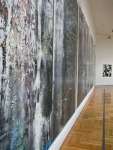
I approached a room at the St. Louis Art Museum that completely gave credence to its acronym. On one giant wall hung three enormous panels by Gerhard Richter, the three months most Winter. Opposite to it across the spacious room – a gargantuan assemblage by Anselm Kiefer was hanging. Between the two I foundered, awestruck and thoroughly a-mazed (assuming that means “to be jettisoned into an unsolvable maze or labyrinth”). Lost. Immersed. Afloat. A parallel to loving my wife.

Like cattle in a feedlot among females, I graze, stare dumbly and bellow, then stunned, flayed and strung up all of a sudden. Before I know what’s happened. Art is like that. You wander in, something strikes you in your senses, you move in – kazowy! – you’re rearranged, undone, overloaded.

I must say I don’t really mind the dystopia, aporia, conundrum’d state of being this implies, but to sense a ground for being in it (to secure one’s being at all!) is tricky. Usually it emerges after the stupor – you become cognizant of pain. Your throat is slit, your blood is gone, you’re an artifact, a meal.

Humans are not that helpless.

This was intended to be a consideration (astute, reasonable, hopefully enjoyable) of ambiguity and liminality – their presence in our apprehension of the world – of art and persons and things. Persons, places and things, how about, the designations “art” and “spouse,” “painter,” “friend,” “S.L.A.M” or “self” are afterbirths of our relations.

So the stairs, the leaky lake-y landscape, the architectures of doorways, the ladies and the painted times…

where I enter, where I leave, seems entirely up for grabs. Depends on the day, my mood or company, my body’s presence with my mind (and vice-versa), the music or chatter or silence in my head, and so on.

There’s a thrill to it, an ecstasis – as if sometimes I become phantom, fleeing and spreading into the surface of things; at others a long contemplation, as if merging with jelly at the bottom of the sea. Usually, amid much stammering, I end up stuttering: “I don’t know. I can’t describe it,” whether to partner or journal,

and begin again.

And sometimes I just breathe (think about breathing) and gaze. Something like a ubiquity of assimilation occurs, a vanishing and presence – to dis-appear. Not to cease, but, apparently, to occur “in,” diffuse, non-identically and undifferentiatedly.

Where am I?

Or might I be aptly participant? As if the similarities of cells and atoms (the family resemblance of objects) and the woven unity of wind have been accepted, acknowledged, awared in the confusion (“fusion-with”).

I don’t know. I can’t describe it.

But I like it and fear it at once – secure and unsettling – like “home,” as it were, or my “self.”

A sort of cognition of the ever-unknown lexeme “I” in its ever-unknowing surround…of people, places and things…that primal chaos and truth. Ambiguous, liminal, present.

The join.

Contemplation Validation: an Addenda

Addenda: Contemplating Language…

Robert Frank photo


Coming clean.

Honestly.

There are many a day that I feel alone or odd or perhaps even neurotic in my obsession with languaging. I go to write…and end up being able only to write language. About language, with language, in language, against language, through language…a medium I am incapable of escaping. I think of those who write stories, or poems, articles or essays about subjects behind the words, things referred to, recounted, and I get excited, think: “I can do this!” – head into artworks or subjects, characters or narratives, and sure enough, soon as I put instrument to page…I’m locked in language…what it does, how it functions, what it means. With the gut feeling that exactly that, is what it does…means. Not something else, more, under or beyond, but means in its being languaging.

So I circle, spiral, seek into, try to self-criticize, split, examine, understand, observe, listen…and end up creating these whirligig texts where language spurs and follows, begins and begins and begins.

I wonder if it bores readers. I wonder if most persons, when I try to hash these conundrums out (the “prison” and “window” of languaging), are thinking…”why don’t you just get on with it…say something! Try it! Communicate, describe, hypothesize, anything – but don’t just dissolve your saying with saying!” I wonder if, to the bulk of our kind, reflecting on reflections without answers, resolutions, commercial products, and so on, is a stumbling block, a misfortune, a psychosis?

And things happen like this morning, where I suddenly feel validation of my contemplation…where the “eternality” of the issue feels ok for me to be obsessed by…today it comes in the form of a lengthy essay by Nobel Laureate (validation!) Octavio Paz, titled Reading and Contemplation. In it, he also enters into the trail of sources that has so shaped me: Benjamin Lee Whorf, Wittgenstein, poets, philosophers and physicists throughout the ages responding to: “Language is society’s foundation and at the same time is founded on it. Without language, there is no society; without society there is no language. To me this is one of the great enigmas of human history. Or rather the enigma.”

Sigh! I’m NOT alone! I’m digging around in perhaps the enigma of being human. “Language is more powerful than the individual self…this language that imprisons us is also a window, a lookout post on the world, on our fellows and on other languages…Perhaps the answer is to recognize that each culture – that totality of material, intellectual, and emotional structures: the things, institutions, and persons that go to make up a socity – is predominantly a symbolic system…that every act of human beings – even their crimes – say something. We are condemned to voice meaning endlessly. We are language.”

Further, “it goes without saying that everything human beings touch is impregnated with meaning; the trouble is that the moment we perceive it, meaning scatters and disappears. There is no meaning but meanings. Each one of them is instantaneous and lasts no longer than its appearance. Ashes of meaning: ashes without meaning…Meanings cancel each other out; on the ruins of meaning there appears a reality that cannot be named or even thought. To question language is to question ourselves.”

And, in a kind of ultimate reciprocation, connection, correlation…at the very core of my daily work, Paz writes:

“If everything we touch and name becomes full of meaning, and if all these meanings – provisional, disparate, contradictory – instantly lose their meaning, what is left to us? To begin all over again.”

And so I do…with this added courage. Perhaps I am not crazy. Perhaps others are interested. Perhaps languaging language matters.


*if you share my intrigue at all, I highly encourage you to seek out a copy of Paz’s Reading and Contemplation. It is a Pazian-version of my “Up with Word(s)” contemplation – nicely done, about 50 pp. I have read it in my copy: Convergences: Essays on Art and Literature by Octavio Paz

Equilibrium’s Joy

foto by Filbert

Feeding the Reach”


Yesterday evening, I sat down in an early dusky chill, on the back steps of my home, for an after-dinner coffee and cigarette, watching with delight my two youngest bounding as penguins on our trampoline.

The sky was clear with an odd bright-but-sunken diffusion of sun, above the roof of the garage thin branches from three separate trees converging and tangling, criss-crossing and enmeshed, forming intricate thick silhouettes of scribblings in the even-ing air.

As I gazed and traced with my eyes and deep breaths, it struck me that after nearly two years of freedom to devote my days and hours to words, reading-writing-reading, a scene, an image like this incredibly marked and tangly night sky, almost immediately, spontaneously metaphored two references in me:

– a sentence

– the connections between ourselves and our world, the ganglia of mind and body enmeshed with “other”

I retraced my day to a half-an-hour I’d snuck to myself to read, while feigning a chore, from J.R. Firth’s later essays on linguistics. In one paper, Linguistic Analysis as a Study of Meaning, Firth very patently set out some fundamental assumptions he believed crucial for understanding the functions, processes, “meaning” of human languaging. I would like to copy entirely these three brief points and then add a touch of commentary, what my mind riffed as I pondered the trees (the tangles and lines, nerves and events conspiring to make a single utterance, a phrase, a sentence), a body and mind (my own) inundated, saturate, with language, and the squawks and giggles of my penguin-children.

First then, from J.R. Firth: (let’s call it “presuppositions crucial to reflecting on words”):

The meaning of any particular instance of everyday speech is intimately interlocked not only with an environment of particular sights and sounds, but deeply embedded in the living processes of persons maintaining themselves in society”

“1. The human being is a field of experience in which the life process is being maintained in the social process. The human being in society is endowed with an urge to ‘diffuse’ and ‘communicate’ his experience by voice and gesture.

2. All language text in modern languages has therefore:

(a) the implication of utterance, and must be referred to

(b) participants in (all language presupposes ‘other’ – events linguistic and non- linguistic)

(c) some generalized context of situation.

These categories must also cover ‘talking to oneself’.

3. The participants in such contexts are social persons in terms of the speech community of which they are members. The key notion is one of personality, the essentials of which are:

(a) Continuity and the maintenance of the life process, the social process. In this

connection the concepts of context of culture and context of experience (continuity of pattern and process) are necessary abstractions in stating the continuity as well as the change of meanings.

(b) The creative effort and effect of speech, including talking to oneself. The preservation of the essentials of life in society from the point of view of the participants in the situation forms a large part of the meaning of language as creative activity.

(c) Personal responsibility for one’s words.

(d) The organization of personality and of social life depends on the built-in potentialities of language in the nature of the human beings and on what is learned in nurture.

“In the most general terms, the basic principle is the unity, identity and continuity of the human personality, bearing constantly in mind that ‘we are in the world and the world in us’…The contextual theory of meaning employs abstractions which enable us to handle language in the interrelated processes of personal and social life in the flux of events.”


For starters. Then Wittgenstein, Heidegger, Sukenick and Blanchot, Beckett, Maso, Nancy and Stevens, Cixous, Kafka, Calvino, Derrida and Austin, Wimsatt, Peirce, Jakobson, Malinowski, Thirlwell, Shakespeare, Homer and Celan and more and more and more came flooding in like the chatter of branches, and I listened with my eyes, and felt deeply in my ears the scramble and magic of our glittering alphabets and strings of letters, colors and symbols and my mind murmuring over and over “feeding the reach, feeding the reach, feeding the reach…”

And I begged patience to add – from what I know of this elegant, flexible, complicated medium – WORDS – their implementing our humanness implementing them – that their primary glorious recklessly beautiful use is just this:

feeding the reach of our humanness

its depth, breadth, height and scope and volume

languaging is the vocation of feeding the reach

N Filbert, March 2012

Shedding Light

“the whole world – luminous, luminous.  We were lucky to be here.  Even in pain and uncertainty and rage and fear –

some fear

-Carole Maso-

Shedding Light

(on fears and forties)

What is it they say about one’s 40s?

When I was in my 20s I think we imagined the fourth decade as a time when one ought to be graduating from the ever-post-grad program school of hard knocks, perhaps the 20s were a fortification and stretching of the self, the 30s a learning and establishing of its bounds and borders, 40s and 50s some growing truce or enjoyment of it all. At my birthday this year my stepdaughter pronounced me “forty-fun” years old. Is that so?

Walking down the stairs from our working studio to procure cream for my coffee, something else strikes me. I see a rectangle of light protrude from an uncovered window in a room I cannot see, falling across another room, two away from the kitchen where I stand and view it through three doorways. My 40s I would characterize (a year-and-a-half in) as the facing and unpacking, or recognition of and inquiry into, my prominent, almost mythical, and apparently irrational, fears.

Among these, the fear of abandonment (a paranoia that has eaten at all of my marriages – luckily my current spouse won’t have it…thus these therapeutic investigations); another, that I’m inherently disappointing or insufficient: my talents, appearance, relationality, aptitudes for sympathy/empathy/emotion, and abilities all suffer some fatal lack, that I am unable to be “enough” of anything or anyone to be of lasting value. Also, that people are threatening and harmful – strangers, intimates, friends, acquaintances – other humans – inherently self-preserving by nature and therefore untrustworthy, at the point one no longer serves their preserving one will be discarded or destroyed (accentuating abandonment and insufficiency fears as you might imagine); and light. Yes, light. Particularly sunlight, but any form of bright light unsettles me profoundly.

Seeing the sunlight cut through a clearly unprotected opening in our home had the effect of an intruder on me – my esophagus tensed up, skin tingled, breath foreshortened and nerves wrenched the muscles of my shoulders and neck – someone had left us exposed – at mercy – at risk.

In the night, feeling my way to the restroom, there’s a glow from my daughter’s room. It suggests presence, but I know (I think) that she is sleeping at her mother’s tonight. Startled and alarmed, I nudge the door – glow sticks, attached in a large circle, lay in the room like an electric eel spiriting by in the ocean’s depths.

I can sit with ease, even sprawl on our lovely porch, enjoy a cigarette, watch branches and pavement, listen to critters at night or in storm, but in daylight I keep moving or stand at the door. Like a doe in a clearing, I feel surrounded, defenseless – everyone (anyone) could see me, take a shot, direct speech my way, ask for things – interrupt, intrude, violate, voyeur.

Our maniacal sun has always struck me as an enormous and torturous spotlight under which we had better perform or disband (scurry) ‘cause everyone (potentially) is judging us; or some atomic or nuclear exposure-radiator, aching to burn and shrivel us, flare us to a crisp, turn us to ash, dehydrate us.

Rain and dark moistness encourages growth, protection, concealment, shelter. Like robing for the stage, fogs and mists mask us, preserve our individuality, turn us into basic shapes, generalize and equalize us, but light, well light “brings to light” – highlighting flaws, differences, disfigurements, scars, limps, pimples, features, you name it – you’re stripped bare before the blazing eye.

Lunar reflection, on the other hand, is like a nightlight – an orb, an aura, a frosted bulb – gently assisting without dominance, our perceptive necessities, like cloudcover or shade.

Perhaps this psycho-physiological trigger comes from years of being scared shitless (literally, I endured diarrhea before each of my performances as a child) or some early programming of scrutiny and judgment; or science labs and hospitals versus woods, basements and photo-development darkrooms or blacklit jazz rooms that were my safe places in my youth. I don’t know, but I can’t remember a time I didn’t prefer the night to the day, rain to shine, cathedral to mega-church theatrics, concert hall to club, museum to mall and so on.

Anyway, the 40s. One survives this far creating and instinctively obeying these fears…perhaps deconstructing them implies one is “over-the-hill,” preparations for death, dismantling the armor that got one this far?

Wanting to be known before one dies? “Exposed” to another? Coming-to-terms with something closer to “reality”? Like mortality? I don’t’ know. It doesn’t make much sense, to grow fearless as one approaches the fearsome end, but what do I know? I’ve only been around for four decades. Cut me some slack.

Please

and….no fears

Joy : Learning

At a certain point one experiences knowledge acquisition (is it a “thing” to have, or an activity to do? or both?), learning, like expanding repertoire for a professional musician.

A day of research, study and reading feels like an increasing conversation for all the voices in one’s head.

It seems endless, for one thing, and like an ultimate “wonder of the world” – an intricate gargantuan and beautiful or awe-inspiring architecture – on another.

I attain these sorts of cumulative swells where each thing I ingest, no matter how remote in time, place, genre, subject, voice or style, seems to recall another voice, argument, demonstration, idea or style and synthetically weaves larger and larger universes of facts, names, concepts, rhythms and perspectives.

It is breathtaking and elating. As if boundaryless and eternal and full of an infinity of details, each their own delight. The impossibility of boredom, exhaustion, comprehension. For the insatiable, or those who go at eliminating the hole by trying to cut it out, the edges just grow wider, more enormous.

Which can also give one the sense of void and vortex. The spiraling braid of information and interpretation fraying abysmally in all directions. A sort of ennui of overwhelm. A stunned gluttony.

But, incapable of finishing prior to death and its elimination, the loom of mind keeps on whirring, constructing colors and patterns I’d never dreamed, yet, inevitably, others have, or did in the thinking, and it grows again.

The age-old cliché that the more you know the more you know that you do not know…absolutely and bewilderingly true. As you increase vocabularies of disciplines, the areas enabled just keep opening up or tangling in to new vistas. Talk about addictive and satisfaction in the endless pursuit! What an ecstatic paradox!

Your capacities, muscles for engaging, increase, and you just keep on exercising them on an inexhaustible supply – the compendium of human and world and all that is stitching them together!

Work it!!!

Afterwords…more words : up with word(s)

After Words…More Words

UP WITH WORD(S)

and any art, after all the other things if may be about, is fundamentally about its medium”

-Ronald Sukenick-

In conclusion?

Perhaps this entire exercise, this simplistic simplification of what I think I might know about the medium of languaging (a mystery to me) has been undertaken and written for myself alone. Perhaps it is comprised of the sounds of sobbing in a dark little attic, me searching to find a “speech fellowship” in this world, in my life experience. I can guarantee to you that it is an experiment in assaulting frontiers, unknowns, and deep abiding fears of mine: that I don’t know what I’m doing, that my languagings aren’t effective, that I don’t relate/co-relate to others well, that my writings are woefully inadequate to experience and the world, that my life doesn’t mean anything, that I and my words don’t matter.

I have hopes beyond these things though.

My hopes, I believe, in part have been to raise or renew an awareness of the mysterious tangle of being languaging engages us in – our realities. And in part to encourage creativity in our usage of language(s), and an openness to its using us, in order for the medium itself to become, and for us to be aware of our languaging as an experiencing, itself. Not necessarily “about” experiences (though it often accomplishes this as well), nor inherently “about” anything “else” – but languaging as activity of being human.

That a compulsion to use language as art, is a movement toward relation and intimacy…to utilize what language(s) open to us, get funky with it (exercise agency), constructing new common places, possible fields, toward more completeness of overlapping or shared experiencing. That our use and experience of languaging is our shared experience – where we meet – without a necessity of sharing referrals or signifieds behind or beyond the words themselves. Meetings in/at/through the artifacts of languaging.

It is my opinion that this is what works of art have always done, regardless of medium, content or imagery: taken available matter, identifiable to us all and humanly acted in and with it, composing it in a manner that becomes its own unique place of experiencing and being.

This often requires undoing habitual ways of using the mediums of living in order that we perceive the human and the medium again, afresh, and are thereby enabled to engage all matters/persons participant directly as experiencing. This may help explain why art is often confounding or unsettling at first…becoming new and unique experiences…as we always fear the unknown swarm of reality until we risk our personalities against/toward/with it.

I want to encourage you, in both expression and encounter, to take more into account, to open against your fears, to begin to engage the materials of experience, the ubiquity of our borderlands, frames and “frontiers” with courage, existing at the thresholds that you always necessarily are, but not only craving the safety that comes from seeking what you know, are accustomed to, have familiarity or agreement with, nor for what it might “mean” or what might lie “behind” it or that it might be “about,” but learning and challenging yourself to meet it directly – to look at it, to relate openly and expectantly.

Moving you to construct in your own surrounds places unique to yourself and available to your world – welcoming or offering others opportunities and possibilities to join. To become.

To continually recommence and expand…our being.

Closure is misanthropic

-Lyn Hejinian-


instants of i…

i” for instance

(iota)

ABCDEFGHIJKLMNOPQURSTUVWXYZ

And how was it I acquired this alphabet among so many others? Broken and crossed-out from the start, I adapted myself, twisted and stretched, contorted and shaped to become something more, something other than my single digit of a mark. Stumbling about all through the letters I reached, bowing this way and that, even circling round on myself exposing the emptiness inside, the only thing noteworthy surrounding me or attached to me from outside, where reality lies. Pleading and spreading my arms, split apart, right up to my crucified and zig-zagged zero-I-ng end.


fears…more fear…no fear(s)?

My Fears: My Need

I DO. I UNDO. I REDO

What deal must I strike in order to be published by you? What pose, bargain, stance, is it I must make with you now?…

you dance so good, you dance so good, you dance so good…???”

language is still a bunch of sturdy, glittering charms in the astonished hand.

A utopia of possibility. A utopia of choice.”

-Carole Maso-

One of the funny things about experimentalism in regard to language is that most of it has not been done yet”

-Donald Barthelme-

“I am huddled around the fire of the alphabet, still”

-Carole Maso-

Again, doubt again. Having never been taken, accepted, acknowledged even, by a publisher, by the system of makers of books for the world, for others, after all of these years and millions of words and thousands of hours, doubt again. Fear.

I undo.

What is it we want of language? Need? And what needs language do? Be? And where is it that I fail?

And you dance, you dance, you dance (but apparently no “so good”).

I undo.

Having done so much.

I do. In a needing language needing body needing language another body. To incorporate. This body, these needs, what surrounds and infests it, needing embodiment. “Everything happens and everything that happens is part of the story” (Ronald Sukenick). I thought. I do.

I undo.

Because apparently not. Apparently what is needed, what needs languaging in this world, this one my body needs in, is needed in, does not incorporate my languaging as what is needed.

I undo.

I unravel with questions, with doubts. Perhaps I was wrong? I am wrong. I fear. What needs in me has to search its needs meeting. But it finds, I do.

I do.

My language needs language finds every day – E. M. Cioran, Samuel Beckett, Macedonio Fernandez, Ronald Sukenick, Franz Kafka, Franz Kline, Raymond Federman, the great Quixote, Laurence Sterne, Gertrude Stein, W. S. Merwin, Helene Cixous, William Bronk, Edmond Jabes, Clarice Lispector, Jorge L Borges, Lynne Tillman, Anne Carson, Nelly Sachs, Cees Nooteboom, Robert Frank, Alberto Giacometti, Emily Mason, M. M. Bakhtin, Jacques Derrida, Ludwig Wittgenstein, Thomas Bernhard, Paul Celan, Arkadii Dragomoshchenko, Jean-Luc Nancy, Janet Kaufmann…

on, on, on…

languaging needing languaging bodies languaging

I do.

I undo.

I redo.

Those “everything that happens” Carole Maso, Louise Bourgeois, Jacques Roubaud, Georgi Gospodinov, Julio Cortazar, Georges Perec, not abstracted, dissimilated, fantasized into shapes unlike our bodies, unlike our lives, with beginnings, middles, ends, developments and growths, tidiness and causes with effects, not like those “parts,” but “everything” the body needs, languaging, chaos and order, present filled with pasts opening into futures, “everything happens” continuing…

I redo.

Within moments I can feel unreality. In magazines, movies, in TV and books, in art. My body needs reality, realization, not escape, not lies and illusions, it is already made of them, honestly.

Beings needs languaging needs being.

I redo.

Hurt and joy, fear and calm, love and lack, pleasure and harm.

Not redemption, not heroes and heroines, not rights and wrongs or rites and songs. Not reasons or religions, but relations between, between true and false, between black and white, noise and quiet, living and dying, myself and my spouse and my children,

the “ethos of ambiguity” (Ilan Stavans), the dim and the grey-blue-black (Beckett), the marshes and steep climbs…

I do.

I undo.

I redo.

My body is experiencing, and to know it, feel it, sense it, be it, I need stories, I am looking for its languaging and I find it or I make it, I do, undo and redo.

If the codifying systems of bodies and languages do not share this body’s needs, then its needs are unique, but still met, what joy if the needs met needs might be shared.

I do.

I undo.

I redo.

The stairwells lead up and down, inside out, toward or away, each always and also their reverse, inverse, “other” – languaging bodies languaging…

I climb, I descend. I pass in and out, I move. I seek and find seeking,

do. undo. redo.

closure is misanthropic”

-Lyn Hejinian-
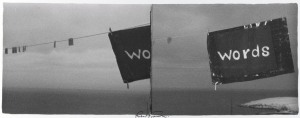
Additional Addenda…approaching an end…

Addenda…Creative Languaging

Here I would like to insert some thoughts and observations regarding the import and opportunities of artistic or literary, making-up, collaging, discombobulating, rearranging “ordinary” languaging. If “words are congenitally conceptual,” and I believe they are – that fact alone being one of the fiercest tractions to work through and past in utilizing language as a medium for art – as objects in the world, rather than symbols standing in for (or between or over) objects in the world – then to arrange them or copulate them between languages or existent terms in a language, etc…is a way to bring the word and the activity of languaging toward experience in itself. Being creative with existent languaging systems means often turning accepted uses or meanings back on themselves, undoing “ordinary” uses and definitions in order that the words might be substances of a medium (like paint or clay for plastic arts, the body for dance, shapes and frames and objects for photography, and so on) that then can be its own artifact – its own place of meeting for a community of persons – a field for creating “meaning” in the world.

Ronald Sukenick and kin repeatedly direct us to view novels and poems not as “problems to figure out” but as “experiences to respond to.” Kafka suggested that “language must not be used as a means but must be experienced, suffered.” Given the flexibility and inaccuracies, polysystemic and multivalent capacities and references of existing language systems, to craft new paths of language, tweak or invite new usages provides us with new ranges of possibilities for direct relations. In a way, using language “novelistically” (ever-new) intends and evinces the making of new “speech fellowships” – occasions for overlapping our experiences – in each new reality of speaking, saying, inscribing.

To draw attention to letters and words as things-in-themselves rather than simply signs-referring-to-things-in-themselves, opens up vast territories of potentiality for the meetings and relations of human beings across languaging-systems, cultural contexts, professional or social standings, psychophysiological realities and so on…meeting in the words, the new words, the repurposed words, revised and invented as new objects in the world – artifacts – for us to engage and encounter together.

I would argue that this is precisely what great literature does (and a principal criteria for “greatness” in literature) – serves as a meeting point for the widest range of humans to deepen and expand their engagement with themselves and the world. The “speech fellowship” aspect might help to explain why some persons respond more strongly to particular authors or styles of languaging, but those works which are great, which renew, humans will recognize (given time) from any point of view.

This, I believe, is a challenge to all humans to attend to their languaging – viewing it as an activity much like sex or eating, work or play, that we do, indeed must do, in order to survive, but may also take pleasure and care in – that it might enrich and increase our moments of being alive – and create opportunities for more and more meaning – which occurs when we actualize and accentuate our interrelatedness – the fact of our being.

Well, there’s that…