The Return – the Quest continues

Pikes Peak

After a glorious week smushed together in an old log cabin without running water and an outhouse on the slopes of Pikes Peak Colorado, we have returned.  It was wonderful family time – hiking, kayaking, playing, reading, climbing and performing the necessary tasks of cabin-living.  Irreplacable.  One of our sons was reading “How to Read Literature like a Professor” for his summer reading assignments in the wee hours and pointed out that this type of vacation shared many qualifications of the Quest in literary themes.  That feels so right.  Life lived in relation to others always seems a quest – to know one another better, love one another better, hear one another better, express and differentiate and develop as persons-in-relation.  I have been immensely blessed with a mixed and quirky collective of children from whom I learn so much, and a spouse who cracks and opens me.  It is a particular pleasure when the world around us is also so splendid and obviously large as it is in the Rockies of Colorado, and when so many distractions are replaced with shared attentions – mushrooms, critters, rock formations, streams, decrepit mines, wild donkeys, and so on.  Priceless time.

Upon return it is easy to see how the quest goes on…kiddos heading back to school…classes starting again…and these packages opened in the pile of mail:

This slideshow requires JavaScript.

the quest always beginning…

Birthday Wishes!!!

HAPPY BIRTHDAY TO MY INCREDIBLE SPOUSE

AND HER TWIN!

twins-birthday

To my dearest and most beloved : Holly Suzanne – I confess, profess, announce, sing, display, proclaim that my life is altered, changed, extended, enhanced, enriched and “reciprocally molded” by yours!  Thank you!  I love you!  Words really do not do justice to what I yearn to express in this matter.  So – Happy Birthday!

And what joy to have your lifelong twin, your originary “reciprocal molder” with us on this day!  Happy Birthday (of course!) to you too – Heidi!  Thank you so much for journeying to be with us in Kansas this year – and to both of you for allowing the nation to celebrate your wonderful existences with such pomp and blast!

Twinning.  It boggles my mind to consider an Other with whom all one’s existing moments have been shared in some genetic and psycho-somatic physio-biological manner.  We all arise from “families of origin” – known or unknown.  Sets of DNA/RNA, environments, contexts, socio-political realities all conjoin to formulate and tweak, morph and develop us along our passing journeys of existence.  With that come difficulties and joys.  Traumas and opportunities.  Constraints and affordances.  Over decades so much of our environment embeds in us it can be hard to discover/uncover/observe/revise the functions and effects of it all.  But this is also a great freedom we have.  The difficult work of digging and awareness, discovery and revision – “unworking” patterns and pains, “automatic” responses and flinches to the world that have been threaded into us from our own “time immemorials.”

Not having composed this song, all the words surely don’t belong – but the tone, and sister-sentiment – “the story goes…” – and the urging to excise and unpack the “demons,” afflictions, griefs, traumas and so forth – that you two have shared from fertilization and beyond – is my wish for you – together and individually (is that possible with twinning?) …

HERE’S TO YOUR LIVES!!!

how glad I am that they entwine with mine!

Summertime

In our realm, Summer busies – schedules, rituals and rhythms deconstruct and a verve of freedom and compulsion arises in our children.  And there are vacations and visitors and spontaneous events.  The weather withers me, people are drawn to the outside, in all – Summer discomforts me.

And yet…this week expect the visits of my wife’s twin, her aunt, and a long-time friend and his family, AND we’ll celebrate these dear twins birthday with wild national hoopla (July 4 – precious to me because she entered the world, but I’m happy to have help in the celebrating at this level!).

What gathers and whispers…or shouts and plays…runs and claps…talks and snuggles…HOME…those precious to us, invaluable, incalculable,

Yesterday eve we were enjoying a particularly (abnormal) gentle, cool Kansas Summer eve on our porch and listening to the music of Keith Kenniff – placed here as a celebration of Summer’s affordances – dislocated time, gatherings, visitations and travels – favorites – family, friends, nests…

Keith Kenniff - Branches

Keith Kenniff – Branches

June 23, 2013 – 3:44 pm – if you had the coordinates you could Google Map it.

What I was composing the other day in my head, or wherever daydreaming occurs: filling up that gap between inside or outside, idea and actual, etcetera.  They told me not to worry about losing it – that it would return, re-emerge.  I lost it.  The idea, sensation, form, content – everything.  Well, not everything, exactly, I guess, because how could I conjure that there was something, some experience, some initiative or other, had I truthfully lost it?  Okay, maybe they’re right, and “everything” is a question of access.

In any case, well, no – in present case or tense or whatever now-situation might be (“Weather”? – see Roland Barthes, The Preparation of the Novel, or Tim Ingold’s essay in Vital Beauty) I am not experiencing “access” to something some part or parts of me (some connectivities) believe or invent a past tense for – a disjunction/abstraction/detachment from.  A difference.

I am believing that I felt differently about something at some other time, that language was forming out of me relating to that affect, and that I had the potential capacity to express all that semiotically – or, in a way that it might make sense, be shared, exist.

Now I’m languaging nothing.  Or, not exactly nothing, more like a different something that in fact is the semiosis of another inexpressible or inaccessible possible something.  Which means, potentially, anyone could find it, discover/uncover/invent/compose/co-construct (co- probably redundant to con- but then I’m not Russian, at least not currently) that initiative and perhaps I’d re-cognize or re-member whatever realigned threads rewove into this particular weaving (what is “now”).

Etcetera.  This is how it goes down for me (current context taken mostly for granted).


Grenzsituationen II

Please read previous post with this in mind:

I would love for any/all to share what those “Limit Texts/Artifacts” are for you?

grenzsituationen

Please share via comment what encounters or engagements with works of art, science, philosophy, writing, music, and any other cultural artifactual form has altered from then on how you select, evaluate, engage other related artifacts from then on?

Thank you!

Grenzsituationen

Recently, I have received several queries into either how I read as much as I read, or how I find or know what to read.  As I respond to these inquiries, it has interested me how in fact, I account for my reading history.  E.L. Doctorow explained he rarely knew what he believed until he had written about it.  Dostoevsky would start authoring a given scene, assuming he understood precisely what he believed about the issue discussed in it, only to have one of his characters convince him otherwise.  Frequently it is only through the actual act of creation that we locate what we really feel and think about a subject.” (Olsen, architectures of possibility).  That, coupled with “Authors frequently say things they are unaware of; only after they have gotten the reactions of their readers do they discover what they have said” – Umberto Eco…resulted in these self-observations:

Even from persons I deem much more knowledgeable than myself I often hear “you’ve read more than anyone I know…” and I have spent many hours a day for many decades – reading.  I was raised in a fundamentalist Christian home, so the concern for truth, authority and canon were socio-culturally inculcated in me from an early age.  When I began exploring music, philosophy and literature I found this concern ruling my approach: what is deemed canonical (attested by authorities), what came first?, and what rings true?  I remember beginning with anthologies of classical poets, then ancient scriptures, Homer and so forth.  Beginning with Plato/Aristotle then forward through those who claimed their influence.  Beginning with Bach, Brahms, Beethoven and then forward and back to origins and influences.  That has been my habit in exploring cultural artifacts.  Find references.  Correspondence.  Claims.  Follow them out.  And follow those out.  And follow those.  And….so on.

As to achieving the absorption of piles of books at a time – when pushed to claim a process – I was surprised at the simple methodologies.  I have referred to “transductive reading” from time to time in these posts – the interaction and co-constitutive commentaries that work provides to work.  So I read large amounts of materials over large amounts of time (though my wife insists I read speedily) – I find I read sections / chapters / pages from a multitude of books and let them interact in me forming tissues and connections, rather than singular voices or ideas straight through.  I read for differences – turns of phrase, terminologies, rhythms, in persons approaches to subjects, rather than reading for topical content or idea-information as data.  Where a voice, approach, or technique is unique is often what particular works have to offer, I have come to think.  And, depending on genre or reason for reading – as overlaps increase as the volume of “have-read” grows – one can often browse for summarizing sections to find the nuances each thinker or creator proffers.

reading a lot

Then there’s my personal history and approach to things.  Hard-pressed to learning from youth=26 straight years of education + 17 years working in or managing retail bookstores – in an effort to be an “excellent” bookseller – implying to me I had to know something of everything a reader might desire (first hand).  Publisher’s catalogs, reviews, recommendations, lists, histories, from the development of language to its variation in forms and contents.  And always that uncanny recognition of Grenzsituationen – or “Limit Texts.”

“It might be helpful to conceive of certain texts as Limit Texts – a variety of writing disturbance that carries various elements of narrativity to their brink so the reader can never quite think of them in the same terms again.  To the brink, and then (for most readers, at least) over.  Karl Jaspers coined the word Grenzsituationen (border/limit situations) to describe existential moments accompanied by anxiety in which the human mind is forced to confront the restrictions of its existing forms – moments, in other words, that make us abandon, fleetingly, the securities of our limitedness and enter new realms of self-consciousness.  Death, for example.”

“If we carry this notion of Grenzsituationen into the literary domain, we find ourselves thinking about the sorts of books that, once you’ve taken them down from the shelf, you’ll never be able to put back up again.  They won’t leave you alone.  They will continue to work on your imagination long after you’ve read them.  Merely by being in the world, Limit Texts ask us to embrace possibility spaces, difficulty, freedom, radical skepticism.  Which writings make up the category will, naturally, vary from reader to reader, depending on what the reader has already encountered by way of innovative projects, his or her background, assumptions and so on…but the more Limit Texts one reads, the less one tends to feel the impulse to return to more conventional narrativity…”

-Lance Olsen, architectures of possibility
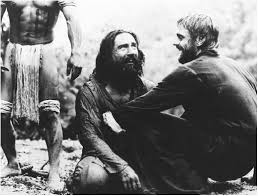
These situations are tattooed on my body (literally)…and include:

Samuel Beckett – Macedonio Fernandez – Paul Celan – Fyodor Dostoevsky – Ludwig Wittgenstein – Maurice Blanchot – Helene Cixous – Clarice Lispector – Franz Kafka – Fernando Pessoa – David Foster Wallace – Mikhail Bakhtin – Rainer Maria Rilke – Edmond Jabes – Federico Garcia Lorca – William Stafford – Egon Schiele – Vincent van Gogh – Johannes Brahms – Alberto Giacometti – Robert Musil – Friedrich Nietzsche – C.F. Peirce…

as you uncover these (your own personal) writers – your pantheon

of those who change your view of the possibilities of language and who you can return to again and again

without  really feeling you’ve been there before – they become coordinates – network nodes – whereby you

evaluate and expand, extend and engage new writings you are exposed to – forever altering your patience and expectations of literature or whatever cultural artifact-type you crave and are pleasured by…thus making your reading more efficient and your selections increasingly more challenging and compelling to you – as long as you continue to leap out and expose yourself to things that might be unexpected

Ben Marcus – Ronald Sukenick – Laurie Sheck – Mei-Mei Berssenbrugge – Lyn Hejinian – Denis Johnson – Laurence Sterne – William James – C.F. Peirce – Michel Serres – Bruno Latour – Jorge Luis Borges – Cervantes – Immanuel Kant –

your lists will spawn as you follow their correspondences, admirations, criticisms, references, citations,

and you develop your literary canon

more on that another time
utopia

**More than a decade on, to update my Grenzsituationen, I’d need to add:

the Philokalia – John Moriarty – St. Isaac the Syrian – George MacDonald’s Sermons – Martin Heidegger – St. John Cassian – Sayings of the Desert Fathers & Mothers – Arkadii Dragomoschenko – Elder Aimilianos – Optina Elders – Haida Myths & Songs – Jim Harrison – St. Ephrem the Syrian – I Ching – Dreamsongs from Australia – St. Theophan the Recluse – Jan Zwicky – Martin Shaw – St. John Climacus – Marguerite Duras, and more…
a tidbit on writing

“every thing is a parliament of lines”

I think many people sense a difference between typing, printing, and writing.  But very few, I surmise, might be able to speak clearly about what those differences are.  There’s the kinesthetic difference, the disjunction of flow between thought forming through the body into theories of letters on paper.  There’s a temporal difference, between the stenography of lightning-thought tapped like Morse code onto a keyboard, versus the individuated pacing of each writers body, hand, and facility of digits.  Some may even say there’s a personality difference between interpreting standardized typography as a communication, and the erratics and imperfections of the same terms from a writing hand.

My desk is dominated by books with titles like Chaos, Incompleteness, Complexity, Information, Emergence, Touch, Telling, Lines and Erasure.  Aspects of being human that glance across gaps or dawdle on edges – where knowledge isn’t comprehensive (and where might it be?) – are the processes and activities that fascinate my fancy.

Coupling an article I chanced upon (thank you Scholarly Kitchen) about Technology and Cursive Writing, with my current readings in Tim Ingold’s Lines: A brief history, I begin to slowly realize that how we interact with lines, with writing, is sourced far beyond and beneath our immediate experience.

Ingold begins with the consideration of what we understand by the words “song” and “music.”  How “music has become wordless; language has been silenced.”  In the past music referred to sonorous words set to harmony and rhythm, sounds alone were an embellishment to language, but not the principle purpose.  Language was the sound-filled reality, like animal chirps or barks, the human’s vocal verbality.  With inscription, language began to silence.  Sound encountered a gap with meaning, or took on meaning of a different kind.

Similar worldview realities are exhibited in ways of inscribing.  “In typing and printing, the intimate link between the manual gesture and the inscriptive trace is broken.  The author conveys feeling by his choice of words, not by the expressiveness of his lines.”  And writing experienced gaps in relation to drawing, language further abstracted.  

“Yet whether encountered as a woven thread or as a written trace, the line is still perceived as one of movement and growth.  How come, then, that so many of the lines we come up against today seem so static?  Why does the very mention of the word ‘line’ or ‘linearity’, for so many contemporary thinkers conjure up an image of the alleged narrow-mindedness and sterility, as well as the single-track logic, of modern analytic thought?”

“It seems that what modern thought has done to place – fixing it to spatial locations – it has also done to people, wrapping their lives into temporal moments…If we were but to reverse this procedure, and to imagine life itself not as a fan of dotted lines – but as a manifold woven from the countless threads spun by beings of all sorts, both human and non-human, as they find their ways through the tangle of relationships in which they are enmeshed, then our entire understanding of evolution would be irrevocably altered…It would lead us to an open-ended view of the evolutionary process, and of our own history within that process, as one in which inhabitants, through their own activities, continually forge the conditions for their own and each other’s lives.  Indeed, lines have the power to change the world!”  (Ingold)

Bringing it back to the inscription of language, it is easy to see the bias of expression in the meaning of signs – but that meaning abstracted into disconnected idea-banks of terms, rather than the entire gesture of activity of inscribing.  My talent diminishing to equational finesse – the fiddling and play or arrangement of alphabets like numbers – rather than a being expressing its thought through gesture and individuated agreed-upon symbols and signs.  Perhaps our sense of difference betwixt the typescript and handwritten is that there is a little less of ourselves as individuated organism, and a lot more of standardized general practices and beliefs.  Perhaps we feel a little less in- when our scripts are preformed?  I do not know, I am foraging the questions…

“every thing is a parliament of lines”

-Tim Ingold

A further addenda on this agenda

The New Supply Chain and its Implications for Books in Libraries

Sudden Soap Box: Digitization = Access (not preservation)

Unbeknownst to me – the next Blackboard discussion assignment for one of my summer classes turned out to be :

  • Is digitization the answer to preserving print materials?  Discuss advantages and disadvantages.

The following was my response – realizing by the end that this had become an impassioned sort of soap box sermon rather (perhaps) than a reasoned response.  Judge for yourselves and please offer replies and conversation!


Is digitization the answer to preserving printed materials? Discuss the advantages and disadvantages


In my opinion the answer is NO.  I believe digitization is an aspect of access, not preservation.  Digitization – the process, format and type of “storage” are all inexact and uncertain dependencies – on energy sources, tools, network connections, licensing, access, programs, softwares, interfaces, and so on down the line.  With no real concept of the reliability, consistency or longevity of data in “cloud storage” – digital documents still need physical copies to ensure longevity.  The only companies I really hear belaboring the issues of continuity, reliability, and potential of accurate digital preservation besides the Library of Congress and Pew are Tim Berners-Lee and the WorldWideWeb Consortium, ITC and other digital business/tech aggregates – which continually discuss the problems, scramblings and deterioration of digital data bits in ethereal storage.  We all understand that we have books 100s even 1000s of years old, from which we can verify online copies, files, etc.  Otherwise many “scanned” documents lose clarity, miss pages, notations, editions, etc.  This is becoming an enormous problem when companies and institutions begin thinking that by digitizing something they are preserving it.  They’re not.  They’re making it available in another format and medium, not preserving it.  Our computers, platforms, servers, programs, hardware and software are continually being altered and updated – formats are insecure, data continuity is insecure, e-book packages automatically deliver updates and editions without preserving previous editions/authors/etc.  Digital access is precarious – a solar flare or atmospheric storm could wipe out or scramble data at any time (as a wise man once said).

Digitization is an answer to access not preservation.  Berners-Lee et. al. have always been clear that the purposes and hopes of WWW and Semantic Web work was to make the world’s culture more readily communicable and sharable – not to preserve it.  To democratize it.  Technology progresses too quickly and outdates too quickly to be a reliable form of preservation.  And with open access and collaborative semantic web – no digital document can be considered “authoritative” or be ensured to represent original writings or creation.  All digital data is open to revision, alteration, damage – it passes through too many hands, servers, connections to be utilized as an authoritative source.  (Perhaps all web citations, whether scholarly or not should be appended with some mark indicating it was retrieved from digital storage, rather than confirmed by printed document).

As access solution – digitization is wonderful.  For “just-in-time” retrieval and sharability, open publications and global learning and information – digitization is an incredible advance in communicating globally.  But reading a text over the phone, or broadcasting pages on TV, etc., are all notated if used in research.  Digitization also seems to mitigate against deep reading or comprehensive research, as digital texts tend to be scanned rather than read through in their entirety, and there seems to be a tendency to retrieve “good enough” or topical articles rather than searching for the best research available to the research at hand.  (side note, sorry).

So, in my opinion, digitization should be used for that which is was developed – a communicative medium – unstable, unreliable and ever-developing – but not an authoritative or preservational archive.  A books average life is between 100-300 years and utilizes much less energy in being used or shared than all the electricity and energy required for digitization and access.  Most ereaders, PCs, and other digital tools last at the outset 5-10 years and then add to the world’s waste, far less recyclable than pulped paper.

Digitization = access – global and unstable.  Physical copies = preservation – relatively stable and verifiable (as long as enough copies are preserved to compare and contrast).  We never considered this problem until now with the enormous weeding and disposal being done by the very places that existed to preserve these artifacts!


Economics of e-books & public-driven acquisitions – a query

libricide2

– Bibliobabble? – 

(click for full article)

The surge towards a print-less e-library recasts academic librarians as “rare book engineers”

by Colin Storey

libricide3

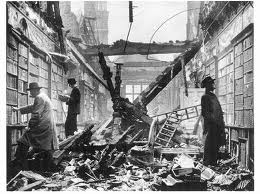
Is “just in time” preserving what will be needed for a (hopefully) long future?

How preservable and verifiable are digital bits?

Who ensures there are physical, tangible copies of information that may come in handy one day…

even if it seems passe or unnecessary in current socio-cultural perceptions?

What if cloud data gets scrambled, wears away, ebook vendors aggregate totalitarian-ly,

Where are our contingency plans for the preservation of knowledge and culture?

How will we verify digital content?

and so on….

libricide