A Positive Review

Max Frisch


What happens for you when you pick up a book lying on some surface of your home with a bookmark in it so that when you lift it and absent-mindedly thumb the edges of the pages of course it gaps at that location and you glimpse a single-sentenced paragraph:

“In the process the scissors break”* ?

Read it again.  Lie back.  Close your eyes (or not).

That’s what I’m talking about.

“Perhaps the chair slipped -“

“only human beings can recognize catastrophes”

further examples.

And if every  sentence does enough work to be its own paragraph like that?  You’ve probably stumbled upon a great book.

*sentence-paragraph occurs on page 60 (where the bookmark is) of Max Frisch’s Man in the Holocene (what a name for our geological era, eh?  Holo – cene, pronounced hollow-scene, interesting enough meaning wholly now or “entirely present” in its Greek constituents (it’s thus been totally now for over 12,000 years), just saying…

An Addition to Credo: the Liturgy

WOW!  From Edmond Jabes, kicking off morning and work…

Rabbi Ed

“The gap between prose and poetry, between rose and rosebush, he had said, ‘is a variable space reserved for the deepening of one and the same love.”

“The book is a promise of writing…the words…are perpetual fulfillment.  Behind them, eternity.  Before them, the distressing and increasing weakness of the infinite.”

“The place of language is language.”

“We read only our own reading.”

“The book is a ‘You’ that temporarily makes us an ‘I.’  But the book is also something else.  It is an ‘It’ that embraces the I/You, dialogue being always in three voices.”

Edmond Jabes, A Foreigner Carrying in the Crook of His Arm a Tiny Book

Blogging Reality – stumbling upon an addenda

This slideshow requires JavaScript.

Blogging Reality – Other’s Thoughts

After completing some thinking-in-action-in-words-as-blog earlier this week, I took up a book and read…the section following where I’d left off in the illustrious and continually praised and most highly recommended text (now in my seventh turn…) Dust by Arkadii Dragomoshchenko, I stumbled upon this smattering of letters:


“In reality, the logic of these changing textures and modes of writing bear witness to something altogether different, and applies to their various manifestations.  Generally speaking, each new mode seems richer than the preceding one; and while the new one does indeed repress what came before it, it also adds new possibilities to what already exists…the means by which new forms of writing subsequently influence ‘writers’ is a history of a different kind.

“In the course of the last decades, with the creation of the Internet and the Web, we have seen not only a gradual revolution in the perception of time and space, and consequently of the possibilities of expression, but also – strange as it may seem – one other fundamental phenomenon: a return to writing, perhaps to virtual writing, but nevertheless to writing.  It turns out that we have unconsciously come full circle, returning to ‘paper’ in spite of all the ardent speeches in defense of the new, digital order of things.  Indeed the Internet has turned us back toward the past because, as Adam Gopnik has written, the Internet is a kind of writing, given that it is literally written ‘from beginning to end.’

“This can of course be refuted: even assuming that you’re right, what is the ‘carrier’ then of this writing?  Can it still be considered ‘writing’?  Paper can be touched.  A book is a tangible, physical object; moreover, it has a smell: printers’ ink, manufacturing chemicals, etc.  And how priceless is writing paper itself, its special, unique odor and color, to which literature has paid much homage so often!  Finally, what separates the first, primordial sign etched in stonen from the image on a computer screen?  To this imaginary question I give the following answer: what is most important to consider are the changes in the concept of materiality, as well in the system of concepts – a process stretching back over the last hundred years – relating to the very possibility of describing any material object whatsoever.  This object, the description of which previously relied on the coordination of the concepts ‘beginning and end’ (every object had both), is now conceived as some kind of oscillating point of a perpetual ‘now,’ a definitive account of which is extremely difficult, if not impossible, to obtain.  Indeed, isn’t it rather naïve to claim that we can feel a sign, as if it were a slab of painted, reinforced concrete that could be dragged up to the forty-fourth floor?

“All in all, ‘to be online’ signifies, on the one hand, a perpetual ‘now,’ real time, but on the other hand it means reading words written by others, no less than typing out one’s own words, addressed to someone else…

            “…writing.  Written language has the inherent ability to create a salutary barrier, a kind of second skin or distance that allows one to disappear from sight whenever one wants.  This is a space in which no one can deprive you of the right to instantaneous solitude on this otherwise all too overcrowded, unlivable island.”                                                    –Arkadii Dragomoshchenko


So…skin, perpetual ‘now,’ “real time,” without beginning or end, a “salutary barrier,” “textures,” “changing forms” and so on….writing

What we do.  What we love.  What we need / depend on.  How we “touch,” of a barrier like skin…flexible, moving, light and air and signs…

Flow on bloggers!  Flow on!

The Fine Line

This slideshow requires JavaScript.

The elusive and ever-present “fine line”

So-and-So comments on my poem “Corpus:”

“Gratitude.  Yes, without flesh, our emptiness would show – more than it already does”

Soooo…what if we stripped it all down?  If we could see through the surfaces and veneers?  Could X-ray skins and masks, barriers and betweens?  What would we find?  What would be there?

I’m not certain I know what Arkadii Dragomoshchenko was writing when, in sort of remembering a painting by Edward Hopper while looking at, listening to, and thinking of other things, he said he caught something the artist had “kept silent about” – “I saw the fine line that separates emptiness from plenitude…like the memory of something that never happened, and which sinks then to the cunning bottom of words…” he says,

which suddenly plunged my own mind/imagination into a fictional mind and body of Alberto Giacometti, strafing and violently thumbing and stripping at sloppy wet clay glopping off wires, or scratching scattering lines upon lines upon lines around toward across and through the densities of a head’s face, a skull’s gaze, to – “get at it,” “down to it”…it, it, it.

Beckett writing round after round, chicken scratching sludgy paths, barnyard maneuvers after…it…

anyone obsessed…the idea of North, a perfect composition, to say something truly or clearly, the search for love, for that specific yellow, for shadow, emotion…anything,

that craving driving hounding driving us after “it”…limned so elastically with emptiness…plenitude apparently (possibly?) impossibly just the other side, just “through,” beyond, “it.”

So let’s Giacometti the flesh, tear it away to tendons and strips, resistant clumps and stains clinging to the fresh gruelly bones.  Empty the organs, scoop out the brains and guts…get rid of the extras, trim the fat, we’re after the core…”it.”  The “plenitude” just the other side of skin, of bone, somewhere…it must be somewhere in all this mess of in-between the structuring holds, no?

Dig to the center of the earth.  Scoot on out of the galaxy.  Find “it”, “it,” “it” – the plenitude…what will it be?  What will you swallow, cuddle, absorb, grasp, “obtain”?

I can’t remember if “empty space” is an oxymoron now or not, akin to the wonderfully wise and riddled aphorism of Wallace Stevens: “Nothing is itself taken alone” – STOP.  Think of it.  “It.”  Is he right?  Anything “taken alone,” “in itself,” is NOTHING?

In other words – pursuing some “essence,” some “right” or singular universal (or personal) “truth” is destined to leave us empty-handed?  Grasping “nothing”?  “Absence”? “Empty space”?  “Void”?

Or the human (we, us, you, I), body stripped apart in a search for a “soul”…

             On the other hand…sometimes Giacometti added.  Put wire together with string together with plaster, clay and cloth, plus chisel and hammer and hands, also paint; and sometimes he kept tracing more and more and more furious lines, strokes, deepening (thickening) eye sockets, figured shapes…

sometimes Wittgenstein multiplied words after word after symbol and equation, sign upon mark attempting to scratch them away…

And there’s the other half of Stevens’ aphorism: “Things are because of interrelations and interactions.”

Perhaps the “fine line” separating (or incorporating?) emptiness and plenitude is the very mess of glop of surface and structure, blood and mud, skin and bone and tangled nerves, oil and pigment, letters and lines, sounds and shapes, all the mixed-up pieces and parts, mushy impurities, congruences and convergences, masses and movements smeary and ever-so-tenuous…

perhaps that’s “it”?  Emptiness and plenitude mutually dependent like each side of this sheet of paper?  Indistinguishable?  The same-different “it”?

So put the body together, love the skin and the noises and fluids that issue from beneath it.  Slap words and songs, shapes and colors, space and time and breadth and depth, subject object, idea emotion and everything you’re able to in your quest for…

well, perhaps actually, your experience of…”it

Everything composes this line.
On Friendship: dialogue, conversation and becoming

A Letter to Friends (far and near, now and future):

On Friendship, Dialogue and Conversation

(even those “silenced to pieces” – Paul Celan)


Addressing an interminable oath, a perhaps-always, perhaps-never, but surely an “only.”  Friendship.

Either there runs an essential conversation, in the realm of the impossible, that is, the meaningless, or there does not.  Meaningless, like infinity, like being, like love – each lying somewhere beyond rationality, or knots of multiplicity, that is, items we are capable of naming, or calling (calling-out toward) but which do not, ever, add up.

Things that are, that are unable to be explained.  At times we call out to them as “paradoxes,” “mysteries,” “ideas,” “sensations,” “beliefs,” and so on, these “entities”(?) “concepts” (?) – “observable creations” that require one another to be, but cannot be identified in themselves (e.g. “same”/”different”; “self”/”other”; “silence”/”noise”; “presence”/”absence”; and so on).  “Things” (?? – but what to name them?) impossible to know/comprehend/understand (even simply perceive!) as themselves, rather only and ever with; each “it” requiring, to be perceived/conceived, “not-it.”

In human relations, when this reciprocal necessity is “felt,” “per-/con-ceived,” “experienced” – when I, in some layered mixture of reason, emotion, situation and manufacture determine that the “I” which I hope/select/choose/desire to be does not exist, is unable to manifest or become without the “not-I” which is you, and You, likewise have this experience/sensation…we call out toward it – “Friendship.”

It is this deep reciprocation, this sensation of “identification”-without-which-not identifiable as such I am naming essential dialogue, through conversation – the activity of friendship.  “Dialogue” I conceive of as a process of speaking and listening, a taking-turns enabled by agreed-upon, co-crafted understandings (co-mmunication), filling the inherent gap between, accentuating and bridging this “lapse” between you and I as individuals…become/ing friends.  “Conversation” I am considering as entering into speech with unknowns…hesitantly and impatiently concocting utterances and responding, languages inviting, striving toward, asking for…dialogue (its possibility).

Friends:  I hope you recognize yourself in this address – you I sincerely hope I have communicated with in some form of dialogue, an ongoing essential conversation – that I would not be, or be able to become, that which I impossibly wish to be, without your specific “not-Is” founding, grounding, in-forming and co-rrelating with me through what experience, encounter, and engagement we share.

This is for you.  For many of you I am no longer in dialogue with, in fact I currently enjoy dialogue with so very few, two or three “friends,” but you are not the less essential, less becoming – we for that.  I am saying that the conversation goes on in me, the calling-it, calling-out, the naming and mystery of our initial and originary correspondences through, across, greater and lesser gaps and lapses.

I believe the conversation-toward-dialogue, the deep and ongoing querying after what is unknown in/beyond those whom one has ever had the intimate understanding of reciprocated dialogue, in general is or is not.  There must be changes chosen or lived through that indeed have the possibility of so altering an individual’s-becoming-I that those corresponding partnerships of dialogic interaction no longer serve their becoming, but I find personally, as I review you who have so significantly shaped me, that my calling-out really does not waver, only the directness of my voice.

I want to thank you each (and in advance those possible future friends out ahead of me) for engaging mutual becomings with me, opening and becoming always being process and present in silent infinite impossible conversation between known unknowns.  At some point we found our paths to dialogue(s), intimate paradox, and that does not come undone, but remains as fact and experience and fuel for our becomings.

Without-you-each : not-I.

Thank you.

For long lapses and enormous gaps I call out: may dialogue be reached yet again, somewhere, someday.

And above all…to become.

Today

A steady, raining day (rare) for Kansas.  Filling it with Blanchot, Kafka, Beckett, Jabes, fervent standbys, companions in favorite times.  Stumbled across this while playing around with making a business card for myself (for a “Writer for Sustenance” – a “Heteroglossic Hominid”)…

for bloggers, then…

“right near the center lies a choice: to speak – a swift, unhesitating, irrevocable choice that leaves everything undecided…to choose speech turns out not to consist in choosing so much as in maintaining the wavering, undecided movement of the either-or (self-other)…What is it that must be said but not the only way it can be?…All that counts is to play; that means seriously.  Without reserve.”

-Ann Smock, What is There to Say?-

The Join

The Join”

Ms. Mann had made a landscape I simply could not decipher. I had a picture like that. Charcoal and paint and wax on a large canvas made by a woman I assuredly knew but no matter how, I never knew well. Modotti’s stairwell, but this was doors, steps leading upwards or down, thresholds to or away. The openings were thick in their darkness, but whether that black was within or without, I could not say. A kind of vertigo. An incapacity to gain my bearings. An experience that art and women have always supplied me with in large measure.

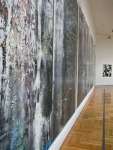
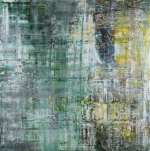
I approached a room at the St. Louis Art Museum that completely gave credence to its acronym. On one giant wall hung three enormous panels by Gerhard Richter, the three months most Winter. Opposite to it across the spacious room – a gargantuan assemblage by Anselm Kiefer was hanging. Between the two I foundered, awestruck and thoroughly a-mazed (assuming that means “to be jettisoned into an unsolvable maze or labyrinth”). Lost. Immersed. Afloat. A parallel to loving my wife.

Like cattle in a feedlot among females, I graze, stare dumbly and bellow, then stunned, flayed and strung up all of a sudden. Before I know what’s happened. Art is like that. You wander in, something strikes you in your senses, you move in – kazowy! – you’re rearranged, undone, overloaded.

I must say I don’t really mind the dystopia, aporia, conundrum’d state of being this implies, but to sense a ground for being in it (to secure one’s being at all!) is tricky. Usually it emerges after the stupor – you become cognizant of pain. Your throat is slit, your blood is gone, you’re an artifact, a meal.

Humans are not that helpless.

This was intended to be a consideration (astute, reasonable, hopefully enjoyable) of ambiguity and liminality – their presence in our apprehension of the world – of art and persons and things. Persons, places and things, how about, the designations “art” and “spouse,” “painter,” “friend,” “S.L.A.M” or “self” are afterbirths of our relations.

So the stairs, the leaky lake-y landscape, the architectures of doorways, the ladies and the painted times…

where I enter, where I leave, seems entirely up for grabs. Depends on the day, my mood or company, my body’s presence with my mind (and vice-versa), the music or chatter or silence in my head, and so on.

There’s a thrill to it, an ecstasis – as if sometimes I become phantom, fleeing and spreading into the surface of things; at others a long contemplation, as if merging with jelly at the bottom of the sea. Usually, amid much stammering, I end up stuttering: “I don’t know. I can’t describe it,” whether to partner or journal,

and begin again.

And sometimes I just breathe (think about breathing) and gaze. Something like a ubiquity of assimilation occurs, a vanishing and presence – to dis-appear. Not to cease, but, apparently, to occur “in,” diffuse, non-identically and undifferentiatedly.

Where am I?

Or might I be aptly participant? As if the similarities of cells and atoms (the family resemblance of objects) and the woven unity of wind have been accepted, acknowledged, awared in the confusion (“fusion-with”).

I don’t know. I can’t describe it.

But I like it and fear it at once – secure and unsettling – like “home,” as it were, or my “self.”

A sort of cognition of the ever-unknown lexeme “I” in its ever-unknowing surround…of people, places and things…that primal chaos and truth. Ambiguous, liminal, present.

The join.

As good as any…

This quotation from Arkadii Dragomoshchenko is as good as any I’ve yet come across in attempts to define or circumscribe what I think of in relation to whom or what or how a “manoftheword” is (in this case attributed in the masculine, because I am of the male gender, as is, supposedly, Arkadii) – but equally (as I see it) applied to any “personoftheword”:

“The place where I’ve finally found myself, is as simple as a child’s board game.  Everything in it echoes everything else.  Coincidences aren’t always believable.  And they don’t always count.  Obliqueness has its own charm…He’s writing…

The man forces out word after word.

The letters run in the rain and pour into the message.  The man, no doubt, is reading the message as he inscribes his letters.

In the message, unflinching, unfolding via ink blots, there are detailed instructions on how to correlate one letter with another, one word with another, and then the rest with rain, paper, war, objects,  fear, the hexagram of ‘fragments,’ toothaches, questions, history, tobacco smoke, poetry, foolishness, you name it…

The message also suggests that neither he nor you will receive a thing for it – this work is done gratis.”

-Arkadii Dragomoshchenko, Here” from Dust

I for instants…borrowed

Arkadii Dragomoshchenko

this one is too good to deny…

“The insignificant position of two associated objects is probably determined by both the randomness of their relationship (let us remind you that neither the ‘statue,’ nor ‘I’ in any way ‘expressed’ a desire to be together, to be united thus by a proposal of anticipation followed by a separation) and – if you will – one’s semic insufficiency.  Indeed, if the semic nucleus of the word ‘statue’ or, say, ‘she’ governs the layers of contextual semes, then ‘I’ is empty (or infinite and hollow, from the very beginning).  This lexeme has no nucleus whatsoever; it’s nothing more than a cocoon of ‘contextual semes,’ like the knot that is a constant deflection of an illusory straight line towards its starting point.

“Frankly, I’d like to say, as I did at the beginning, that ‘I’ is reduced to a ‘seething, ever-changing void.’ But let’s leave it at that.”

-Arkadii Dragomoshchenko-

And, in very much seriousness…if you are a writer in any sort of way (letters, memos, journals, ANYthing)…I find it hard to stomach you not having read Dragomoshchenko’s book Dust.  Really.  Truly truly truly.  Please, if you have even a passing interest in the use and creation and employment of language (even for conversation, thought or memory)…Dust, Dragomoshchenko, Dust, Dragomoshchenko…(mantra until you hold it in your hands)

I beg of you.

Goods for all

Virginia Woolf:  “What is the phrase for the moon?  And the phrase for love?  By what name are we to call death?  I do not know.  I need a little language such as lovers use, words of one syllable such as children speak when they come into the room and find their mother sewing and pick up the scrap of bright wool, a feather, or a shred of chintz.  I need a howl; a cry.”

Jean-Luc Godard:  “Put another way, it seems to me that we have to rediscover everything about everything…There have been periods of organization and imitation and periods of rupture.  We are now in a period of rupture.  We must turn to life again.  We must move into life with a virgin eye.”

Carole Maso:  “Precious words, contoured by silence.  Informed by the pressure of the end.

Words are the lines vibrating in the forest or in the painting.  Pressures that enter us – bisect us, disorder us, unite us, free us, help us, hurt us, cause anxiety, pleasure, pain.

There is no substitute for the language I love.

I close my eyes and hear the intricate chamber music of the world.  An intimate, complicated, beautiful conversation in every language, in every tense, in every possible medium and form – incandescent.”

Jacques Derrida:  “Shall I just listen?  Or observe?  Both…reading proceeds in no other way.  It listens in watching.

Writing…coordinates the possibilities of seeing, touching, and moving.  And of hearing and understanding…Writing…gives itself over to anticipation…associated with the hands, not the eyes, it must recognize before it cognizes, apprehend leading toward comprehension”