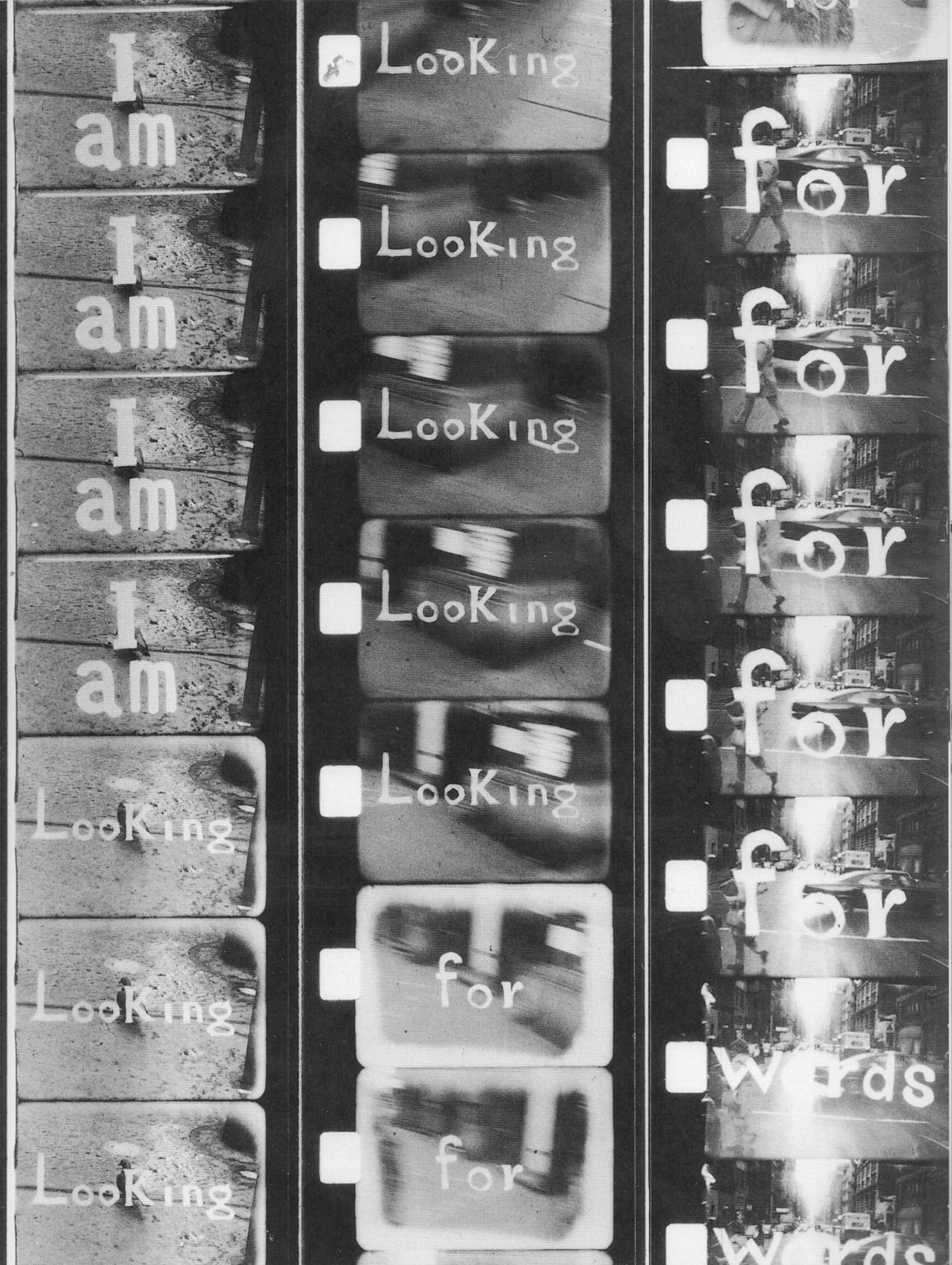
Writing(s)

“Electronic writing will give us a deeper understanding of the instability of texts, of worlds.

Print writing will remind us of our love for the physical, for the sensual world.

Electronic writing shall inspire magic.  Print writing shall inspire magic.  Ways to heal.”

-Carole Maso, Break Every Rule-

How perfect is that?

photo by Robert Frank

Good ol’ Franz

“The variety of views that one may have, say, of an apple: the view of the small boy who has to crane his neck for a glimpse of the apple on the table, and the view of the master of the house who picks up the apple and hands it to a guest.”

-Kafka, Zurau Aphorisms

photo by Viggo Mortensen

Additional Addenda…approaching an end…

Addenda…Creative Languaging

Here I would like to insert some thoughts and observations regarding the import and opportunities of artistic or literary, making-up, collaging, discombobulating, rearranging “ordinary” languaging. If “words are congenitally conceptual,” and I believe they are – that fact alone being one of the fiercest tractions to work through and past in utilizing language as a medium for art – as objects in the world, rather than symbols standing in for (or between or over) objects in the world – then to arrange them or copulate them between languages or existent terms in a language, etc…is a way to bring the word and the activity of languaging toward experience in itself. Being creative with existent languaging systems means often turning accepted uses or meanings back on themselves, undoing “ordinary” uses and definitions in order that the words might be substances of a medium (like paint or clay for plastic arts, the body for dance, shapes and frames and objects for photography, and so on) that then can be its own artifact – its own place of meeting for a community of persons – a field for creating “meaning” in the world.

Ronald Sukenick and kin repeatedly direct us to view novels and poems not as “problems to figure out” but as “experiences to respond to.” Kafka suggested that “language must not be used as a means but must be experienced, suffered.” Given the flexibility and inaccuracies, polysystemic and multivalent capacities and references of existing language systems, to craft new paths of language, tweak or invite new usages provides us with new ranges of possibilities for direct relations. In a way, using language “novelistically” (ever-new) intends and evinces the making of new “speech fellowships” – occasions for overlapping our experiences – in each new reality of speaking, saying, inscribing.

To draw attention to letters and words as things-in-themselves rather than simply signs-referring-to-things-in-themselves, opens up vast territories of potentiality for the meetings and relations of human beings across languaging-systems, cultural contexts, professional or social standings, psychophysiological realities and so on…meeting in the words, the new words, the repurposed words, revised and invented as new objects in the world – artifacts – for us to engage and encounter together.

I would argue that this is precisely what great literature does (and a principal criteria for “greatness” in literature) – serves as a meeting point for the widest range of humans to deepen and expand their engagement with themselves and the world. The “speech fellowship” aspect might help to explain why some persons respond more strongly to particular authors or styles of languaging, but those works which are great, which renew, humans will recognize (given time) from any point of view.

This, I believe, is a challenge to all humans to attend to their languaging – viewing it as an activity much like sex or eating, work or play, that we do, indeed must do, in order to survive, but may also take pleasure and care in – that it might enrich and increase our moments of being alive – and create opportunities for more and more meaning – which occurs when we actualize and accentuate our interrelatedness – the fact of our being.

Well, there’s that…

Reflecto Numero Ocho

Pt. 8: Mean What You Say What You Mean

Meaning, the torture of meaning, is the vain and interminable agreement between what there is,

on the one hand, and ordinary language, on the other – between ‘well-seeing’ and ‘well-saying.’

The agreement is such that it is not even possible to decide if it is commanded by language

or prescribed by being”

-Alain Badiou-

What makes a word is its meaning”

-V. N. Volosinov-

As a general rule – each word when used in a new context is a new word”

-J. R. Firth-

A new meaning is the equivalent of a new word

The real is only the base. But it is the base.”

-Wallace Stevens-

I am supposing that it could be inferred from the previous section that since we are implicitly unable to adequate our total experience in language, and that a direct transference of our experience in and through language is not possible; in other words, that our presentations of our experience in language are inherently ill-seen and ill-said efforts; that dipping into the language palette as a member of the human community equals an action or activity of relating rather than an accurate substantive transaction…

that it might not, in fact, matter what signs or gestures are utilized, but merely participating in the activity itself.

A skeptical view, perhaps, that, if all signs are multiplicitous (like all perceptions) – both overly general and inanely individualized – simply using language accomplishes its meaning, not what language(s) is/are used?

Another way of saying – is it possible to effectively mean something, or to translate substantively, matter, in language…communicating content instead of relations?

Common-sensically writing, we are, when speaking, utilizing billions of units of accrued and generally agreed-upon ranges of “meaning” or indications, directions, references and significations attached to these kernels of sound and expression…”words are congenitally conceptual” (Jerome Klinkowitz).

de Saussure might have signed these palettes as langue – the fund of sign-systems in parlay at any given time among certain social systems of persons – the cultural clime, professional environments, demographical contexts of semiotic webs. But accounting for the psychophysiological uniqueness of individual entities in these systems results in a furthering texture of usages, an explosive ganglia of intentions and purposes and desires for each occasion of a gestural item or practice of signs.

Which leaves all manner of matter of languaging approximate. Every time.

If involvement in languaging at its essence is relational, the primary or ontological “meaning” of the fact of languaging is given: languaging is a human system of engagement and encounter. That means a lot already, as a purposive human activity. Beyond that, we demonstrate a need that that fundamental exhibition of relatedness have experiential-personal-specific trans-actional effect.

This is where each palate or hand operating with the ocean of signs always affects and, at its fullest, effects the language(s) utilized…

I’m tempted to say that the languaging experience, whether that experience is of language itself, or is using language to stand in or refer for some other content (feelings, ideas, messages, objects, etc) is an activity of what we “mean” by “meaning” at its core. If by “meaning” we sign something like an experience or sensation plus the rationality of awareness added to agreement, that is, gesturing some aspect of reality in to a field shared in common, therefore a capacity of understanding, a co-relation of questioning or co-mprehension of experiences, then to constantly increase our apprehension of available sign systems and continually developing our facility of utilizing (organizing, selecting and incorporating) this universe of signs seems critical and imperative.

For the function of languaging in humanity it seems crucial, given its relational reality, that although perhaps “any old sign” will arbitrarily “do,” in the fullness of possibles our closeness to well-seen/well-said satisfaction will be in proportion to each entity’s concern and acquisition of the greatest possible breadth and depth of shared sign-systems, and locating or languaging into what J.R. Firth has called “speech fellowships” – something referring to collections of humans sharing the greatest overlappings of sign-systems and contexts they generate/are generated by.

within speech fellowships a speaker is phonetically and verbally content because when he speaks to one of his fellows he is also speaking to himself. That can be the most deeply satisfying form of self-expression” (J. R. Firth)


“And to meet: in my sense, exceeds the power of feeling, however tender, and of bodily motions, however expert” (Samuel Beckett). This harmony that may occur between happenings and their languagings into a shared system, wrenches each inhabitant of the “speech activity” away from anonymity…provokes “meaning” I believe. As does shared feeling (or an overlap of sensory/sensational happenings among persons) or shared movements and embodiments.

This drives the urge of ill-seeing ill-saying toward better-seeing better-saying, the compulsion to recommence and recommence the attempts…extending/expanding utilization and aptitude of sounds and gestures available and seeking “fellows” with similar or overlapping apprehension of languaging-systems…to co-rrelate and co-rrespond, ask and answer toward…to relate…to “mean…”

Up with the Word(s)…continued (Pt. 7)

Part Seven:

Do we “know” what we’re talking about?

What can we (are we) know(ing) in words?

that we cannot know the essence of language (that we cannot escape language in order to view it cognitively) – know it according to the traditional concept of knowledge defined in terms of

cognition as representation – is not a defect, however, but rather an advantage through which

we are drawn forth in a distinctive realm, that realm where we, who are needed and used

to speak language, dwell as mortals.”

-Martin Heidegger-

the human engagement with language in usage engages us in our mortality; second, our relation

to language, our dwelling as mortals with(in) language, can only be thought from our

linguistic’ usage, that is, from the way we are used and engaged in usage for the speaking

of language…in other words, we must speak the relation in order to begin to think it.”

-Christopher Fynsk-

the ‘relation of relations’ (is now the relation in which language itself unfolds)

thereby our saying remains, as an answering, always relational”

-Martin Heidegger-

So what happens in our palatizing of the palette of language, our utilizing and being-used-by the fund of signs and gestures we appropriate toward communication? Do we “know” what we’re talking (writing, translating) with, through and about? If we can never quite adequate our signs to individual or universal experience, if we line and limn the threshold of entity/not-entity with this matter of language(s), ever seeking to approximate the “all” of our experience into available sounds and gestures that might be sensed and understood, but incompletely, what do we actually result with(in)?

Samuel Beckett has written that the conditions of our experiencing are the “ill-seen, ill-said,” ever striving for the “well-seen, well-said” that would stop it all, silence us, allow us to rest…completely…comprehensibly.

We are limited, finite. Our eyes perceiving always from their particular point of view, their stance in relation to the world, turning, deleting, comparing, choosing, focusing, blurring out, etc…millions of things in order to see anything at all – “ill-seen.” Our languages and vocabularies, grammars and knowledge and palates are also distinct and finite, our experience (no matter how broad or deep) an excruciatingly microscopic fraction of the happenings of the world – “ill-said.”

In seeking to express the happenings specific to us into a world specifically various and multiplicitous incalculably, we encounter an inconceivable expanse, breach, rift between our microcosm and the macrocosms of microcosms that might possibly acknowledge us, share or join with our experiences.

Given all that…for what might we hope? What content, substance, matters might be communicable? Might we “know” anything together? What is the nature of the signs?

Here, Heidegger, Fynsk, Bakhtin, Wittgenstein, Jakobsen, Halliday and their likes redirect us…joyously. They point out that what is being known in languaging are systems of relations – our very connectedness – interconnectedness – in fact, utter mutual dependence, absolute co-dependence with our world and others. In examining HOW language is used, what occurs in the actions of signing and saying, they help us see perhaps further than the apparently impossible struggle or lost battle of adequate communication.

Our own using of language(s) already immerses us in relatedness, whether it is “incommunicable,” “private” (questionable possibilities) systems of marks, movements or sounds, or efforts at comprehensive lucidity to the widest possible audience. To “make language” means as much to be “made by languages,” as an abstract painter whom we find it difficult to “understand” is still using materials and movements theoretically available to all.

In other words, in languaging, we are always already communicating –with even as we strive to communicate. There is always a prior relatedness before we seek to relate. Therefore, every ill-seen, ill-said attempt functions as both a pointing out of the enormous rift between each and all, and as the suturing that cleaves the gap.

Signs are relation, whether “successful” “comprehensible” or not. This is where, again, Derridean deconstructionist mythologizings of differance comes handily into play.

Along the vast scale of gradations of comprehensibility – each understanding, correlation, comprehension, or connection is only possible because it can be apprehended, shared, insofar as it is different, that is knowable, identifiable, recognizable, perceptible.

So whether speaking to ourselves (teasing out our worries, fears, feelings, hopes and so on) or shouting for someone to get out of the way – the miscommunications, disjunctions, incompletions, multipossibles of languaging forge us together via incomprehension.

“Ill seen, ill said” means necessary relatedness…that knowing, communicating, saying, thinking, feeling, doing at all, requires a world and others, a world of others, even to be conceivable, perceptible, possible.

Singing (even signing “poorly”) might be said to be the “relation of relations,” relations exemplar in the very rudimentary awareness that a sign does not exist except as a human utilizes it, nor a human identifiable apart from signs and gestures (even isolated, or “to-oneself”). No self occurs until we make a rift, invent a sign that might refer, imaginatively separate it enough to treat as something capable of being investigated or related to…like all things for the human.

What we “know” languaging…what is experienced languaging, then, is RELATION – an ill-seen ill-said asking and answering toward….
 

To read…to save your lives…

nuggets…

if you squirrel them away and chitter at the meat…

your life can/will be different….

Eugenio Montale, The Poet in Our Time

Aleksandr Hemon ed., Best European Fiction 2012 (the preface by Nicole Krauss & intro by Hemon remind)

H.L. Hix, Spirits Hovering Over the Ashes

I urge…encourage…envision…plead…hope…wonder…

and Part Six….palatable

Part the Sixth: A Palette of Words on Your Palate

Your lips and tongue and oral cavity, in the manner of your fingerprints, pronounce consonants and vowels like no other body. In most cases this is noticeable only to machines and highly trained specialists, but physiologically speaking, your speech has a distinct personality, in the manner of what some would call your psyche or soul.

Your make-up is distinctive, by-and-large very similar to every other human being. This is one of the reasons you are able to understand others – recognize humans, their gestures, expressions, actions and sounds. They partake in voluminous similarities to your own. Still, a far cry from “identically.”

In fact, from one day to the next, even one hour, you yourself are not identical to yourself, body or otherwise. So how do we keep track of who’s who, where, when, etc? We use signs and labels for things and concepts…symbols that can stand for things and adjust to things while they change and flow.


The socio-linguistic faction of semioticians view human consciousness, personality, individuality something like this:

Your physiological composition and arrangement, however similar it may be to other human beings, is still unique. Individuality refers to this aspect: indeed, you are a discreet example/entity of the species.

This plays a very important part in your acquisition or formation/development of personhood. As the other entities immersed in the systems (polysystemic – gender, race, nationality, education, economics, etc.) incorporate you into these systems by means (primarily, or most directly) of more overlapping systems of signs and gestures, your individualized entity adapts these uniquely – fitting yourself into the systems, learning to use existent systems (ideologies) in your particular, but enmeshed way.

This interplay of inner distinctiveness and outer systems of interrelated elements = your flexible and evolving personality.

You are granted, accorded a place in the systems – counted as a person, even as you adapt and acquire roles and behaviors in the systems you engage – becoming a “person.”

The chicken and the egg are synchronic. You can’t have one without the other.

Languages are those threading elements you affect and alter even as they effect and shape you. “Psyche,” “personality” does not exist separately from these systems. In other words, you could not recognize yourself, think, have awareness, in a void or in total isolation (even “isolation” as a word doesn’t make any sense without “others” or “else” to be enabled by – isolated from). You are you by virtue of your physiological uniqueness and capacities immersed in systems of anythings not-you.

Sign-systems, languages, general as they may be, are the medium whereby your personality (formed with those systems) and all that you are not, encounter and engage, take shape, “become” in what we call a “conscious” matter.

Crux? Your palate and brain, organs and anatomy are things (particular objects), your interrelational existence (roles, personality, style, etc.) are not, that is, not extractable realities, but are however you ideology (idea-words) the flow of your individuality and everything else or other-passing-by at all moments.

Fluid, flexible, and always, we chicken-and-egg-and-chicken our “selves” and the “world” linguistically.

Languages our floating, loaded systems of communication (self-to-self, self-to-other, other-to-self) we select from and individualize with each application, while keeping us immersed and enmeshed with itself and its social and organic forming and flow. Palate-to-palette-to-palate it goes…

Your palate, aswim in the world-palette, dabbles in and mixes the palette, further coloring and staining your palate, and so on…or so my palette palatates it…


one is necessary, one is a piece of fatefulness,

one belongs to the whole, one is in the whole”

-Friedrich Nietzsche-

Language and personality partake of both nature and nurture

and are the expression of both”

-J.R. Firth-

A quotey-quote

“Once philosophy was stories, religion was stories, wisdom books were stories, but now that fiction is held to be a form of lying, even by literary sophisticates, we are without persuasive wisdom, religion or philosophy”

Ronald Sukenick

“Everything happens and everything that happens is part of the story and everything that everyone thinks about what happens is part of the story…and isn’t it interesting how in stories everything comes together but to continue…

Wording on…Part 4

Part 4: At the Threshold

Which brings us to:

the look in the eye/I.

Tell me you don’t know this:

you flood – you are filled up with an exceedingly distinct comprehension, you are “in it,” “getting it,” for now, let’s say this is a “profound sensation.”

simultaneously (usually) you are experiencing what seems to be an all-over, thorough-going “impression” (or impressions), this all meeting in what we are calling “profound sensation,”

inner and outer; incoming outgoing; expression impression, these are overwhelming and gravitate to interpretation and communication, expression and recording or description, in signs or series of signs and gestures.

Might be through sound or gesticulation, a color shaped, an action or behavior…these interfusions come out / in all the time, it is what it is to be living, it makes us who and what we are, the world and ourselves, to the world and to ourselves.


Words are the signs that conceivably might carry the largest amounts of this sensation…could they be found, or adequately arranged. It would incarnate this experience – give it body and form and objective factual existence among I and not-I.

Animals shriek, bark, run, tussle, shiver, bite, rise up, lay low, paint, scratch, gesture and so forth…but human animals have this additional matter – concept-conveyors and description-declaimers – able to stand in solidly, as beings, for gestures, sounds, colors, actions, emotions, events, and so on…separately. Words.

Outside rushing in and through, inside processing around and out, the threshold filled with signs like skin…thoughts, perceptions, emotions, sensations, commands, refusals, representations, questions…apparently everything that can happen in this mutual conditioning of person and world can be lexically signed.

The threshold double-passageways of terms.

Promising…exciting….intelligible….and yet?

Would you not agree that the moments the word-beings actually seem identical to the enmeshed flow are extremely rare?

You see her, or have seen her so long, you gaze, smell, listen, observe. You touch her, you are touched by, you taste her, this intimate between…you must convince her, exclaim to her what goes on in this…

you stammer or embellish, metaphor or moan, sing, laugh, cliché…

but it does not come out “right.” The arguments are unjust to the message intended. The emotions pour out through the sieve of the letters as you say them…uncontained, unconveyed, “at a loss.”

Or you read Heidegger or Pessoa, Blanchot or Lorca, you are moved and all the lights come out as in Spring, the sense of their words courses through you like brandy…you call your friend, you begin to sputter, attempting translation, your words sound foreign, unconvincing, unclear and inane…it is impossible to paraphrase – “unintelligible and untranslatable but not incomprehensible” after all, you “got it,” you’re suffused with “it” – the comprehension, reciprocation, “profound sensation” of the mutual conditioning of self and words/world…isn’t this what words are for? And yet…

This is the threshold of creative language. For speaker/writer “new layers of reality and insight have opened up” – language is required to factualize, birth this presence…but all the language you know seems unable…

Which brings us to:

the look in the eye/I

Tell me you don’t know this…

N Filbert 2012