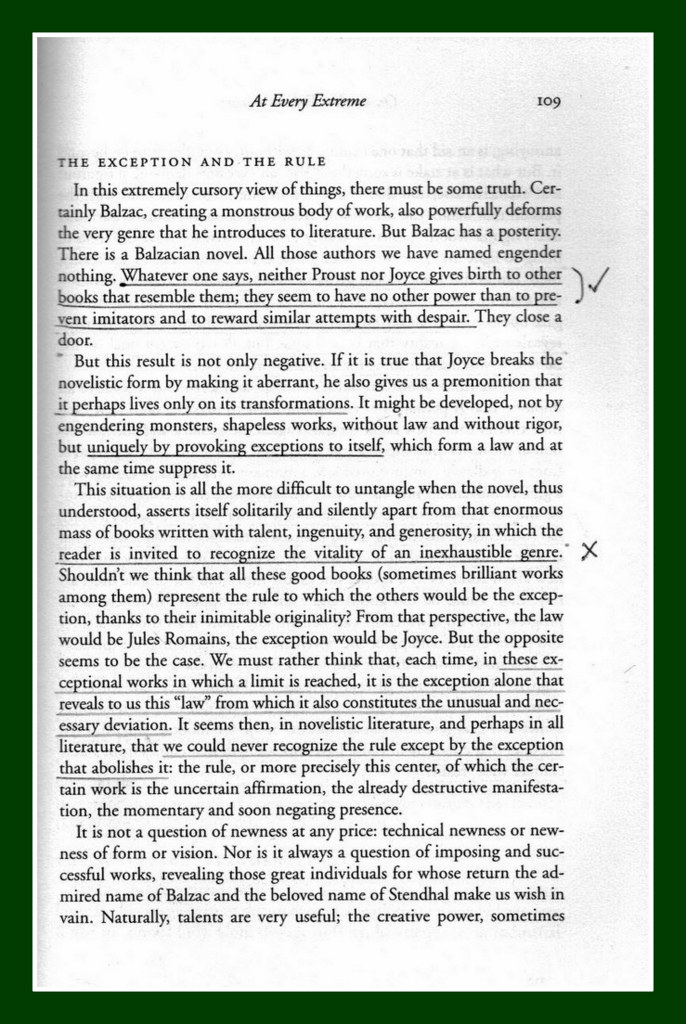
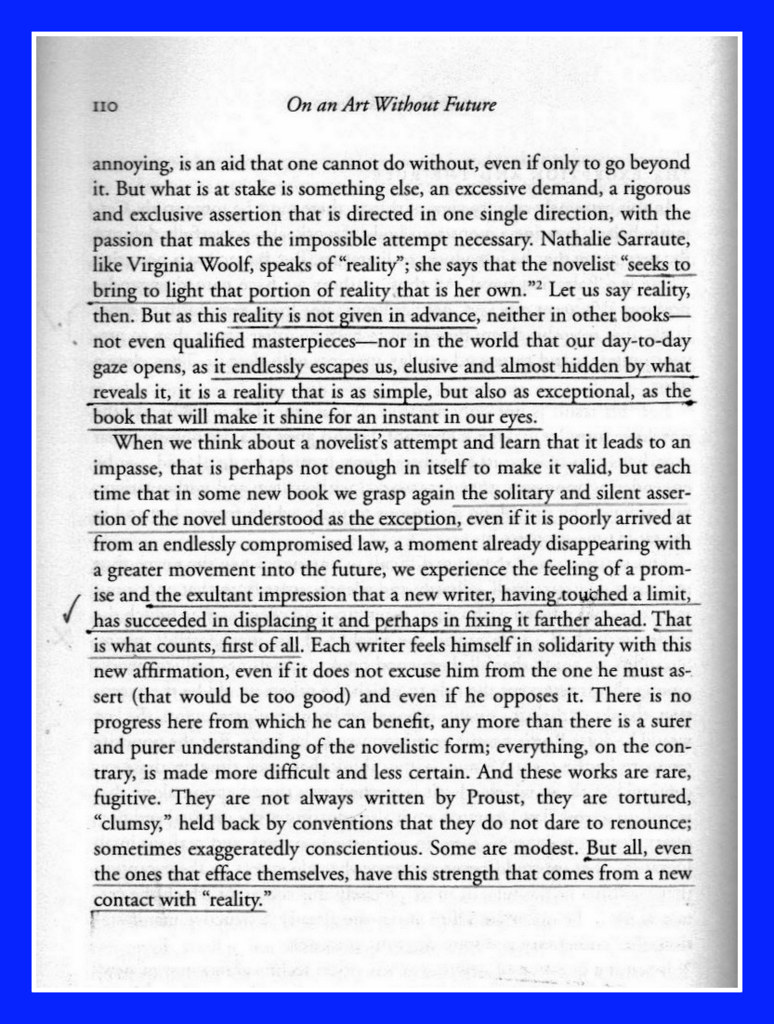

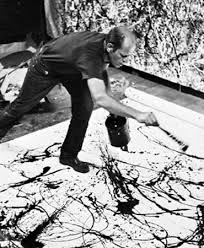
What I was composing the other day in my head, or wherever daydreaming occurs: filling up that gap between inside or outside, idea and actual, etcetera. They told me not to worry about losing it – that it would return, re-emerge. I lost it. The idea, sensation, form, content – everything. Well, not everything, exactly, I guess, because how could I conjure that there was something, some experience, some initiative or other, had I truthfully lost it? Okay, maybe they’re right, and “everything” is a question of access.
In any case, well, no – in present case or tense or whatever now-situation might be (“Weather”? – see Roland Barthes, The Preparation of the Novel, or Tim Ingold’s essay in Vital Beauty) I am not experiencing “access” to something some part or parts of me (some connectivities) believe or invent a past tense for – a disjunction/abstraction/detachment from. A difference.
I am believing that I felt differently about something at some other time, that language was forming out of me relating to that affect, and that I had the potential capacity to express all that semiotically – or, in a way that it might make sense, be shared, exist.
Now I’m languaging nothing. Or, not exactly nothing, more like a different something that in fact is the semiosis of another inexpressible or inaccessible possible something. Which means, potentially, anyone could find it, discover/uncover/invent/compose/co-construct (co- probably redundant to con- but then I’m not Russian, at least not currently) that initiative and perhaps I’d re-cognize or re-member whatever realigned threads rewove into this particular weaving (what is “now”).
Etcetera. This is how it goes down for me (current context taken mostly for granted).
“The novelistic ‘drive’ (the love of the material) is not directed toward my past. It’s not that I don’t like my past; it’s rather that I don’t like the past (perhaps because it rends the heart), and my resistance takes the form of the mist i spoke of – a kind of general resistance to rehearsing, to narrating what will never happen again (the dreaming, the cruising, the life of the past). The affective link is with the present, my present, in its affective, relational, intellectual dimensions = the material I’m hoping for (cf. ‘to depict whom I love’).”
Please read previous post with this in mind:

Please share via comment what encounters or engagements with works of art, science, philosophy, writing, music, and any other cultural artifactual form has altered from then on how you select, evaluate, engage other related artifacts from then on?

“One of the wonderful things about word processors is they transform all composition into continuous process. You can rearrange, rewrite, tinker, copy, cut, paste, open separate files for separate chapters or story sections or poem fragments, a window for notes, another for your outline, and still another for your list of characters and their attributes, and have them all on your screen simultaneously so you can flip among them as necessary while your web browser provides you with a dictionary, a thesaurus, a Wikipedia page, a website to aid you checking this fact or that…
(The less than wonderful thing about word processors is they make every draft look like a final draft, sloppy writing look as polished as just-published. Careful about being duped by the sheen, and don’t disregard the notion of trying to compose on a lined tablet unless you’ve already tried it and found it lacking; it is a method that both slows perception and increases conscientiousness).”
-Lance Olsen-
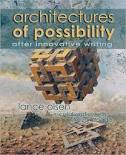
for Friday Fictioneers – 21 June 2013

As long as nobody moves. Scenario accomplished. Sky filled with blues. Reflected in waters, reassembled by lines – manufactured / emergent. The breath would come. Optionally. A reality could be structured with less than this. Hold still. In the beginning – world. Populous, variegated, intricate with potential. A setting of pebbles and mimes. Activities at the ready. Engine set to whirl. As long as nobody moves. Nobody says. Nobody breathes. Still-pointed swirl. Anticipation. The drawing of the sneeze. A trickling toward itch. Hummingbird-eyelid. A sudden rush of wind. Transgress.
via J.M.G. Le Clezio


A providential addendum!
Lispector…
The journey one takes toward Clarice Lispector has a great deal to do with the way she is read. I came to her through Helene Cixous, and therefore she (CL) has become inseparable from me, as I experiment with my reading of her, paying almost as much attention to my internal carry-on-chorus that wobbles along side my conscious movement from word to word in the linear structure. Clarice Lispector exists for me outside the text, using the context defined “inner world” to stretch out and beyond into the borderless “outer world”. It is her ability to create this (anti)structure that separates her work from “stream of consciousness” or circular topic based narratives. I read a lot of experimental fiction that tires to appear deliberate when marrying avant-garde techniques such as experiments with grammar, reflexive thinking/acting and searching for the space between the words, but hers is the only writing I…
View original post 1,005 more words
a pretty obvious take, but in the midst of a nearly impossible week,
it’s what i could do…Friday Fictioneers 6-14-2013

The obvious one. Anyone could tell. The way he bobbed his head in traffic or nodded slowly in the wind, syncopating steps with the train rails’ click-clack, fingers never still at the table – proverbially whistling as he worked. Even his breath had a cadence – nary emitting verbal lines without their shaping tones. Foot bevel harmonizing crossed-legged knee bounce – friends said “he always had it in him.” Phrasing his rises and his falls. Ears ever plugged wide open – he tasted and he touched, he heard, saw and smelled the world as sound. He really was into music.
Student Magazine of IISER Mohali
Music, Musicology, and related Matters
a photographic pilgrimage to Orthodox Christian monasteries across the continent
Meandering Through a Literary Life
Orthodox Christianity, Culture and Religion, Making the Journey of Faith
Erik Kwakkel blogging about medieval manuscripts
"That's the big what happened."
Networking the complexity community since 1999

 All my Words are Silent