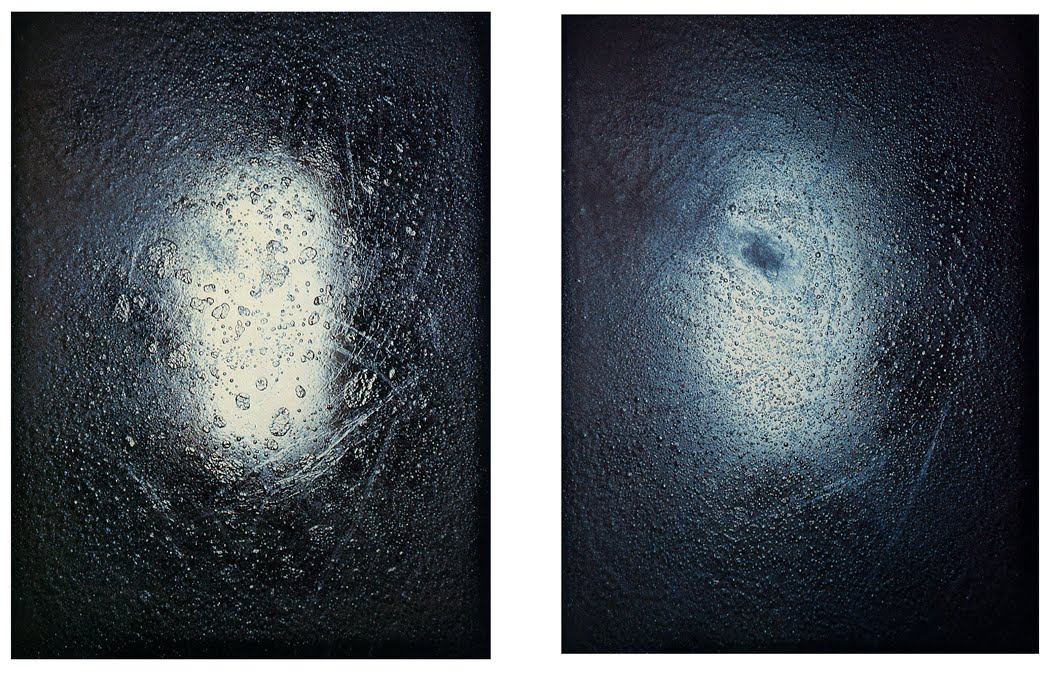
Sentence Strokes

About running small.  Over a surface made of paint.  Exhilerating lostness.  It is then I know texture.  Arms draped over a streaking swell.  Scritches and scumbles underfoot.  Are there this many colors in the sea?  Splattering like sparrows.  Am I getting the picture?  I lie down.  Cairns and edgings against my back.  What seemed soft – crisp and poky as briars.  What looked hard and smooth gives like dried glue.  I scurry in the trenches left by brush.  Spin through dips and curls.  A painting is a planet I inhabit.  Directed through the paths of subtlest vein.  To explore I engage.  Guard asks that I step away.

N Filbert

What Happens (with a semblance of truth): A True Story (that is never true)

Many things might have happened, indeed, could have happened.  It is impossible to tell until it happens.  Whatever happens.  And so it goes.

Recollection subjects what happens to interpretation, a puzzling assemblage of memory (embodied brains in changing circumstances) and occurrences (embodied brains in specific situations), making it impossible to tell what happens, when it happens, or after it happened, save from a very particularized attention and intention, point-of-view, disposition and enmeshment (the factors being relatively endless).

And so we call histories, scientific observations, statistical reports, etc. al., “stories;” journalism, research, theories or assays (essays), “fictions;” and personal memoirs, dialogue, descriptions or statements – “fantasy.”

Everything that happens or happened is what might have happened.

Let’s theorize that an author or reader, group or individual, has a concern for “truth” – something being what it seems to be – who or what has total and essential access?  The only truth in human expression that I can surmise is that it is truly “made up.”

An individual may have something approximating total and essential access to a thought or feeling, personal experience or idea, but insofar as it actually occurred according to an experiencer, there are already multiple points of view, ranging from molecular to cosmic, matter/energy to cultural.  To say nothing of the complicating fabrics incumbent on expression – whether a grimace or a novel, a shriek of pain or a tally mark on a chart – it has entered uncertain and collaborative interpreted ground.

All to say “experience” is utterly specific and solipsistic (non-transferable “truly”) and is an enabled product of embedded participation in significant (if identifiable as an “event” or “occasion,” “moment” or “intuition” – any feeling, sensation or awareness) surroundings, expanding niches of existing things with variant points of view.

This is how I can guarantee that nothing I show you or tell you is “true.”

It may be more or less accurate to my experience or understanding of it (depending also on your experience/understanding of my presentation of it) but it will in no wise be what it is or was, in truth.  I assume truth to be as impossible as god.  It would require omnipresence, omniscience, boundary less experience (which could not accord with our experience, or a grain of sand, or an ocean) and would be immediately foiled by the omni-ability (omnipotence?) those other necessary qualities would demand.  One could not be absolutely enmeshed or identical-with and entirely and completely objectively separate or alien-from at once.  At always.  That is not a paradox but a contradiction.  If imaginable, incommunicable.

So we speak of a “semblance of truth” or a “truth-seeming” quality to account for our realities and desires (our want for security, to grow order in chaos, to know, to choose or act with less fear or uncertainty).  Things like our ages, census reports, laws and principles (grammar, mathematics, semantics, processes and methods, etc.) a creepage over toward what we think of as “facts” – majority-mutually-agreed-upon-interpretations/perceptions/hypotheses.  These can hold for a long time because they’re held by so many, so widely.  But they most assuredly change over time, again, from atomic behaviors to the shape of the earth and its relation to elsewhere, from what constitutes pain to what gets moniker’d “god.”

What counts as fact does so by being open and shared.  Semblance of truth comes by corroboration, conversation and multiplying points-of-views and expressions of experience.

Perhaps this is one reason we blog.  To try “it” out on everyone, potentially.  If our expressions resonate with others, perhaps they have a semblance of truth, or contribute toward creating it.  Enough “I know, right?’s” and we’re on our way to a fact.  But no amount of data or language, materials or activity makes it so…it rests on agreement and compromise, observation and interaction shared most widely, coagulations of interpretations, accretions of experiencing – fabrication.

Make then, express.  Hypothesize and share your experience – we ask for your two-cents worth – we’re accumulating a fund.
final light-writing this week 🙂

Alias Harlequin's avatarGypsy Wall

closing out the week with these…the crew seems familial to me…working the light


View original post

Writing Whys Wherefores


I notice that there has been a recent spate (probably not all that) of authors of blogs I follow and enjoy, reflecting on why it is that they write, and what they think they might be doing by writing…in the current upheaval of things I needed to make some additions to my “About” page and provide a brief bio for another project and in that process stumbled across an earlier writing of mine that seemed to accord or converse with you other creators, so I’m reposting it here in case it adds anything…

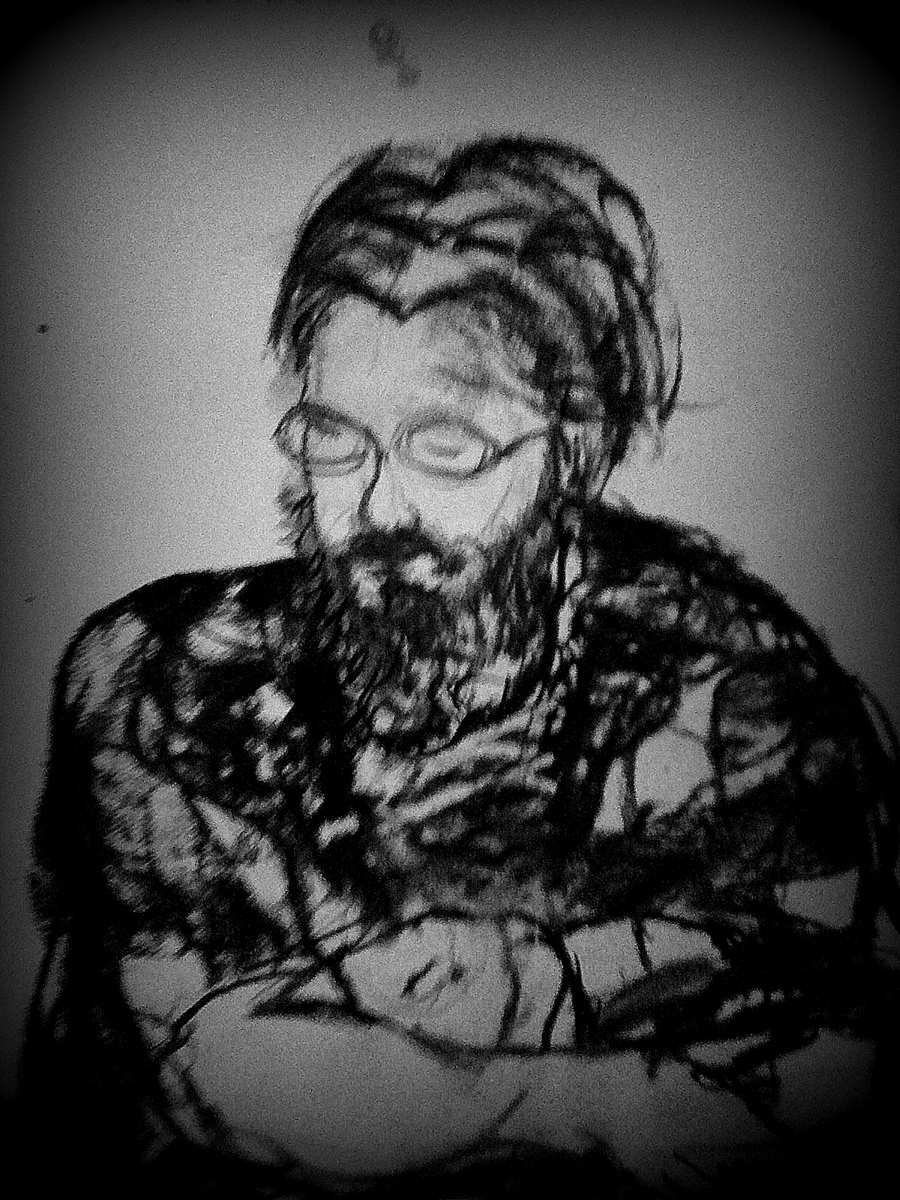
Quick sketch of me by Holly Suzanne

Living is a kind of madness (a prose text)

in reference to

Christian Mihai

Brainsnorts

Boy with a Hat

Adventures in American Writing

and others, thanks!

now i’m finding artists “associated..”

Alias Harlequin's avatarGypsy Wall

View original post

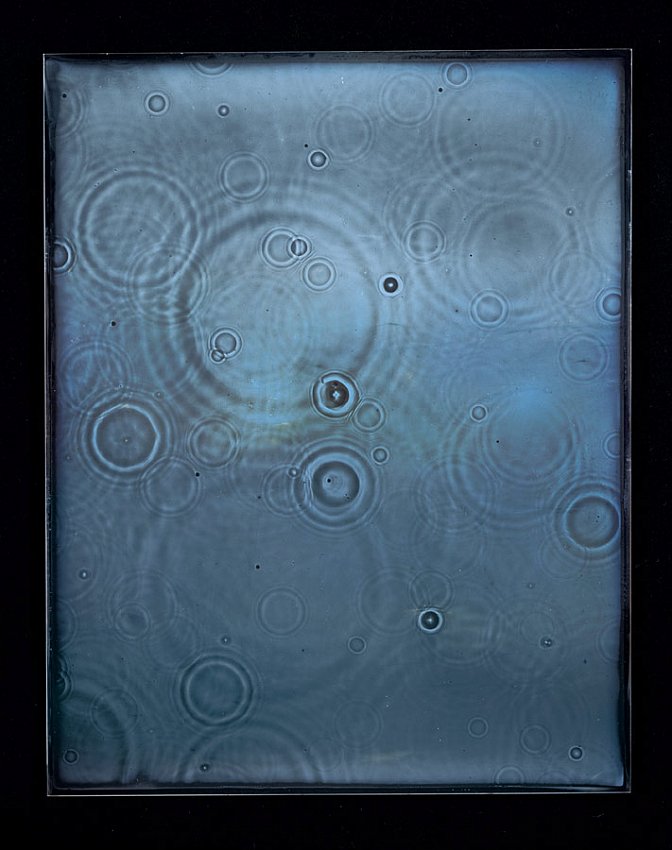
more Nelson-Atkins works that caught our eyes…Gary Fabian Miller – and truly “light-writing”

Alias Harlequin's avatarGypsy Wall

View original post

taken by her work after this weekend’s visit to the Nelson-Atkins Museum of Art in Kansas City

Alias Harlequin's avatarGypsy Wall

View original post

To Advance

This week’s feeblish attempt at Friday Fictioneers 100-word stories…

It was never difficult to see the way, it’s the getting there that problems.  The paths unique to our movements.  We tend to think it’s the setting out – that getting going  presents the obstacle – but we’re always going somewhere.  The millions of streets and alleys, those are what throw us, what keep us from the end.  How do we know, in constant diversion?  Oh I see a way, but not the destination.  I’ll move as I see fit.  As will you.

Consider, then choose.  But always keep moving.  There’s no other way.  Keep your eye on the opening.

N Filbert 2012

Nothing, In General

In which case, he writes, for life.  As if asked about nothing, in general.  There never has to be a reason, what is called illusion or delusion, he can’t remember which.  He is at a loss, that much he knows, unsure if “at” is place or time, so often hand in hand.

Writing.

He could just as well be painting, singing, creating some other cultural artifact, and all offered up in an aether, but he’s not.  He writes, for life, in this case, as if in general, about nothing.  Which is everything also, for him – writing, at a loss – the nowhere now here is.

The words, like images, serve.  Serve to draw out and reflect.  Like actions or encounters, self-portraits or redundancies.  In other words, those would be.  In writing he extends his veins and neural works, outstrips his body into text – an alchemy of sorts – and then relates to them as if an other, at a loss, in what he sees, or reads, as the case may be, words as much an image when inscribed.

Which are now here, which were not, because he’s writing.  Which, in fact, he does, at a loss –  moments so much like chaos, say “entropy” – for the offering of something indicative, external, outside – as if verifying a place and a time, i.e. organizing a disorder, finding a nowhere.

Similar to nothing, in general, become something, in particular.  Like an idea, or an atom, an interpreted emotion, or a god.  Each action a creation like an assortment of patterns on chaos.  Like nothing in general, or everything in particular.

At which point, in which case, he writes.

N Filbert 2012

Singing in the Rain

“No bird has the heart to sing in a thicket of questions”

-Rene Char-

There was something tragic in fighting the borders, the heroism of shortcomings, the panic of passion”

-Bruno Schulz via Jonathan Safran Foer-


            It may be raining, very gently, while whispering its verdant perfume, just behind me, just outside my open window.  If it’s not, I’m pretending it is, and the world is agreeable.

I’ve been reading an older essay by Susan Sontag entitled “The Aesthetics of Silence,” an article from which I feel a chiding exposure of invented artistic double binds, a renewed challenge for integration and expression (the ways rain shares), and primarily the pleasure of yet another perspective.

Like “the heroism of shortcomings” from Bruno Schulz as carved out of pages by Jonathan Safran Foer in The Tree of Codes – the powers of self-negation and its failure in the likes of Kafka and Kleist, Jabes and Joubert, Artaud and Rimbaud, Blanchot and Beckett and so on.  Those great unsilent successes of botched commitments to silence.

As emptiness might only occur in a context of fullness.


Being so glad that I am writing this by hand, as I do with every document I create, usually quite uncertain of what is inside each letter until the systems of nervous muscles begin to work.  The quotes above, for instance, copied from handwritten notecards copied from marginal notes and underlines copied from the midst of other authors reworked texts, and then copied again here with the proviso that perhaps in forming it yet another time, by hand, something missed before gains another change to arise.

I am thankful that writing is quiet.

Although I used to use the typewriter’s beat to edit my lines of poetry.

And I’m sure the background music, passing cars, and sounds of squirrels and wind and children all have their effect.


I also appreciate seeing the whole page, battling mood-related or arthritically scribble script versus partial views on-screen and standardized formations of fonts.  I enjoy those bloggers who scan their manuscripts and writings but don’t trust your powers of vision compared to the particular words I end up selecting by the time I reach the machine.  No need to add difficulty to difficulty, in this case.

Still, you’d probably know something more (or at least differently) were you opening up an envelope gathered from your mailbox with this folded up inside.


Like silence or a thicket of questions, rain or a grumbling stomach, everything comes round to context.  Persons embodied, embedded in an active variable surround expressing through media, tools, machines, to wherever, whomever, however you are reading, deciphering, translating, decoding, interpreting, creating yet again in another contextual universe of another time.


Such a dynamic endeavor.  Our artifacts, messages, calls and displays.

Panicked passion, tragic fighting of borders, heroic shortcomings these.  Aesthetics of silence.  All.

With hearts to sing in our questioning thickets.


Sing.