Intimacy as Art

Intimacy as Art

“A way of connecting, on relatively safe middle ground, with another human being”

“that ‘neutral middle ground on which to make a deep connection with another human being’… was what fiction was for.  ‘A way out of loneliness’…”

Jonathan Franzen, on David Foster Wallace

“If the novel were able ‘to give the reader, who like all of us is sort of marooned in her own skull, to give her imaginative access to other selves,’ it opens the potential that she might, as a result, feel ‘less alone inside’”

Kathleen Fitzpatrick, on David Foster Wallace

My son and I arguing about the nature of things – is there anything we can agree on?  mutually believe?  are we similar? – in what began as an attempt (on my part) to soothe obvious hurt and confusion (on his part).  He kept pointing to (referencing) his mirror, his bedside table, in an effort at agreement, at a meeting-point that might be solid, be reliable, be “correct,” or “true.”  Some relatively stable collection of roving and vibrating molecules we might sharingly recognize, might hold, attend, or unite around – together.

Throughout my life I’ve attempted to comprehend – to make a symbol for myself –  what works of art, particular pieces of music, specific phrases or pages of literature, momentary glimpses of nature, dollops of emotional experience DO.  How they work.  Why they “feel” – move us, take an occasional effect we might call “profound.”  Why, even if they shatter us, cause us to weep, provoke in us the enormous courage required to change, we also somehow still feel safe, often empowered, somewhere beyond “okay” (ecstatic? – out of ourselves?)?

Although often evoking experiences I’d describe as most completely, totalizingly personal, I always felt their effectiveness, their possibilities of success and individuated power, came precisely because they were not (personal).  That what intimacy they provided – what outlet or spillage, what expression they represented or evinced – was contextually impersonal, through matter and energy uniquely organized, mediated.

In other words, we could throw all of ourselves into, at, toward or away from them (works of art, formal arrangements of world) without the danger or threat, anxiety or fear, of influence.  We wouldn’t hurt, harm, embarrass, shame, offend or be misunderstood by a cornflower, a collective of strokes of paint, a recording of sound waves, moving molecules.  No direct hits of miscommunication, misinterpretation.  Perfect, variable, flexible presentations of world, of other, that we might release ourselves in relation to, without fear.

Existent things, moments, that genuinely represent otherness from ourselves but without direct exposure, without a being’s inquiry, possible scrutiny, judgment or evaluation.  Interpretation.  Many-sided, borrowed perhaps, but mediated via only one person – me.  I could not fail, fall short, be inadequate to, or otherwise  mess up a novel, poem, composition or film, and if I experienced myself as any of those things – it was my own judgment, assessment.  Mediated.

After years of such exposure, why do I still choose sides, entrench myself in arguments of logic, when I mean to comfort, soften and heal?  Alone, later, I sat and asked myself over and over – IF I have changed, grown, matured in any fashion in my 42 years of life, IF I have learned anything to the point of conscious belief, what might it be? – what  might I say that I know?

I don’t know.

What I scribbled into the margin of my journal was simply that my fundamental belief about the world and life in it was that – at the core of things – “Everything is essentially messy.”  By which I (at least partially) meant (intended) was incomplete, mobile and complex.

Nothing “fixed.”  Staid, finished, whole.

Throughout years of journaling, as I’ve grown to understand how deeply I desire “intimacy” (which I suppose I would describe as “shared personhood” or “met experience”?  Co-events?) I have repeatedly diagramed what seems to me an only possible means between humans:
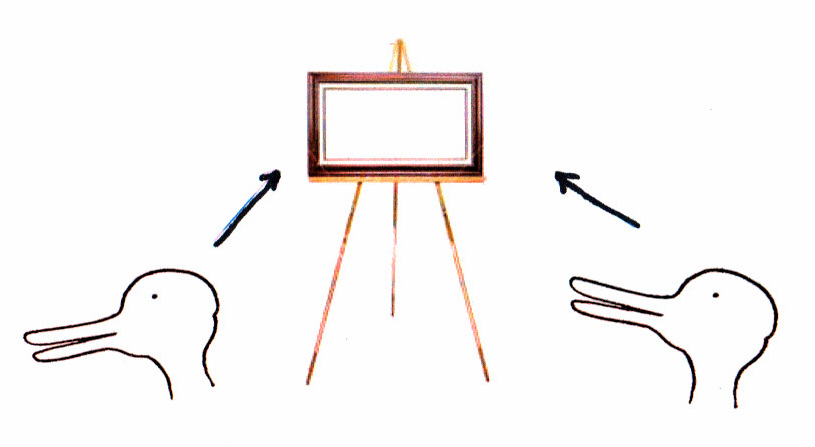
             Using Wittgenstein’s duck-rabbits to represent whatever we happen to perceive ourselves as, and “Art” on an easel representing anything as a mediated format outside of our “selves” (themselves, I surmise, also likely a constructed medium for experiencing world), to or in which multiple human persons might invest all they experience themselves to be, without necessary personal organism-survival fears, and, possibly, perhaps, occasionally MEET via that medium in toto (or as nearly as possible): experience intimacy, mutuality.  No longer isolated as a being, alone, but finding a common, a sharing-realm, co-perceiving, co-experiencing.

If it be so, that, in fact, as human organisms, all of our entity-type experience is, truly, mediated – through various organizations of mobile and voluble matter and energy – never identifiable as a stasis or final form, if we might begin to see it (us) as such – might we become able to experience direct, person-to-person (experientially) intimacy?  Co-being?  This is where I have turned effort (driven by desire) with my wife, my children.  What if we became safe mediums for one another to experience through?

That would be another entry altogether.
David Foster Wallace – “both a quantum of information AND a vector of meaning”

ah how I relish in his mind and language…

Deciderization 2007 – A Special Report

from

Masterful Hejinian on Language

“Language discovers what one might know, which in turn is always less than what language might say.  

We encounter some limitations of this relationship early, as children.  Anything with limits can be imagined (correctly or incorrectly) as an object, by analogy with other objects – balls and rivers.  Children objectify language when they render it their plaything, in jokes, puns, and riddles, or in glossolaliac chants and rhymes.  

They discover the words are not equal to the world, that a blur of displacement, a type of parallax, exists in the relation between things (events, ideas, objects) and the words for them – a displacement producing a gap.

Because we have language we find ourselves in a special and peculiar relationship to the objects, events, and situations which constitute what we imagine of the world.

Language generates its own characteristics in the human psychological and spiritual conditions.

Indeed, it nearly is our psychological condition.

This psychology is generated by the struggle between language and that which it claims to depict or express, by our overwhelming experience of the vastness and uncertainty of the world, and by what often seems to be the inadequacy of the imagination that longs to know it – 

Language is one of the principal forms our curiosity takes.

It makes us restless.

As Francis Ponge puts it, ‘Man is a curious body whose center of gravity is not in himself.’

Instead that center of gravity seems to be located in language, by virtue of which we negotiate our mentalities and the world; off-balance, heavy at the mouth, we are pulled forward.

Language itself is never in a state of rest.

Its syntax can be as complex as thought.  And the experience of using it, which includes the experience of understanding it, either as speech or as writing, is inevitably active – both intellectually and emotionally.

The ‘rage to know’ is one expression of the restlessness engendered by language.  ‘As long as man keeps hearing words / He’s sure that there’s a meaning somewhere,’ as Mephistopheles points out in Goethe’s Faust…”

Lyn HejinianThe Language of Inquiry

Preserving Blogs, ebooks, interactive and hypertext files….lots being done here!

http://eliterature.org/pad/afb.html

Writing it out : writing in

Into (and out of) the labyrinth of language

“there can be no fully articulated thought without symbolic embodiment…

language is the very stuff of which ‘ideas’ are made…

to separate thought from its symbolic manifestation would be as futile

as to try separating a mind from its embodiment in a human organism”

-Max Black, The Labyrinth of Language

“words are part of action and they are equivalents to actions”

-Bronislaw Malinowski-

            Sometimes silenced.  Pressured in channels.  A void creates a vacuum.  Fettered speech – often necessary but variant to “open” or “expressive” on a relative continuum.  To a purpose.  Carrying a message.  Responsive.  Reducing uncertainty.  Extrinsic.  Sometimes.

As if a balance of scales.  A fluid diagram – flow chart.  Internal at the individual end, external at the communicative social.  Between are many pages, many possible sounds.

If days go by.  When days go by.  After days without a feeling of spillage, a “seems” – the experience, for this writer, of unexpurgated, unconventional intrinsic release – that is, writer’s personal experience (a complexity of interactions – organism with environment and others) there ensues a kind of illness, like constipation, like perpetrated violence or censorship, like oppression – that, unless a leakage is allowed, some systemic crack, a private valve – writer risks implosion.  (Say – depression, frustration, resentment, anger).  Holding a forest beast under the lake.

Slipping out and away, writer beast finds a crevice or hollow, cavern or plain in which, from whence, he or she can reduce uncertainty, verbalizing observations and ideas.  As if life is the laboratory that would go unmarked and unnoticed without jotting tallies on a page.

Writing it out – writing in – a labyrinth.

Taking up the ball-point pen, dragging it along the surface of clean paper, is like turning the tap.

Hiss and sputter – tubes finding matter or substance, inciting energy – then flow.


I write about heaven and hell, the monsters here to there.  Of inscribing itself, the requirements of entity and imagined self or other.  The many, the few, and the plants and the beasts.  What air.  In the woods and the desert, the mind.  The heart with its loves and its rage.  Perpetual fears and the virus of mayhem.  I write about her and the children, of friendships and evil and time.  About death, about life, about learning.  In senses, in theories, in words.

It’s not difficult, I’ve just done it.  And you have provided the meaning, already.  Each term stimulating your “abouts,” descriptions and definitions, the semantics.  I craft words your eyes and ears compose commentaries to.  Little point to my telling.

Yet some of you read differently, perhaps listening.  Maybe wonder the about.  How it comes to be, what is signified for me, and why just so?


Creates conversation.  Your doctor can doll out the pills you receive and absorb, internalizing into your existent system.  Your god may tell you what you should do.  Your boss indicates how you should do it and when, friends and family surround you to be.

Not I.  I don’t want it to work quite like that.  I am spinning no story for you to follow along, no pattern upheld to your measure.  Writing it out in the labyrinth of language, I mean for exchange, for a wander – we enter, we leave the deposits we find, discover and fashion with so many hands, so many eyes, ubiquitous ears.

Write it out writing in, in the reading together, again, wending our way trading secrets and gems, co-constructing meanings and moods all to the tunes of language.


I step out of the water and dry.

The Labyrinth of Language
by Max Black

N Filbert 2012

This has been one of those weeks…children home sick from school, an art show to hang (see here!), school studies, and all the sundries of necessity leaving very little time for nourishing reading and composition.  Needed to set aside some time beginning this day.

Reminded of things…

arbitrary views of aging posts on my site somehow meandered me into this…

and I like it!

Ronald Sukenick

http://bweal474.files.wordpress.com/2011/02/postmodern-fiction-paper-21.pdf

(I still can’t find that masterful essay “The New Tradition in Fiction” by him I so want to share with all of you)

you can find it in here!

I’m Learning

Within the architecture of participation, she asked for plausible promise.  More is different, she said.  I was learning a new society.  Worlds become foreign in very small missteps.  I am learning.

It’s never one-to-one.  Each encounter multiplies complexity.  Even the same.  Identity remains to be found.  Only hints and surmisings.

In that look I believed I had found you.  I suppose I did, and so many, pronouns always plural.

We disparage our language its labyrinths.  Drowning in oceans of context.  Each arriving a  slipping away.

How else might it be true?

“Language discovers what one might know, which in turn is always less than what language might say.”

– Lyn Hejinian –

*phrases lifted from Clay Shirky’s Here Comes Everybody

Question: What Makes a Masterpiece?

“A masterpiece isn’t a masterpiece until it is well known and has absorbed all the interpretations to which it has given rise, which in turn make it what it is.  An unknown masterpiece hasn’t had enough readers, or readings, or interpretations…A work of art isn’t created a masterpiece, it becomes one…the authority, the familiarity and the relevance of a great work of literature: we open it, and it speaks to us of ourselves…naturally every reading affects the book, in the same way as the events we experience effect us…”

Umberto Eco & Jean-Claude Carriere, This is Not the End of the Book

Your thoughts…?  Any “unknown” masterpieces possible?

Outside This Window

I struggled this week, this picture, and the myriad of life going on…couldn’t seem to find a spark.  But in the spirit of Friday Fictioneers, felt I oughta make a go of it.  So here it is – and in accord, many thanks to Rochelle Wisoff-Fields for taking up the inspirational, curatorial mantle of keeping our practice alive!

Stomps back, livid grimaced flesh flushed, shouts, more of a gritty scrape of screed: “you never…anyway…I don’t know why I ever…” huffs, seethes, jolting in a kind of place.

Unseen, steely, weight of concrete in its rage, him, silent, back there, unmoving.  Something trembles.

Wind too, perhaps occasions of rain, drizzle, precipitation seems likely, somewhere, here, somehow.

She keeps it going, it’s like a flood, like a multi-chambered dart gun, can’t seem to stop, doesn’t want to end.  Not silence.  Not distance.  Disregarding.

Something recedes, perhaps him.  Substances exiting every direction.  All wearing out.

Everything outside this window.

N Filbert 2012

Holly Suzanne and the Layering of Experience

It is my great pleasure to be composing something for myself regarding my wife’s art in regards to an upcoming showing of hers in Wichita KS (see below for details).  I am accustomed to engaging her work with an ekphrastic/participatory sensibility and interaction rather than an observer’s point of view.  The pieces below are mixed media encaustic works by Holly Suzanne on 6×6 or 8×8 wood boards.

This slideshow requires JavaScript.

“First my…forever my…grown in a…garden” of hands, words, expressions, visages and image.

The mind in bloom, the mouth as fruit, our world in our hands, are nothing new.

Underlying love vaguely aware of an end from the stars of night to ground of flesh,

in layers.

I was thinking of text-emotion-change-emotion-text-emotion-change.  Of over and again.  Begin.

With rarely the perspective to see in, or through, as we are forming and tattering layers simultaneously.  Always.

There is something viscous about us, like warm wax.

“Turning away…she saw herself…”  But not really.  Recollection rearranges, perception also blinds.  Assemblers and dissemblers we.  Our stories.  Growing them even as we prune.  Story over story, backwards, forwards, like the strokes of a brush, the trembling of hands, motions of a body at rest.  What comes out, in, or through depends on the moment.  Each story a backstory with a curious future.

“First my…forever my…” ever-altering “garden,” the world in my hands behind my face.  I tinker and trouble, collage and create, rationally embodied in emotion.  What shields and separates reveals and connects: our skin, our language(s), our sighs.

Even our  names are malleable, oily pools.

Look at, look in, look through.  And over again.

Begin.

If near Wichita…you can look for yourself!!:

Holly Suzanne Show: Mead’s Corner Coffee House
October 31-November 30, 2012

see more of Holly’s works here: Holly Suzanne: A Gallery of Creative Artistry

Holly Suzanne Fine Art

and visit her blog! Lifeinrelationtoart

Related: Show Announcement – Mead’s Corner (Combinatory Art in Motion)