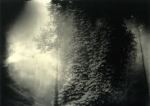
Wisconsin

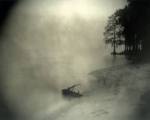
(this piece is derived from and to be read in the accomaniment of Bon Iver’s “Holocene” song + video)

Wisconsin

            My fingers felt the indents.  I knew I was alone.  Had been left, alone.  Had left myself, alone.  A jagged vacancy, thick without “us,” and filled with pounds.  Each weighty page struck and branded, burned with this black blood of ancestors.  I could feel them, gentle as I turned each page, hard and sharp in each dark divet.

I smelled it.  Them.  I deciphered their messages, long ago and near.  From ages, this age.  I smelled it.  I looked out.  I heard these smells, ironed leaden letters smacking, tracking, leaving.  Open sky, soaring bird, jagged peaks, thick with ice.  Each ominous digit of tongues, hammered black to brown to rusted and yellowing green, bantering about the walls of my emptying skull.  The lost decree, saying nothing, enough for me.

And at once I knew I was not magnificent.  From my fathers burdened library of laws and languages to the clean green and snow, silvered bleak of lake and stone, the clouds beyond.  And beyond.  I could see for miles, miles, miles, following that bird.

I set out.  Into the jagged vacance, thick with ice.  Thick without.  My legs weighed, I could feel the imprints’ stains on my hands, spines entangling my own.  Pulling on a woolen coat, full and encompassing, and handling a sturdy stick, I set out.  Away, toward.  From the windows I could breathe the miles, their width, their breadth, their depth.  I would be in them like a bird, once beyond.  I climbed.  I trod.  I set out.  I carried with me what I knew for certain and would always know and all at once each time: I was not magnificent.

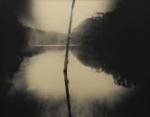
Partway through the day I met a lake.  Mirrored, grey, and deep in silences, the whispering began.  Voices from here and there and far away, the hallow bright, jagged vacancy of my memory.  I smoked the screen to hear what they might be, hands cupped to mouth and breathing deep – hah…hah… forming curls of smog to make the utterings appear.  To make it what it was to be, not the needle, nor the thread, but echoes, echoes, whisps of hollowed wind, odd edges of light around crooked lines of night.  Wordings, phrases, myths and murmurs, poems and songs from long-fingered wraiths scribbling my mind.

These had carried me, stolen and created me like dreams and nightmares, goblins and godparents, stitching and twisting me like frost along rails and tunnels and streamings of light.  My body, and all that’s immaterial in me had portaled through them all my years.  My openings, my escapes, inscribed riddles of the dead.  They rhythmed and rhymed me, cradled and rocked me,

I could see through them.  Their spines and tangles, the jagged vacancies they ripped into my home, my school, all my solitary life.  I clutched the light of them tearing their screeches and lullabies, dancing, shrieking, rumbling their caresses.  The path of the wide-winged bird so high.  I set out.  The lost decree.  Each wave and ripple of this mimicking lake an intimate familiar, voices echoing from the leaves, the papers, the books.  My fingers felt their divets.  Sweet long Braille of what is gone, my companies – the gone, gone, gone.

At once I knew…I was not magnificent.  Not unique.  I looked around.  My chest and limbs a giant valley, empty and overcast.  Thick with absence.  I knew I was alone.  Miniscule.  At the mercy of.  Full of insignificance.  I scrambled and scaled.  From here, high above, left behind, I could see for miles, miles, miles.

I spread my meaningless arms.  Wind.  Water.  Jagged vacancies thick with ice, without an “us,” with or without a me.  The bird circled slow.  It trembled.  It swooped.  It dove.  I followed.  Not me.  Not anyone.  I knew I was not magnificent.  I could see what forever might be.

At a precipice I flew.

Perhaps I circled, perhaps I swooped or even soared as I fell.

This I do not know.

But I smiled.  I laugh and smile.

I am not so heavy after all, not made of wood and wire.

I know I am not magnificent

but I could see for miles,   and   miles,

and    miles.

.

Transcription: Re-re-readings

for any of you also fascinated by photography as an art, or the pull of images from movies to family albums, travel brochures to advertisements, even how you ought to “look” or you images of yourself…traversing literally hundreds of studies of images and their pulls, powers, possibilities…these I reread again and again – to argue with, learn from, investigate myself and the world:

“Another Way of Telling” by John Berger & Jean Mohr

“The Photograph: A Strange, Confined Space” by Mary Price

“Camera Lucida” by Roland Barthes

“On Photography” by Susan Sontag

“What do pictures want: the lives and loves of images” by W.J.T. Mitchell

and for core mechanics:

“Looking at Photographs” and “The Photographer’s Eye” by John Szarkowski

“The Nature of Photographs” by Stephen Shore

Scripting the Photographer, Pt. 6

Scripting the Photographer: The Photographer Discusses His Many Eyes

I did not choose the square, I merely direct it, I “aim” it, what philosophers refer to as “intention.”  The rectangl’d eye limits me, but also sees things I’m unable to.  I need extra eyes, to see.  As you know, my vision has been bad from birth, have required many assistants.  Left to my own body I see a fuzzy swollen version of a clear night sky lain over transparencies of its negative.  Clouds and pom-poms.

I’ve turned to lenses.  They transcribe the world to me.  They record for me, cross-writing the world through direct impressions of light bounding off objects.  My boxed eye evidences existence and matter I might never know.  Where my vision is rounded and illusory, darting and fluid, my extra eyes, borrowed eyes freeze it a moment, show me distinctions and planes, colors and forms, what, perhaps, is really there?  Or also there?  Out there, out beyond the gauzy curtains draping my own eyeballs, spotted and stained and all warbly.

My four-eye captures shapes, tones, responds rather than interprets or occludes.  Perhaps mine is not a misfortune?  Perhaps multiple visions would benefit everyone?  Perhaps all human eyes inherently skew to their shapes, their veils, the thoughts and feelings of the bodies that house them, now constricting, now expanding what they perceive?  Smearing discrete objects and occurrences into a wash of associations, altering what they take in into an image of what they actually apprehend?

Sunset seen, described into a version of sunset seen, concocted over said sunset, compared to still other forms, visions, images of “sunset”?

I cannot speak for those of us boasting the proverbial 20/20, clear in-sight, for this I’ve never experienced, enjoyed?  I only know my many apparati that combine to provide, present, re-present an interesting show of the “world.”

Including myself.  Snapshots and Polaroids taken of me and those I know rarely reflect the image we have of ourselves, like hearing my own voice through a machine or over a wire or recording.  I never “feel” identical to what I see or hear.  I notice those around me (more reliant on other eyes than they might think) repeatedly and continually (constantly?) comparing what they are seeing to images, other visions – “that looks like a photograph!” (which photograph?), or “if only I had my camera” (how would that change, signify, preserve?), or “I don’t remember it like this” and so on.

My many eyes help expose each other’s deficiencies, particularities, distortions, additives and deletions.  I’m not certain I can ascribe purpose to any of the various visions, it seems that the blurs and framings, foci and subjects/objects chosen are particular to each kind and moment of eye.

But its why I listen to the speech of eyes, listening also to my own (“reading” – listening with the eye?).  The eyes of children and foreigners, the aged or disabled, the rich or the poor, males, females, video, color, black & white.  Every eye seeing its own reality, even from camera to camera, lens to lens, light to light to photograph (after all, once developed and materialized, the print has gone through processes replete with adjustments and accidents, alterations and mediums becoming yet another subject/object to be variously, multifariously “seen”).

Nothing exists unchanged or unaltered.  This is the message of my many eyes.  “Original” is an illusion – a manifestation of disappearance – a mirage.  This is part of the reason I suggest you grab for eyes, multiply eyes, hear eyes out from any direction or make – to “see what you can see.”  For each and every I/eye reports individually, uniquely, distinctly.  Layering and unlayering veils of vision, the optics demonstrate convergences and separations, agreements and arguments that help me, at least, to “see” what might possibly be “being seen” of this fluid process we call “world,” call “vision,” call “life.”

“But them…they’ve got…no eyes.  More precisely: they’ve got eyes, even they do, but there’s a veil hanging in front, not in front, no, behind, a movable veil; no sooner does an image go in than it catches a web, and right away there’s a thread spinning there, it spins itself around the image, a thread in the veil; spins around the image and spawns a child with it, half-image and half-veil…and in my eye the veil is hanging, the movable one, the veils are hanging, the movable ones, you lift one and the second one’s already hanging there…”

-Paul Celan-

“the camera may be thought of as comparable to the eye.  The difference is that the camera is not more than an eye.  It does not think.  Any connection with judging, choosing, arranging, including, excluding, and snapping has to be with the photographer…what the picture is of limits meaning while it encourages the exploration of meaning”

-Mary Price-

Scripting the Photographer, the notebooks

Scripting the Photographer: from the Notebooks


“It’s more likely that we take pictures in order to come closer, yet again, to an unsolved contradiction: the desire to ‘photograph’ something lying beyond the jurisdiction of the eye – and likewise beyond light, shadow, chemistry, polygraphs, time, memory, hope, etc.; something that preceded by a vague certainty that this ‘future’ image (not yet extant) has already been thought, already been in the mind, yet without a concrete ‘image’; the act of manipulating physical substances (such as glass, plastic, metals), distributed in time and shaped by the logic required for the execution of an ‘intention,’ is in fact a method of ‘visually’ demonstrating this ‘mental figure,’ which itself asserts the reality of one’s own existence whenever it becomes necessary to make such an affirmation, or else repeat it – which affirmation and/or repetition are, perhaps, ideal, tautological rituals that don’t derive something from something else but merely change one’s perspective.  When ‘experiencing’ or ‘studying’ a photograph, however, one is, in fact, less inclined to start an investigation, to engage in an aesthetical einfuhlung, into the simultaneity of absence/presence.

“What we want, simply, is to study ourselves through photographs, ourselves looking out onto the field of depiction; and our desire to conclusively combine the outside view with the inside is like bridging ‘tomorrow’ with ‘yesterday,’ deleting the space ‘in between,’ which is of course impossible, since we can exist only in this ‘between.’  In our desire to overlap these concepts – we are caught ‘between.’  The present will never be ‘complete.’  The figure of death doesn’t clarify a thing, no matter how many times it’s exposed.  One hardly ever succeeds in even grasping a simple feeling of empathy.

“Every photographic attempt to capture a wedding, vacation, funeral, statue, roof, bed, etc., etc., etc., is yet another meaningless attempt to convince ourselves that we exist.  Unfortunately, we are never wholly convinced.”

-Arkadii Dragomoshchenko-

“Images are not everything, but at the same time they manage to convince us that they are.  There is a peculiar tendency of images to absorb and be absorbed by human subjects in processes that look suspiciously like those of living things.  We have an incorrigible tendency to lapse into vitalistic and animistic ways of speaking when we talk about images. ..In its most extended sense, then, a picture refers to the entire situation in which an image has made its appearance…it is a very peculiar and paradoxical creature, both concrete and abstract, both a specific individual thing and a symbolic form that embraces a totality.  To get the picture is to get a comprehensive, global view of a situation, yet it is also to take a snapshot at a particular moment…”

-W.J.T. Mitchell-

I did it anyway

CREDO

art is not a mode of faith, it’s a way of thinking. In fact, it’s better than thinking because it’s easier and more rooted in experience, only we don’t have another name for it, other than art…

the easy way out that’s hard to find”

-Ronald Sukenick-

 I think beliefs are mobile manifestos

I believe we invent experience as we go along

I am uncomfortable with creeds

I believe in thinking it through

I think we feel toward thought

I believe that art is utilitarian

I think that being is ambiguous and ambivalent

I believe in art as relationship

I think language functions

I believe making is interactive

I think we are made as we make

I believe in the nothing between

I think everything is medium

I believe to do is to be

I think we are

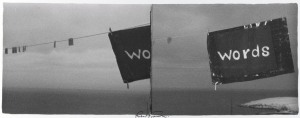
I am looking for words

What Begins

First Responder

Once in awhile,

perhaps always

(of this I’m unsure)

we answer;

and this answering is always a yes.

It may sound as a “no”

even feel that way too,

but “no” is no antonym,

only adjustment


A woman responds to a man

addressing a yessing already

to the asking

so even “no” is a “yes” to relation.

Negation may come

as it certainly does

in its various ways

but it cannot undo

or erase

the first token

(even if there are no children.

There are always children)


No, it merely describes,

perhaps even alters

the original gesture.

But yes is the endless beginning.

The Join

The Join”

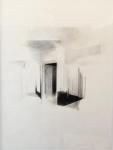
Ms. Mann had made a landscape I simply could not decipher. I had a picture like that. Charcoal and paint and wax on a large canvas made by a woman I assuredly knew but no matter how, I never knew well. Modotti’s stairwell, but this was doors, steps leading upwards or down, thresholds to or away. The openings were thick in their darkness, but whether that black was within or without, I could not say. A kind of vertigo. An incapacity to gain my bearings. An experience that art and women have always supplied me with in large measure.

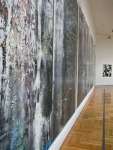
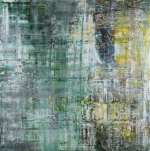
I approached a room at the St. Louis Art Museum that completely gave credence to its acronym. On one giant wall hung three enormous panels by Gerhard Richter, the three months most Winter. Opposite to it across the spacious room – a gargantuan assemblage by Anselm Kiefer was hanging. Between the two I foundered, awestruck and thoroughly a-mazed (assuming that means “to be jettisoned into an unsolvable maze or labyrinth”). Lost. Immersed. Afloat. A parallel to loving my wife.

Like cattle in a feedlot among females, I graze, stare dumbly and bellow, then stunned, flayed and strung up all of a sudden. Before I know what’s happened. Art is like that. You wander in, something strikes you in your senses, you move in – kazowy! – you’re rearranged, undone, overloaded.

I must say I don’t really mind the dystopia, aporia, conundrum’d state of being this implies, but to sense a ground for being in it (to secure one’s being at all!) is tricky. Usually it emerges after the stupor – you become cognizant of pain. Your throat is slit, your blood is gone, you’re an artifact, a meal.

Humans are not that helpless.

This was intended to be a consideration (astute, reasonable, hopefully enjoyable) of ambiguity and liminality – their presence in our apprehension of the world – of art and persons and things. Persons, places and things, how about, the designations “art” and “spouse,” “painter,” “friend,” “S.L.A.M” or “self” are afterbirths of our relations.

So the stairs, the leaky lake-y landscape, the architectures of doorways, the ladies and the painted times…

where I enter, where I leave, seems entirely up for grabs. Depends on the day, my mood or company, my body’s presence with my mind (and vice-versa), the music or chatter or silence in my head, and so on.

There’s a thrill to it, an ecstasis – as if sometimes I become phantom, fleeing and spreading into the surface of things; at others a long contemplation, as if merging with jelly at the bottom of the sea. Usually, amid much stammering, I end up stuttering: “I don’t know. I can’t describe it,” whether to partner or journal,

and begin again.

And sometimes I just breathe (think about breathing) and gaze. Something like a ubiquity of assimilation occurs, a vanishing and presence – to dis-appear. Not to cease, but, apparently, to occur “in,” diffuse, non-identically and undifferentiatedly.

Where am I?

Or might I be aptly participant? As if the similarities of cells and atoms (the family resemblance of objects) and the woven unity of wind have been accepted, acknowledged, awared in the confusion (“fusion-with”).

I don’t know. I can’t describe it.

But I like it and fear it at once – secure and unsettling – like “home,” as it were, or my “self.”

A sort of cognition of the ever-unknown lexeme “I” in its ever-unknowing surround…of people, places and things…that primal chaos and truth. Ambiguous, liminal, present.

The join.

As good as any…

This quotation from Arkadii Dragomoshchenko is as good as any I’ve yet come across in attempts to define or circumscribe what I think of in relation to whom or what or how a “manoftheword” is (in this case attributed in the masculine, because I am of the male gender, as is, supposedly, Arkadii) – but equally (as I see it) applied to any “personoftheword”:

“The place where I’ve finally found myself, is as simple as a child’s board game.  Everything in it echoes everything else.  Coincidences aren’t always believable.  And they don’t always count.  Obliqueness has its own charm…He’s writing…

The man forces out word after word.

The letters run in the rain and pour into the message.  The man, no doubt, is reading the message as he inscribes his letters.

In the message, unflinching, unfolding via ink blots, there are detailed instructions on how to correlate one letter with another, one word with another, and then the rest with rain, paper, war, objects,  fear, the hexagram of ‘fragments,’ toothaches, questions, history, tobacco smoke, poetry, foolishness, you name it…

The message also suggests that neither he nor you will receive a thing for it – this work is done gratis.”

-Arkadii Dragomoshchenko, Here” from Dust

Scripting the Photographer, pt 5

The Photographer Goes Back to Basics


If you pressed me, now. If I were honest, a photographic career is, basically, just like any other, with different tools and products. It fluctuates, you know? You move from the zeal of the capture, the feeling that your point of view (POV) might be “special” or “unique” – and it is – it’s one-of-a-kind even when one is copying someone else, still a translation or a version, not a “same.” You get over the miraculous. It wears off with time. Inattention, a zillion images from a million Kodaks, Polaroids and Nikons, and the clicker just feels overwrought, or miniscule, inundated and insignificant.

So you join a cause or a team, a kind of “group POV.” You figure there’s strength in numbers, you can at least make a digit’s difference, someone else cares or shares or might be helped by what you do, who you notice, how you work. But that film plays out as well, being as how everyone in the “group POV’ can’t ever actually escape their individual POVs, it ain’t long before you each understand a “place” or a “role,” an “effect” you come to feel is replaceable, or that you could as well perform that function on your own. Cut and splice. Disappear.

Now sometimes a kind of “back-to-square-one” occurs here – or a sensation of discovery that’s nearly always re-discovering, which is just fine. You pay a little more attention to your tools, try old ones, new ones, mix up the chemicals, collage the exposures, experiment surfaces and pages. You plunge the medium, see if something ain’t been missed or never combined, used just so, at this or that time, this or that way. When you look hard enough (if you care, that is) – you’ll find it. Someone’s been there, thought it, shot it, used it, what-not.

Then you might try plumbing your individuality – family roots or land, self-portraits, things you figure only you have access to; or you try some wild novelty – work for no other reason than to try what you haven’t seen tried, usually the results are ridiculous, maybe some cool accidents, but very rarely anything world-shaking or earth-shattering comes of it, more like play. Banality and/or play. Too finite or too abstract. Solipsistic or anonymous.

At this point, usually 20 years in or so, give or take decades, many sell out. Either by doing “well enough,” using their skills developed for someone else’s purposes, or literally unloading the shebang on Craigslist or gifting it to a young idealist upstart or relative; or you teach.

Others of us simply scale down. By which I mean you return to the basics, by which I mean you figure out through all the efforts, jobs, mechanisms and situations, what actually pleased you. What gave you the willies the highs the joys the thuds about being and doing…and you figure out, at whatever level of notoriety or negligence, how you can keep on doing these things.

You look, and you feel. What you like feeling looking you make pictures of. Could be people’s faces, secret subway shots; could be getting yourself off to remote places – mountains, trees; could be naked women or men; innocent children; dangerous wars. Could be proximity to the rich and famous; or microscopic lives of plants or insects; could be the chemicals and lights themselves, the materials – blurs, slurs, Rorschach-like concoctions. Only you know, ‘cause you’re the one that feels it when you look.

Hell I’ve been a grocery bagger, an insurance peddler, kindergarten teacher and garbage man, just to see the chaos of shapes and light, just to rove the streets to or from with my “magic box.” You’ll know if you gotta. You’ll even know what you’ve gotta.

I gotta.

This slideshow requires JavaScript.

I for instants…borrowed

Arkadii Dragomoshchenko

this one is too good to deny…

“The insignificant position of two associated objects is probably determined by both the randomness of their relationship (let us remind you that neither the ‘statue,’ nor ‘I’ in any way ‘expressed’ a desire to be together, to be united thus by a proposal of anticipation followed by a separation) and – if you will – one’s semic insufficiency.  Indeed, if the semic nucleus of the word ‘statue’ or, say, ‘she’ governs the layers of contextual semes, then ‘I’ is empty (or infinite and hollow, from the very beginning).  This lexeme has no nucleus whatsoever; it’s nothing more than a cocoon of ‘contextual semes,’ like the knot that is a constant deflection of an illusory straight line towards its starting point.

“Frankly, I’d like to say, as I did at the beginning, that ‘I’ is reduced to a ‘seething, ever-changing void.’ But let’s leave it at that.”

-Arkadii Dragomoshchenko-

And, in very much seriousness…if you are a writer in any sort of way (letters, memos, journals, ANYthing)…I find it hard to stomach you not having read Dragomoshchenko’s book Dust.  Really.  Truly truly truly.  Please, if you have even a passing interest in the use and creation and employment of language (even for conversation, thought or memory)…Dust, Dragomoshchenko, Dust, Dragomoshchenko…(mantra until you hold it in your hands)

I beg of you.