This quotation from Arkadii Dragomoshchenko is as good as any I’ve yet come across in attempts to define or circumscribe what I think of in relation to whom or what or how a “manoftheword” is (in this case attributed in the masculine, because I am of the male gender, as is, supposedly, Arkadii) – but equally (as I see it) applied to any “personoftheword”:
“The place where I’ve finally found myself, is as simple as a child’s board game. Everything in it echoes everything else. Coincidences aren’t always believable. And they don’t always count. Obliqueness has its own charm…He’s writing…
“The man forces out word after word.
The letters run in the rain and pour into the message. The man, no doubt, is reading the message as he inscribes his letters.
In the message, unflinching, unfolding via ink blots, there are detailed instructions on how to correlate one letter with another, one word with another, and then the rest with rain, paper, war, objects, fear, the hexagram of ‘fragments,’ toothaches, questions, history, tobacco smoke, poetry, foolishness, you name it…
The message also suggests that neither he nor you will receive a thing for it – this work is done gratis.”
If you pressed me, now. If I were honest, a photographic career is, basically, just like any other, with different tools and products. It fluctuates, you know? You move from the zeal of the capture, the feeling that your point of view (POV) might be “special” or “unique” – and it is – it’s one-of-a-kind even when one is copying someone else, still a translation or a version, not a “same.” You get over the miraculous. It wears off with time. Inattention, a zillion images from a million Kodaks, Polaroids and Nikons, and the clicker just feels overwrought, or miniscule, inundated and insignificant.
So you join a cause or a team, a kind of “group POV.” You figure there’s strength in numbers, you can at least make a digit’s difference, someone else cares or shares or might be helped by what you do, who you notice, how you work. But that film plays out as well, being as how everyone in the “group POV’ can’t ever actually escape their individual POVs, it ain’t long before you each understand a “place” or a “role,” an “effect” you come to feel is replaceable, or that you could as well perform that function on your own. Cut and splice. Disappear.
Now sometimes a kind of “back-to-square-one” occurs here – or a sensation of discovery that’s nearly always re-discovering, which is just fine. You pay a little more attention to your tools, try old ones, new ones, mix up the chemicals, collage the exposures, experiment surfaces and pages. You plunge the medium, see if something ain’t been missed or never combined, used just so, at this or that time, this or that way. When you look hard enough (if you care, that is) – you’ll find it. Someone’s been there, thought it, shot it, used it, what-not.
Then you might try plumbing your individuality – family roots or land, self-portraits, things you figure only you have access to; or you try some wild novelty – work for no other reason than to try what you haven’t seen tried, usually the results are ridiculous, maybe some cool accidents, but very rarely anything world-shaking or earth-shattering comes of it, more like play. Banality and/or play. Too finite or too abstract. Solipsistic or anonymous.
At this point, usually 20 years in or so, give or take decades, many sell out. Either by doing “well enough,” using their skills developed for someone else’s purposes, or literally unloading the shebang on Craigslist or gifting it to a young idealist upstart or relative; or you teach.
Others of us simply scale down. By which I mean you return to the basics, by which I mean you figure out through all the efforts, jobs, mechanisms and situations, what actually pleased you. What gave you the willies the highs the joys the thuds about being and doing…and you figure out, at whatever level of notoriety or negligence, how you can keep on doing these things.
You look, and you feel. What you like feeling looking you make pictures of. Could be people’s faces, secret subway shots; could be getting yourself off to remote places – mountains, trees; could be naked women or men; innocent children; dangerous wars. Could be proximity to the rich and famous; or microscopic lives of plants or insects; could be the chemicals and lights themselves, the materials – blurs, slurs, Rorschach-like concoctions. Only you know, ‘cause you’re the one that feels it when you look.
Hell I’ve been a grocery bagger, an insurance peddler, kindergarten teacher and garbage man, just to see the chaos of shapes and light, just to rove the streets to or from with my “magic box.” You’ll know if you gotta. You’ll even know what you’ve gotta.
“The insignificant position of two associated objects is probably determined by both the randomness of their relationship (let us remind you that neither the ‘statue,’ nor ‘I’ in any way ‘expressed’ a desire to be together, to be united thus by a proposal of anticipation followed by a separation) and – if you will – one’s semic insufficiency. Indeed, if the semic nucleus of the word ‘statue’ or, say, ‘she’ governs the layers of contextual semes, then ‘I’ is empty (or infinite and hollow, from the very beginning). This lexeme has no nucleus whatsoever; it’s nothing more than a cocoon of ‘contextual semes,’ like the knot that is a constant deflection of an illusory straight line towards its starting point.
“Frankly, I’d like to say, as I did at the beginning, that ‘I’ is reduced to a ‘seething, ever-changing void.’ But let’s leave it at that.”
-Arkadii Dragomoshchenko-
And, in very much seriousness…if you are a writer in any sort of way (letters, memos, journals, ANYthing)…I find it hard to stomach you not having read Dragomoshchenko’s book Dust. Really. Truly truly truly. Please, if you have even a passing interest in the use and creation and employment of language (even for conversation, thought or memory)…Dust, Dragomoshchenko, Dust, Dragomoshchenko…(mantra until you hold it in your hands)
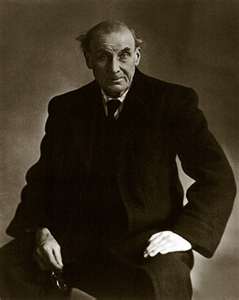
I’m an old man now. I know about time. I know how I am not I. No longer. This mottling, freckling, wrinkling and mole-ridden flesh each new hour I am forced to call mine. The pain in the shoulders and the neck and the knees, my excruciatingly stooped back, my trembles and twitches…I fight back.
I capture the young. Flesh nubile and soft, pliable and pure, elastic. I carry my posture of strength, contracted muscles of athletic days on this little 3×5 glossy scrap, you see? Here’s uncle Mort – alive, swimming – BEFORE 1918 and he was no more. Pah! Right here friend! Right here is uncle Mort. And the Native Americans did live here first, and did wear strange clothing, ride horses, build tee-pees and clod huts – you see?
What might have been erased by vile death, by erosion, what we may have never truly “witnessed” or “seen” – right here through this powerful small cannon!
Matthew Brady
If we speak simply of existing, in whatever form (given what becomes of our actual bodies and minds) Atget has defeated death – you may challenge me to find his flesh, his bones, his musty breath – perhaps not! But here, right here! His aspect, his presence, his form. See? None of us, none of us, even those of us who greet it at our own hands, like death. We try to circumscribe it, undo and short-circuit its authority, vitiate its inevitability – well, here is how I do it!
Eugene Atget
Death and anonymity destroyed by the ambiguity of the lens! You may have no inkling WHO this subject is/was, but you will not doubt that they were, and therefore are in your ingestion of their image.
Beauty vs. decay. Beauty of decay. Youth versus age, the vitality of age. Life against death, or the life of death. I can capture it, exercise my will to power, stay the tide if only this moment, you see?
The action makes the difference in the arts. That I can take action against, on, within my world and produce a stoppage, an ongoing, an object that without me would not remain, be.
A salesman’s pitch, a preacher’s sermon, a whistling in the dark, you say – I say sure! I say it’s a banter and a babbling whistle, but it is my friend, it is. This is the significant battle, the valorous war. To take a stand against void while accepting its encroachment, to face up to destruction taking names and numbers, to perpetually freeze its moments, stop-gap, isolate and preserve. Seek and destroy.
I think of each shutter-click like a whittling, another shiver off death’s enormous trunk, a cut, a shape and scrape, a form emerges in its waste.
There are many a day that I feel alone or odd or perhaps even neurotic in my obsession with languaging. I go to write…and end up being able only to write language. About language, with language, in language, against language, through language…a medium I am incapable of escaping. I think of those who write stories, or poems, articles or essays about subjects behind the words, things referred to, recounted, and I get excited, think: “I can do this!” – head into artworks or subjects, characters or narratives, and sure enough, soon as I put instrument to page…I’m locked in language…what it does, how it functions, what it means. With the gut feeling that exactly that, is what it does…means. Not something else, more, under or beyond, but means in its being languaging.
So I circle, spiral, seek into, try to self-criticize, split, examine, understand, observe, listen…and end up creating these whirligig texts where language spurs and follows, begins and begins and begins.
I wonder if it bores readers. I wonder if most persons, when I try to hash these conundrums out (the “prison” and “window” of languaging), are thinking…”why don’t you just get on with it…say something! Try it! Communicate, describe, hypothesize, anything – but don’t just dissolve your saying with saying!” I wonder if, to the bulk of our kind, reflecting on reflections without answers, resolutions, commercial products, and so on, is a stumbling block, a misfortune, a psychosis?
And things happen like this morning, where I suddenly feel validation of my contemplation…where the “eternality” of the issue feels ok for me to be obsessed by…today it comes in the form of a lengthy essay by Nobel Laureate (validation!) Octavio Paz, titled Reading and Contemplation. In it, he also enters into the trail of sources that has so shaped me: Benjamin Lee Whorf, Wittgenstein, poets, philosophers and physicists throughout the ages responding to: “Language is society’s foundation and at the same time is founded on it. Without language, there is no society; without society there is no language. To me this is one of the great enigmas of human history. Or rather the enigma.”
Sigh! I’m NOT alone! I’m digging around in perhaps the enigma of being human. “Language is more powerful than the individual self…this language that imprisons us is also a window, a lookout post on the world, on our fellows and on other languages…Perhaps the answer is to recognize that each culture – that totality of material, intellectual, and emotional structures: the things, institutions, and persons that go to make up a socity – is predominantly a symbolic system…that every act of human beings – even their crimes – say something. We are condemned to voice meaning endlessly. We are language.”
Further, “it goes without saying that everything human beings touch is impregnated with meaning; the trouble is that the moment we perceive it, meaning scatters and disappears. There is no meaning but meanings. Each one of them is instantaneous and lasts no longer than its appearance. Ashes of meaning: ashes without meaning…Meanings cancel each other out; on the ruins of meaning there appears a reality that cannot be named or even thought. To question language is to question ourselves.”
And, in a kind of ultimate reciprocation, connection, correlation…at the very core of my daily work, Paz writes:
“If everything we touch and name becomes full of meaning, and if all these meanings – provisional, disparate, contradictory – instantly lose their meaning, what is left to us? To begin all over again.”
And so I do…with this added courage. Perhaps I am not crazy. Perhaps others are interested. Perhaps languaging language matters.
*if you share my intrigue at all, I highly encourage you to seek out a copy of Paz’s Reading and Contemplation. It is a Pazian-version of my “Up with Word(s)” contemplation – nicely done, about 50 pp. I have read it in my copy: Convergences: Essays on Art and Literature by Octavio Paz
Where it all begins, I suspect, is the “snapshot.” Whether family photo album, yourself messy-faced in diapers and high-chair, exotic postcards or history books – that strange “a-ha!” instigated by the similitude of the unknown or misremembered. The “whap” of what you imagine you’ve seen, fantasized, dreamt or been, suddenly presented to you as an instant, an image.
“Stealing a glimpse” kind of thing. A centuries-past wedding, the Rockies in sepia, a Hindu temple, your sister as a baby – the mystery of it, the magic! That first plastic camera, disposable and durable, that I used like a weapon as a boy. Bam! Bam! Blam! – my toe, my dog, the playground sand. Blast! Wham! Crack! – got you candy wrapper! Beetle! Back of daddy’s head!
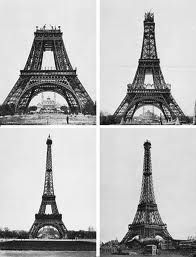
What wonder, no? The outlaw Jesse James – preserved! The Eiffel Tower! Existed then, exists now, because of this contraption, this mad science. Africa, India, colors and clothing, languages, beliefs and cultures – perhaps! perhaps! – someone must have really been there – and something! – the camera may be able to lie, but it cannot create matter, substance! It records moments, minutes, on battlefields, of cheetahs, camels and pyramids!
I had a grandpa! Or I didn’t, but here’s a possible one – detached from his family of origin – available image – who really occurred – could be mine – you see?
For all the skewing of this miniscule eye…the fragile lens…the limiting range and frame, the delicate settings and the passage of time – in only a couple of centuries (as testament to its early stimulus and fascination) – our world has been literally flooded with these fragments. Images. Perhaps rivaling the entire history of visual arts, save writing, no?
So to start, it is enthrallment. Magic, mystery, forbidden, anonymous, it appeals to everything in human youth: the impossible! To experience – perhaps to capture! To seek – to startle – to freeze – to kill.
To take the photo. To grasp the image. To snap the shot. To keep the memory, its stimulus. In the blink of an eye.
I proceed to enact a daguerreotype, a portrait, of a nude human body. I desire the body, the nude, for its pliable form. Shapable still-life, form requiring will. I will need to place my hands on you, move you, to sculpt your body into lights and shadows. I choose you because you are beautiful to me, interesting, unique. You consent, or choose, “for art,” you say, “for art I will remove all my clothing and exist only in my skin and bones,” “for art I will be naked.”
And I agree. Regardless of artifice or style, mechanisms or techniques, art reveals us naked, as we are in our skins, our fragile, porous borders. I must touch you. Art cannot occur in solitude. Always there must be “other.” Always there must be “form,” a here and a there, an inside / outside, a marking and memory.
I do not know how it feels for you to have my hands upon your body. You lie still. You are naked, are beautiful. I place my palm underneath of your knees and pull them up toward your chest. Your calves I press firmly along your thighs to the point where your heels cleave buttock. Sharp angles, slow curves, deep shadow. My fingers trace around your bottom and up the small of your back, learning your spine, your lines. I whisper.
Firmly, quietly, I shove your shoulder up over your knee and push your blade firmly, flattening a slope with a vertebrate edge, cupping the folds of your legs and creating shades of muscle and rib along the contortion of your back. Turning your face to the floor, I stress the creases of the tendons securing your neck. I use your hair like a pencil. Sketching and tracing the shape of your skull like thick charcoal, then drawing out strands for fine points, contour every which way of scapula and horizon, blade-rib-spine for highlight, sweet water of flesh as it pours your body and bends.
This takes time and concentration, you must hold still while your figure trembles. The arms? The hands? I flatten one out between my own, straining the fingers as widely as I’m able, squashing it against the surface where your face ought to be, now hidden beneath the likeness of your hair, pivoted on your nose and your crown. The other I stretch along your back to your bottom as a mirror, a reflected wave providing border and frame to the curling fetus of your twisting torso.
Hold there. Adjusting your digits to the swerve of your buttock, I tap them to the turn of your thigh. You are beautiful, pliable, soft. I stare. I close my eyes and gently feel my way over every shape of you in the dark. A blind man finding my way along the rocks of a beach, underwater. I imagine work onto paper, in wet clay or cool marble, correcting some angles of compromised gradients, pools of stasis, until you exist only as flow and obstruction. Yes there, yes there. How do you feel? Do not answer, you cannot afford to breathe, you are art, an object, an artifact.
Stay as I fix my devices, reform your surround, and manipulate tools. Stay.
We begin. I shape you, you will. I twist you, you choose. We wait, we wait, attendant to the sky.
Indeed there are days I’m uncertain. Unsure if I’m able to see. Since youth I’ve been blind, very nearly, “legally”? – yes, in my left, but spectacles account for that, I mean “vision.” Shapes, soft and blotted, everything variations of strangely spotted, fuzzy ovals. My natural eyesight is that I see what you see examining blood cells through a microscope. It’s a hell of a guess to proclaim something “tree,” or “car,” “human,” “house.”
My glasses restore what is known as “normal vision,” in other words, I’m enabled to distinguish walls and streets, eyes from mouths, blades of grass, shadows, pebbles, feathers even.
What I’m attempting to signify here is not accuracy, but that dread of poor vision, its undoing – where my eyes open out and register lines and fields, patches and frames, sketches and grounds, and I feel certain, uneasily assured, that what my brain is recording is itself. That these forms I “see” and “recognize” – sharp angles of a roof, scribbles on sky-canvas of a great bare cottonwood, spillages and squee-gee’s smears of walking figures – that these forms feel, in fact, to be formed. Forms formed by me. That rather than seek and capture I en-vision and create.
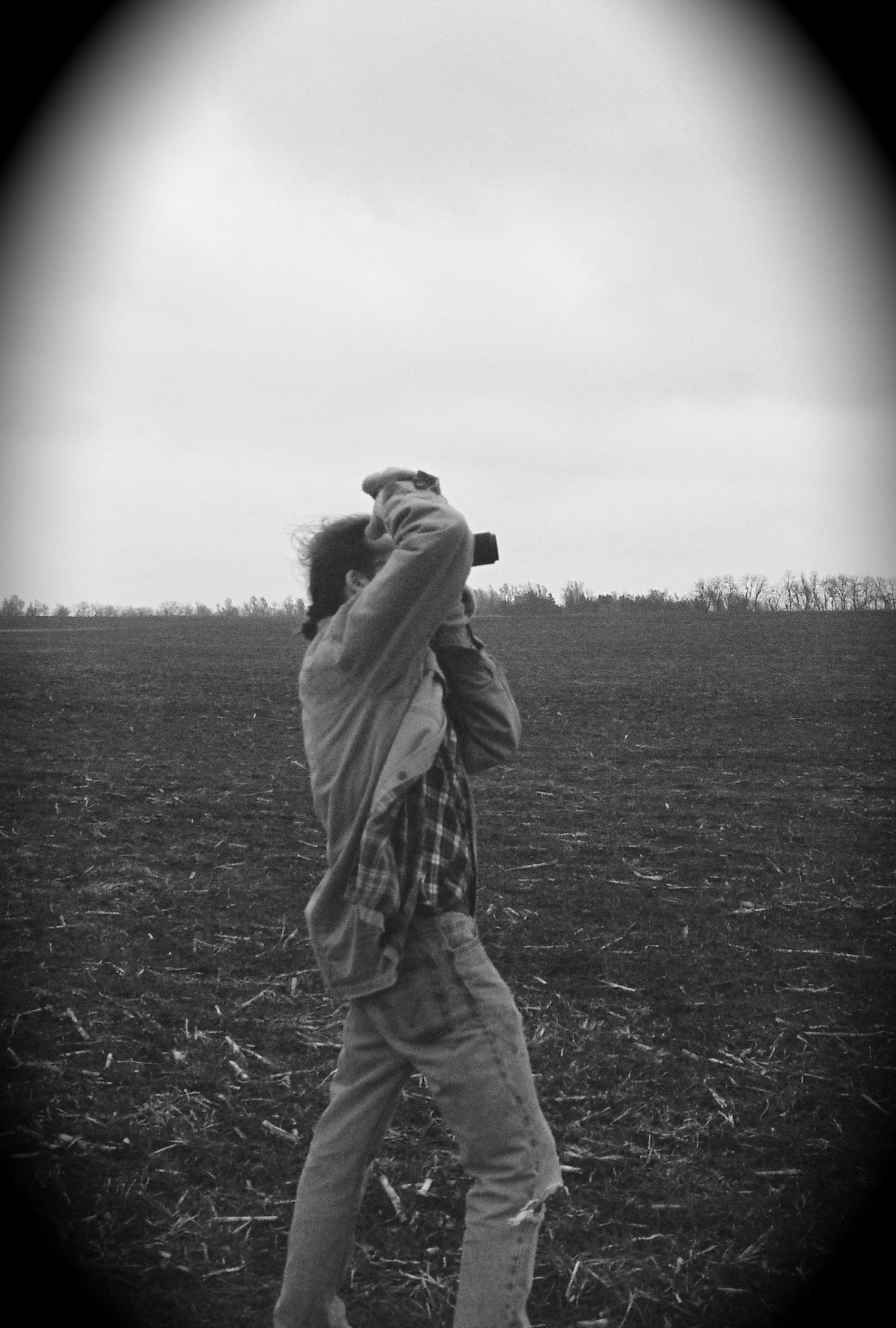
That the world is all dim-grey and full of shadows, and I mark it using light. Light is all – a motion, a shudder and click – and somehow I’ve reordered what might be there. My point of view, my stance. Decrepit old man with still the use of his fingers, albeit shaking, shooting willy-nilly, random violence, chopping up what is and nailing it in fragments.
At first I sought, I really sought. I ached a way to know what’s real. I hungered, craved, and wanted – to get out there, in there, attach – somehow seal myself to my surround – to objects. I thought: I’ll see something – something really there – and then I’ll, I’ll, well, I’ll prove it to myself – make a little monument, a document, an artifact that might bless me, secure me – I WAS HERE I SAW THIS – see? I indeed exist and was present – at least at that moment. That I might hold it, a thing, an object, something with matter, that matters.
But doesn’t repeat – you see? What I did with the light and the shapes, the forms and the shutter – my “settings” – that is what I look at again and again – it’s “developed” on me. What I saw develops as I see, and then again with each viewing, but is not, I repeat, is NOT what I took the picture of. Which was a moment. My prints, my negatives, are next moments, and next. New situations, new contexts – new sights: with the requisite distortion of my vision.
In the museum, the gallery, the box in my closet, laid out on my desk, with a friend on my couch – new forms, new shapes, new visions surround. Points of view.
Poor vision, you see? Inaccurate. Not the world or the subject, but me. Not my eyes (“corrected” by lenses), but what directs them to look, what selects their focus, blurs the contexts – my settings – what chooses. Responds.
Yesterday evening, I sat down in an early dusky chill, on the back steps of my home, for an after-dinner coffee and cigarette, watching with delight my two youngest bounding as penguins on our trampoline.
The sky was clear with an odd bright-but-sunken diffusion of sun, above the roof of the garage thin branches from three separate trees converging and tangling, criss-crossing and enmeshed, forming intricate thick silhouettes of scribblings in the even-ing air.
As I gazed and traced with my eyes and deep breaths, it struck me that after nearly two years of freedom to devote my days and hours to words, reading-writing-reading, a scene, an image like this incredibly marked and tangly night sky, almost immediately, spontaneously metaphored two references in me:
– a sentence
– the connections between ourselves and our world, the ganglia of mind and body enmeshed with “other”
I retraced my day to a half-an-hour I’d snuck to myself to read, while feigning a chore, from J.R. Firth’s later essays on linguistics. In one paper, Linguistic Analysis as a Study of Meaning, Firth very patently set out some fundamental assumptions he believed crucial for understanding the functions, processes, “meaning” of human languaging. I would like to copy entirely these three brief points and then add a touch of commentary, what my mind riffed as I pondered the trees (the tangles and lines, nerves and events conspiring to make a single utterance, a phrase, a sentence), a body and mind (my own) inundated, saturate, with language, and the squawks and giggles of my penguin-children.
First then, from J.R. Firth: (let’s call it “presuppositions crucial to reflecting on words”):
“The meaning of any particular instance of everyday speech is intimately interlocked not only with an environment of particular sights and sounds, but deeply embedded in the living processes of persons maintaining themselves in society”
“1. The human being is a field of experience in which the life process is being maintained in the social process. The human being in society is endowed with an urge to ‘diffuse’ and ‘communicate’ his experience by voice and gesture.
2. All language text in modern languages has therefore:
(a) the implication of utterance, and must be referred to
(b) participants in (all language presupposes ‘other’ – events linguistic and non- linguistic)
(c) some generalized context of situation.
These categories must also cover ‘talking to oneself’.
3. The participants in such contexts are social persons in terms of the speech community of which they are members. The key notion is one of personality, the essentials of which are:
(a) Continuity and the maintenance of the life process, the social process. In this
connection the concepts of context of culture and context of experience (continuity of pattern and process) are necessary abstractions in stating the continuity as well as the change of meanings.
(b) The creative effort and effect of speech, including talking to oneself. The preservation of the essentials of life in society from the point of view of the participants in the situation forms a large part of the meaning of language as creative activity.
(c) Personal responsibility for one’s words.
(d) The organization of personality and of social life depends on the built-in potentialities of language in the nature of the human beings and on what is learned in nurture.
“In the most general terms, the basic principle is the unity, identity and continuity of the human personality, bearing constantly in mind that ‘we are in the world and the world in us’…The contextual theory of meaning employs abstractions which enable us to handle language in the interrelated processes of personal and social life in the flux of events.”
For starters. Then Wittgenstein, Heidegger, Sukenick and Blanchot, Beckett, Maso, Nancy and Stevens, Cixous, Kafka, Calvino, Derrida and Austin, Wimsatt, Peirce, Jakobson, Malinowski, Thirlwell, Shakespeare, Homer and Celan and more and more and more came flooding in like the chatter of branches, and I listened with my eyes, and felt deeply in my ears the scramble and magic of our glittering alphabets and strings of letters, colors and symbols and my mind murmuring over and over “feeding the reach, feeding the reach, feeding the reach…”
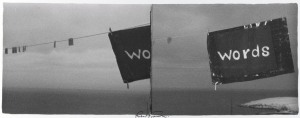
And I begged patience to add – from what I know of this elegant, flexible, complicated medium – WORDS – their implementing our humanness implementing them – that their primary glorious recklessly beautiful use is just this:
“the whole world – luminous, luminous. We were lucky to be here. Even in pain and uncertainty and rage and fear –
some fear“
-Carole Maso-
Shedding Light
(on fears and forties)
What is it they say about one’s 40s?
When I was in my 20s I think we imagined the fourth decade as a time when one ought to be graduating from the ever-post-grad program school of hard knocks, perhaps the 20s were a fortification and stretching of the self, the 30s a learning and establishing of its bounds and borders, 40s and 50s some growing truce or enjoyment of it all. At my birthday this year my stepdaughter pronounced me “forty-fun” years old. Is that so?
Walking down the stairs from our working studio to procure cream for my coffee, something else strikes me. I see a rectangle of light protrude from an uncovered window in a room I cannot see, falling across another room, two away from the kitchen where I stand and view it through three doorways. My 40s I would characterize (a year-and-a-half in) as the facing and unpacking, or recognition of and inquiry into, my prominent, almost mythical, and apparently irrational, fears.
Among these, the fear of abandonment (a paranoia that has eaten at all of my marriages – luckily my current spouse won’t have it…thus these therapeutic investigations); another, that I’m inherently disappointing or insufficient: my talents, appearance, relationality, aptitudes for sympathy/empathy/emotion, and abilities all suffer some fatal lack, that I am unable to be “enough” of anything or anyone to be of lasting value. Also, that people are threatening and harmful – strangers, intimates, friends, acquaintances – other humans – inherently self-preserving by nature and therefore untrustworthy, at the point one no longer serves their preserving one will be discarded or destroyed (accentuating abandonment and insufficiency fears as you might imagine); and light. Yes, light. Particularly sunlight, but any form of bright light unsettles me profoundly.
Seeing the sunlight cut through a clearly unprotected opening in our home had the effect of an intruder on me – my esophagus tensed up, skin tingled, breath foreshortened and nerves wrenched the muscles of my shoulders and neck – someone had left us exposed – at mercy – at risk.
In the night, feeling my way to the restroom, there’s a glow from my daughter’s room. It suggests presence, but I know (I think) that she is sleeping at her mother’s tonight. Startled and alarmed, I nudge the door – glow sticks, attached in a large circle, lay in the room like an electric eel spiriting by in the ocean’s depths.
I can sit with ease, even sprawl on our lovely porch, enjoy a cigarette, watch branches and pavement, listen to critters at night or in storm, but in daylight I keep moving or stand at the door. Like a doe in a clearing, I feel surrounded, defenseless – everyone (anyone) could see me, take a shot, direct speech my way, ask for things – interrupt, intrude, violate, voyeur.
Our maniacal sun has always struck me as an enormous and torturous spotlight under which we had better perform or disband (scurry) ‘cause everyone (potentially) is judging us; or some atomic or nuclear exposure-radiator, aching to burn and shrivel us, flare us to a crisp, turn us to ash, dehydrate us.
Rain and dark moistness encourages growth, protection, concealment, shelter. Like robing for the stage, fogs and mists mask us, preserve our individuality, turn us into basic shapes, generalize and equalize us, but light, well light “brings to light” – highlighting flaws, differences, disfigurements, scars, limps, pimples, features, you name it – you’re stripped bare before the blazing eye.
Lunar reflection, on the other hand, is like a nightlight – an orb, an aura, a frosted bulb – gently assisting without dominance, our perceptive necessities, like cloudcover or shade.
Perhaps this psycho-physiological trigger comes from years of being scared shitless (literally, I endured diarrhea before each of my performances as a child) or some early programming of scrutiny and judgment; or science labs and hospitals versus woods, basements and photo-development darkrooms or blacklit jazz rooms that were my safe places in my youth. I don’t know, but I can’t remember a time I didn’t prefer the night to the day, rain to shine, cathedral to mega-church theatrics, concert hall to club, museum to mall and so on.
Anyway, the 40s. One survives this far creating and instinctively obeying these fears…perhaps deconstructing them implies one is “over-the-hill,” preparations for death, dismantling the armor that got one this far?
Wanting to be known before one dies? “Exposed” to another? Coming-to-terms with something closer to “reality”? Like mortality? I don’t’ know. It doesn’t make much sense, to grow fearless as one approaches the fearsome end, but what do I know? I’ve only been around for four decades. Cut me some slack.






 All my Words are Silent