Sunday: 3 new things (to me) as gift recommendations (to you)

I have never engaged “graphic novels” much in a kind of snobbery for text and misunderstanding of modes of expression. Β This weekend, visiting the library with my children, I snatched out titles that looked interesting and have truly been gifted by them. Β I have needed a weekend for rest and refreshment, I am thankful it has come. Β Here are my recommendations:

Trouble Will Find Me by The National

Trouble Will Find Me by The National

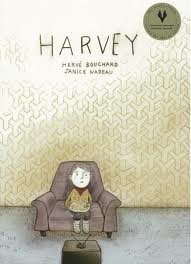
Harvey - Bouchard
Harvey by Herve Bouchard / Janice Nadeau

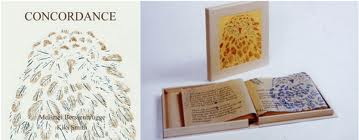
Seriously Mimicking Birds

combined with Bach, Beethoven, Brahms…

if I had to select an album from my lifetime….

perhaps?

LOVE

LOVE.

De-Presses

“What a joke it is to read or hearβ€”as I have read or heard more times than I can countβ€”that writers β€˜see more clearly’ or β€˜feel more deeply’ than non-writers. The truth of the matter is that writers hardly β€˜see’ or β€˜feel’ at all. The disparity between a writer’s works and the world per se is so great as to beggar comment. Writers who arrange their lives so as to β€˜have experiences’ in order to reduce them to contemptible linguistic recordings of these experiences are beneath contempt.”

β€”Something Said,Β by Gilbert Sorrentino

Dalkey Archive

Via strange twists of events, connections that could only be re-constructed through fantastic imagination, I have been moved back into perusing publishers for work that inspires, raises and extends one’s ideas of what “art,” “literature,” “human” are.

While most publishers must infuse their catalogs with books that will sell, there are still a few presses that are simply committed to grandeur – to works that express and challenge what humans are capable of making, thinking, expressing, creating – works that assess and challenge our condition of being.

Two presses I’d like to promote – that continually provide works that surprise and engage (fully) and elastically foment my boundaries of concept and possibilities – with bewildering form and content – in other words, publishers from whom you might randomly purchase titles and ALWAYS be made richer, better, exponentially more humane – (THIS IS A REMARKABLE THING):


please visit them and order…ANYTHING…

your life will be BETTER.


Excerpts of Mei-Mei Berssenbrugge

Ideal

byΒ Mei-mei Berssenbrugge
1

I did not know beforehand what would count for me as a new color. Its beauty is an analysis
of things I believe in or experience, but seems to alter events very little. The significance of a bird
flying out of grapes in a store relates to the beauty of the color of the translucency of grapes.
There is a space among some objects on a table that reminded her of a person, the way the bird reminded her,
a sense of the ideal of the space she would be able to see. Beauty can look like this around objects.
AΒ plastic bagΒ on a bush, moving slightly, makes an alcove, a glove or mist, holding the hill.
Time can look like this. The plane of yourself separates from the plane of spaces between objects,
an ordered succession a person apprehends, in order to be reminded.

Mei-mei Berssenbrugge

Red Quiet, Section 3

byΒ Mei-mei Berssenbrugge
Our conversation is a wing below my consciousness, like organization in blowing cloth, eddies of water, its order of light on film with no lens.

A higher resonance of story finds its way to higher organization: data swirl into group dreams.

Then story surfaces, as if recognized; flies buzzing in your room suddenly translate to “Oh! You’re crying!”

So, here I hug the old person, who’s not “light” until I embrace him.

My happiness at seeing him, myΒ French suitΒ constitute at the interface of wing and occasion.

Postulate whether the friendship is fulfilling.

Reduce by small increments your worry about the nature of compassion or the chill of emotional identification among girlfriends, your wish to be held in the consciousness of another, like a person waiting for you to wake.

Postulate the wave nature of wanting him to wait (white space) and the quanta of fractal conflict, point to point, along the outline of a petal, shore from a small boat.

Words spoken with force create particles.

He calls the location of accidents a morphic field; their recurrence is resonance, as of an archetype with the vibration of a seed.

My last thoughts were bitter and helpless.

Friends witnessing grief enter your consciousness, illuminating your form, so quiet comes.

berssenbrugge red quiet

A Reading of Red Quiet

Potent Selections from Vacation Reading

“I wondered what indeed it meant about me that I was so set against the notion of convention that I should attack it. Β So, I replaced theΒ dream withΒ theΒ novel, stripping the stories of my dreams of any real meaning, but causing the form of them to mean everything.”

“…the gap between theΒ subject of enunciation and theΒ subject of enunciating not only failed to appear to me as a place of entry, but also failed to register as something I might elide. Β For me, there was no gap, as there is no gap for anyone.”

P Everett 1

“…generally, people are only inclined to speak of the past with those they believe will somehow not only share some commonality, but who will also be disposed to exhibiting sympathy.”

“Is a photograph always present tense? Β I described them so…better, let the question be, is what is in the photograph always in the present, without a before, without an after? Β Of course, it is. Β And isn’t that actuallyΒ you in the picture?”

ennuyeux

“On Ludwig Boltzman’s tombstone is carved:Β S=k. LogW. Β S is the entropy of a system,Β kΒ represents Boltzman’s Constant, andΒ W is a measure of the chaos of a system, essentially the extent to which energy is dispersed in the world. Β This equation meant little to me as I read of it the first time, but as I considered it I grew excited. Β The space betweenΒ S andΒ W is the space between the living thing in front of me and stuff hidden inside beyond my observation and comprehension. Β It raises the question: Β How many ways can the parts of a thing be rearranged before I can see a difference? Β How many ways can the atoms and molecules of my hand move and recombine before I realize that something is wrong? Β Thinking about it scared me. Β Certainly, I understood that natural events symbolize collapse into chaos and that events are motivated by dissolution, but the idea of such subversive and invisible change moved me. Β I likened it to observing the minds of others.”

P Everett 2

ootheca

“Ezra Pound said, ‘Every word must be charged with meaning to the utmost possible degree.’ Β Let it be the case then. Β But words need no help from anyone. Β Bet thew ords kneeknow hellip freeum heinywon. Β Context, story, time, place – don’t these work like Bekins men, packing the words like so many trunks? Β But finally, words are not cases to be packed at all, but solid bricks (and, of course, like a brick, even a word’s atoms are not motionless).”

“We do not give the creatureΒ reality enough credit, choosing to see it sitting out there as either aΒ construct of ours or an infinitely regressing cause for the trickery of our senses. Β But I claim here that the most important thing I have learned is that reality has a soul, reality is conscious of itself and of us, and further is not impressed by us or our attempts to see it. Β In fact, we see it all the time and don’t know it, perhaps can’t. Β It is like love in that way.”

-all quotes byΒ Percival Everett

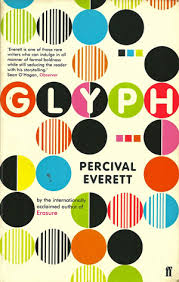
from his novel,Β Glyph

Glyph - Everett

a la Sympatico

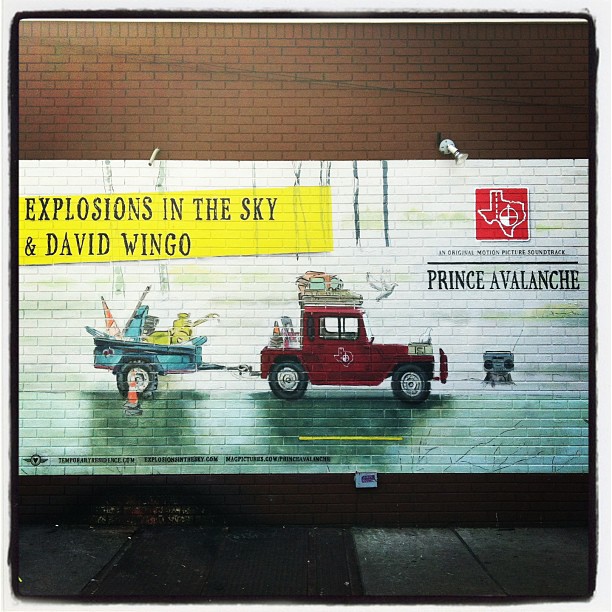
This week marks (for me) an exciting new release from Explosions in the SkyΒ and David WingoΒ – they’ve composed the soundtrack for the recent film Prince Avalanche (I’m also a fan of Paul Rudd).

PAMuralalthough I haven’t viewed the film yet (I fully intend to) – I was unable to wait to acquire the soundtrack, in fact it was a primary plus in returning to Kansas from the Rockies of Colorado (after the books – see prior post).

Beyond that – it would appear the film offers a sympathetic example of quest in another mode – and the soundtrack definitely does… So, entering a new semester, a season of changes and re-established routines – finding our way forward – quest – here is a sampling of the soundtrack: Prince Avalanche by Explosions in the Sky and David Wingo:


The Return – the Quest continues

Pikes Peak

After a glorious week smushed together in an old log cabin without running water and an outhouse on the slopes of Pikes Peak Colorado, we have returned. Β It was wonderful family time – hiking, kayaking, playing, reading, climbing and performing the necessary tasks of cabin-living. Β Irreplacable. Β One of our sons was reading “How to Read Literature like a Professor” for his summer reading assignments in the wee hours and pointed out that this type of vacation shared many qualifications of the Quest in literary themes. Β That feels so right. Β Life lived in relation to others always seems a quest – to know one another better, love one another better, hear one another better, express and differentiate and develop as persons-in-relation. Β I have been immensely blessed with a mixed and quirky collective of children from whom I learn so much, and a spouse who cracks and opens me. Β It is a particular pleasure when the world around us is also so splendid and obviously large as it is in the Rockies of Colorado, and when so many distractions are replaced with shared attentions – mushrooms, critters, rock formations, streams, decrepit mines, wild donkeys, and so on. Β Priceless time.

Upon return it is easy to see how the quest goes on…kiddos heading back to school…classes starting again…and these packages opened in the pile of mail:

This slideshow requires JavaScript.

the quest always beginning…

(The First Good Novel)

Meaning

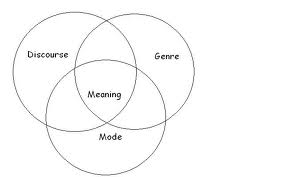
In any breaks in necessity – between semesters, breaks at work, children otherwise occupied, no “required” readings or commissioned work, etc… – with each passing season, I gradually discover what matters most to me (literarily speaking, which, for me, involves much of my lived life) – perhaps I might refer to it as my meaning-making-factory-resources (Blanchot says of Borges that he is “an essentially literary man – which means that he is always ready to understand according to the manner of comprehension that literature authorizes).” Β At this point in my living, over four decades along, and a large percentage of the pie devoted to reading, those voices I turn to, their messages and efforts, have become quite consistent. Β Each year there are new ones, new threads and concepts, theories and expressions that very significantly impact my living – but they tend to find their place as commentaries, extensions, additives and queries to what (I suppose) now forms my central “canon” of sorts.

This struck me, following my return to Bakhtin and Blanchot, and as we prepare for vacation how I immediately reached forΒ Soulstorms by Clarice Lispector andΒ The Museum of Eterna’s Novel (The First Good Novel) by Macedonio Fernandez. Β In searching for this image of Fernandez:
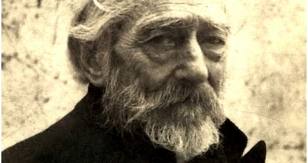
Macedonioa host of Google’s “related images” arose – including Borges, Lispector, David Foster Wallace – and I got that vision of how pantheons develop and connect and gradually form a kind of woven semiotic pattern – a “worldview” or “Innenwelt” I guess – it begins to make sense what’s connected to what and whom to whom throughout time and space of world-being. Β Beckett, Blanchot, Dostoevsky, Pessoa, Rilke, Cixous, Kafka, Bakhtin, Jabes, these visions and verbals I return to again and again and again and again – inexhaustibly – and although my copies are nearly glutted with markings and underlinings – and they feel intimate and familiar (on the one hand) – that I also feel I am always learning them anew, freshly, with EVERY read.

These things astound me.
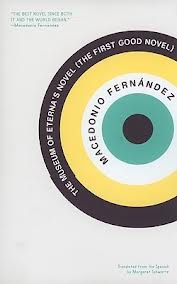
Museum of Eterna's Novel

Of this particular book (which I often say is the very best novel I have ever read, repeatedly), Adam Thirlwell writes “It is a novel which does not want to begin. Β Or, perhaps, it is really a novel which does not want to end…The aim of Macedonio Fernandez’s novels is to convert all reality into fiction (or the other way around).” Β “The real subjects of this lightly playful novel are the grave ones of death and love.”

“In his novel, Fernandez tests the possibility that all philosophical questions are only meaningful in relation to human relations: that all questions of infinity are really questions about love.”

and so on.
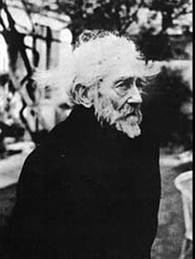
Macedonio 2

Macedonio is, for me, a hero the likes of Bakhtin, Blanchot, Beckett – those writings and writers I will never “get over,” never “get around.” Β Writings I can only ever “go through.”

Perhaps these writings are characterized by the question – “What is it to be real?” Β I recently discovered in one of those “shock of recognition” moments that although I’ve studied theology, philosophy, classical music, art and literature and now information sciences and systems theories – that none of the CONTENTS of these fields sustain my passions – it is the relationships between them – the ligaments and synchronous reverberations they emit – the MEANING-making effects of their pursuit and inquiry that is REALLY what drives me toward, into and through them. Β I’m not looking for truth or necessarily facts or any answers – but for PROCESSES and PRACTICES that enrich, enhance and extend my biological life in relation to the world I’m “thrown into.”

Borges wrote of Fernandez: “MacedonioΒ is metaphysics, heΒ is literature” and that “writing was no trouble for Macedonio Fernandez. He lived (more than any other person I have ever known) to think. Β Every day he abandoned himself to the vicissitudes and surprises of thoughts as a swimmer is borne along by the current of a great river.” Β The novel’s translator writes: “The method is madcap; the intent is desperately human.”

Perhaps that is what I’m after – to be “desperately human.”

and now we’re heading off to the wilds – to be desperately human with-world with-family – replete with above-mentioned authors and without wi-fi or internet services!

P.S. (also from current reading –Β The Waste Books by Georg Christoph Lichtenberg):

“Be attentive, feel nothing in vain, measure and compare: Β this is the whole law of philosophy.”

and

“To grow wiser means to learn to know better and better the faults to which this instrument with which we feel and judge can be subject.”

All the best!
As relates to…


bakhtin2

I have wanted to share (for years) the significance and import of Mikhail Bakhtin‘s manner of thinking, writing in the formation of my own worldview and understanding of the confounding irritations of working in language and the interactional miracles of the medium. Β C.S. Peirce and Bakhtin strike me as two composers with whom I do not encounter a brilliantly organized thought or true-ringing arrangement of letters that they are not echoed in. Β I discover re-presentations and simulacra of their models, but rarely extensions, corrections, or improvements.

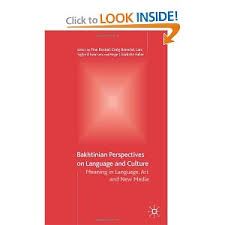
With that in mind, I have been poring through a multi-authored volume entitledΒ Bakhtinian perspectives on language and culture: meaning in language, art, and new media edited by Bostad, Brandist, Evensen and Faber. Β Note-taking, underlining, cross-referencing, formulating, and it has occurred to me that these texts are SO mesh-marked with mnemonic traces for me, that I should simply provide interested readers access to all I can link. Β Setting out to locate a Pdf of the introduction and chapter 2: “Rhetoric, the Dialogical Principle and the Fantastic in Bakhtin’s Thought” I came across the entire collection available online – and so I offer it here. Β If you begin, and the perspective captivates you – read on – to the chapters that carry concepts you are passionate about. Β If not, never ye mind! Β I am happy that texts like this can be available – not easily “stumbled upon” in contemporary bookstores and libraries (unfortunately).

To life:

Bakhtinian Perspectives


par example: Β “Language is to be experienced as an interaction of signs neither neutral nor innocent: the word bears the burden of the contexts through which it has passed. Β And every speaker or listener bears the consequences of signs put into circulation, of signs he perceives and answers, of signs he picks up and makes use of for his own ends. Β One cannot stifle the traces stored in them. Β One has to face the cultural experience a whole language underwent in its history. Β Speaking this language and listening to it one unwittingly responds to this experience – the ‘word that lies on the border between one’s own and the other,’ the ‘word that is actually half someone else’s.’ Β The one meaning cannot maintain itself in the face of the many meanings. Β B’s concept irritatingly links the atomizing intrusion of the many meanings into the one (an act that atomises this meaning) with the idea that meaning ‘explodes’ in the contact of two different meanings. Β In other words: splitting up and differentiation, accumulation and trace must be thought of as occuring in the word simultaneously…Because meaning is always a recourse to another meaning and a project for creating new meaning, it doesn not achieve a decisive, definite presence.”

And so forth….!!!!