Found Objects

Greetings all – squishing this in before the homework hits.  As always I highly encourage any and all of you creatives out there to take these generous prompts and craft away, as exercise or effort – The Friday Fictioneers weekly wonderful co-creativity :

Copyright-Rochelle Wisoff-Fields

“Look, the details don’t matter, okay?  It happened, and here’s the proof, and now nothing will ever be the same.”

“As if it were.  As if things could change like that – all over and immediate.  How do we even know what from this collage?”

“Jesus Ralph!  They’re connected by the photograph!  Look!”

“As if the image were the thing itself.  C’mon Rachel, really?”

“God dad!  It’s grandpa, a menorah, a dial-up and some crayons – how obvious does it have to be?”

“I’m gonna need something more than a sign Rachel, something more than a trick of the light.”

N Filbert 2013

Back to School Preparation: “Gleicked”


Other Worlds / Our World … as conceived by a Semiotic Animal

The following is, again, a fairly dense essay, but I find the content so fascinating and very well presented.  The concepts and observations herein form a central core of what I desire to use language to explore – signs upon signs within signs over signs – living in the specificity of our species – and attempting to discover what/where/how that specificity (namely language) might lead/take/auto-generate itself forward.  If these sorts of things interest you as well, i encourage you to lend Deely’s writing your time.

(click here for essay) – Umwelt by John Deely

Fumbling toward FICTION

Okay, here goes.  I’ve been diddling my way into another attempt at a longer go of writing, and today have decided, (largely by the courage of company – Tocksin has also begun posting portions of a novelistic go) to post a few rudimentary fragments.  Up until yesterday  the working title was simply FICTION.  I’ve written 3-5 chapters over the past month or two and in seeking an orientation for the work certain symbols and recurrences have led to an inquiry.  “Write about what you want to know” Lance Olsen says, and I can see I’m searching after something in these words.  The epigraphs that shoot me on are the following…

“Reality is the motif”

-Wallace Stevens-

“The universe was the glue that held him together”

-Jonathan Lethem-

“I only care about fiction that raises the question of what fiction is…”

-R. M. Berry-

“The line is only a shadow cast by one (memory or fiction) over the other (fiction or memory).  Once I place memory into language, memory becomes a rumor that makes room for uncertainty.  Memory slips into fiction but then fiction becomes memory once again in an/other way…It is difficult to separate fiction from memory, which is different from separating truth from lying.”

-Doug Rice-

and so it begins…

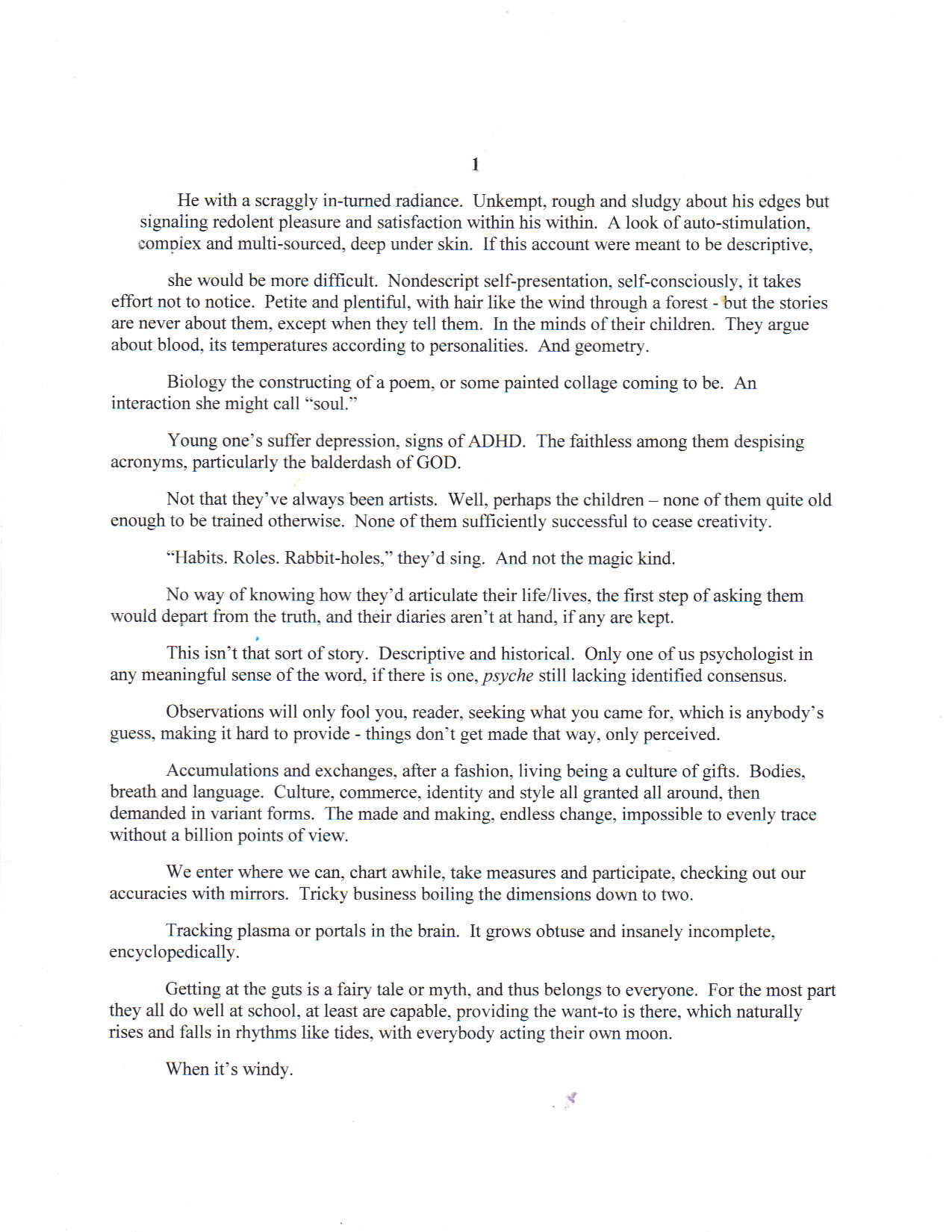
Family 1

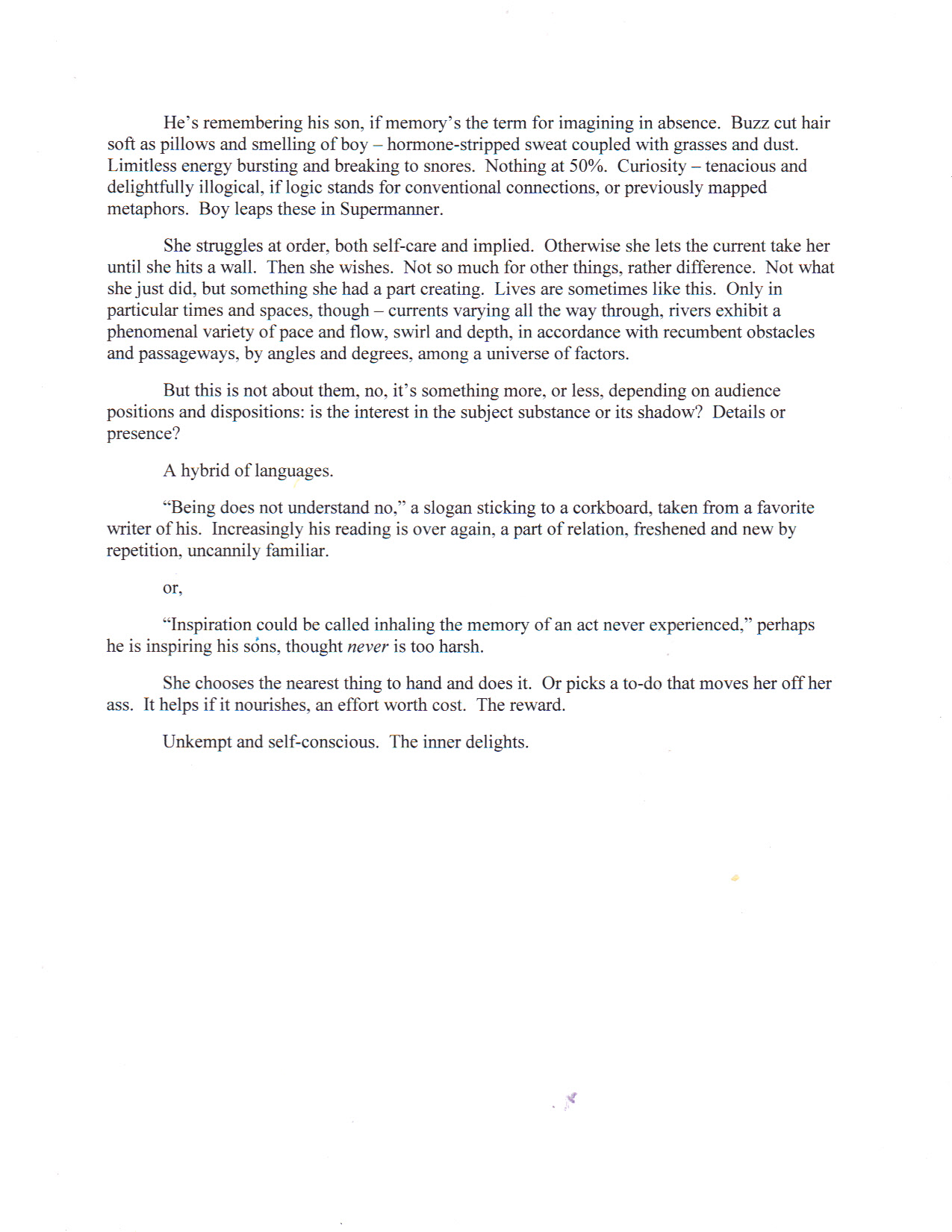
Family 12Family 13

Plunder

Items arriving today:

This slideshow requires JavaScript.

and how I stay in school:

This slideshow requires JavaScript.

keeping on keeping on

“Write about what you want to know”

-Lance Olsen-

The Unfinished

The Unfinished.

(click on title to get to content)

Straightforward: Words from the Book of the Living

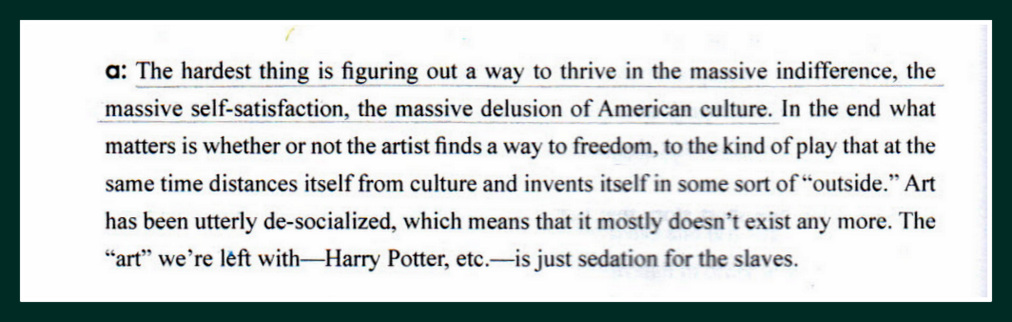
Curtis White, in response to the question “What do you think is the hardest thing about being a creative in this culture?” (North America, 2012):

Curtis White
from, Architectures of Possibility by Lance Olsen

and to “What’s the best advice you might offer a beginning writer?” (I just ‘slipped’ and typed “writher”!), he replied:

“So my best advice is to read Nietzsche until you understand him and go from there”

thank you Curtis White 🙂

Aspects of Writing: The Beginnings – Conception. Inception.


The Beginnings: Conception, Inception

To be thinking about thinking about thinking the origins, the inception, where/when/how the movement-act, a specific verbal urge – that is, to write – conceives.

“To form or develop in the mind.”  “To become pregnant (with child); to grasp seed.”  No when, no how.  No description.  What? – it is a verb, it is verbal.  Con– implying, for inference, a with-ness.  Form requires relation in order to.  Something grasped, taking shape, coming to be.  Wombed – a gathering and a nurturing growth.  Where? – the mind, the gut – of imagination and body.

Inception, then, a beginning, a change, necessarily requiring an other, an outside – entity or energy, movement/matter, to be taken, grasped, to form and develop.   WITH.

Lodged “under the skin,” catching “in the throat,”  sticking “in the mind.”  Festers and swells.  Obstructs and impedes.  Reminds and welcomes or avoids.  Alters, morphs, catalyzing change in and with the host.

Conception: to take with, grasp with, grow and develop with.  To begin is to become.

Alter your position, feel what meets your body, even if only air.  Step forward or back, turn – ceiling, sky.  Nuzzle your nose inside of your neckline – inhale.  Be with all that you are with.  Take it in, work to grasp it, and let it grow and develop, in and with you.  Change.  Begin.  Become.

Conceive.

Otherwise inception, impossible.

 other Aspects of Writing

Aspects of Writing: Writing the Impetus. The Self-Reflexive.

The Self-Reflexive.  Impetus.

The urgency, that is, the urging I feel in setting forth to compose, is dismantling.

In other words, the forcings that encroach, impinge and unleash within me when I’m ‘of a mind’ (experiencing the intention of) ‘to create’ is one of destruction, a defensive attack.

I am thus synonymed by sculptor, woodcarver, archaeologist.

One wants to undo the stories before they reach the page.

In order to find, discover, the figure of them, a more lasting (perhaps) form or shape.

To strip them of their ‘qualities’ or ‘style.’  Their manipulations.  Creation as a straining of the weak, the falsifiable…a process in survival of the fittest, the more “true”(?) or apt.

Chiseling personal explanations and perspectival descriptions down to possibilities.  Unraveling myths toward oracles.  Discounting proofs into theories.

The impetus of writing evokes the motivation of doubt, the landscape is struggle.

“To be inspired” might mean to be activated by an experience accurately called “perfink” (David Krech), or, “perceiving, feeling and thinking at once” (Jerome Bruner).

Regurgitant feeling: investigation, analysis, interpretation – meanings attacking meanings, in hopes.  In hopes that a perfink of “meaning” (a satiation of anxiety, terror, doubt) might prove indestructible – as a possibility.

The narrative, then (the verbal expression of a perfink), is a traffic jam of conventions, presuppositions, reality-views and solipsistic Gnosticism forged within the forging self; writing – as apparatus, activity, function – reflexes: brings self-world to bear on self-worlds in attempts to deconstruct automatic (as it were) constructions of perceiving/feeling/thinking – fighting, clawing, tearing against it with the information and energy of shared resources: language, “knowledge,” the usable past.

Clashings of systems, perfinking perfinks, violent internal skirmishes and acts of terror(ism) – a doing that attempts the undoings of doings – an otherwise endlessly insular, of unverifiable and infinite traces, activity known as self-reflexive

– producing stalemates of exhaustion, individual paucities of supply and reinforcement, ourobourosian

offering only extrinsic chances for momentary cease-fires – the artifact, figure, form of the battlefield, photographed in process and thus submitted – to critics, to readers, to colleagues, to shadows (i.e. to genuine Others) that it might become real (exist in relation, to be directly experienced), corroborated or dismissed by equally limited and idiosyncratic perfinking, outside – both in the world, and of it.

“the contest any artist has with his or her art: working toward a perception that is his or her mind’s peace.”

-Louis Zukofsky-

“the mind carries an austere

inwardness that will not put out its eyes”

-Laurie Sheck-

“Writing is a lonely business’ is both a dull myth and a material fact of the profession, one I happen to be temperamentally suited to endure but which doesn’t gratify my sense of what it’s for.”

-Jonathan Lethem-

Creeley

-Robert Creeley-

see Aspects of Writing
Congruency: Of Delight in It

Thank you Superstitious Naked Ape for such a spot-on condensed rendition of (I think) what Pelevin’s Helmet of Horror evoked for me as well!  Really readers – check these out together – incredible lucky spontaneous occurrences of “synchronicity”?  Almost?

brain-in-hands1

“The God Machine”

by The Superstitious Naked Ape

with the personal caveat that it may as well be named “The Self Machine,” “The Reality Machine” and so forth…

The Helmet of Horror (selected emissions)

by Victor Pelevin