a tidbit on writing

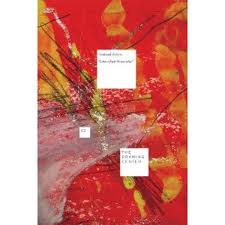
“every thing is a parliament of lines”

I think many people sense a difference between typing, printing, and writing.  But very few, I surmise, might be able to speak clearly about what those differences are.  There’s the kinesthetic difference, the disjunction of flow between thought forming through the body into theories of letters on paper.  There’s a temporal difference, between the stenography of lightning-thought tapped like Morse code onto a keyboard, versus the individuated pacing of each writers body, hand, and facility of digits.  Some may even say there’s a personality difference between interpreting standardized typography as a communication, and the erratics and imperfections of the same terms from a writing hand.

My desk is dominated by books with titles like Chaos, Incompleteness, Complexity, Information, Emergence, Touch, Telling, Lines and Erasure.  Aspects of being human that glance across gaps or dawdle on edges – where knowledge isn’t comprehensive (and where might it be?) – are the processes and activities that fascinate my fancy.

Coupling an article I chanced upon (thank you Scholarly Kitchen) about Technology and Cursive Writing, with my current readings in Tim Ingold’s Lines: A brief history, I begin to slowly realize that how we interact with lines, with writing, is sourced far beyond and beneath our immediate experience.

Ingold begins with the consideration of what we understand by the words “song” and “music.”  How “music has become wordless; language has been silenced.”  In the past music referred to sonorous words set to harmony and rhythm, sounds alone were an embellishment to language, but not the principle purpose.  Language was the sound-filled reality, like animal chirps or barks, the human’s vocal verbality.  With inscription, language began to silence.  Sound encountered a gap with meaning, or took on meaning of a different kind.

Similar worldview realities are exhibited in ways of inscribing.  “In typing and printing, the intimate link between the manual gesture and the inscriptive trace is broken.  The author conveys feeling by his choice of words, not by the expressiveness of his lines.”  And writing experienced gaps in relation to drawing, language further abstracted.  

“Yet whether encountered as a woven thread or as a written trace, the line is still perceived as one of movement and growth.  How come, then, that so many of the lines we come up against today seem so static?  Why does the very mention of the word ‘line’ or ‘linearity’, for so many contemporary thinkers conjure up an image of the alleged narrow-mindedness and sterility, as well as the single-track logic, of modern analytic thought?”

“It seems that what modern thought has done to place – fixing it to spatial locations – it has also done to people, wrapping their lives into temporal moments…If we were but to reverse this procedure, and to imagine life itself not as a fan of dotted lines – but as a manifold woven from the countless threads spun by beings of all sorts, both human and non-human, as they find their ways through the tangle of relationships in which they are enmeshed, then our entire understanding of evolution would be irrevocably altered…It would lead us to an open-ended view of the evolutionary process, and of our own history within that process, as one in which inhabitants, through their own activities, continually forge the conditions for their own and each other’s lives.  Indeed, lines have the power to change the world!”  (Ingold)

Bringing it back to the inscription of language, it is easy to see the bias of expression in the meaning of signs – but that meaning abstracted into disconnected idea-banks of terms, rather than the entire gesture of activity of inscribing.  My talent diminishing to equational finesse – the fiddling and play or arrangement of alphabets like numbers – rather than a being expressing its thought through gesture and individuated agreed-upon symbols and signs.  Perhaps our sense of difference betwixt the typescript and handwritten is that there is a little less of ourselves as individuated organism, and a lot more of standardized general practices and beliefs.  Perhaps we feel a little less in- when our scripts are preformed?  I do not know, I am foraging the questions…

“every thing is a parliament of lines”

-Tim Ingold

Lines, Meshwork, Aether…

I’ve recently acquired (via Inter-Library Loan!  Woo-hoo!!!) a collection of writings exhibited below:

Vital Beauty: Reclaiming Aesthetics in the Tangle of Technology and Nature

which opens with an essay by anthropologist Tim Ingold who starts it off with a remarkable movement through slugs and storms, lines-earth-eather, Kandinsky, Klee, Merleau-Ponty, and others – investigating them through a concept of “meshwork.”

“By this I mean an entanglement of interwoven lines.  These lines may loop or twist around one another or weave in and out.  Crucially, however, they do not connect.  This is what distinguishes the meshwork from the network.  The lines of the network are connectors, each given as the relation between two points, independently and in advance of any movement from one toward the other…the lines of a meshwork, by contrast, are of movement or growth.  They are temporal ‘lines of becoming’…Life is a proliferation of loose ends.  It can only be carried on in a world that is not fully joined up.  Thus the very continuity of life – its sustainability, in current jargon – depends on the fact that nothing ever quite fits..”

-Tim Ingold, “Lines and the Eather”-

Journeying on from there through Deleuze and Guattari, mood and weather, meteorology and aesthetics he arrives at a conception of flesh as both meshwork (exhalation) and atmosphere (inhalation) – a whole-being experience of relation enabling and realizing animate life….

I’ve now been browsing numerous writings by Ingold, fascinated by the semiotic/anthropologico/ontological /scientific meshwork his production encompasses… Thankfully, he makes much of his work available full and free to us… if you’re interested – I risk the promise it will be worth your while…

Lines: A brief history by Tim Ingold

Being Alive by Tim Ingold

and a fascinating working paper as introduction:  Realities: Bringing Things to Life


“Transductive Reading”

Warning:  an unfortunate side-effect of immersion in summer, family and graduate studies is the near-impossibility of crafting fragments of writing into art.  For the time being, then, if you choose to read this blog, it will consist primarily of recommendations, snippets, quotations and reflections with hopefully a weekly creative venture of flash fiction or a poem or two.  The following will fall under the “Reflections” category.

I mentioned “transductive” a few posts ago.  As defined by Gilbert Simondon, a transductive relationship is “a relationship whose elements are constituted such that one cannot exist without the other – where the elements are co-constituants: e.g. humanity and technics are indissociable” (from Bernard StieglerTechnics & Time, vol 2: Disorientation).

I read books by piles.  From time to time I post an updated “currently reading” list, usually comprised of 50 or more books that I keep lined about my desk as a privacy barrier and womb-like conversational enclosure.  I dip in and out of these, ruled by something like mood or intuition – at times I sense exactly what voice or rhythm, style or subject I desire, crave, or need for some sort of equilibrium I lack, and slowly regain by engagement with these texts.  In other words, for my own sense of sanity, well-being, provocation or anticipated growth, I need a collective of minds and voices, styles and subjects to wake me, challenge me, inform me, soothe me, spur me on.  Here’s a smattering from each of the stacks surrounding me…

This slideshow requires JavaScript.

What I recognized today, is that the way I read is transductive – each voice, style, subject, mind I engage is co-constitutive of the others I take in.  

For example, today I’ve been primarily soaking in Mark Taylor’s Field Notes from Elsewhere, and Roland BarthesThe Preparation of the Novel lectures.  Barthes describes the urge to change, to purpose singly, “to invest / disinvest / reinvest” as an experience of the “middle-of-the-journey” – an impossible location, but “nothing other than the moment when one realizes that death is real” and time changes, everything is re-evaluated, re-purposed, the familiar is questioned and made strange.  I think (transductively) what Taylor refers to as “Elsewhere“: “not so much a place as a condition that renders whatever had seemed familiar utterly strange…the axis of the world shifts, even if ever so slightly, and what passes for normal changes.

These books are filled with insight, interest and intrigue (as are the whole swoop of titles in the slideshow), but today, today, I am revelling in the company and conversation these writings (surrounding me) construct and carry one, the opportunity I have to be in the midst of it, my mind like a circuit-operator, pushing buttons, pulling plugs, reconnecting, crossing wires, silencing…reading this way is kind of like the work of conducting a symphony – except the melding sounds occur only within the ampitheatrical shell of my own neuronally-linked brain…transductively.

These works co-constitute me, and come to co-constitute my transductive relationships with my loved ones, environment, world.  Taylor writes provocatively of all the betwixt and betweens of reality – “I am never sure whether light makes the mountains appear or the mountains make light visible…Darkness in the  midst of light and light in the midst of darkness…There is a texture to light that allows – no, requires – the tissue of vision to be constantly woven anew…

Paradoxes and contradictions form the very stuff of our lives…the challenge of teaching, writing, and, indeed, living is to join the abstract and the concrete in thinking about questions that truly matter” (Taylor).  

At this stage in my own biolography…I feel this acutely and persuasively.  The “before / after” of which Barthes writes so fluidly – that there is not enough time left to go on creating projects for the future, what lies behind has not achieved the “wanting-to-write” sufficiently…Elsewhere has been visited (or has visited)…and change, choice and directions must be purposed…

To Want-to-Write‘ (Vouloir-Ecrire) = attitude, drive, desire, I don’t know what: insufficiently studied, defined, situated.  This is clearly indicated by the fact that there’s no word for this ‘wanting to’ – or rather, one exists, a delightful exception, but in decadent, late Latin: scripturire, used just once (in the fifth century) by Sidoine Apollinaire, the bishop of Clermont-Ferrand who defended Clermont against the Visigoths (major poetic work).  What I mean to say is: since a word exists in one language, albeit only once, it is wanting in all the others…

     Why?  Probably because underrepresented, or perhaps, in a more complex manner, because here the relationship between the drive and the activity is autonymical: wanting-to-write is only a matter of the discourse of someone who has written – or is only received as discourse from someone who has managed to write.  To say that you want to write – there, in fact, you have the very material of writing; thus only literary works attest to Wanting-to-Write – not scientific discourses…an order of knowledge where the product is indistinguishable from the production, the practice from the drive (and, in that case, belongs to an erotics) – Or, put differently again: writing is not fully writing unless there’s a renunciation of metalanguage; Wanting-to-Write can only be articulated in the language of Writing: this is the autonymy I referred to…”

-Roland Barthes-

I’m there.  Elsewhere.  Wanting-to-Write…


Borrowed Mask 1.

The only rule,

the only law

of genius, of imagination, of abandonment, of truth,

is change.

.

Not reworking, but change.

.

What is this borrowed mask?

The same old song once more?

Will Apollinaire defend us

this time?

As he did Renoir,

                       his Arcadia, his nudes.

Who will bring back

the soul of art?

Who will bring it back

from the Underworld?

                      Picasso having played

                      Orpheus this go round.

2.

Never rework,

the influence being imaginary

at best, but isn’t that

enough?

.

Always new again,

though there is no new

                    matter.

No new paint.

Only rearrangement.

No change.

Nothing to be changed.

No looking back.

No back upon which

                               to look.

-Percival Everett-

Henry Magazine

Greetings all – thanks to the continuous hard work of Lisa Thatcher et. al., the experimental literary-aesthetic new magazine Henry is live!  I’m excited about this project, not only because Thatcher’s own work and interests are so astute and lively, but the principle of the thing and the open energy of the legacy of Henry Miller.  I invite you all to check it out (helps if you are able to read French), and you will also find a piece of creative writing by myself within.  Thanks Lisa & co., thanks Henry for verve and example, thanks writers and readers – it manifests!

a link to my piece on The Whole Hurly Burly

The Return

Within the hallowed halls of Powell’s Books in Portland, OR with a next-to-nothing budget is not an easy thing to be for book-cravers.  But it also picques the selectional impulse somewhere thrumming in our genetic bands.  Survival of the “fittest” given current conditions and some self-observation through excruciating choice.

What came back with me:

what did not , purely due to economic constraints, and set aside at the last possible moment (at closing):

equivalency finds for my wife:

mary frank Richter - Lines

now to prepare pictures of those immaterial experiences – the fleeting profounds – that happen as we go

to be posted soon

Accompanying me home

“For my father, the road had to wind uphill both ways and be as difficult as possible.  Sadly, this was the sensibility he instilled in me when I set myself to the task of writing fiction.  It wasn’t until I brought him a story that was purposely confusing and obfuscating that he seemed at all impressed and pleased.  He said, smiling, “You made me work, son.”  He once said to me in a museum, when I complained about an illegible signature on a painting, “You don’t sign it because you want people to know you painted it, but because you love it.”  He was all wrong of course, but the sentiment was so beautiful that I wish to believe it now.  What he might have been trying to say, I suppose, thought he never would have even thought about it in these terms, was that art finds its form and that it is never a mere manifestation of life.”

-Percival Everett-

compliments of:

Excursion

we’re heading off to visit children and family in the Pac-NW for a week +…not sure how often I’ll “get back again” to ze blog, but aside from my amazing wife, I’m taking these….

This slideshow requires JavaScript.

Happy Trails….

“A meaning only reveals its depths once it has encountered and come into contact with another, foreign meaning…” – M. M. Bakhtin

Response to a Question from Novy Mir

– M. M. Bakhtin –

Getting to the Point : Tracing Complex Intersections

“A point is considered one of the fundamental objects in Euclidean geometry.  Without depth, breadth, or dimension it is a part that has no part.  It is represented by a dot or period that has some dimension but is not a point, but must cover the point infinite times over.  The point in the two-dimensional world is the intersection of lines and in three dimensions of another line as well and on and on.  A point is only location.  And isn’t that what we are?  Mere points?  Some points suggest beginnings, some ends, all divide, and when they connect or divide, where they are defined, it is always because of a turn, an angle, a shift toward another plane.  How else could we see a point?  The point is.  The point made.  Getting the point.  Pointing the way.  Points out.  Points in.  Point terminus…

…The meaning of life is the purpose of life

…In similar fashion he came to some comprehension of the whole ballet, language being a small window through which very little passed and became helpful, the dance being nearly everything.”

Percival Everett

Point being that there is no point.  That a point is like an abstract sign – a two-sided symbol – of a non-place where relation occurs – where intersection, connection – moves, happens.  Probabilistically?  Infinite.  Point being that getting the point involves a complex thinking

“going beyond itself in the direction of complexity…not from the simple to the complex, but from complexity to ever increasing complexity.  Let us repeat: the simple is no more than a moment, an aspect among several complexities (micro-physical, macro-physical, biological, psychic, social).  We attempt to consider the lines, the tendencies of a growing complexification…as they function (in relation to autonomy, individuality, richness of relations, aptitudes for learning, inventiveness, creativity, etc.)” 

Edgar Morin

(Further reading): Overview of Complexity Thinking – Ferrara

Point being.

Something similar to that – we utilize points and pointing to signify a passing, passage, to trace – to attend to or refer at some intersectional context – thereby creating interactive referants/actants – you, I, the relation.

WordPress as a case in point.

I am ever-so-honored and thankful to have been considered and nominated in community awards insofar as they represent mobile points of connectivity and passage – where one or more of we and our “representation spaces” intersect in this “information common” of the blogosphere.

From Words that Flow like Water I received the “Sunshine Award”


and from  CLisaWork, the “Versatile Blogger Award”

both of which I am very honored and thankful for.

The fantastic element to me about these WordPress community awards is that they allow us to introduce and further the connectivity and intersecting “points” of convergence and accordance that shiftily pertains to our activity and representation here.

The acceptance of the awards imply some obligation to self-report.  I am unsure how I might bring “sunshine” to others through my working-spaces here, but am happy to live with the mysteries.  I tried to find a “Sunshine award” icon that featured rain as rain is much more vitalizing, inspiring and motivating to me personally than sunshine, be that as it may.  So, some things about myself:

  • I prefer rain to sunshine, having always felt the sun to be somewhat invasive and threatening in its brightness and exposure, and rain to be softening and safe, providing more subtle noticing.
  • I also find raw emotion  threatening, and much prefer rational expression of emotion (or musical or aesthetic or literary) to emotionally reported emotion.  In other words, I prefer emotion mediated through other things than body and voice.  I continue to try to understand why this is so.
  • I often feel helpless as a parent.
  • It is never my intention to report my knowledge or ideas as facts or certainties.  I find each day bringing with it so much information that the pattern of it is never symmetrical.
  • I am tremendously graced with a spouse and family that allow and enable me to inquire and pursue connections and concepts in the human universe of information that are far from profitable or sustainable economically.

I am going to use the “award-passing-along” as an opportunity to suggest blogs that (in the “sunshine” vein) inspire and inform me in ways that keep me at it myself, and that enhance my own “versatility” through what they offer and provide.  Please visit them – I am confident that there are so many more that should be listed below (I follow 100s) but there is not world enough and time…

Objects

Simon H. Lilly

Tocksin

Life in Relation to Art

[im]probability theory

Philosophy of Information & Communication

Asifoscope

Unwanted Advice: Reflections of a Self-Appointed Life Counselor

draw and shoot

biblioklept

Creativistic Philosophy

so very very

Searching to See

Spoondeep: Magazine of New Writings

Literary Man

The Unquiet Librarian

Petrujviljoen

Lunch Sketch

and so on….(check my blogroll)…

Thank you all for the rain-like sunshine and versatility you bring to my days:

the connections…