Writing: Chapters that don’t belong – all of them, so far

Here is what has assembled so far…seems like a sort of series…in its wayward way…


WRITING:

CHAPTERS THAT DON’T BELONG

“The pen asks / much more than it can answer / one word at a time”

Philip Levine


“(the world is like a comparison – / the second part elusive),”

Arkadii Dragomoshchenko


“An other is a possibility, isn’t it”

Lyn Hejinian


“Consciousness is always consciousness of something”

Larry Levis


1.  “wake up, snare-setter, / in the snare / spacious, like chance” (Arkadii Dragomoshchenko)


And sometimes I do, wake up.  St. Sebastian pinned as a still-life with crystal lances, a clarity.  But that is catching too, and refracts.  “I think that what I thought when I was thinking that, at least in thinking of it now, I am thinking that I thought it…” and so on.  Crystal lances.  Thoughts refracting.  The occasional conviction.  (Which we call certitude).

The margins within margins, windows in reflection.

Every image being an entrance through which we exit.  From.


I call this “letting actually resonate.”  This being, activity, thinging we do.

If I stand still, so to speak, I form a spiraling vortex, an enormous vacuum.  What is: portal and Black hole every now.  With.

Prepositions being ever-so-important, say “sign-ificant,” that they deserve their own sentencing.


I’ll never know what it is “to write.”  If only because it questions.  Every word.  In.

I can think of it as a working, out, but that is far from any truth I can conceive.  “the second part elusive” with each toggle of a term.


Gravity enforcing force, to fly.

I’ve never been fond of violence, but how else might we change?  Or even move?  On.


A recent well-organized text I perused and then ate, mentioned dialetheia as a two-way truth; or, “true contradictions,” that is, in one.  Word.  Split with a twin.  Comparison as congenital doubling.  Of difference.  Equals such same.


We look toward what can be seen.  Compromised and concealed by a frame.  Otherwise unseen.  Learn, therefore, (through your senses), in-visibility.  Dialetheia.

We do (many of us) love to be astonished, after all.  With.


If there are more parts to this I haven’t found them.  They’re either too large or too small.  I’ll have to wait.  I’m unable.  Nothing living waits.  Patience is pretense, pretend.  Waiting, is searching; patience, is longing.  Loss is implicit.


2.  The Chorus

“As for we who ‘love to be astonished’…

…A pause, a rose, something on paper implicit in the fragmentary text”

(Lyn Hejinian)

            Explicitly.

I.e. “the loss was always implicit as the longing” (Alain de Botton).  And I quote, quoting from someone else’s quotation, but I forget which (or whose).  For.

I’m certain for various reasons.  Which beggar the certainty.

A pause, arose, and fragmented this text.

Because I don’t

know

what I’m

doing

I am writing,

and it questions.

            As if we could get intimate with our process, so near it as to join.  In other words, if our action, breathing, effort, language, thinking, senses and the uncountable inborn “blind spots” that a human system circulates were, well…coterminous.


Is that a question lacking its mark?

It would seem so.  About.

Either too large or too small, perceptively, I suspect.

Causing a pause to rise,

as I search for something implicit.

            Explicitly.


Given the fragmentary text(s) (you agree?) I have to ask:  might writing be possibling an other?  “Consciousness is always consciousness of something” (he said).

That is a possibility, isn’t it?  (the second part’s elusive),


Blatantly – I feel caught in a snare I am setting, as spacious as I imagine chance to be, (having no other name I can call it), ensnared as I seem – some web, some matrix, some universe and beyond – too large or too small to perceive (I am guessing)

which always gives rise to a pause, implicitly.

What I had hoped to make explicit.


What I call “wanting actually resonate,” some loss implicit as longing.

I write, asking more than it answers, or “the closer the look one takes at a word, the greater the distance from which it looks back” (Karl Kraus, which I quote off someone else, who knows who – yet I hope someone does!)


“But of any material, the first thing to make is an ash-tray”

(Lyn Hejinian, I quote this text from its source,

apparently).


3 – ?

“’Appearances / remain suspended / in transmission’ (Craig Watson) are not so much perceived as apprehended, handled; the one affecting, infecting, the next”

(Charles Bernstein)


            Or something to hold what dies off.  The reverberations without resonance.  All edited, edited out, according to needs for appearance, depending on what apprehends, the shape of the handler’s snare.

Think of it – what is selected for capture, in captivity, infects, slipping frequencies to drift on, transmitting, transmitting, there is always ash that won’t be removed, no amount of soaking, scrubbing or spray…

perhaps it’s under the nails, clogging the pores, dusting the follicles… the remains.
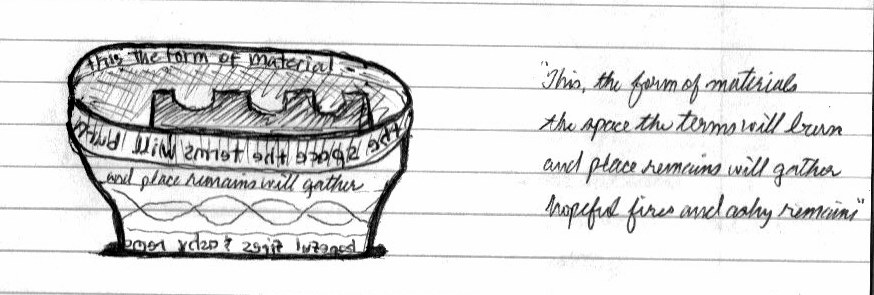
We don’t know why we write, trusting such ephemeral weightless shifty particles to catch as motes in an eye…appearances, like dust (in just the right angle of light), remaining suspended in their transmission…hoping (without, really, hope) to, in apprehension – apprehend, by being handled to affect, infect…

always wanting next.  Making it so.

Depending.


Why the book is needed (as ashtray) as form to hold the crumbling, an urn for the remains, until such time as they might be stirred or shaken or spilled.

Again in the commerce of bodies, handled, brushed and staining.

It gets everywhere.  And remains.

Note its infective spread.

Language, whether structures/systems of, or fragments – bits and pieces, lying everywhere implicit.

To write – to make explicit?  It asks more than it answers, word by word, by letter, by ash…


And what remains?  Suspended…in transmission…for affect…a dormant virus…waiting to be breathed…


4.  Desiring Reality

“the loss was always implicit as the longing”

-Alain de Botton-

“But, no one / can tell without cease / our human / story, and so we / lose, lose”

-Li-Young Lee-

“[Writing] is born from…’dissatisfaction’ – an internal void provisionally filled by the achievement of expression”

-Eugenio Montale-

“Because [writing] mediates between the requirements of desire and the conditions of reality, and because the relation between the two keeps changing, no statement of that relation is final”

-Ronald Sukenick-

“What is important…is not a word that is a stable and always self-equivalent signal, but an always changeable and adaptable sign”

-Katerina Clark / Michael Holquist-


I desire to write.  I think of it, at times, as an inscribing of thought, a physical processing of emotions, subconsciousness, dreams and ideas…”thought is a form of grief…but think we do, and lament we must, because lose we will” (H.L. Hix).  “But no one can tell without cease our human story…” ashes accumulating, carried by arbitrary winds, dissolved in sand and sea…

“Lose, lose” and don’t want to lose (desire); my ‘not-wanting’ is my longing (implicit loss), in other words “what memory is not a gripping thought?” (Lyn Hejinian)…imagination grasping in desire what it does not want to lose…forming an ashtray.  For what it loses.  Implicitly.

“No statement of that relation is final.”  Even, then, obviously, that statement.  Therefore we long to apprehend and handle…capture and contain…frame and represent…to ourselves (for?), for one another (to?) reality as it is not-known to us, unstable, uncertain and always changing.  Remember?

This is what makes this “fiction,” a “novel” – some new telling and unique ashtray design, in search of the fluttering ash, the “changeable adaptable sign.”

Required by desire, conditioned by unstable and unceasing reality, I write…words asking more than they answer, the dissatisfaction(s) (losses implicit in the longing) ever ephemerally, temporarily, momentarily filled by the action, the thought, the attempted expression (inscription) and then immediately felt again (affected, infected).  The plot, the narrative, the characters, all bound up right there – in the next moment’s void.  A gripping thought.  I give pursuit.  I desire.

I write.


5.  Without Trace


At the liminal edge, porous, moist, invisible and insensible arc…imagined limit, threshold…the ache to enter, with nothing to penetrate; the yearn to cross over or through, yet there is no barrier.  Simply following the pen, without copying.

Another way to say “possibility becoming,” or “questions and answers are words,” “letting actually resonate.”  The next part elusive, but its begun.  Refusing to compare.  Forging-foraging-forgery.

I am writing.  An other possibility that must be consciousness of something, perhaps implicit in the fragments, without identifiable trace because ensnared in the traces.

What is fiction, or poetry, essay / memoir / treatise…because making, with usable words.  That toggle so, and displace.  That render in their sundering.  That make a difference…by comparison, where the “other” is not known.

Assuming a tracing could follow or draw.  Like that – following lines or leading them on.  The perceptions, scratch that, apprehension or handling the senses must do when the look, feel, hear, smell, touch; the loss inherent in the transmission to thoughts, fueled by the desire to grasp or retain.  What was never suspended.  Always in transmissive motion…the letters.

If the lines are drawn effectively…I may form a working receptacle (as they falsify and crumble behind me in the ongoing change) where the ashes might be held.  Am I getting the picture?  Taking it?  Is taking it the same thing as making it?  Or must I develop it too?  The pen asking so many questions, word after word, tracing an image, a setting, a how…Will you follow?  Will I?  Will this be called writing and reading?  “Literature”?

I create without trace in the traces.  I go on.  Each word a threshold, a bottomless pit, then beyond that…again.

Like stringing the line and entangled.  Hooked for life…which is death.

Asking synonyming answers.  And vice-versa.  Just words.


I am writing.
Scribbling chapters that don’t belong…(2)

2.  The Chorus

“As for we who ‘love to be astonished’…

…A pause, a rose, something on paper implicit in the fragmentary text”

(Lyn Hejinian)

            Explicitly.

I.e. “the loss was always implicit as the longing” (Alain de Botton).  And I quote, quoting from someone else’s quotation, but I forget which (or whose).  For.

I’m certain for various reasons.  Which beggar the certainty.

A pause, arose, and fragmented this text.

Because I don’t

know

what I’m

doing

I am writing,

and it questions.

            As if we could get intimate with our process, so near it as to join.  In other words, if our action, breathing, effort, language, thinking, senses and the uncountable inborn “blind spots” that a human system circulates were, well…coterminus.

Is that a question lacking its mark?

It would seem so.  About.

Either too large or too small, perceptively, I suspect.

Causing a pause to rise,

as I search for something implicit.

            Explicitly.

Given the fragmentary text(s) (you agree?) I have to ask:  might writing be possibling an other?  “Consciousness is always consciousness of something” (he said).

That is a possibility, isn’t it?  (the second part’s elusive),

Blatantly – I feel caught in a snare I am setting, as spacious as I imagine chance to be, (having no other name I can call it), ensnared as I seem – some web, some matrix, some universe and beyond – too large or too small to perceive (I am guessing)

which always gives rise to a pause, implicitly.

What I had hoped to make explicit.

What I call “wanting actually resonate,” some loss implicit as longing.

I write, asking more than it answers, or “the closer the look one takes at a word, the greater the distance from which it looks back” (Karl Kraus, which I quote off someone else, who knows who – yet I hope someone does!)

“But of any material, the first thing to make is an ash-tray”

(Lyn Hejinian, I quote this text from its source,

apparently).

Scribbling chapters that do not belong…

1.  “wake up, snare-setter, / in the snare / spacious, like chance” (Arkadii Dragomoshchenko)


And sometimes I do, wake up.  St. Sebastian pinned as a still-life with crystal lances, a clarity.  But that is catching too, and refracts.  “I think that what I thought when I was thinking that, at least in thinking of it now, I am thinking that I thought it…” and so on.  Crystal lances.  Thoughts refracting.  The occasional conviction.  (Which we call certitude).

The margins within margins, windows in reflection.

Every image being an entrance through which we exit.  From.


I call this “letting actually resonate.”  This being, activity, thinging we do.

If I stand still, so to speak, I form a spiraling vortex, an enormous vacuum.  What is: portal and Black hole every now.  With.

Prepositions being ever-so-important, say “sign-ificant,” that they deserve their own sentencing.


I’ll never know what it is “to write.”  If only because it questions.  Every word.  In.

I can think of it as a working, out, but that is far from any truth I can conceive.  “the second part elusive” with each toggle of a term.


Gravity enforcing force, to fly.

I’ve never been fond of violence, but how else might we change?  Or even move?  On.


A recent well-organized text I perused and then ate, mentioned dialetheia as a two-way truth; or, “true contradictions,” that is, in one.  Word.  Split with a twin.  Comparison as congenital doubling.  Of difference.  Equals such same.


We look toward what can be seen.  Compromised and concealed by a frame.  Otherwise unseen.  Learn, therefore, (through your senses), in-visibility.  Dialetheia.

We do (many of us) love to be astonished, after all.  With.


If there are more parts to this I haven’t found them.  They’re either too large or too small.  I’ll have to wait.  I’m unable.  Nothing living waits.  Patience is pretense, pretend.  Waiting, is searching; patience, is longing.  Loss is implicit.


An Equation

I’m running through files trying to organize things and adjust to a new computer.  Once in a while I stumble on something I hardly remember making but still feel a deep accord with.  This was one of those things.  I think it stands for.  Still.  What.

(i only wish it were still freezing)

Here goes:

Moment: Airy

(being an experiment, in theory

a result)


It is hard.

It is hard and it is cold.

Hard as in difficult.

Each thing.

And cold because of the weather.  Well below the freezing point.  But his gloves staid on, his lips held a cigarette, and he boxed.

He could box that paper.  That paper-thin page.  Already beaten to a pulp.


Him with a theory.

The theory a sort of equation.

The equation as follows:


ALL (whatever a person is, has, does) + ALL (a person’s skill, effort, strength, talent, knowledge and ability)

= Appearance of Art (momentarily)

Notation:  A + A = AA

An utter mystery to him.

So he sat in the freezing cold, a pen in his hand, the ink sludging slow, paper on a desk, digging/ exposing / exploring himself, believing / composing / revising language,

oh, and the catalyst necessary to the actual experimentation of this theory – (he writes) – MAKING

One had always to be making (working, acting, writing, performing) with ALL (of him or herself) and ALL (of one’s capacities, faculties and tools) to carry out this experiment, i.e. to test the hypothesis.

Catalyst: (he notes) making (out of/into/with/toward)

Source and goal (purpose, intent) unnecessary, indifferent

Any action requires an energy source.  In this case: living organism possessing capacities, perhaps even proficiencies, and coffee, and cigarettes.

No specified laboratory or station or constituents (conditions) to each his own [marginalia]


Quite a simple test really.

Requiring no great funding, no special services or permissions, few qualifications, variant supplies.

Simply vast amounts of time and consistent (persistent) and enormous amounts of effort. (As he saw it).


Reviewing centuries of other experimentations and practitioners of this simple eternal test led him to observe : “results in momentary airy results”

(often discovered in different places at different times dependent on observer – even in same test results – thus airy, ephemeral moments)


Feeling he had yet to produce an AA.  A momentary Appearance of Art, he was compelled to introduce a compendium of criteria – identifiable attributes – whereby to justly analyze resultant artifacts and actions.

Again the qualities boiled down quite simply:  put the equation into reverse for the observer or verifying assistant:

an Appearance of Art results through the remaking process or catalyzation of the observer,

requiring as a result, ALL of the observer’s person and ALL of the observer’s capacities,

faculties, abilities.

Notation: criteria for AA to be AA:

AA = (must equal) A + A

He practiced this experiment from both sides of the equation – attempting to verify Appearances of Art by engaging / observing / remaking results that demanded enormous effort, large amounts of time and all of his experience and capacities, and as the performer of the experiment – devoting vast amounts of time, energy and effort of his total self to the making of Appearances of Art.


It wasn’t going well.

It is hard (extremely difficult)

And it happens to be very cold (causation: weather in Winter)


He’d read of other conditions explicated by practitioners before him: contingencies such as warmth, geographical position, silence, wealth, solitude, suffering (the Ss came up quite often); specific environments, times or places, assistant substances or particular tools or resources, even difficulty itself had been recorded – but there seemed to be no rhyme or reason, certainly no agreement, in fact, very often direct and incommensurable contradictions between one catalystic experimentor of A + A = AA and the next, which led to his marginal note (copied above): “to each its own


He carried on, in spite of the grave difficulties, confusions and multivalent referents of the equation’s elements.  Once in awhile he believed he had discerned a momentary result – an appearance of art in his own private performances of the experiment; unfortunately he could not obtain verification of his tests from contemporary scholars/students/or adepts of the ancient and cryptically-clear equation.

He had no trouble himself verifying most attested AAs, given sufficient time and effort, but, as he progressed in his work, identification became more efficient yet verification demanded more and more of him, devouring his time, energy and effort, interfering with and greatly complicating his own experiments and test cases from the equation’s other end.

He began to understand why past personages were led to choose to practice and perform the experiment from one side or the other.


It is hard.

It is cold.

And there is only so much time and effort.

There is only so much living organism to be had.

Limitations began to seem insurmountable.

But by now he had come too far.

There was only to go on.


It is hard, he wrote.

It is hard and it is cold, he recorded.

Hard as in difficult.

Each thing.

And cold because of the weather.

But my gloves stay on, he wrote, and my lips still hold a cigarette, right to the end.

His gloved hand fighting the pages.

There is only so much life.


N Filbert 2012


Embosched

A story-like creature I found in the paintings of Breughel and Bosch…recently submitted to Fresh Ink…thought I would reblog here.

Embosched

Writing: the Subjects

Writing: the Subjects

A lot can be read about what it takes, means, requires, or qualifies a person as a writer.

From “someone who inscribes a text,” (akin to walking or speaking), to publication and critical acclaim (akin to fame and riches).

As I see it

it must begin with a facility with language.  Any language.  An awareness of words and their implications.  The intention to utter.

Uttering tends to search a subject, (what words are “about” is as various as the universe) and a style or voice (how it will inscribe).

From there it’s simply performance: arranging or placing the selected words in a medium with a measure of physicality, sense-ability, somewhere capable of being perceived.

As far as I can think it, when these few elements are satisfied what we are engaging is “writing” as a product of “writer.”

He chooses a form of English he has acquired through hunting and gathering, a language institutionalized and socially invested in him with measures both beyond and within his control.

He searches a subject to say.  Already subjective (as he is the one searching with what language he has or is able to acquire or create) his utterance will always contain an “I” – both shaped and formed by his responses and politically constructed by his social milieu.  In other words, there are always more than one “subject” in every utterance.  At base, at least three: the language, the user, the construction and arrangement.

He’s already overwhelmed with the largeness of the simple subjects inescapable to human languaging, and he’d thought to write about rocks (geology) or time (epistemology); romance (psychology) or events (history; ontology).

Subject-fields are vast, you understand.

Having sought to describe an object (desk or stone) in space (again scientific theories / epistemology) each signal latent in language subjectivized: using language creates subjects, no objects remain but are subjectively engaged.  Language is an invisible bridging, a liminal skin, connective absorbent tissue, subjectively creating subjects-in-relation.

This, apparently, its object.

Thus uttered…a story.

N Filbert 2012


Recommending Brilliance

Today I am thinking of that particular mysterious and mind-blowing talent that a very few writers have done well throughout history, beginning perhaps with Cervantes or Sterne? perhaps Ovid…that amazing capacity to seamlessly, compellingly involve myriad levels of reality in each paragraph.  The containment and development of Reader, Writer and Character or Language without distracting or abstracting any of us from the propulsion and enchantment of the written work!  I strive toward this – that the reality that an experience of art is – is fully presented in each work of art – its requirement of relationship – of a maker, a recipient and a form – to give all of it its due – but so few succeed in this masterfully.  Here are those I am recommending today:

The Museum of Eterna’s Novel (The First Good Novel) by Macedonio Fernandez

On the cover of this book rests the self-reflexively ironic blurb “The best novel since both it and the world began – Macedonio Fernandez)

Fun as that is…as my life goes on and my bodies acquisition of literature expands…I am honestly compelled to agree with that!


the works of Cees Nooteboom – and there are many others –

again, brilliant incorporation of story/character/reader/writer/event seamlessly woven for our engagement

Raymond Federman – works and writings…these are my favorites, but many others also accomplish this reality-making-presenting that literature makes possible on so many levels.

Arkadii Dragomoshchenko

I could throw in Fernando Pessoa, Ronald Sukenick, Lance Olsen, Lynne Tillman, Homer, Shakespeare, Alejandro Zambra and many others…such a wonderful experience to read…but for today – seek these!!!!

The Blank Page

or, it matters what you do with it.

The following are papers made by my children for me for Fathers Day 2012 –

they knew what to do with it!

(hopefully I will learn!)

What Once Was Here…Again

A couple of days ago I reblogged Searching to See‘s incredible posting “What Once Was Here.”   Their pictures lived on and wriggled their way into my psyche, so I asked if they would be open to me composing some paragraphs responding to the images.  What follows is the result of that…

What Once Was Here
images – Emily and Alex Hughes
texts – N Filbert
  1. What’s left hanging, a dangling or loosened shadow, often ends determining.  A note you left with simple instruction opened on unprepared mystery.  Unable to handle and afraid of the dark, tiny conduits tunneling everywhere.  The twine wobbly and knotted, but the lines of the threshold so clear.  When things are left hanging, though exciting and ominous, possibilities frighten.  The key to what once was here is risk.

 Read More…..

WHAT ONCE WAS HERE

Time to Revisit

What is fiction, what isn’t?  William Gass…and self-apparent words…

“that words and sentences should refer less to an outside, signified reality, and more to themselves – whether in their individual physical sounds, or in the train of associations they build within the sentence or paragraph…In this case fiction is the lovely woman Babs (the text), who is made love to (shaped into a novel) by a series of clumsy unappreciative lovers (writers who fail to realize the richly self-apparent potential of language in their hands)…the earlier philosophical work (Blue) is more qualitatively fictional than the second…in each case, the meandering associations are conceptual, triggered by words of course which are first of all there for their self-apparent sense…but which for action depend upon intellectual content, which takes us back (and forth) from fictional self-apparency into philosophical debate…Gass’ theory…is his fiction itself…” -Jerome Klinkowitz

and Gass himself:  “well, it’s really what I’m running into all my inks about, so I had better mention it: the use of language like a lover…not the language of love, but the love of language, not matter, but meaning, not what the tongue touches, but what it forms, not lips and nipples, but nouns and verbs.” (Wm Gass, On Being Blue)