RE-GIFTING PRESENTS, part 1: Inhabiting the Medium We Inhabit

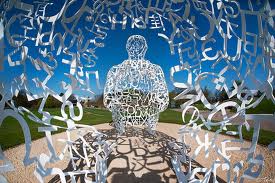
Juame Plensa sculpture

This post is an attempt at exploring and hopefully explicating (at least a little) a dialogue that began in a series of comments between the excellent thinker/writer Tocksin and myself.  The comment thread can be read in full here (if you wish), but I will highlight two sections for purposes of this post:

tocksin says: I am noticing we two like to wax philosophical at the expense of letting our characters speak. We are mere babes in the woods being raised by wolves. Tooth and nail we will fight to have our day. Write we must.
N Filbert says: I find that to be true – what you say about being babes in the woods. Wrestling with everything else inhabiting our medium.
tocksin says: Let me feel you more with what you mean by wrestling with everything else inhabiting our medium.

At which point I made some bumbling effort toward it, seemingly tangling into more confusion.  And was set thinking – how would I verbalize what I mean by the wrestling that using language is?  The next two (or more) posts will be my preliminary attempt to language into it.

I interpreted Tocksin’s first message (above) to concern our propensity as writers to be unable to “leave ourselves out of it” (e.g. to let plot and characters, narrative and action be), rather than to voice-in, reflect, trouble and scrutinize our place in the mix of it, the ourness in the howness of any languagings aboutness.  “Tooth and nail we will fight to have our day.  Write we must.”

All of this started rattling about in my old noggin with what darts around in there from Wittgenstein, William James, Gertrude Stein, Bakhtin, M.A.K. Halliday, J.R. Firth, Benjamin Whorf, C.S. Peirce, Edward Sapir, Peter Berger, and thousands of other voices and ideas regarding LANGUAGE, THOUGHT, BEING, PERCEPTION, etc…

As far as I can tell, these relations have concerned humans since humans have experienced concern.  Who are we?  What are we?  How are we?  When are we?  even from time to time expeditioning toward Why?

language

A few posts ago I quoted Judith Butler from her Excitable Speech to the tune of:

 “language is not a tool that merely allows meaning to happen.  Rather, the relation between language and its users represents a complex ‘matrix of intelligibility’ that makes us readable to one another.  Language, in other words, represents a framework that constitutes both the ‘doing’ and the ‘doer’ alike: the subject always exists in a condition of relation to language that implicates the person using it, as much as the addressee – ‘we do things with language…produce effects with language, and…do things to language’ because ‘language is the thing that we do.’ (from Christina Milletti).

Much greater minds than mine have attempted to tackle this – in language, with language, to language, as well as in painting and music, film and image and architecture and dance: Who are we?  What are we?  How are we?  When?  What is?  Happening?  Basic problems of being as faced by our particular type of organism’s means of awareness: senses, perceptive apparatus, and largish brain – all inputting and outputting, inter- intra- extra- extro-putting simultaneously.

Due to our conditions, one of the stickiest problems seems insurmountable – the ability to experience (consciously) BEING.  Or NOW.  The Present.  IS-ness.

In our splendiferous operations of surviving/existing, the mechanisms and processes of doing so (predictive, inductive, deductive, collaborative, receptive, perceptive, oscillatory, responsive, reactive, self-generated, externally infringed, incited, and so on – AMAZING processes!) TAKE TIME, if only nanoseconds…all to say that our perception and/or sensation of being and existing NECESSARILY are not simultaneous to its occurrence, and yet also ARE, because the organizing and perceiving of our activity also constitutes our experiences AS they occur.

This is one of the reasons William James insists on the metaphor of “stream” for our being.

Here he writes on introspection (self-reflection, becoming conscious of consciousness, or perceiving perception – what language and symbols, signs allow, enable, concoct):

“introspecting the contents of that stream, more precisely, a particular item floating along it, interrupts the streaming, arrests the item (or objectifies), detaches and isolates it.  Let anyone try to cut a thought across in the middle and get a look at its section, and he will see how difficult the introspective observation of the transitive tracts is…As a snow-flake crystal caught in the warm hand is no longer a crystal but a drop, so, instead of catching the feeling of relation moving to its term, we find we have caught some substantive thing, usually the last word we were pronouncing, statically taken, and with its function, tendency, and particular meaning in the sentence quite evaporated.  The attempt at introspective analysis in these cases is in fact like seizing a spinning top to catch its motion, or trying to turn up the gas quickly enough to see how the darkness looks.”

experience

And is also experience, experience becoming.

As I am considering language, that is – assigning description, value, reality using symbol/sign/or index to something in human experiences – I am presenting a coming-to-terms (languaging) for myself of what I attempted (languaging) to “mean” (communicate, share, RELATE) in my off-handed comment to Tocksin regarding “wrestling with everything inhabiting our medium,” as well as an hypothesis that has been haunting me since.

“Wrestling with our medium/habitat – language” means for me in this way: As I conceive (language) the being or existence of the human organism, I interpret an organism of proactive and retroactive complex processes organizing and imputing value to its environment, selectively perceiving and constructing a context or situation in which it can get what it needs to survive.  In the scheme of things (or, its organismal specificities IN RELATION TO other organisms and contexts) the human has developed metaphoric and metonymic signification capacities for purposes of more efficient and productive navigation / survival.

Language, (or humans as semiotic beings) then is a medium in the sense of a manipulator of gaps, or a “thing” insofar as it operates between, RELATIONALLY.  Signs are always IN RELATION TO.  Inner experience, outer experience, communication, description, definition, etc…a SHARED HABITAT, an activity, indeed a primary thinking process – signing experience is a composition, exploration, examination and organizing (improvisational and purposive) of our world and our perceptual relations within experience of it.

Signing – languaging world – is for us our activity of finding out, making sense, interpreting, composing and exploring being/existing.

So when we go with purpose to the page to write language – all of this is inherent to the medium – we make our world (as we experience it) inhabit language so that we can experience it and also we inhabit language in order to experience (perceive our perceiving, become conscious of our awareness).  Language is the “stuff”(?) – the medium – the lubricant of passage between ourselves and our senses and perceptions; and everything beyond those individual sensings and perceptions.  Thinking organizes and determines experience.

So self-consciously involving ourselves in language opens up all our experience (known and unknown, much like dreams) to be wrestled with in attempting to make a poem, a story, a report, or a conversation, or, even, a thought.

That is part of what I was trying to say, Tocksin.  Part two will be the idea that has haunted me since…

Immediate sources referenced:

Lyn Hejinian, The Language of Inquiry.  U. of California Press, 2000.

R.M. Berry & Jeffrey Di Leo, editors. Fiction’s Present:Situating Contemporary Narrative Innovation. SUNY Press, 2008.

Gyorgy Buzsaki.  Rhythms of the Brain.  Oxford, 2011.

Rudolfo Llinas.  I of the vortex.  MIT Press, 2002.

William James.  Principles of Psychology.  Cambridge, 1981.
Emissions from the Helmet of Horror, novel mythology-cognitive-science-literature-art

“no one realised that the book and the labyrinth were one and the same…”

-Borges, The Garden of Forking Paths-

[as leaked from the skull stuck to Victor Pelevin]

“…progress is a propulsion technique where we have to constantly push ourselves away from the point we occupied a moment ago…the funny thing is that the concept of progress has been around for so long that now it has all the qualities of a myth.  It is a traditional story that pretends to explain all natural and social phenomena.  It is also a belief that is widespread and false.”

“If a mind is like a computer, perhaps myths are its shell programs: sets of rules that we follow in our world processing, mental matrices we project onto complex events to endow them with meaning.  People who work in computer programming say that to write code you have to be young.  It seems that the same rule applies to the cultural code.  Our programs were written when the human race was young – at a stage so remote and obscure that we don’t understand the programming language any more.  Or, even worse, we understand it in so many different ways and on so many levels that the question ‘what does it mean?’ simply loses sense.”

Ariadne:  “…The diagram was called ‘the helmet of horror’ — it was written in big letters above the drawing.  The main body of the machine was shaped like a helmet.  And there was an identical helmet standing on the demonstration table — an ancient bronze headpiece, and underneath it a visor with holes in it curving back inside…Its lower section ran back inside the helmet through a slit in the middle of the face.  And there were some kind of side plates too — everything was very old, green with age.  It looked like a Roman gladiator’s helmet — like a bronze hat with a visor.  Only this one had horns as well.  They came out of the upper section of the helmet and curved backwards…the helmet of horror consisted of several major parts and a lot of secondary ones.  The parts had strange names: the frontal net, the now grid, the separator labyrinth, the horns of plenty, Tarkovsky’s mirror and so forth.  The largest element consisted of the now grid and the frontal net.  It had two parts that were sometimes fused into a single unit.  Its external part, the net, looked like a visor with holes in it, and its internal part, the grid, divided the helmet into an upper section and a lower one, so there was no way you could squeeze even the smallest head into it…the now grid separates the past from the present, because it is the only place where what we call ‘now’ exists.  The past is located in the upper section of the helmet, and the future in the lower section…The helmet’s operating cycle had no beginning, so it can be explained starting from any phase.

“…start by imagining the gentle glow of a summer day caressing your face.  That’s precisely how the frontal net, heated by the action of the stream of impressions falling on it, transmits heat to the now grid.  The grid sublimates the past contained in the upper section of the helmet, transforming it into vapour, which is driven up into the horns of plenty by the force of circumstances.  The horns of plenty emerge from the forehead, curve around the sides of the helmet and intertwine to form the occipital braid, which descends into the base of the helmet.  There, below the now grid, the bubbles of hope that arise in the occipital braid are ejected into the region of the future.  As they rise, these bubbles burst against the now grid, generating the force of circumstances, which induces the stream of impressions in the separator labyrinth.  And the stream of impressions, in turn, is shattered against the frontal net, heating the now grid and renewing the energy of the cycle.

“It’s not always hope at all, it’s more likely to be fear and apprehension, suspicion and hate, all sorts of nonsense, in fact any of the cud that is chewed with such habitual stupidity…technically speaking it is correct to call them bubbles of the past.  They are called bubbles because their constant tendency is to expand and occupy the entire volume of the helmet, preventing anything else from appearing in it and leaving no space or opportunity for the recognition of what is actually happening…since past is enriched exclusively with more past, the bubbles of hope consist entirely of past, they are simply past in a different state…

“The separator labyrinth is the most important part of the helmet of horror.  It’s the place where everything else is produced out of nothing, that is, the place where the stream of impressions arises.  And it’s also the place where the past, present and the future are separated.  The past moves upwards, the future moves downwards, and the present, in the form of the stream of impressions, falls on to the outer surface of the frontal net, generating the cycle’s passionate desire to recur, so that it becomes a kind of perpetuum mobile…”

“That means that it’s past that decomposes into past, present and future?  In actual fact the whole cycle is simply the circulation of now in various states of mind, in the same way that water can be ice, or the sea, or thirst.”

“…the ‘inside’ and ‘outside’ have no existence in themselves.  They are generated by the separator labyrinth by the force of circumstances and from there they enter the horns of plenty, where they enrich the past, transforming it into the state of bubbles of hope.  But since there is no ‘inside’ or ‘outside’ anywhere except in the horns of plenty, the stream of impressions can quite easily arise inside the helmet and fall on to it from the outside.  And the same applies to everything else as well…never under any circumstances regard anything as real.  The entire phenomenon is induced, like the electromagnetic field in a transformer…as far as I could understand it, the horns of plenty operate like enrichment units in a chemical plant.  When it’s driven through them by the force of circumstances, past gets mixed up with everything else, becoming richer and acquiring value, with the result that bubbles of hope are produced in the occipital braid, go gurgling through the region of the future, are reflected in Tarkovsky’s mirror and perceived as the novel freshness of a brand new day.”

“In real life what you see depends on where you look…the word ‘change’ has no meaning…where you’re looking depends on what you see.  Is that clear?”

“The future is produced from the past, so the further we go into the future, the more past is required to produce it.”

“Free will.  Life’s like falling off a roof.  Can you stop on the way?  No.  Can you turn back?  No.  Can you fly off sideways?  Only in an advertisement for underpants specially made for jumping off roofs.  All free will means is you can choose whether to fart in mid-flight or wait till you hit the ground.  And that’s what all the philosopher’s argue about.”

“Always the way when you feel you’re just about to understand something important.  It’s like the whistle of a bullet or the roar of an aeroplane.  If you can hear them, it means they’re already zooming past you.”

“…a labyrinth comes into being in the course of any discussion with yourself or others, and for that period of time each of us becomes either the Minotaur or his victim.  Although there is nothing we can do with this…there’s nothing we can do without it either…even the discourse itself can only come into being within the discourse.  But the paradox is that, although the entirety of nature arises within it, the discourse itself is not encountered anywhere in nature and was only developed quite recently…Basically a labyrinth comes into being when you have to choose between several alternatives, and the alternatives are a set of our possible preferences, conditioned by the nature of language, the structure of the moment and the specific features of the sponsor.”

“Perhaps that’s the whole point.  Not to think about where the way out is, but to realise that life is the crossroads where you’re standing at this precise moment.  Then the labyrinth will disappear as well.  After all it only exists as a complete whole in our  minds, and in reality there is nothing but a simple choice — which way to go next…We’ve all got dead-ends.  Only it’s not obvious straightaway, it just takes a little while.”

“The helmet of horror fractionates the one thing that is, into the multitude of things that are not.  But since the helmet of horror is in no way the one thing that is, it is also one of the multitude of things that are not.  And the things that are not may enter into every possible conceivable and inconceivable kind of relationship, since these relationships do not in any case exist anywhere except in the helmet of horror, which does not actually exist itself…An individual by the name of A may be a part of the helmet of horror worn by B, and an individual by the name of B may at the same time be a part of the helmet of horror worn by A.  This is the final infinity in both directions, and often both of them are quite nice people.”

“The means by which for many millennia he has attempted to make himself real are terrible and foolish, like all the mysteries of his world.”

A remarkable new mythology from Victor Pelevin

(all above quotations arise from!)

Enough about Writing…


Came across this article…seems to jibe with many blog discussions/posts floating about out there just now…thought I’d like to share it.  It’s a bit dated in places, but the overall concept seems worth your ruminations….

Introduction:
Why Books?
LIBRARIES 2000
Libraries 2000, a seminar to re-examine the function and future
development of libraries in Alberta, was held in 1983. A committee
consisting of representatives of Alberta Culture, the Alberta Library
Board, the Alberta Library Trustees Association, the Library Association
of Alberta and the Learning Resources Council of the Alberta
Teachers Association was set up to look into ways of following
up on the suggestions arising out of the seminar. This is the second
booklet commissioned as a result of these discussions.
Public libraries have long attempted to fulfil many functions and
roles in our society. As financial and human resources have become
harder to obtain, librarians and library trustees have had to give
more attention to examining these roles and assessing their relative
worth. In recent years, there has been increasing discussion of the
public library as an information provider, but less discussion of the
more traditional view of library service.
Sam Neill is a professor at the School of Library and Information
Science at the University of Western Ontario, London, Ontario.
This booklet is based on a speech delivered at the Ontario Library
Association Conference, Ottawa, 1984, entitled “The Role of a
Traditional Library in an Age Bludgeoned by Information.” The
opinions and ideas expressed are those of the author and do not
necessarily represent the view of Albe11a Culture, or the Alberta
Library Board. The assistance of the Alberta Library Board in editing
and printing this booklet is gratefully acknowledged .

Why Books? by Sam Neill

(click for full article, please)

dove-tailing ever-so-nicely with another book I stumbled across in the library (which also contains a fine consideration of David Foster Wallace in one of the chapters), and considers, I think, the same sorts of issues of humaneness and being alive meaninfully:

Another Pause, Another Someday

“Words give clothing to hide our nakedness”

Susan Howe

“But a word is a bottomless pit”

Lyn Hejinian

And then it arrives, unexpectedly, another gap.  She sees a magician in bright jester’s garb, seated on a branch in a tree.  Amid the traffic.  Amid a swarm of bees, of thrumming crows and starlings.  A bat lies in labored breathing on the sidewalk.

Lightning- and Lady- bugs.

Like that, like both.

There is no goal to it in the beginning.  At first.  The seconds’ glow catches you off guard.  “What was that?” neon spot moving in the night.  Imperceptible polka-dotted red creeping carefully over your toe.  Structures pause.  Structures moment.  When realized, when you bring your own accident: awareness.

What pressures turns out to be necessity.  Of deadline, of assignment, of transactional fulfillment – relationship or vocation, even health.  Without apparent choice.  Or ever so long ago.  Why markings called parentheses are shields.  What gives pause.  And stays the pressuring.  For the moment.

An extended kiss.

A lapse in volume.

An ignored alarm.

You find yourself there : (YOU).

The rest of the world lining up, encroaching, exerting itself, themselves, your other selves, against the slender boundaries, the slick curving walls – they can’t be climbed, nor be toppled, only inverted )if you accept the pressures(, or erased as if they’d never happened.  Become brackets.  Prison versus asylum (in its native safety-seeking sense).

(YOU)?  )YOU(?  [YOU]?  ]YOU[?

            Now and then.  Another pause.  Another Sabbath.  A so-called rest.  Time is not the issue (as duration).  Time is at issue in its momentary absence.  Glancing the lightning-bug, bird-call, ladybug feeling out the stem.

“Another pause” with pressures all around.  Expectations or chores.  But no one calling, not this nowLast week too, unexpected, unprepared, cage door left awry, or finding key in hand.  Parentheses.  And then you sleep that active way we call “rest.”  For a moment.  You make, for the joy of making, or not.  Either way is pleasure.  Or pleasant at the most.

Such as now, another pause, this day, another Someday that arrived.

Mark Marking Marks

Cy Twombly

Mark Marking Marks

“oh it’s working, it’s magic, each word lifts me up, takes me away from here,

from this nothing; I feel…I am…speak always, Maybegenius.”

Macedonio Fernandez

Writing as the ‘Talking Cure’

As long as I keep speaking, Mark thinks, – ?

WHAT IS REAL?

            As long as I keep talking to myself, even better the inscribing, using matter somewhat foreign to myself, like this plastic pen, this sheet of paper, this blue ink…I am providing myself with evidence.  A humming continuity, a series of marks, a silent sounding breathed into air.

But when unable?

As long as I keep telling myself these stories, Mark thinks, – ?  then what – ?  why – ?

There is evidence that I am here, he says to himself, marking it down.  Marks make Marks, he supposes, I am, at least as far as the reach of this pen, and I stay, at least longer than my thoughts, he thinks.

Mark got tattoo’d.  He did so for evidence, a permanence.  They said it could not be undone.  So he had them spit into his skin the names of those who had changed him, affected.  As if to say, to go on and on saying, these, these existed for me, in and on me, these folks made impressions that made impressions on me, therefore I must, yes, it logically follows, here – you can see them can you not – ?, it logically follows that I must exist – to have these names, these titled and organized and permanent woundings of names, of those who existed (it’s attested by many), so it follows, it must, with them pierced in my arms, that I, too…

If it all keeps on talking, these whispering names, the sound of my voice, the terms in my head, and if I work to make it real, as an object, if I chisel or stencil or ink it to the world, then surely it must testify on my behalf – I was here!  I am here!  I’ve left my Mark!  Mark marking Mark – a declare!

Or so he is thinking through his days, through his life or lives, through his odd and self-imposing tormenting sort of fear, of worry.

Am I?

To no effect?  he wonders – ?

Mark often fears he’s interchangeable.  Or worse.  Perhaps another boy would have been a better son, left a fuller name, a more remarkable mark than – ?.  Another man a truer spouse and more sensitive or empathetic, more evolved or more mature than his straggly droopy heavy brain of a – ?.  A more substantial father with clearer love and direction, firmer hands, readier tears – ?.  Mark was aware they were out there.  They’d been fellow students, inhabited stories and novels and other people’s lives.  Why were his people stuck with the – ?.  His nagging mark, so often read right over as innocuously as a comma or period.  Weren’t they looking for content not a pause or an absence?  A man marked by inquiry?

But if I leave here some trail strewn round my desk, this floor all these cupboards, perhaps at some point they will see I was here!  I am!  And I was watching and listening, loving and feeling them all.  Spending myself and my worries in this strange attempting to trace and to hold, to keep and remember their details, their effects, my responding.

Someday shuffling through or perhaps clearing out, maybe they’ll stop, pause, question and wonder.  Who was this man?  Where was he?  When?  How?  Why?

What did he do think make say?  And perhaps they’ll find these markings.  Perhaps they won’t have burned or mouldered away, and all these messaging reports, all these processings and accounts will come to mean, to have significance, these bird-routes of scratches and marks, dashes dots lines, this pouring forth of constructing an identity against with the world…

As long as I keep speaking, Mark thinks, possibly –

– ? –

Content’s Dream

“The essential aspect of writing centered on its language is its possibilities for relationship, viz, it is the body of ‘us’ness, in which we are, the ground of our commonness, 

Language is commonness in being, through which we see & make sense of  & value.  Its exploration is the exploration of the human common ground.  The move from purely descriptive, outward directive, writing toward writing centered on it wordness, its physicality, its haecceity (thisness) is, in its impulse, an investigation of human self-sameness, of the place of our connection: in the world, in the word, in ourselves.”

-Charles Bernstein-

The Bewildered Bewildering (attempts toward clear thinking)

Searching for truth(s)

As one attempts to come nearer to one’s existence as a human – its systems, structures and functions – from mental imaginative realms down to cellular genetic levels – the complexity and confluences involved can be bewildering.

Are bewildering.

It is easy to get one’s self “lost” as a human being.  On literally billions of levels we participate in constant (and I mean unceasing) input and output of information, movement, form, energy and so on.  It’s more than we can individually handle.  Yet we are made to.

In other words, it is we as individual humans – our bodies, our minds and experiencesdoing the bewildering we find bewildering.  Perhaps this is my first noble truth: consciousness means being aware of and bewildered by our bewilderment.

How to proceed?  There are a bewildering amount of possibilities and processes for us bewildered humans to bewilder our way into.  We can study, forge purposeful relationships, work, play, think, dream, parent, fight or flee our bewilderment.  Opened up, we do not know the options or capabilities, the extent our bewilderment can reach.

Everything is strange.  If this were my second noble suggestion, it would imply that with each moment of our existence we are encountering the unknown.  We recognize our existence by dissimilarity, non-identity, difference.  This makes all things new.  We literally have never been where we are in space, time or living at any instant, before.  We do not re-live, we are ever living-into.  The contents of the past can become part of our structuring and processing, but nothing repeats, everything “enters.”  Each no-time now is brand new experience of unknown reality, experienced, imagined, interpreted, perceived and felt by us in incalculable ways through a vortex of communications and processes we have very little control over.

We, the producing products.  Perhaps this is noble human notation number 3.  What happens in our bewilderment of presentness is that our individuality opened out ubiquitously functions to produce experiences which are products of our experiencing.  In other words we are unceasing experimentors producing experiences as our products.  It all applies; it all exports.  There are no deletions, erasures or extractions – only new experiences, new dissimilar moments of ongoing processing.

There is no exit from this process.  Form 4: NO EXIT.  Imagined observation, fabricated explanation, hypothetical objectivity, invented theories, meanings, interpretations of sense – none of these removes us from our experiencing or transfers us to any other point-of-view from our individual field.  Bewildering in our bewildering surround.  Semblances, “insights,” knowledge and so on are just pieces of the ongoing differentiation in bewilderment.  How we exist, perhaps not the ant or paramecium or tree cell.  But, then again, perhaps so!

If a lion spoke we wouldn’t understand them, Wittgenstein proffered.  Another way of saying we’re us, bewildered and bewildering beasts, forging into the unknown.  Our access limiting in its unlimitedness (i.e. finitude); systematically mind-blowing and ecstatically depressing in an awe-full or awe-some(?) way.

Be human.  Be glad for it.  Be wilder.

N Filbert 2012

In Praise of Darkness

“And those of us, never angels, who are verbal, who ‘on this low, relative ground’ write, those of us who lowly imagine that ascending into print is the maximum reality of experiences?  May resignation – the virtue to which we must resign ourselves – be with us.  It will be our destiny to mold ourselves to syntax, to its treacherous chain of events, to the imprecision, the maybes, the too many emphases, the buts, the hemisphere of lies and of darkness in our speech.”

-Jorge Luis Borges-