Writing’s Toxin

Barthes - Novel

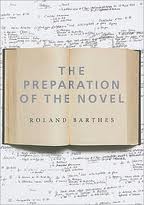
“Is it possible to make a Narrative (a Novel) out of the Present?  How to reconcile – dialecticize – the distance implied by the enunciation of writing and the proximity, the transportation of the present experienced as it happens?  (The present is what adheres, as if your eyes were glued to a mirror).  Present: to have your eyes glued to the page; how to write at length, fluently (in a fluent, flowing, fluid manner) with one eye on the page and the other on ‘what’s happening to me?'”

“The novelistic ‘drive’ (the love of the material) is not directed toward my past.  It’s not that I don’t like my past; it’s rather that I don’t like the past (perhaps because it rends the heart), and my resistance takes the form of the mist i spoke of – a kind of general resistance to rehearsing, to narrating what will never happen again (the dreaming, the cruising, the life of the past).  The affective link is with the present, my present, in its affective, relational, intellectual dimensions = the material I’m hoping for (cf. ‘to depict whom I love’).”

“This is actually to go back to that simple and ultimately uncompromising idea that ‘literature’ (because, when it comes down to it, my project is ‘literary’) is always made out of ‘life.’  My problem is that I don’t think I can access my past life; it’s in the mist, meaning that its intensity (without which there is no writing) is weak.  What is intense is the life of the present, structurally mixed (there’s my basic idea) with the desire to write it.  The ‘Preparation’ of the Novel therefore refers to the capturing of this parallel text, the text of ‘contemporary,’ concomitant life.”

“Now, although at first glance making a novel out of present life looks difficult to me, it would be wrong to say that you can’t make writing out of the Present.  You can write the Present by noting it – as it ‘happens’ upon you or under you (under your eyes, your ears) – In this way, we at last come in sight of the double problem, the key to which organizes the Novel – on the one hand, Notation, the practice of ‘noting’: notatio.  On what level is it situated?  The level of ‘reality’ (what to choose), the level of the ‘saying’ (what’s the form, what’s the product of Notatio)?  What does this practice involve in terms of meaning, time, the instant, the act of saying?  Notatio instantly appears at the problematic intersection between a river of language, of uninterrupted language – life, both a continuous, ongoing, sequenced text and a layered text, a histology of cut-up texts, a palimpsest – and a sacred gesture: to mark life (to isolate: sacrifice, scapegoat, etc.)”
“On the other hand, how to pass from Notation, and so from the Note, to the Novel, from the discontinuous to the flowing (to the continuous, the smooth)?  For me, the problem is psychostructural because it involves making the transition from the fragment to the nonfragment, which involves changing my relationship to writing, which involves my relationship to enunciation, which is to say the subject that I am: fragmented subject (=a certain relationship) or effusive subject (a different relationship)…a Novel-Fragment…”

for Friday Fictioneers – 21 June 2013

copyright -Managua Gunn

As long as nobody moves.  Scenario accomplished.  Sky filled with blues.  Reflected in waters, reassembled by lines – manufactured / emergent.  The breath would come.  Optionally.  A reality could be structured with less than this.  Hold still.  In the beginning – world.  Populous, variegated, intricate with potential.  A setting of pebbles and mimes.  Activities at the ready.  Engine set to whirl.  As long as nobody moves.  Nobody says.  Nobody breathes.  Still-pointed swirl.  Anticipation.  The drawing of the sneeze.  A trickling toward itch.  Hummingbird-eyelid.  A sudden rush of wind.  Transgress.

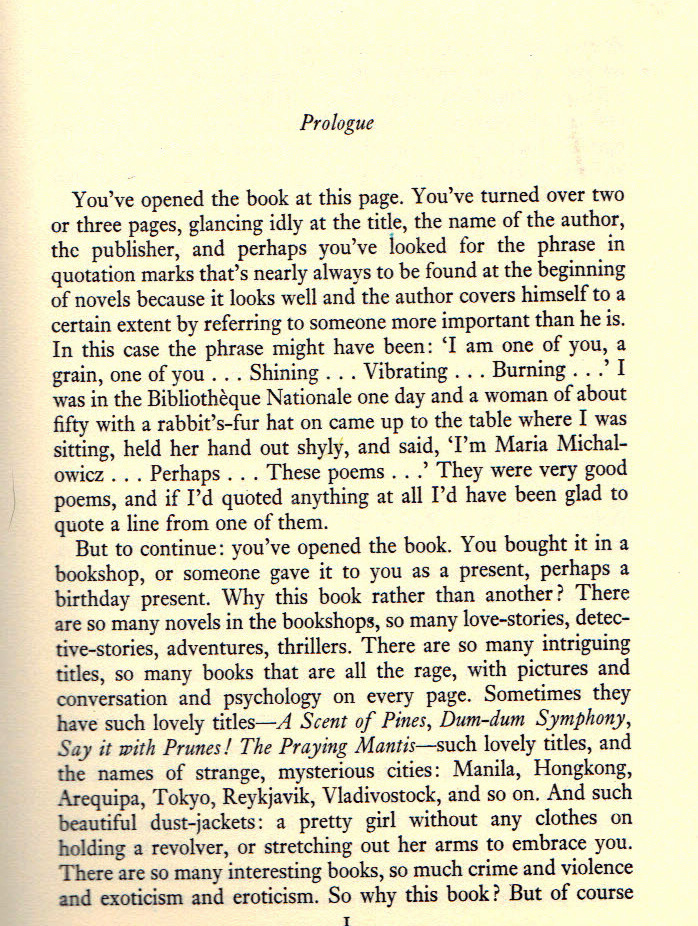
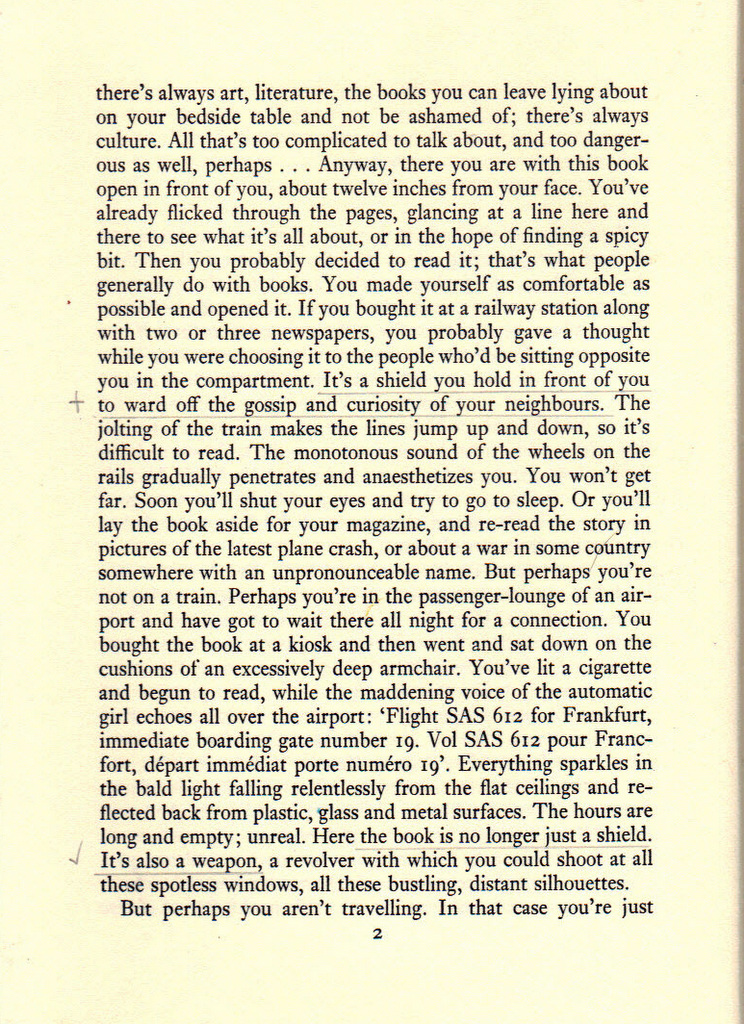
On entering the world(s) of the text: Prologue

via J.M.G. Le Clezio

Terra Amata

Terra Amata2

Terra Amata3

Terra Amata4

Percival Everett on Meaning

Window Dressing

for Friday Fictioneers, May 31, 2013

Copyright - Janet Webb

You, in your bluish hue – nostalgic and hopeful – ever inhabiting a kind of aether, neither here nor there, but possible – like heavens, like waters – deep, open, beyond.  A different form of presence, not with, but altogether.  Perhaps.  Whereas I, in fleshy, earthbound, soiling tones – dressed to catch the eye – hang myself into the world of shapes and edges, angles and points – risking extravagant extension rather than mirroring sea and sky.  Butting bodies – yours forgiving and surrounding, just shy of the resistance for friction – mine stolid and secure, and flagging its pronouncement.

N Filbert 2013

Never Good With Numbers – 24 May 2013 – Friday Fictioneers

knee-jerk response trying to coax the writing machine within, thanks Rochelle Wisoff-Fields and Friday Fictioneers community

Copyright - Danny Bowman

I was never good with numbers.

I meant, I intended, I felt the pressing need to say, to clarify.  But I was never good with numbers.  At least to specify, remonstrate, apologize, perhaps even to confess.  Certainly profess, express remorse, plead a little, cry.  I wanted you to know.  So many things.  How you struck me, thudded through, infiltrated, saturated, overwhelmed.  How I craved and believed.  What I dreamt.

But I was never good with numbers.


Excursion

we’re heading off to visit children and family in the Pac-NW for a week +…not sure how often I’ll “get back again” to ze blog, but aside from my amazing wife, I’m taking these….

This slideshow requires JavaScript.

Happy Trails….

The Argument Tunnel / A Chaos Tube

            From non-computational directions we arrive.

We may enter unaware or gingerly, with good and caring intentions.  We might have plans to rush right through – eyes cinched, hands clenched, heart throbbing – with risk and fear in angry justice or righteous defense.  We often stumble in.  We get tripped up.  It is possible we are shoved.  Sometimes we charge.

However we get there – within all that dark and churning – disorientation accompanies our arrival.  This temporal funnel – a passage where noise wins the day, interference scrambles messages, things fall apart and the center will not hold – renders us untethered, at loose ends – the chaos tube.

Occasionally we may notice our derailment as our words and thoughts cease mating, time travel whisks us to and fro ‘twixt past and present and some unknown yet desperately predictable future, full of echoey recalls, details smeared and marred, yet panic and terror renowned.  Feelings turn to Emotion – symbolic, iconic, religious.  We find ourselves grasping, delirious, snatching at this phrase and that, yowling or yelling, whimpering and weeping or delivering laws, lecturing truth.

Caught in the Argument Tunnel.  There’s a beginning and end, but they’re tricky, elusive and vague, and no matter.  Socially constructed – this moving event, experimental device – of a limiting duration.  At what point is haywire?  Do body and mind turn ape shit?  Humanity parenthetically undone?  What triggers, pressure, stress compress an organism toward self-destruction – deconstructive discombobulating dislocation?  Unhinged and multi-piloted, the divagations of entropy?

Wind tunnel, spin cycle, a sequencing coming apart at the seams, gyrating out of control, baffled and frazzled by fuzzy and unsolving sets – irrotational vortices of turbulent flow.

Spitting us unknown and misrepresented out the other side.  Episodic psychoses, neuroses, and unity.  Draining extremes, pushed through the wringer, all flushed and muddied – it’s blood and guts, a birth canal, an orifice, survival.

Of limiting duration.  A tunnel, a tubing, a way.

This slideshow requires JavaScript.
The Heart and its Branches

“I do not want to know about the human heart.  I do not desire to speak at all about those indwelling, intimate reaches of the heart in which anguish is an undiminishing personal interrogation, much less to analytically enfetter those reaches.

I have the sense, the good sense, the decency, to have nothing to say.”

“Sick of all the you be’s?  Well, what do you say, you be you and I’ll be me?  What do you say?  We can fall asleep in a room full of the snoring dead.  We can sleep while an old woman twangs away on a bad piano while rain keeps time in the empty street.  We can listen to and count the closings of a child’s fist as he tries to catch a fruit fly.  We can listen to the whistling of the bombs.  We can listen to each other.

I do not want to know about the human heart.”

“I am not a man of science.  I am not proficient in any branch of nature study.  I do not know the difference between an amphibian and a reptile.  I have no yearning for hard knowledge about the hard world.  And yet I have no affinity for anything spiritual.  In fact, I have a pronounced, conspicuous, and striking absence of an affinity for anything spiritual.

I know but one hard thing about the hard world and it is this:  from the sum of all theories, as arranged in accordance with ascertained facts, we make a few assumptions, that we have actually ascertained facts, that we are actually here to ascertain them, and that there is actually a here.”

-Percival Everett-

Dialogue

“You and I exchange lines of dialogue.  Each line is a trap, a misuse, and each misuse is justified by some standard upon which we  have previously agreed, if tacitly.  Thereby appears the nature of meaning.  It is a force that hazards to subjugate other forces, other meanings, other languages.  We understand this all too well and yet, and yet – well, it is like the infirmity, the defect at the base of a dam.  It will hold and it will hold and then it will give up, the dam will give up.  As do we all…

“Believe what you like.  Or, better, believe what you believe; it’s always easier, if you ask me.  You would have me imagine that in some cases language really is just a simple transmission of rather functional, if not banal, messages between speakers.  Not only is that not true, but it is necessarily untrue, even in the most functional of exchanges, say between two firemen or a pilot and her navigator or a surgeon and his operating-room nurse and here between you and me as you attend to me, where I use she and where I use he and even why I might have put she before he, or did not phrase the question as he following she.”

-Percival Everett-