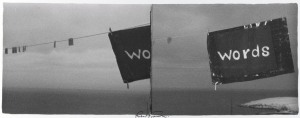
Waiting for words to tell…

Immersed in summer and studies, I find myself struggling with capacities of some purer form of origin beyond connections.  The creativity that satiates me in relationship and studies is one of associations, extensions, combinatory experiments of life-experiences and informations and knowledges.  Fiction and poetry, in a unique manner, seem to process the connectivities and associations invented somehow more within myself.  Not so much in activities of external bonds and ties that loop within/without between concepts and voices, persons and family, and my own; but what bonds those activities and informations spawn within me.  I am finding that these recognitions and constructions take a different sort of time and attention than the frenetic and immediate processings of conceptual knowledges and intimate relations.  Those, of necessity, must be continuous, on the fly, in situ.  Creative writing, in distinction, requires for me the ability for bracketing a space and time in which I am able to attend (somehow) to the recursive loops and dangling ganglia of my own organism of thoughts and emotions.   A sort of internal processing vaguely distinguishable from reciprocal or social processing.  It may not even be real, but only a sensation of process, a variant attention, a sidelong perspective.  In any case, it emits something unique in my writing and reflection, feelings and sensations, and something that I cannot simply produce; something that must be prepared and allowed for, visited, beckoned, welcomed.

I recognized this as I struggle to create for a project, and also possess a yearning to be creating new fictions.  The process art both provides and requires is unique and intense, difficult and serious.  It calls to mind the “effortless efforts” of things like meditation and awareness, mindfulness and tolerance.  The writings of Laura (Riding) Jackson piqued this recognition for me and I will share a couple of early paragraphs from her book The Telling.

“[1] There is something to be told about us for the telling of which we all wait.  In our unwilling ignorance we hurry to listen to stories of old human life, new human life, fancied human life, avid of something to while away the time of unanswered curiosity.  We know we are explainable, and not explained.  Many of the lesser things concerning us have been told, but the greater things have not been told; and nothing can fill their place.  Whatever we learn of what is not ourselves, but ours to know, being of our universal world, will likewise leave the emptiness an emptiness.  Until the missing story of ourselves is told, nothing besides told can suffice us: we shall go on quietly craving it.

[4] Everywhere can be seen a waiting for words that phrase the primary sense of human-being, and with a human finality, so that the words themselves are witness to what they tell.  The waiting can be seen not only in the eager inclined posture of believers.  It can be seen also on the faces of disbelievers, the idolizers of the evident: they are not happy in their impatient assurance of there being no cause but uncaused circumstance, they wear the pinched look of people whose convictions make them a meagre fare.  In the eyes of all (in the opaque depths in them of unacknowledged presentness to one another) are mirrored (but scarcely discerned) concourses where our souls ever secretly assemble, in expectation of events of common understanding that continually fail to occur.  We wait, all, for a story of us that shall reach to where we are.  We listen for our own speaking; and we hear much that seems our speaking, yet makes us strange to ourselves.

[5] …A religion addresses the longing in us to have that said from which we can go on to speak of next and next things rightly, in their immediate time – the telling of what came first and before done forever…How our story has been divided up among the truth-telling professions!  Religion, philosophy, history, poetry, compete with one another for our ears; and science competes with all together.  And for each we have a different set of ears.  But, though we hear much, what we are told is as nothing: none of it gives us ourselves, rather each story-kind steals us to make its reality of us.

from The Telling by Laura (Riding) Jackson, 1967


“Acquiring an open rationality”

The best that I can do on this trip is to share some of the inputs coming my way… aside from the gorgeous lush thick greens of Oregon and Washington, there are also these gorgeous, lush, thick growths…

Edgar Morin – Paradigm of Complexity

Le Moigne – Intelligence of Complexity

The Joy of Incompleteness

“By Godel’s theorem the following statement is generally meant:

  • In any formal system adequate for number theory there exists and undecidable formula – that is, a formula that is not provable and whose negation is not provable
  • A corollary to the theorem is that the consistency of a formal system adequate for number theory cannot be proved within the system”

Rebecca Goldstein

“…there can be neither a first nor a last meaning; [anything that can be understood] always exists among other meanings as a link in the chain of meaning, which in its totality is the only thing that can be real.  In historical life this chain continues infinitely, and therefore each individual link in it is renewed again and again, as though it were being reborn…”

-M.M. Bakhtin-

“And so the world is interior to our mind, which is inside the world.  Subject and object in this process are constitutive of each other.  This doesn’t lead to a unifying and harmonious vision; we can’t escape from a generalized principle of uncertainty.  In the same way that as in microphysics, the observer disturbs the object, which disturbs the perception, in the same way the notions of object and subject are profoundly disturbed each by the other: each opens a crack in the other.  There is, we will see, a fundamental, ontological, uncertainty in the relation between the subject and the environment…a new conception emerges both from the complex relation between the subject and the object, and the insufficient and incomplete character of the two notions.  The subject must remain open, deprived of all decidability in itself; the object itself must remain open toward the subject and toward its environment, which, in turn, necessarily opens and continues to open beyond the limits of our understanding…

All this incites us toward an open epistemology…Epistemology is not pontifical nor judiciary.  It is the place of both uncertainty and dialogics.  In fact, all the uncertainties we have raised must confront and correct each another; there must be dialogue, without, however, hoping to stop the ultimate crack with an ideological Band-Aid.

“If this gap is recognized, then the gap becomes an opening of one toward the other, opening toward the world, opening toward a possible surmounting of the either/or alternative, toward a possible progress of knowledge…”

Edgar Morin-

“Meaning is a collective phenomena…” – Jay Lemke

Material Sign Processes and Emergent Ecosocial Organization by Jay Lemke

“It is only meaningful to speak of originality where there is a tradition” – Robert Musil

“thus one could probably ‘dissect’ any writer whatever (formally, or according to subject matter, or even according to the intended meaning), and would find in him nothing but bits and pieces of his predecessors; by no means completely ‘taken apart’ and ‘newly assimilated,’ but preserved in broken shards”

“Thus in serious literature the peculiar situation emerges that the general ongoing tradition and the personal contribution of the individual cannot be separated from each other.  In this process the continuum does not grow in any dimension other than extent, nor does the personal element gain a solid position.  The whole consists of variations that randomly come to rest on each other.”

-Robert Musil, “Literati & Literature”-

It’s complicated

“In a complex relationship with the environment, very similar substances with the same chemical structure can become quite different in their reality and form”

-Michael Gazzaniga-

“On the evolutionary tree, we humans are sitting at the tip of our lonely branch…We have the same roots as all living organisms.  All those similarities are there.  Our cellular processes depend upon the same biology, and we are subject to the same properties of physics and chemistry.  We are all carbon-based creatures.  Yet ever species is unique, and we are too.  Every species has answered the problem of survival with a different solution, filling a different niche…Homo sapiens entered a cognitive niche…

…in one sentence Garrison Keillor captures humanness…such a simple sentiment, yet so full of human complexity…

BE WELL.  DO GOOD WORK.  KEEP IN TOUCH.

-Michael Gazzaniga-

Another strong recommendation from me for those interested in the what’s and how’s and some where’s and when’s of being a particular we.

Updating Margins

Greetings all you who take the time to peruse my blog.  I thank you.  Let me begin this by saying how I have missed creating blog entries that feel creative to me, that require me to a degree that is nourishing and satiating, rather than feel like marginal notes to my studies.  Thank goodness for a few projects and Friday Fictioneers that  spur me to some dedicated time spent “creating” purposively – differently from intellectual processing toward understanding.  And yet…

As I emerge into a brief pause between semesters, I find myself bewildered with experience and an oddly felt “freedom” that spawn confounding questions in me.  As I completed my final semester paper this week, my mind and body revved to the thought that fictions, essays and poems that participate in the structure of my desk – beckoning and ready as I researched away – can be grasped and delighted in, engaged at will, enter my cranial conversation…but this is also true of my researching – I have been consistently able to construct academic projects that involve and enable my immersion in those things that inspire and enthrall me – that feed my “what do I want to know?” urges.  So where this different nuance of feeling/experience in reading?

This is the question occupying me currently (or field of questions).  As I re-entered Robert Musil’s writings these past few days, while skimming and browsing an unbelievable desk laid with exquisite appetizers (Hejinian, Okri, Danto, Deleuze, Shklovsky, Creeley, Fante and so on) I recognized a feeling I can only describe as “insight.”  My preferential selections do not differ much between resources for academic work and resources for some other purpose.  I am driven to “know” what I am driven to know – it is continuous, related, dynamic.  Any sources from any genre or field or discipline that provide a certain “something” accomplish it.  What felt like “insight” was the recognition as I ranged over very different styles (Floridi, Serres, Wittgenstein, DFW, Larry Levis and so on) that what I seek consistently (and an effect that Musil invariably realizes for me) is work that I must achieve, that challenges, that invents, wrestles, requires change and adaptation, innovation and labor on my part to be ingested, understood.  That forces dialogue between my micro-world of knowledge and understanding and another.  Be it in the mode of expression, the language employed, the ideas, questions and concepts examined or points of view – it must be something that invigorates and surprises, invites dialogue and conversation toward meaning and understanding to occur.  Writing that requires change to be engaged.

At the same time I recognize that I read differently different writings.  I expect poetry, aphorisms, fragments to require percolatory time, as if the texts and spaces sprinkle my mind-lawn and will find their way to the roots in their own time.  I expect logical writings, perspectives or positions to argue with me, to have asked questions beyond what I have had the knowledge to ask, therefore pushing whatever I contain toward corrections and new formulations – adaptation and growth.  If writing asks that I be passive, within sentences it is set aside.

These are the questions I’m formulating and troubling in this margin –

  • How are freedom and restraint – affordances and constraint related (particularly in relation to my felt experience of reading selections – and to what purposes (“academic” vs. – ?)  (is there a versus? or is my criteria for reading homogenous regardless of “assignments” or artifact?)
  • Related: compositions – whether related to schoolwork or blog or journal or artistic projects – are they dissimilar in any way other than forms of expression, manifestation and items?  Or is all processing and expressing work similarly creative, inventive – processes toward meaning?
  • Can I begin to dissolve my penchant for categories and tasks, loosen a little my instinct of organizing complexity?  Do I want to?  Why?

These are my offering for today – reports from the margins, the notations always accruing and collocating in my experience – given air through a shifting of immediate responsibilities…

“To accept questions consists in immersing oneself in the search for the answers that answer them.  Furthermore, the questions specify the answers that they admit.”

-Humberto Maturana-

attached: a phenomenal recollective account of the theory of Autopoiesis – of creatively self-organizing systems like ourselves and our molecules that stuns me.  I invite you to read and differently consider your experience of the world:

Humberto Maturana – Preface to “Tree of Knowledge”

“the pursuit of knowledge does not mean conquest, but invention, the establishment of new relations, which supplement already existing ones and can transform them, make them branch out into unexpected dimensions, rather than deny them, or discredit them as manifestations of opinion, illusion, ‘culture.'”

-Isabelle Stengers-

attached:  a powerful account of “knowing” and how we conceive/relate to the acquisition of knowledge.  Again, if these sorts of things interest you and you are not familiar with her work – I highly encourage you to browse this writing:

Isabelle Stengers – Do We Know How to Read Messages in the Sand?

And again, I thank you for indulging me  in sharing some of my process of living

through this blog…

In addition

This slideshow requires JavaScript.

What I Was Meaning To…

“Abandoned Writing Projects” by R. M. Berry, from:

Signs of Love

“sheer curiosity is even more universal and compelling than lust…”

-Nelson Goodman-

Our Similarities are Different, our Differences so very Alike

            I tell him he’s gotta grant she’s pretty much the same as the last one – skin all over, shoulder-length hair, fingernails and eyeballs.  Her insides must resemble too – veins and nerves, capillaries and molecules, organs and structural bones.  Her life can’t be that much different – born of a woman spent with a man, fluctuating assemblage of persons and animals, a fair share of good times and bad, events and arrangements all occurring in particular times at particular places.  Spoken to and speaking, looked at and looking, heard and hearing, nurtured and natured.  Surely a sign for something.  A sign for herself.

“But she’s so god-damned different man!” he says.  “One in 7+billion!  ‘Like’ no other creature I’ve known!  Her thoughts are anomalous.  She sentences words her-uniquely, her habits, nuances, quirks.  I tell you there’s no one else ‘like’ her!” he insists.

I point out that there are great similarities to her differences – we all of us with particularized habits, specified modes of talk, no two bones alike and what have you – but they’re bones, flesh and language all the same.  She falls within the mean – income and weight, literacy, height, okay.

“But there’re so many differences in those similarities, you dig?” he whines.  “It’s like everybody’s riffing and she’s got my groove!”

            And Johnson has a theory of perspective.  “TOP” he calls it.  He’ll listen to you gloat or bemoan and respond with his “that’s the TOPs!” as if he’s settled the foundations.  I try to get at what he means.

            The undergrads recently requested that I speak to them of love, and I told them all this story (it conveniently being Valentine’s Day).  I read through the roll call, through Margaret, Mary, Toby and Frank.  Through Matilde and Jason and Luzanne and Lars.  Some fat, some skinny, but most in-between, each exhibiting some marker – for instance, their names.  We need those tags to tell us apart, do we not?  We’re all so darn much the same.  Autopsies, biopsies, EKGs, X-rays and cardiograms – most of our differences are ever so slight.  Some flesh here, hair here or not, coloring, dialect, language, inches either way.  However, what we notice – are attracted to or struck by, occasionally enthralled or repelled by – in other words, whatever catches your attention – will lie in those mini-borders of difference.

We’re programmed that way, it’s a survival skill bred in the chemicals – be aware of the unexpected, the variant, the things that are unique – sights, shapes, sounds or energy – locate, isolate, focus – survive it.  Use your limited energy and resources for that – ignore the enormous other.

So every time you’re swept by lust or fall in love – there really IS a difference to that bloke or blonde – IN that gendered entity – you’ve perceived it.  Now comes the process of fitting it to YOUR life.  Your self, habits, knowledge and activities, groups and quirks and ways.  “Normalizing” – becoming “intimate” with those astounding specificities – familiar.

Accommodate, adapt, survive.

By now you’re holding hands or marrying.  Waking up next to.  Joining your bodies and your mealtimes, work and pleasure, daily rounds – and it turns out your partner’s much the same as all the rest (without losing any of their uniquenesses you first attuned to – in fact at this point you’ve uncovered many many more – including a surprising set of facets regarding yourself) – fitting and squeezing and torqueing them into their “signs,” incorporating it all into your own.

They fight, they cry, they talk and fear.  They’re selfish and sweet, funny and sour.  Relatively weak and strong, smart and dumb, kind and cruel.  What did you expect?

Yet having become part of your world, seaming into your point of view, you’re never so alert to them as first you were when they were strange to you and un-experienced, unless you’re threatened or faced with change.  Your energy and perception (remember, by instinct) are set to trigger differences, out-of-the-ordinary readings and measures – the defamiliar.

So although your partner’s arse is golden – or curved similarly to any other – your eyes lock elsewhere.  On unknowns.  Untoucheds.  It’s not adventure or risk that you seek – not exactly – although your senses could be called “restless” in their fearful jitterings and scans – you’re tuned to locate difference – unconsciously filing all that registers “recognize” as same.

As if the world were a line-up and your senses are always on call at the station.

And so on.

We all know (by now) that we’re all fundamentally, formally, the same.  We’re of genus and species and kind.  A school of fish, a hoard of bees.  Excited by difference (spelled “possible danger”) and presumptive of same (spelled “familiar”).

“What’s love got to do with it?” a spritely student asks.

What “love” has to do with it is to shape perception intentionally.  To recognize and remember the vastness of similarity (choosing to ignore many limbic cries over slight variations – the unreasonable feelings of attraction, shazaam, lust and novelty) and cultivating attention to the differences of the familiar.  The creative work of defamiliarization.

A cloud is a cloud is fine droplets of liquids and gas, pressures and waves, particles in patterns and puzzles and billions of babbling atoms…OR…sketchy shapes of oceans, mountains, camel-backs or breasts.  A cloud.  If you dissect your partner’s thumb or knee, spine or brain, or even examine an eyelash or bead of sweat close enough – you’ll enter world upon world of mystery and minute difference…similar to everyone else.  They’re individual entity’s shaped roughly like gorillas or aliens with less hair.  Or angels.  But they don’t think, walk, breathe, sleep, talk, dream, feel, sweat, laugh, stumble, fear, mimic, grieve, complain, remember, hope or anything else “like” ANY OTHER human in the world, not now, not past, not future.  Tune to that – you’ll never ever exhaust it – as you’ll never come to the end of yourself.

“Love” or “attachment,” “personal relations” or whatever we refer to it by – orients and trains our perception through attention (intentional perception).  Keeping in mind and check the reality of mass similarities (with all their exhilarating differences) and fixing determinedly on the magnitudes of distinctive, unrepeatable, specifics and uniquities of this one chosen familiar.

            Anyway, that’s a version of Johnson’s TOP:  “it all depends on how you’re looking at it.”