What Follows

As I mentioned in yesterday’s post, the notebook I grabbed in case of moments of free creative scribbling contained prior forgotten reflections that carried me into further reflections…recorded below:

journalingThe wonderful thing…

The wonderful thing about writing…

The wonderful thing about writing is that you can always begin.  You always face opportunity.  BEGIN.

In addition to that…”in other words”…

In other words, you can always start over.

Begin.  Start over.  Begin.  Start over.

It’s a wonderful thing.

Language.  like moving your body, there’s a kind of body to inhabit.  A world.  A way of being.  You wake.  You move.  You remember…by dis-membering.

In other words.

You sleep.  As you cease to sleep, you remember.  You remember by feeling your limbs, your breath, by seeing, by feeling things (Dismembering).  As you dismember (stuffy nose, neck-ache, coffee smell, pain behind the eyes, the need to potty, and so on…) – you also re-member (stitch together, sew, seam, canvas, invent) and become (again).  Writing is like this.

Language.  A body dismembered – waiting for membering (memory, membership) – invention, use.  Beginning.  Again.

In other words, like organs instructured in-skinned, awaiting awareness, the fabric of socio-cultural symbology (languaging) lies:  in wait:  to be animated, enlivened, embodied:  woke up.

The substance, the atoms and organs – await.  Circulation, enervation, emergence – to live – animate –

to be possible

And become.

In other words, to create, to move, to motivate.

There is no such thing as starting from scratch.

But a scratch is a beginning.

In our bodies, within matter,

in the world – moving gauze, filling quilts,

sensing flesh, donning clothes, filling whispers…

I’m alive.  I begin.

The wonderful thing about writing…

…to awake into a way of being.
IMG_6607p.s… i’m thinking that each begin includes a hope to mean
Troubling Identity in Writing – What Scribbling Does

As an addendum and prequel to writing anything/everything I wanted to share a couple of terrific essays on the strange elimination (or difficulty of perceiving) a “self” or “personality” or “identity” or any of those socially constructed concepts relating to human individuals.  Prompted by the scribbling exercise of last week (see previous post) – the conundrum has long fascinated me and seems to be so well presented in texts like Jorge Luis Borges‘ The Nothingness of Personality (also perhaps available here) and this tremendous first essay – relating to Maurice Blanchot‘s writings – in Anne McConnell’s Approaching Disappearance – (click image to read)

McConnell - Approaching Disappearance

all help me to understand better why it often seems hard for writerlies to formulate or maintain “strong senses of self” – as the practice of entering language in such a way seems to dissolve the separations that might preserve that artificial construction.

Related…

“Yet if language gives no words for what happens…it nevertheless gives itself”

-Christopher Fynsk-

“Not to discover – not to be able to discover – the solution, is the general tragedy of all writing”

“To try to express oneself and to want to express the whole of life are one and the same thing”

-Jorge Luis Borges-

“Reality works in overt mystery”

-Macedonio Fernandez-

8th segment

’cause I don’t have to stop.  ’cause it doesn’t.

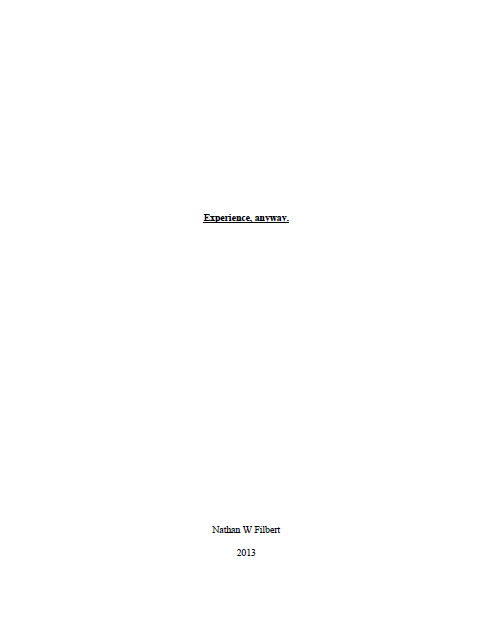
experience anyway cover

8

            And now “I” am different, again.  Change.  Is how I would “put it.”  What with the whip of atoms calling “I” ever-coupling to the Itself that the “I” calls “world,” really, when one gets down to it, in it (always), the distance is elusive (is “illusion”).  And so “I” changes at the rate of the wind “I” is sharing; of the sea “I” is seeing; of the matter (volatile shivering).

It is Here.  We are.  Since we cannot claim a territory, we strain for modes to re-fer (de-fer?).  Differ.  We’re attuned to it.  The rhythm of our tune is differance.  There is no reason that suffices.  We are in it.  It.

A live.

In vocalizing, movement sounds (for humans).  Or in gesture – perceptible matter (always suited to the version capable).  It is always a matter of moving around, shuffling space with time.  I cry, there is movement.  The air and the chemical sea.  I look – things displace, replace, are placed by my gaze – an interactive mechanism – part of a NEVER discontinuous train.

We touch, because sound, because cell, because particles and waves (as both) – because movement.  Because “separate” is an aberrant traction (abs-traction).  A practical folly.

I love you – re-cognition that borders are empty, margins erased.  That “you” and “I” intersperse (wind, sea, light) molecules.  Movement.  Alive.  I love a live.

Because live doesn’t noun an “f.”  Life.  Life is a period, an arbitrary stop.  Imposed.  But a “v” simply vibrates.  We are a-live.  We are the living.  Even the “the” can’t contain it.  It rushes the punctual, overcomes it.  We are us and I love you (us).

Perhaps we need little realms to find out.  To discover.  Acting networks to re-member (to sew, to put back together) what’s dismembered convention.  “The way it is” – what we’re impressed to “get by” (“survive”).

This, It, is NOT the survival of fittest, a live is the fittest and cannot be dismembered, “I’s” just being particled Lifes – and those not really – except in that most human of ways (itself a “not really” invented by us).  It is more complex than that (call it “what’s live” or Enaction), and can’t be reduced to its “parts.”

Nor combined in a “whole” (another punctuated word).  It’s not final, complete, but just changing (rates of wind, of sea of weather; of stones and planets, emotions and plants) – if we could dissect it (and we try) the variation of paces “seem” astounding…but It’s chock full of seams like two sides of paper – not different but same save the semes that are perceptible.

These semes are intended for motion:  I love you.  My so-called chapters and segments to “say” – we are us, there’s no other, and we’ve little idea of that.

“I” lean back, am exhausted, and rest (always moving).  “I” don’t see the difference in sleep.

Today is different – Selections

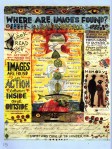
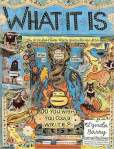
inspiration from Lynda Barry

Experience, anyway. (parts 6 and 7 are new)

This work is a slow-grower.  I think it wants to be read that way as well.  Slow accretions of interaction and recursively referent.  Not sure where it will continue.  Click the title page to investigate.  Comments are welcome.

experience anyway cover

Seriously Mimicking Birds

combined with Bach, Beethoven, Brahms…

if I had to select an album from my lifetime….

perhaps?

Potent Selections from Vacation Reading

“I wondered what indeed it meant about me that I was so set against the notion of convention that I should attack it.  So, I replaced the dream with the novel, stripping the stories of my dreams of any real meaning, but causing the form of them to mean everything.”

“…the gap between the subject of enunciation and the subject of enunciating not only failed to appear to me as a place of entry, but also failed to register as something I might elide.  For me, there was no gap, as there is no gap for anyone.”

P Everett 1

“…generally, people are only inclined to speak of the past with those they believe will somehow not only share some commonality, but who will also be disposed to exhibiting sympathy.”

“Is a photograph always present tense?  I described them so…better, let the question be, is what is in the photograph always in the present, without a before, without an after?  Of course, it is.  And isn’t that actually you in the picture?”

ennuyeux

“On Ludwig Boltzman’s tombstone is carved: S=k. LogW.  S is the entropy of a system, k represents Boltzman’s Constant, and W is a measure of the chaos of a system, essentially the extent to which energy is dispersed in the world.  This equation meant little to me as I read of it the first time, but as I considered it I grew excited.  The space between S and W is the space between the living thing in front of me and stuff hidden inside beyond my observation and comprehension.  It raises the question:  How many ways can the parts of a thing be rearranged before I can see a difference?  How many ways can the atoms and molecules of my hand move and recombine before I realize that something is wrong?  Thinking about it scared me.  Certainly, I understood that natural events symbolize collapse into chaos and that events are motivated by dissolution, but the idea of such subversive and invisible change moved me.  I likened it to observing the minds of others.”

P Everett 2

ootheca

“Ezra Pound said, ‘Every word must be charged with meaning to the utmost possible degree.’  Let it be the case then.  But words need no help from anyone.  Bet thew ords kneeknow hellip freeum heinywon.  Context, story, time, place – don’t these work like Bekins men, packing the words like so many trunks?  But finally, words are not cases to be packed at all, but solid bricks (and, of course, like a brick, even a word’s atoms are not motionless).”

“We do not give the creature reality enough credit, choosing to see it sitting out there as either a construct of ours or an infinitely regressing cause for the trickery of our senses.  But I claim here that the most important thing I have learned is that reality has a soul, reality is conscious of itself and of us, and further is not impressed by us or our attempts to see it.  In fact, we see it all the time and don’t know it, perhaps can’t.  It is like love in that way.”

-all quotes by Percival Everett

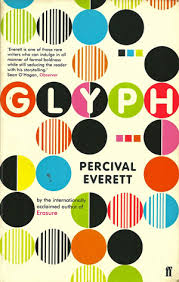
from his novel, Glyph

Glyph - Everett

Experience, anyway. Coupling. (section 5)

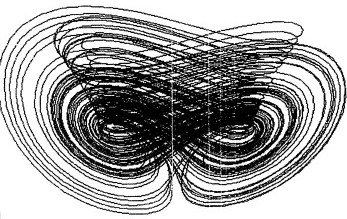
Coupling Chaos


5


Couplings


            We conferred, that is, we engage, experiencing contact.


We will set out, clinging, and submerge in, together.  To gather, to keep hold.  To track and trace in the tracing of trackings.  To recognize with(-ness).  To witness with-ness.  As experiment – critical.  Experience, anyway.  “Ours.”


Between the quark and the jaguar, we leap in, already moving.  Enduring much criticism: stop-motion behavior/practice.  A snipping tool.  We move on.


Must have been moving before we begin, different organization, as also (ever “also,” both/and) until “we” is spoken, still speaking.  In other words.


If complexity allows purpose, however shallowly combined – moment-airy radiant gradient – if selection involved “choice” (in other words), so we.  So-viet.  Co-Be=”It.”


We continue beginning potentials.  Experience.  Anyway, any way at all, even those unimagined per se – potentially – given contexts (complexes before and beyond) to speak spatially (corrupted language: co-ruptured, erupting-together).  “Always more than one,” our simple mantra.  Breathe.  Walk.


Early ones (to speak temporally, parler temporellement, another language) tout “the world knows not boundary.”  Perceptual divisor, arbitrary (i.e. species-specific) and then some.  Or boundary as invented in traversal, trespass, complex thoroughfare, reciprocity.  Feed-forward in a sort of randomness, chaos emerging orders.


We blend thus to cognize.  We merge to pattern difference.  Another way of saying “no boundary” (i.e. engagement, interactivity, living, being).  To couple.


Beginning again in infinite multiplicity (our limited numeracy) – were we able to count even to we.


casclick here to read Experience, anyway. in its current entirety

A probable linguistics

“In our day-to-day use of the English language we possess a perfect record of the language’s evolution; when we hear ourselves speak we listen to the voices of all those many millions who have come before us, who have, in their own use of the language, constructed ours, as we continue to construct it.

Whether or not we’re able to decipher this record is another matter altogether.”

-Evan Lavender-Smith-


Take it from here…

“If one wishes to describe the enunciative level, one must consider that existence itself; question language not in the direction to which it refers, but in the dimension that gives it; ignore its power to designate, to name, to show, to reveal, to be the place of meaning or truth, and, instead, turn one’s attention to the moment…that determines its unique and limited existence.  In the examination of language, one must suspend not only the point of view of the ‘signified’ (we are used to this now), but also that of the signifier, and so reveal the fact that, here and there, in relation to possible domains of objects and subjects, in relation to other possible formulations and re-uses, there is language

-Michel Foucault-

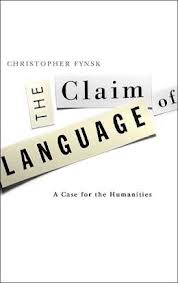
Fynsk - Claim of Language

“The opening of speech – every time – presupposes the material site provided by that structure of exposure that defines the essence of human being ( at least insofar as we are dealing with human speech), and the problem of thinking that exposure requires a new understanding of what calls for thought and the possibility of thought’s answer…An offering occurs in language, but this gift and its historical unfolding – thought from the way language is given – cannot be thought apart from a usage of the human that it presupposes…The notion of an experience with language, in other words, pointed to a thought of the way the human being, in its essence, is itself given to the speaking of language – every speech event entails at its limits an exposure of the human – language communicates im-mediately – the human essence is relation

-Christopher Fynsk-