Disjunctive Cartography – Our Propensities, Asking after the Nature of Nobody, cont’d

“The map is not the territory.  That’s an expression which  means

the world does not match the picture in our heads”

-Lemony Snicket, All the Wrong Questions, vol. 1

            It thinks.  It considers that it has not done with it.  It reasons that I will know more tomorrow.  Its hope of reading, of selecting and organizing, of patterning and arranging toward some partial whole, toward an item, an element, a concept or thought (any Other) that it might also become (or have been, an “I”).

In other words, it requires difference.

Yesterday I played soccer with  my son, it concocts.  I was the Other experiencing, moving, tripping-shouting-laughing – discretelyother than the ball or grassy ground, other than the leafy trees and wind, the boy (the one I called son), it was anOther yesterday, and therefore it may refer to that example of human-in-a-context (a surround of not-it) by a meaningful (adequately functional) pronoun (name-toward), namely “he” or “I.”

I gained definition by my surroundings, it conjures.  Any object will do (it’s perceiving assorted matter and energy, its limbs rest on some as “desk,” the 10” fence as “books” and the process of sensing, transforming to perception as “time” and mediates “it” as separate-though-connected – of the same stuff (matter) but in motion and of a unique form (relating to) – and names its organized system “self,” “me,” “I”).

It meditates (categorizes, classifies, identifies, compares and contrasts) on these sensations/percpetions/affectations and wonders.  “It was I,” it hears without sound – a confession aimed at a photo of a boy-child near against an aged man I knew as “grandpa.”  I looked so different – of different cells and height and weight, blood pressure and vision, facial contours, bones, hair and skin – so very different (it looks at a reflection) – how is it the “same” (identical to) “I” it is now?

Or might be tomorrow – through an utterly unknowable future of events, weather, interactivities, sensations, affectations and cognitions.  Will it be me tomorrow?  It wonders how identity can withstand such difference – variance, change, even replacement and erasure – and still meaningfully or validly considered “same”?

It places its’ head on its’ wrists.  It writes these words (is writing) in order to create (or craft) a recognizable trace, an effect, communally learned, socially agreed-upon marks that construct a momentary reflexivity its’ own existence.  A sort of extrinsic, partial it, to feel like also an I, at a moment.

It in-scribes in a medium, borrowed from others – borrowed, acquired, manipulated, stolen – a kind of proof to it that it is, and is unique, separatively connected, yea, conjoined seamlessly, molecularly, and yet… distinguishable… therefore I-able.  Referable.  Nominal.

It senses discomfort in parts labeled (categorized, classified, i.e. generalized and lumped indiscriminately/arbitrarily or learned) “head” and “neck” and “shoulders.”  It shuts its eyes.  I slept well last night, that is, I woke refreshed, my discomforts (aches) diminished.  It remembers I went to bed dry-eyed and suffering allergic responses to Springtime.  It drinks coffee.  It is not the same.

This is a portion of a map that does not represent the territory.  There are, perhaps, moments – instances – in which I fit with my surround – but usually it is organizing a mapping conference of sensation, affect, percept and infinite inputs coupling to pre-formed acquired categories and classes, fuzzy generalizations to stencil lines and rivers, mounds and fissures with very little correspondence to the world.

It writes this as “my world,” or “the world that I in-habit.”
-Becoming Human: Asking after the Nature of Nobody pt. 1

Our Propensities

“identifying a function for dreams or pretend play or fiction doesn’t mean that we’ve identified the function”

-Jonathan Gottschall-

I am enjoying this book more than I expected.  Often overview-type books of aspects of human phenomena leave me with a touch of “yeah, we all know that (i.e. we experience that), but tell us something new, give us opportunities to create knowledge from new data!”  Gottschall’s book is a well-written tour (akin to the work of de Botton on aspects of human life) – representative of current knowledge, suggestive rather than pedantic, and fluidly engaging.

“Consider the following information:

Todd rushed to the store for flowers.

Greg walked her dog.

Sally stayed in bed all day.

Quick, what were you thinking?…

In the same way that your mind sees an abstract pattern and resolves it into a face, your imagination sees a pattern of events and resolves it into a story…studies show that if you give people random, unpatterned information, they have a very limited ability not to weave it into a story…the storytelling mind is a factory that churns out true stories when it can, but will manufacture lies when it can’t…it’s usual method is to fabricate the most confident and complete explanatory stories from the most ambiguous clues…the Sherlock Holmes in our brains job is to ‘reason backwards’ from what we can observe in the present and show what orderly series of causes led to particular effects…we will always rather fabulate a story than leave experience unexplained.”

And so on.  In fact, the sentences he writes above are on-the-fly conjured random fact-statements unrelated.  Most of us probably had already begun to fit it into something ‘meaningful to us’ before we finished the third one.  Does this help you see how your view and perspective on reality – your ‘automatic’ or instinctual or deferral mode comprehension ALWAYS needs sorted out with CONTEXT and the empirical world?  Our minds are amazing and unbelievable in their functions and operations (literally), factories of fictions based on ancient genetic messages qua homo sapien, empirical experiences from our own individual lifespans, and an untangleable web of socio-cultural input and in-formation.  We’re fascinating…and utterly unreliable.  Thus we have each other, and our senses and myths and science and all sorts of other-world perspectives to adjust and possibilize our own stories.  Perhaps there are moments our thoughts align with facts, but those will be rare in our lives.

Taken in a context of Nelson Goodman’s Ways of Worldmaking, John Canfield’s Becoming Human and Alan Singer’s The Self-Deceiving Muse, Gottschall’s delightful foray into the impulsivity of fiction-like brain behavior makes for a savory meal. I’m concocting stories about it even now (it’s sure).

Situating Language

“ultimately all the meaning of all words is derived from bodily experience”

-Bronislaw Malinowski-

(from The Problem of Meaning in Primitive Languages)

P9180114-001

RESPOND

Becoming Human: Asking after the Nature of Nobody

“What, in summary, is the nature of the singular entity referred to by the word ‘I’ in judgments like ‘I am in pain’?  Answer: since those uses of ‘I’ do not refer, the question is nonsensical.  One might as well ask after the nature of Nobody.”

-John Canfield-

“The ‘main point’ is rarely extricable from the digressions.  Every section spills into every other… [he] no longer knows what he was talking about.”

-R. M. Berry-

            It grows hair.  It remembers things differently.  It is singing as if in a mumbling voice.  Yesterday I got angry.

It thinks, but after talking with the child I was upset with, it revises its conception, taking into account that she said I exhibited joy.  Yesterday I was happy.

This glassy essence.

“I will need to accomplish a task tomorrow,” it thinks, in a manner different from image, music or text.  It can almost see me doing it – in a situated context – surrounded by people (other ones), objects, time and space.  Not essentially.  Well, maybe.

It calls to mind (read fabricates) what I was like two decades ago.  I was climbing mountains then, most often alone (i.e. not in the company of additional humans), still it is able to consider me there.  There where?  It imagines Long’s Peak in Colorado (in neither image, language nor feeling – it cannot recall particulars well enough to reconstruct)…it senses I was there.  It is reading in a diary.

Does this make it me?  The same as the I who wrote it, camping somewhere along the Eastern slope of Long’s Peak in 1995, apparently gladly absent of friend, foe, spouse or tamed animal counterpart?

I had a pack full of peanut butter and potatoes, a couple jugs of water, a tent, a cloak, a knife, an assortment of pens, books and blank journals.  It roughly remembers some of that.

It reflects (not to itself – that doesn’t even make sense) – must be a sort of nuanced synonym for thinking – (with itself? of itself? nonsense, it simply reflects) – I’m sitting cross-legged on a small clearing near a frothy crystalline stream within a circle of baby pines, trying to read philosophy texts packed in for the purpose of uninterrupted, or it could be me yet-to-come as distinguished by Swiss mountains and an understood language barrier protecting my solitude along with evident (it imagines) distance (and therefore time) between whatever residents might exist and I.  It (hypothetically) notices that (well, enough to pick out an “I” on the Jungfrau or Matterhorn).

But that has happened too.  Does the case that it conceives me thus proscribe an identity?   It isn’t sure, but there are similarities of some variety.  It isn’t saying for certain (the fact is it could say “for certain” but what might that establish as regards me?) – the appearance and accidents, character and behavior are in many ways inexact and altered – but for pragmatic and discriminatory purposes – it would designate me “me” (if it were in conversation or thinking extrinsically).

Could it really say, most definitely, that I was there?  Any more than that I will be?  It is uncertain, entirely possible.

This glassy essence.

It remains, for now.

Thinking of the time I was writing this (nearly now but just before).  It is writing, but not this, I have written this, it is aware, but only just before or just after – that it is I.

It writes.

“…man, proud man,

Drest in a little brief authority,

Most ignorant of what he’s most assur’d,

His glassy essence, like an angry ape,

Plays such fantastic tricks before high heaven

As make the angels weep.”

-Shakespeare, Measure for Measure

The Direction of Dreams

a la Friday Fictioneers – everybody should give it a go!  Thank you Rochelle Wisoff-Fields for keeping us prompted…

copyright - Jennifer Pendergast

The Direction of Dreams

My son says he always dreams the same house, strangely enough.  Except with a spiral staircase.  The cartoon girl runs jerkily past.  Perhaps she trips, perhaps there’s a dog in the way, perhaps a lady walking with a stroller.  He doesn’t know the house, he says, but it’s always the same house.  With a spiral staircase, but not a cartoon girl.  I know she’s running though, in fits and starts, with urgency.  Something depends on her speed.  There’s a trying to get somewhere, in any direction.  And direction needs a context.  Something about dreams, spirals and speed.

N Filbert 2013

In Essence

“It is in and through language that man constitutes himself as a subject, because language alone establishes the concept of “ego” in reality, in its reality which is that of the being.

The ‘subjectivity’ we are discussing here is the capacity of the speaker to posit himself as ‘subject.’  It is defined not by the feeling which everyone experiences of being himself…but as the psychic unity that transcends the totality of the actual experiences it assembles and that makes the permanence of the consciousness.  Now we hold that ‘subjectivity,’ whether it is placed in phenomenology or in psychology, as one may wish, is only the emergence in the being of a fundamental property of language.  ‘Ego’ is he who says ‘ego.’  That is where we see the foundation of ‘subjectivity,’ which is determined by the linguistic status of ‘person.'”

-Emile Benveniste-

“signification occurs only through discourse, that discourse requires a subject, and that the subject itself is an effect of discourse.”

-Kaja Silverman-

How can I not?

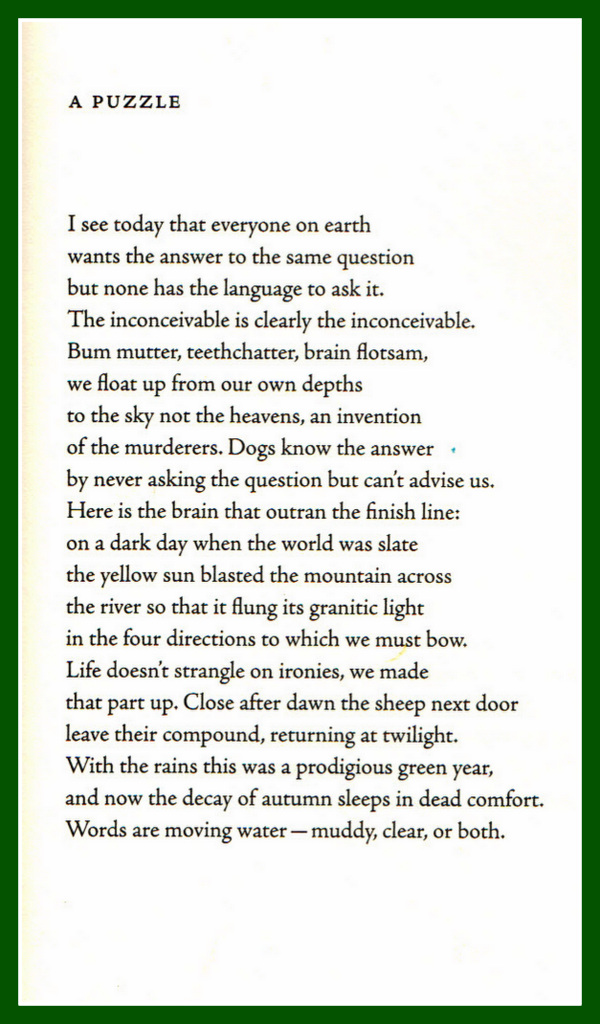
A Puzzle by Jim Harrison


Going Back, Going Forward

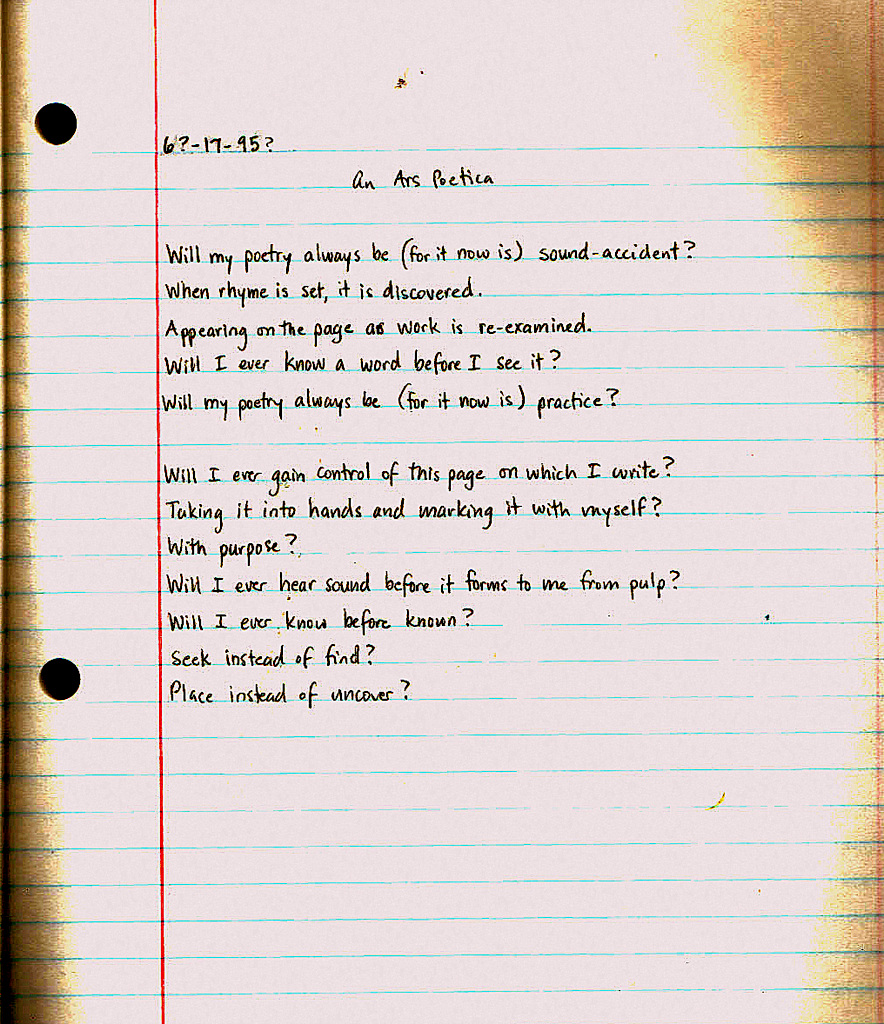
I hastily grabbed a notebook of primarily blank pages as I whooshed the children off for a swim.  I needed to study and make notes while they splashed about and played and require pen & paper for the process.  It turned out that the pages containing my writing dated some 15 years ago – journaling from a 4-day solo hike I had made in the Colorado mountains.  Included was this me-of-20-something’s poem:

Ars Poetica 1995

The whole notebook was nostalgic for me – my youthful vibrant concerns for solitude and justice, freedom and nature and virtue.  What struck me about this little number was how consistent (or persistent) the concerns and interests worded here have been (obviously) throughout most of my life.  Seeking purpose, expression, control – recognizing somehow that once language is entered, is invoked, everything changes.  Our purposes, searches, availabilities, capacities, expressions, knowledge, – all gets reworked and revised as we engage in the broader activity of language.

If, as John Canfield theorizes, “in language we never leave the sphere of the social” and that “language is a vague concept with unclear boundaries,” in part because it “grows as more language-games are added to the mix, and as existing ones are enriched in various ways,”  that, fundamentally “language is a set of customs in which words play a role, a set of patterned, culturally determined modes of interaction..” so that with “increasing cultural complexity come increasing complexity of our patterns of interaction” then my lifelong hunches that I’ll never get a handle on it, or master its use, or turn it explicitly to my purposes are a matter of course.

M. A. K. Halliday’s Triangle

Which is also what fascinates, compels and rewards its use.  Again, with such a limited arsenal of units – (take a look at your keyboard and consider for a moment to what gargantuan and variable use we put those 100 keys or so) – every engagement with the tool is interactive, reciprocally shaping and shaped by us, and unfailingly externalizing for our organism – the medium thrusts and immerses us into our society and culture and history and possible futures, as well as all the “thinks you can think” and more!

On the right day, then, my bewilderment in the face of language as my vocational practice gets to be an adventure of constant discovery, novelty, and learning – immersing me in some infinite-like context, warping and woofing my organism into a universe of threads…

all quotations from John Canfield’s Becoming Human: The Development of Language, Self and Self-Consciousness

The Nothingness of Symbols

a drowning.  a submersion.  a baptism (immersion)

I am drinking the arbitrary nothingness of symbols.

I am writing.

Writing is both a cry and a response.

Intuition / rationalization.

Nurtured and natural.

In the realm of symbols, I am safely between.  In the place of no safety.  The nowhere realm – a world of now here.

Where I am drowning.  Delirious.  Drunken on these symbols, arbitrary and well-developed, representative and unnecessary (?) signs.

I am alive.

Combining intellect to emotion to situation and its social constituents…I am writing, uttering, verbalizing –

– and, by chance, perhaps, you are here.

I am side-swiped.  Side-tracked.

In other words,

I set out to circumlocute on this very “subject” / “topic” / “matter”…yesterday…

resulting in a nothing of the kind.

Drowning in a limitation of symbols –

“composition,” we call it,

“For it is in the nature of language, as I have already noted briefly, that it is governed by the principle of ‘duality of functioning’,..to be more specific, the distinctive features of the sound system that constitute a language are determined by the limited set of phonemes employed in constructing the next unit up, morphemes.  And morphology is determined by the uses to which morphemes are put in forming lexemes or words.  Words, in their turn, are formally describable by the functions they perform in sentences.  Sentences, in turn, achieve their significance from the discourse in which they are embedded.  Discourse is governed by the communicative intentions of the speakers.  The communicative intentions of speakers, of course, are governed by the transactional requirements of the culture.  And along the way, there are further determinants of form that operate in this same way…”

-Jerome Bruner-

That sickness, that plenitude, those realistic illusions – as if one were totally absorbed in the unrealities of the human way of being-in-the-world.

“the world is not what we thought it was”

-Jim Harrison-

There will be a day my sons will die.

Hopefully I will be gone.

My spouse will die.

Hopefully I will be gone.

There is a word for things that hold too much (e.g. “things that can hold no more”)

Things at, or beyond, capacity.

There are 26 letters in the English alphabet.  They are drunk, drowned, saturate.

And still there are fresh occurrences.

There are also #s, codes, algorithms, symbols…

I like the idea of doing something that matters, of being someone that matters, of my strange happenstance of existing as an organism having some effect, making some verifiable difference in a larger web of existing things

liking the idea certainly doesn’t make it so

and yet, perhaps,

My intention had been to talk about the wonder…

…that out of 26 letters…

this many years (generations, eons)

and variety

had even occurred.

Was all.

that meaning, is interesting, is cool

that, to (lil’ ol’) me…

it’s amazing…!

in 26 letters

#s, symbols, diagrams

we keep constructing…

Being Human – Voracious, Delusional, Fantastic

I get a little weary of philosophy.  It fascinates and intrigues, has its spectacular, glittering moments of what feels like beauty and “accomplishment” – like architecture, the sciences and arts, studies human and social and hard.  But with each human activity and behavior there can be too much of a good thing.  Perhaps it’s the fantasies involved in abstraction – in the feeling of “figuring things out,” or of “making sense” – our human super-additives to experience that are also experience themselves – that I, at times, weary of.  That eminently falsifiable intuition that everything is made up.

It is extremely hard work to keep up a worldview.  Involving enormous complexities and details, layer up on layer and strand interweaving strand of biological and logical, illogical, psychological, irrational, emotional, – ologies and descriptions, manipulated perceptions and re-interpretations of interpretations reinterpreted (ad infinitum) – it takes matter and energy, and particular organisms, which grow tired.

Those same realities, capacities and activities are also extremely inspiring, enervating and exciting for organisms – the behaviors of productivity, creativity, imagination and survival – and our weird confounding capacity to think we can observe our perceptions/observations to an infinite regress, make for a very strange frenzy of energy and matter indeed.

In a possibly (?!) infinitely webbed interdependence with our surround copious possibilities of activity are available – all bewildering: chaos can be so generative.  Chaos can be so nullifying.

What might we know?

And why do we want to?

  • That we are organism within dynamic systems?  (How would we know that, from within the systems?)
  • That we are dynamic organisms alongside other dynamic forms of matter and energy?  (Sometimes seems to be our sense of it – that we might somehow step aside – wha-?!)

and…so…what!?

Alongside and within – in order to be – apparently (that is, according to OUR OWN perceptions) – however would could we exist either detached (abstracted) or without (independently, unattached).   To imagine distance, “objectivity,” without the imaginative capacities of fantasy – illusions – for example logic, mathematics, economics, philosophy, psychology – codes and symbols – DElusions in order to play the games in these forms of life we are with delusional sincerity – effectively.  And our fantastic delusions or profound poeitic creations are often effective, productive, pragmatic, dynamic and evolving – techniques and time – which would seem to imply that they also are part of being within a myriad of dynamic systems…

…one might suppose (i.e. “hypothesize”); or infer (i.e. “fantasize”)

All an immersion in symbols – languages – stipulated relations – codified behaviors –

– which is what I had set out to consider

drowning in symbols

the wonder and bewilderment of it

the sense of delusion and ecstasy

being human…