Too Big to Know (Essential Readings in the Philosophy of LIS)

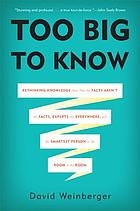
I’m currently reading Too Big To Know by David Weinberger and quite intrigued by his observations – Lane’s account is a cogent analysis of why.


Lane Wilkinson's avatarSense & Reference

If David Weinberger is to be believed, the Internet hasn’t just changed how we access information, it has altered the very meaning of ‘knowledge’. In a recent interview with The Atlantic, Weinberger claims that “for the coming generation, knowing looks less like capturing truths in books than engaging in never-settled networks of discussion and argument.” Supposedly, the networked, collaborative, and social nature of the Internet has changed our very understanding of knowledge to the point that knowledge is no longer tied to concepts of truth, objectivity, or certainty. Instead, as Weinberger argues in his recent book, Too Big to Know, “knowledge is a property of the network” (p. xiii). That is, the Internet has profoundly changed what it means to be a fact, to be true, or to be known. This book has been making the rounds among librarians, so I thought it might be a good idea…

View original post 1,765 more words

And finally…poems

I recognize that I hunger for poetry – periodically I canvas new poetry books and the old on my shelves to be STRUCK – to be wakened – charged – re-membered – into some leaping alive sensibility awareness delight sorrow grief ecstasy – that the vividness and risk of well-made poems incite…

for me, anyway.

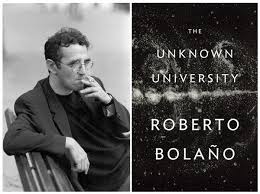
Thus, the Bolano.  A beginning.

Thus, returning to Nooteboom, a certainty.

Thus, the new arrivals shelf – Wichita Public Library.

and then…today…BOOM.

Bob Hicok, tested favorite, “new arrival,” Elegy Owed

the jump-start.

the activation.

something like recognition and instigation at once.

what poetry does.

and having no idea where to begin to share it with you

to recommend

to commend to you

I’ll just offer the opening poem:

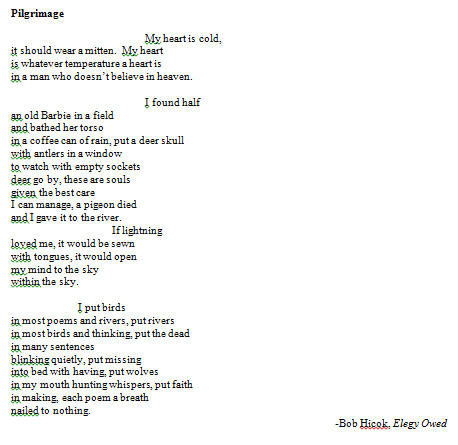
Pilgrimage - Bob Hicok

and the closer…

Good-bye

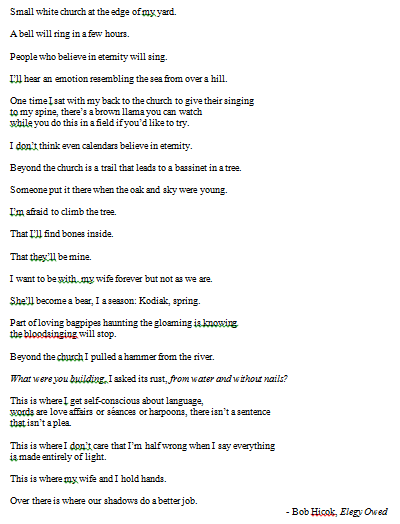
Hicok - Good-bye

and to tell you that everything in between is every bit as good

and some even better….

Good-bye


Small white church at the edge of my yard.

A bell will ring in a few hours.

People who believe in eternity will sing.

I’ll hear an emotion resembling the sea from over a hill.

One time I sat with my back to the church to give their singing

to my spine, there’s a brown llama you can watch

while you do this in a field if you’d like to try.

I don’t think even calendars believe in eternity.

Beyond the church is a trail that leads to a bassinet in a tree.

Someone put it there when the oak and sky were young.

I’m afraid to climb the tree.

That I’ll find bones inside.

That they’ll be mine.

I want to be with  my wife forever but not as we are.

She’ll become a bear, I a season: Kodiak, spring.

Part of loving bagpipes haunting the gloaming is knowing

the bloodsinging will stop.

Beyond the church I pulled a hammer from the river.

What were you building, I asked its rust, from water and without nails?

This is where I get self-conscious about language,

words are love affairs or séances or harpoons, there isn’t a sentence

that isn’t a plea.

This is where I don’t care that I’m half wrong when I say everything

is made entirely of light.

This is where my wife and I hold hands.

Over there is where our shadows do a better job.

– Bob Hicok, Elegy Owed

New Arrivals, with poetry and music

Submerged in due dates.

Here’s what’s arrived in the center of (my) radar:

This slideshow requires JavaScript.

and then, from Roberto Bolano

DON’T WRITE POEMS BUT SENTENCES

Write prayers that you will whisper

before writing those poems

you will think you never wrote

Bolano - Unknown University

Strange gratuitous occupation    To go losing your hair

and your teeth     The ancient ways of being educated

Odd complacency     (The poet doesn’t wish to be greater

than others)     Not wealth or fame or even just

poetry     Maybe this is the only way

to avoid fear     Settle into fear

like one inhabiting slowness

Ghosts we all possess    Simply

waiting for someone or something in the ruins

and finally,

MY LITERARY CAREER

Rejections from Anagrama, Grijalbo, Planeta, certainly also

            from Alfaguara,

Mondadori.  A no from Muchnik, Seix Barral, Destino… All

            the publishers… All the readers

All the sales managers…

Under the bridge, while it rains, a golden opportunity

to take a look at myself:

like a snake in the North Pole, but writing.

Writing poetry in the land of idiots.

Writing with my son on my knee.

Writing until night falls

with the thunder of a thousand demons.

The demons who will carry me to hell,

but writing.

all poem like creatures – Roberto Bolano

De-Presses

“What a joke it is to read or hear—as I have read or heard more times than I can count—that writers ‘see more clearly’ or ‘feel more deeply’ than non-writers. The truth of the matter is that writers hardly ‘see’ or ‘feel’ at all. The disparity between a writer’s works and the world per se is so great as to beggar comment. Writers who arrange their lives so as to ‘have experiences’ in order to reduce them to contemptible linguistic recordings of these experiences are beneath contempt.”

—Something Said, by Gilbert Sorrentino

Dalkey Archive

Via strange twists of events, connections that could only be re-constructed through fantastic imagination, I have been moved back into perusing publishers for work that inspires, raises and extends one’s ideas of what “art,” “literature,” “human” are.

While most publishers must infuse their catalogs with books that will sell, there are still a few presses that are simply committed to grandeur – to works that express and challenge what humans are capable of making, thinking, expressing, creating – works that assess and challenge our condition of being.

Two presses I’d like to promote – that continually provide works that surprise and engage (fully) and elastically foment my boundaries of concept and possibilities – with bewildering form and content – in other words, publishers from whom you might randomly purchase titles and ALWAYS be made richer, better, exponentially more humane – (THIS IS A REMARKABLE THING):


please visit them and order…ANYTHING…

your life will be BETTER.


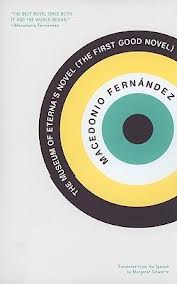
(The First Good Novel)

Meaning

In any breaks in necessity – between semesters, breaks at work, children otherwise occupied, no “required” readings or commissioned work, etc… – with each passing season, I gradually discover what matters most to me (literarily speaking, which, for me, involves much of my lived life) – perhaps I might refer to it as my meaning-making-factory-resources (Blanchot says of Borges that he is “an essentially literary man – which means that he is always ready to understand according to the manner of comprehension that literature authorizes).”  At this point in my living, over four decades along, and a large percentage of the pie devoted to reading, those voices I turn to, their messages and efforts, have become quite consistent.  Each year there are new ones, new threads and concepts, theories and expressions that very significantly impact my living – but they tend to find their place as commentaries, extensions, additives and queries to what (I suppose) now forms my central “canon” of sorts.

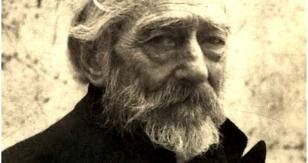
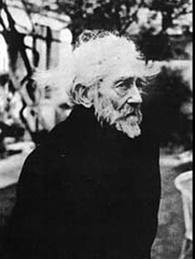
This struck me, following my return to Bakhtin and Blanchot, and as we prepare for vacation how I immediately reached for Soulstorms by Clarice Lispector and The Museum of Eterna’s Novel (The First Good Novel) by Macedonio Fernandez.  In searching for this image of Fernandez:

Macedonioa host of Google’s “related images” arose – including Borges, Lispector, David Foster Wallace – and I got that vision of how pantheons develop and connect and gradually form a kind of woven semiotic pattern – a “worldview” or “Innenwelt” I guess – it begins to make sense what’s connected to what and whom to whom throughout time and space of world-being.  Beckett, Blanchot, Dostoevsky, Pessoa, Rilke, Cixous, Kafka, Bakhtin, Jabes, these visions and verbals I return to again and again and again and again – inexhaustibly – and although my copies are nearly glutted with markings and underlinings – and they feel intimate and familiar (on the one hand) – that I also feel I am always learning them anew, freshly, with EVERY read.

These things astound me.

Museum of Eterna's Novel

Of this particular book (which I often say is the very best novel I have ever read, repeatedly), Adam Thirlwell writes “It is a novel which does not want to begin.  Or, perhaps, it is really a novel which does not want to end…The aim of Macedonio Fernandez’s novels is to convert all reality into fiction (or the other way around).”  “The real subjects of this lightly playful novel are the grave ones of death and love.”

“In his novel, Fernandez tests the possibility that all philosophical questions are only meaningful in relation to human relations: that all questions of infinity are really questions about love.”

and so on.

Macedonio 2

Macedonio is, for me, a hero the likes of Bakhtin, Blanchot, Beckett – those writings and writers I will never “get over,” never “get around.”  Writings I can only ever “go through.”

Perhaps these writings are characterized by the question – “What is it to be real?”  I recently discovered in one of those “shock of recognition” moments that although I’ve studied theology, philosophy, classical music, art and literature and now information sciences and systems theories – that none of the CONTENTS of these fields sustain my passions – it is the relationships between them – the ligaments and synchronous reverberations they emit – the MEANING-making effects of their pursuit and inquiry that is REALLY what drives me toward, into and through them.  I’m not looking for truth or necessarily facts or any answers – but for PROCESSES and PRACTICES that enrich, enhance and extend my biological life in relation to the world I’m “thrown into.”

Borges wrote of Fernandez: “Macedonio is metaphysics, he is literature” and that “writing was no trouble for Macedonio Fernandez. He lived (more than any other person I have ever known) to think.  Every day he abandoned himself to the vicissitudes and surprises of thoughts as a swimmer is borne along by the current of a great river.”  The novel’s translator writes: “The method is madcap; the intent is desperately human.”

Perhaps that is what I’m after – to be “desperately human.”

and now we’re heading off to the wilds – to be desperately human with-world with-family – replete with above-mentioned authors and without wi-fi or internet services!

P.S. (also from current reading – The Waste Books by Georg Christoph Lichtenberg):

“Be attentive, feel nothing in vain, measure and compare:  this is the whole law of philosophy.”

and

“To grow wiser means to learn to know better and better the faults to which this instrument with which we feel and judge can be subject.”

All the best!

Cause for Celebration – Library Retrievals


and Evan Lavender-Smith’s MFA thesis from 2004: The Invention of Love!!!!

New Fiction: “Experience, anyway.”

For some time I have been lacking for representation.  Processes and patterns go on, no doubt, but nothing materializes save scattered words, informed thoughts, scholarly papers, and so on.  Spouse says of self: “I need something to shoot for, develop toward, to propel…otherwise I stagnate, repeat…” and I agree with her – I’ve been itching for fiction – a larger project – something to belong to and build while fulfilling responsibilities, learning, parenting, husbanding, being “professional.”  But the pages have been blank.  This morning I began, and it started like this:

**************************************************************************************************************

Experience, anyway.

            And stared at the head of Buddha.  As if literature were whatever could be fitted to symbols.  There were experiences anyway.  Complex goings-on.

He started.  As if starting were the only thing he could do.  He, she, self, other, organism – whatever.  It had begun.  If there were a god, it might know where, but they – for the life of them – could not figure it.  Not literature.

And for all the anyway-experiences, also.

In other words.

They stitched and thatched and wove, tore through, ripped out, clipped and pasted and tagged.  For all the cross-hatching and shading, foregrounding and back-, no image came through.  Or if it did, it never matched.

Representation.  Representamen – for a more mystical suggesting.  Arcane.  Obtuse.  That which is metaphor’d.  That which signals, indices, or forms.  That which functions.  Which can be acted on, or with, within, without.  Functioning ephemera.  To latch.

And undo.  It passes.  Lock on – decipher.  Pass around the room.  Agreeing by argument, it becomes.  Difference.  Evaporate.

The head of the Buddha is shaped out of stone.  More likely poured, cast.  More likely art – official.  What is artificial? – But human construction of world.  That radical deflect.  That begin.  In symbol.

At a certain time (constructed, invent), cross-purposes : experience.  Anyway, perceived.  So aroused – appreciation, cognition, desire, belief – purchased (bought, fallen-for, faith-in) : acquired.  Experience, anyway – head in corner on bookshelf knick-knack antiques, money (that wasn’t there), and taken away.

Evaluation = meaning.  Interpretation.  Somewhere whereabouts and how, or when – experience, anyway.  Action occurs.  It’s started.

Grenzsituationen

Recently, I have received several queries into either how I read as much as I read, or how I find or know what to read.  As I respond to these inquiries, it has interested me how in fact, I account for my reading history.  E.L. Doctorow explained he rarely knew what he believed until he had written about it.  Dostoevsky would start authoring a given scene, assuming he understood precisely what he believed about the issue discussed in it, only to have one of his characters convince him otherwise.  Frequently it is only through the actual act of creation that we locate what we really feel and think about a subject.” (Olsen, architectures of possibility).  That, coupled with “Authors frequently say things they are unaware of; only after they have gotten the reactions of their readers do they discover what they have said” – Umberto Eco…resulted in these self-observations:

Even from persons I deem much more knowledgeable than myself I often hear “you’ve read more than anyone I know…” and I have spent many hours a day for many decades – reading.  I was raised in a fundamentalist Christian home, so the concern for truth, authority and canon were socio-culturally inculcated in me from an early age.  When I began exploring music, philosophy and literature I found this concern ruling my approach: what is deemed canonical (attested by authorities), what came first?, and what rings true?  I remember beginning with anthologies of classical poets, then ancient scriptures, Homer and so forth.  Beginning with Plato/Aristotle then forward through those who claimed their influence.  Beginning with Bach, Brahms, Beethoven and then forward and back to origins and influences.  That has been my habit in exploring cultural artifacts.  Find references.  Correspondence.  Claims.  Follow them out.  And follow those out.  And follow those.  And….so on.

As to achieving the absorption of piles of books at a time – when pushed to claim a process – I was surprised at the simple methodologies.  I have referred to “transductive reading” from time to time in these posts – the interaction and co-constitutive commentaries that work provides to work.  So I read large amounts of materials over large amounts of time (though my wife insists I read speedily) – I find I read sections / chapters / pages from a multitude of books and let them interact in me forming tissues and connections, rather than singular voices or ideas straight through.  I read for differences – turns of phrase, terminologies, rhythms, in persons approaches to subjects, rather than reading for topical content or idea-information as data.  Where a voice, approach, or technique is unique is often what particular works have to offer, I have come to think.  And, depending on genre or reason for reading – as overlaps increase as the volume of “have-read” grows – one can often browse for summarizing sections to find the nuances each thinker or creator proffers.

reading a lot

Then there’s my personal history and approach to things.  Hard-pressed to learning from youth=26 straight years of education + 17 years working in or managing retail bookstores – in an effort to be an “excellent” bookseller – implying to me I had to know something of everything a reader might desire (first hand).  Publisher’s catalogs, reviews, recommendations, lists, histories, from the development of language to its variation in forms and contents.  And always that uncanny recognition of Grenzsituationen – or “Limit Texts.”

“It might be helpful to conceive of certain texts as Limit Texts – a variety of writing disturbance that carries various elements of narrativity to their brink so the reader can never quite think of them in the same terms again.  To the brink, and then (for most readers, at least) over.  Karl Jaspers coined the word Grenzsituationen (border/limit situations) to describe existential moments accompanied by anxiety in which the human mind is forced to confront the restrictions of its existing forms – moments, in other words, that make us abandon, fleetingly, the securities of our limitedness and enter new realms of self-consciousness.  Death, for example.”

“If we carry this notion of Grenzsituationen into the literary domain, we find ourselves thinking about the sorts of books that, once you’ve taken them down from the shelf, you’ll never be able to put back up again.  They won’t leave you alone.  They will continue to work on your imagination long after you’ve read them.  Merely by being in the world, Limit Texts ask us to embrace possibility spaces, difficulty, freedom, radical skepticism.  Which writings make up the category will, naturally, vary from reader to reader, depending on what the reader has already encountered by way of innovative projects, his or her background, assumptions and so on…but the more Limit Texts one reads, the less one tends to feel the impulse to return to more conventional narrativity…”

-Lance Olsen, architectures of possibility
These situations are tattooed on my body (literally)…and include:

Samuel Beckett – Macedonio Fernandez – Paul Celan – Fyodor Dostoevsky – Ludwig Wittgenstein – Maurice Blanchot – Helene Cixous – Clarice Lispector – Franz Kafka – Fernando Pessoa – David Foster Wallace – Mikhail Bakhtin – Rainer Maria Rilke – Edmond Jabes – Federico Garcia Lorca – William Stafford – Egon Schiele – Vincent van Gogh – Johannes Brahms – Alberto Giacometti – Robert Musil – Friedrich Nietzsche – C.F. Peirce…

as you uncover these (your own personal) writers – your pantheon

of those who change your view of the possibilities of language and who you can return to again and again

without  really feeling you’ve been there before – they become coordinates – network nodes – whereby you

evaluate and expand, extend and engage new writings you are exposed to – forever altering your patience and expectations of literature or whatever cultural artifact-type you crave and are pleasured by…thus making your reading more efficient and your selections increasingly more challenging and compelling to you – as long as you continue to leap out and expose yourself to things that might be unexpected

Ben Marcus – Ronald Sukenick – Laurie Sheck – Mei-Mei Berssenbrugge – Lyn Hejinian – Denis Johnson – Laurence Sterne – William James – C.F. Peirce – Michel Serres – Bruno Latour – Jorge Luis Borges – Cervantes – Immanuel Kant –

your lists will spawn as you follow their correspondences, admirations, criticisms, references, citations,

and you develop your literary canon

more on that another time
utopia

**More than a decade on, to update my Grenzsituationen, I’d need to add:

the Philokalia – John Moriarty – St. Isaac the Syrian – George MacDonald’s Sermons – Martin Heidegger – St. John Cassian – Sayings of the Desert Fathers & Mothers – Arkadii Dragomoschenko – Elder Aimilianos – Optina Elders – Haida Myths & Songs – Jim Harrison – St. Ephrem the Syrian – I Ching – Dreamsongs from Australia – St. Theophan the Recluse – Jan Zwicky – Martin Shaw – St. John Climacus – Marguerite Duras, and more…
New Feasty Arrivals – kudos Inter-Library Loan

How Literature Saved My Life by David Shields
The Preparation of the Novel by Roland Barthes


Stammering Great Literature

“Great literature is written in a sort of foreign language.  To each sentence we attach a meaning, or at any rate a mental image, which is often a mistranslation.  But in great literature all our mistranslations result in beauty”

Marcel Proust

“Having a bag into which I put everything I encounter, provided that I am also put in a bag.  Finding, encountering, stealing instead of regulating, recognizing and judging…It is an assemblage, an assemblage of enunciation.  A style is managing to stammer in one’s own language.  It is difficult, because there has to be a need for such stammering.  Not being a stammerer in one’s speech, but being a stammerer of language itself…writing does not have its end in itself precisely because life is not something personal.  The only aim of writing is life, through the combinations which it draws…and there is no method for finding other than a long preparation…”

-Gilles Deleuze-