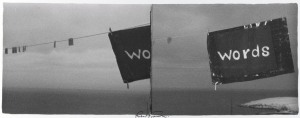
or, it matters what you do with it.
The following are papers made by my children for me for Fathers Day 2012 –
they knew what to do with it!
(hopefully I will learn!)


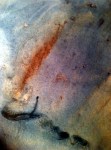

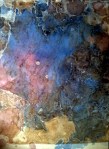
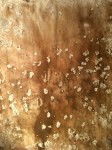


or, it matters what you do with it.
The following are papers made by my children for me for Fathers Day 2012 –
they knew what to do with it!
(hopefully I will learn!)
Fathers Day 2012
(for Tristan, Aidan, Ida and Oliver)
I would use the word “foundational”
but it’s much much more than that.
“The child is father to the man”
in so very many ways.
Fundament comes closer
expanding in us a sense
of ever-expanding edges
of universe and galaxies
within which everything that is,
is
But, personally, it’s larger,
and deeper, and wider
and exponentially more important
these children that father me
to fatherhood.
Giving me these things they’ve made
of me.
I look at them.
I long for them.
I love them.
and I marvel.
I come from this! I sing
these four amazing
and tremendous beings
making me their father,
shaping me as man,
a human,
a relationship
after all.
I’m not much of one for ‘truth’
but will say ‘this I believe.’
N Filbert 2012
Most of you have probably gathered by now, if you’ve viewed some random posts of mine, that I am addicted to and dependent on libraries and the treasures they hold. In the Fall, in fact, I will be entering the Master of Library Science degree program at Emporia State University in Emporia, KS. The fearless director I will be studying under (Matt Upson) and collaborator have created a number of these fantastic little comic BOOKS praising libraries and librarians and guiding and enticing usage of them. I’ve asked if I can share one here – please take some time to view it – it’s fantastic! (CLICK ON THE IMAGE FOR LINK!)
(see also: Matt Upson – Librarian)
Eat. Pray. Love.
On a wonderful jaunt to our public library yesterday, my wife spotted a movie based on a mega-bestselling memoir that she’d been curious to see since its release a couple of years ago. We checked it out and viewed it last night in hopes of a light, relaxing fare to happy us toward slumber.
It was excruciating. My first reaction was – can a person’s biography truly resemble such a cliché’d American self-realization mythology? Basically a woman goes on a journey away from her responsibilities to others to “find” or “heal” herself, in the process (and apparently justifiably since it delivers her to a goal of peace, happiness, pleasure and love with a seasoning of spirituality) wrecking others’ lives and forgiving herself for it, ending in the arms of a handsome foreigner on a tropical island with some standard religious “truths” in tow.
Here are things I realized about myself:
I am suspicious of personal pleasure that causes others pain.
I am oh-so-glad and grateful that I grew up in a reserved Western culture with Continental philosophy and theologies at its roots. I much prefer battling to wisdom and calm through the frenetic and anxiety-ridden vertigo of a convoluted mind ferociously doubting and investigating than through some “be here now” philosophies of higher unities and cosmic accord. Rather interrogate now than “let go” and “let be.” I am attached to the workings of our brains and our languages, pestering perception and scrutinizing sense experience with imaginative and skeptical rationales.
I radically doubt “gurus,” “prayer,” “saviors,” and other spiritual or “wholistic” practices of “balance” that accomplish “goals.” Outcome-based anything feels totalitarian and programmatic and therefore facile to me, as if there were a form or behavior we might fit ourselves to that would lessen the struggle or suffering of “to be.”
The film’s story took a year’s time, replete with life-changing habits of mind and body and some claimed resultant growth. As if wisdom came from Apple or McDonald’s. The past was hardly processed, responsibilities released like thoughts during Zen, and no effort to apologize or repair any damage or hurts the main character had caused those close to her along the way (thank goodness no children were involved!).
It was the time-tested failure of the American Dream: do what you want to get yourself comfortable in your own skin (whatever beliefs, illusions and experiences that might seem to require) and everything will be alright in your world.
I simply don’t buy it. And I won’t. If we are socially constructed realities (and my point-of-view on the cosmos supports this) then final import is not in a self, but in a system. Not toward results but a how of processing. Not a personal calm or pleasantness but a social accord.
The film made me terrifically thankful for scrutiny and doubt, fervent self-questioning in light of surroundings, and the “wisdom of no escape.” It just goes on.
For what it’s worth,
here lies a steaming pile of my opinions.
N Filbert 2012
Acknowledgement and Re-cognition
Lately there’s been a rash of occasions in which I’ve been requested to tell things about myself (my wife would immediately note the choice of nouns as descriptor and tack on “well, that’s one way to look at it” i.e. as irritant, possible disease, discomfort – a “rash”).
I’ve noticed that discomfort. Say I’m elated to have a poem accepted somewhere, or receive these lovely and encouraging blogging awards in WordPress, each joy arriving along with these little nettles: “please provide two paragraphs of biography,” or “tell us about yourself,” “list seven things about yourself your readers probably don’t know” and so on.
And I desire to tackle it all poetically, as fiction, an invention (which perhaps I think it actually is : “self-perspective” blah blah blah)…
…and yet…
Why are we writing or sharing recipes or art in the first place? What is that urge?
To express, perhaps – we feel aburst with something and want relief, to press it out…into where? why viewable? readable? hearable? physical? For whom?
For ourselves, we might say, some more objective, ab-stracted processing of what goes on in us as we struggle to live? Okay. But, again, why do we share it? Click the keys and hit “send” or “publish” or “post”? Why not leave it all on our desks, in our journals, our notebooks, as undeveloped film and private files?
Maybe we write to discover, to create, pass along information, simply verbalize…I agree. But also – why not just read? We’ll never compass it all, even without adding another jot or image. And if we’re paraphrasing experience as an exercise in knowing – echo – why share it? Why book? Why picture? Why avail?
My guess is that, whether I like it or not (about myself, about being a social human critter, about existing) we all of us make/use signs, marks and gestures in order to engage. In fact we must and we need to. To acknowledge and be acknowledged; to process and join the process; to have our being validated, even to ourselves, which still requires another.
I find that many of the blogs and their creators I have come so much to value are likewise reticent, withdrawn, coiled in a very unique, particular and special veil of language and machinery, cybernetic cyberspace…a safety of at least felt and imagined control over what re-presents us in our world, an edited voice, or bodiless pattern of thought. Where we feel some level of risk-management and damage-control.
My wife was recently bullied in a small claims court case. Last year one of my children was bullied on a walk home from school. In both cases, I was enraged. Almost uncontrollably vehement at what I perceived as injustice, depersonalization, predatory victimization, intimidation and abuse of power (etc.) I quickly activate into activist, I do things, strike back, strike out, and defend. As she talked me down through this recent event, my beloved spouse asked me what it might feel like to come to my own defense in that way? To be incensed at being ignored as a person, a voice, a being? To say “no, you don’t get to do that to me” as if I were just as valuable as her, as our children?
WHAM.
I could hardly imagine such a scenario. My instincts have defended me in fright or danger. I’ve escaped, avoided or saved myself in andrenalin-rushed bravado or terror, but never really exhibited courage for myself, or because of my personally estimated worth. Billions of graves, agnosticism, “life-happens-and-then-you-die” awareness along with saturations of accounts of wars and their rumors, poverty, destitution, abuse, genocide and all the etceteras have left me pretty humble around complaint, as if “first-world problems” didn’t count as “problems,” after all.
I haven’t figured all that out, but I’m willing to say that in whatever world, we all of us actually matter, and would do well to respect ourselves at least as much as we must all these others we care about, visit or “like,” protect or take the time to read.
I may never know any of you in a fully personal way, that is, embodied and face-to-face or voice-to-voice, but I am learning that whatever we do is personal, for the simple fact that we are persons doing whatever however whyever whenever we do.
So thank you – EVERYONE. Whether you’re disguised behind an invented gravatar, code-name or handle, some fictional aspect of yourselves – it doesn’t matter – I believe it’s originating with a person, that’s important to me, and so are you. Thank you each for whatever it is you provide to this vast and wriggling system of signs.
A “Person Award” to you all – as in recognition, not as bestowal.
THANK YOU
Such Great Heights: On Loving
“I wonder at vocalism’s ability to rephrase or reenact meaning and goodness even without the wished-for love. Can a trace become the thing it traces, secure as ever, real as ever – a chosen set of echo-fragments? … The still eye reflects a neutral ‘you’ that is me; and yet secret. Who can hold such mirroring cheap? It’s a vital aspect of marriage and of deep friendship.”
-Susan Howe-
These are things she told me:
She tells me she just needs to be held. Held and heard. And validated. That I understand how she feels, that I empathize. No need to agree with her or her feelings, no need to fix anything. Just pay attention (“be with me” she calls it), say some things back kind of like echoes so she can hear that I’m listening, knows I’ve “got” it, and nod and affirm. Saying things like “I hear how hard that is for you,” or “I can see this makes you angry” and the like. A safe place, a sounding board, a kind of mirroring…a world-the-size-of-arms or bodies in which it’s okay to be in process, to have your stuff, to be inaccurate, and be.
I tell her I just want to be loved for who I am, not what I do or how I perform, whether I make someone feel better or not, whether I’m useful or succeed, get stronger, am sensitive, smart or good-looking. I’m fine with being any of those things, but they will always feel like side-effects or attributes, things taken up from time to time, situation-contextually. I really want to be loved for who I am also, or otherwise, the self I do not know, am unaware of, except that it’s always changing. I’m wanting value as a being, I suppose, that it’s simply good enough, and matters, that I am. That someone would choose that.
She’d like to be appreciated for all of her efforts. All the pains she endures, compromises she makes, limitations she accepts in order to account for me, for my “neuroses” (read “personality”). ‘d like to hear a heartfelt “thank you” now and then for her services and sensitivities, considerations and workings toward dialogue, care and attention. She’d like to be recognized, feel wanted, feel loved and craved and adored.
I’d like to be loved with my spaces and misgivings. From a distance, and the distance loved too – the whole globe of me – my fears, paranoias and worries. My anxious body. Jealous narratives, fantastic brain. As an entity – yes – as a system or sphere, to be chosen, sought out and let be, even celebrated as this odd, unique and difficult human, just like all the others, but different too, in exactly the same ways we all of us are. A curious realm of unknowns and effects. Would like that cloud of debris I refer to as “me” to trigger charges in her, of desire, of respect, of wonder and intimate knowledge. A paradox really. To be known as unknown, loved dissimilarly, absolutely, and so on. Misplaced desires, but there all the same. I ask her to love indeterminacy and confusion.
She asks to be free of her past – not its effects but its definitions. That we encounter it together – our childhoods and children, our spouses and griefs, our risks and our failures, fulfillments and joys – not compared with the present, competitively, but engaged, encouraged, absorbed. That not everything “not-me” be a threat, not her job and its clients, her acquaintances, family and friends, past lovers our journeys, events – that they be welcomed and included as ours now – memories, sources, realities we bring to a NOW. Not as distractions, escapes, private holdings. That we invite each other whole and unprocessed. That we be a process for each. That I be here now with, see her moving toward me, being here, not fragment and dissect her into her pasts and the world.
I tell her I’d like to be ultimate, her be-all, end-all, preference and ideal. Chaos and all, that this mass of me be some divinity-like, awe-inspiring wonder of an incomparable glory she adore and pursue. I want to feel special, holy, set apart, unbelievably brilliant and beautiful – in short, spectacular – in all my grungy messy remedial ways and blundering battles. That it truly stun her how amazing I am all muddied up and crazy, insecure and inconsistent, incompatible and at serious odds with myself – that I be wonderful to her.
She told me she’d like it to be real. To be purposive and true. That we be brave and open, vulnerable and strong. Flexible and protective, guarded and unafraid. That we feel life securely and take great risks, be certain and unsure. That we trust and be trustworthy in every metamorphoses we move through. Tenderly powerful, gently fierce, insistent and forgiving, patiently intense. That we strive for balance, a balance I guess like nuclear fusion – unaccountable energies in a strangely held rest.
I said it all sounds good, sounds like love to me, and impossible. Which is fine as I’ve started as a failure, but heroic, and she’s a god arose from ashes. Hell, she’s died and lived again. We latch on, strap in and unwind. We are here. Here we go. These terrible chasms and such great heights.
These are things I tell myself.
N Filbert 2012
(couldn’t help but think of this – click for tunes)
Blurt
We have to hold still. To take care. To look at each other. To remember what we’ve never quite understood: the value of one another. Which we’ve never really comprehended, nor, finally, are we quite able to.
I suggest the exercise: Pretend-Everything-Depends-On-It, that is, on The Other, i.e. even within yourself. See how far it goes, if it chances to keep you alive, or defends the rights of another, imaginary or not.
Luckily, the always perhaps. Perhaps, to a point. To the point – what is possible – tell me who might be the one deciding that? (or the many?). I’m listening. This is where God lies. The possible. Irreducible without end, fortunately. And how.
Go on then, practice, live, throw yourself into it – see what becomes. At least you will. Forget about it! There’s always until. What has that to do with us? Very little, finally, it’s something we will never experience, we cannot process or reflect upon. So get to it now, then. That’s all I’m saying. Pretend, provoke, prevent and process. There’s nothing to it.
Defend the other with your life.
Telling Our Stories
After all, it is language, this story. This telling of you, of me, of our feelings and years, whatever we’ve done. We are just speaking, really, creating from language our world and our children, our works and our actions as if we remembered.
I can’t see the harm in it.
I say I remember, here looking at you, that first time in your eyes, whether 18 or 40, when we may have sat facing each other or entwined, as if we’d first met and must absorb everything. How large they seemed, how blue and soft as rain, how far I could swim there as if building a nest.
I don’t see the danger in using our language to say so. In making up stories, alone or together, about us; our world and our selves, what we think.
After all, it is language we share. As you bend at your work, your collar reveals a fresh sentence, your skirt a painting of terms, in your flesh all these stories I study to learn. Of your breast and your elbow and hair. The nape of your neck exclaims and your scars everywhere. What the poet said, also with words, combining verbs and adverbs and nouns: “Your body is a book of thoughts that cannot be read in its entirety.” Just words, but I keep them and sing them again, I can’t see the harm in the trying.
I love you with terms of my body. I sign them to you when it’s dark. It is language, oh yes, and you hear me. We read with our skin. Typography refers to impressions. You impress me, even as I Braille what I need. How else might we weave what is we without terms and strokes or gestures?
Only language, after all, that we borrow, I get it.
But where is the frailty in trying?
I read and I read and I read what you tell, ever growing a Talmud of comment. I notate, I argue, I vent. Then repeat. I praise and I question and soothe. You likewise make of my verbiage a stream; a spring from far peaks that dissolves to a delta. What should we call what we do? Relat-ivity? Our capacity to engage and to meet – to relate? Communication? Always co-, ever with, filling munitions and messaging, our vocation?
To say, to listen, to hearken, to spell. Here we tumble and thicken and age. Her we interpret, reply and enrage. Here we bind ourselves, it is language we keep using, keep finding, continue to tell…
“………………..Even in sleep
our bodies seek each other, your face the moon
lighting my dreams. And by day, scenes beyond
untanglement. Tell me my story, love;
how could I know it, we are such knotted things?
-Philip White, from Aubade
Signs
“We wanted love. This sentence has no meaning outside a sentence. We wanted a multitude of words. Love was to become the quarrying of ourselves, emerging from a completely different side of the narrative…Representing ourselves to ourselves was an unmanageable task from the beginning. To continue being a reality while simultaneously becoming its sign that dissembles nothing, only relentlessly elevates itself in a continuous shadow – “
-Arkadii Dragomoshchenko-
There was no doubt we wanted. What it was that we wanted, exactly, was another matter. We wanted love? Perhaps. Love made from words and signs and gestures. From the beginning we had trouble representing ourselves. Being a reality while also signifying it and being its addressee – inveigled us in a continuous loop. We needed another view. From a completely different side of the narrative.
Maybe we wanted to drink reality to its dregs. We wanted love. Someone who could read the being and its signs and comprehend its address. Someone to help interpret the loop, quarry the signs, chart and map the shadowy spiral. We wanted a multitude of words. Words we’d never thought of. Never heard before. Synonyms and antonyms to set apart our signs, that we might, perchance, see who we are. Learn, not just be. We wanted love.
Loving ourselves was clinging to continuous shadow. Ourselves always just ahead of us, being, quarrying experience, fabricating new signs, dissembling nothing. We didn’t know, anything. We wanted love and a multitude of words, of gestures – significations of action and matter – we wanted to be real.
Your side was completely different. There you were – being, assembling signs, dissembling words I thought I knew into paradoxical meanings. I’d see a sign that seemed familiar but the language was foreign, the reference obscure, of exotic materials. Where were you quarrying? I was stunned and fascinated – we could make such similar things of our surround and within – yet pointing in apparently opposite directions! How could this be?
We wanted love. I followed your signs, tried to tell you what they meant. We wanted for multitudes of words. You sought to explain, what with the being, the source, the signs and address, indicating your shadow, not mine. I, forever chasing the shade of your dress.
We wanted for love and showed each other signs. We gestured and addressed our bodies and songs, put on shows of ourselves for each other. Here are my banners and pennants. Here my consistent mottoes. Here the images we keep – representations of ourselves like lost memories. Here our directions and contents, graphics and readings. Signs, signs, and a multitude of words.
We began telling one another their stories as we read. Replete with new words, new signs and misreadings. This did not often go well. With each sign that we made we were reading the last. We couldn’t keep up, swimming in continuous shadow.
A multitude of loving and words. We believed we wanted reality. We decided to quarry together – our insides working into a shared surround. We disagreed on its representation and agreed to post personal options. We grew confused and crowded with signs and gestures. Grabbing some of these, we started swinging, thinking ours might outlast the others, might prove “right,” win out, or be “true.”
Our signs began to shatter as our words and gestures dissembled. We established picket lines and separate camps. We fashioned more signs with blazoned slogans of ourselves and our views, losing them inside our shadows. We decided to climb. Perhaps a view from afar, or you’ll be off on expedition. We located a guide. Who seemed to think all of our signs were true. We looked again and could read that we wanted for love. Our valley was riddled with signs. Our guide interpreted gestures the same. Words of pain, words of fear, a multitude of words. All quite similar but in our own languages.
We wanted love, he said.
Someone to read our beings, our signs and receive their address. Someone to help interpret our loops, quarry new signs, and map our spiraling stories. We wanted multitudes of words and we had them. Words we’d never thought of nor read. Words replete with variant meanings and references. Synonyms, antonyms distinguishing our signs, redirecting our shadows. If we listened and looked, and with care, he said, perchance we might see who we are, being. And learn how to be. If we wanted for love, we had it, he said. Just look at the signs.
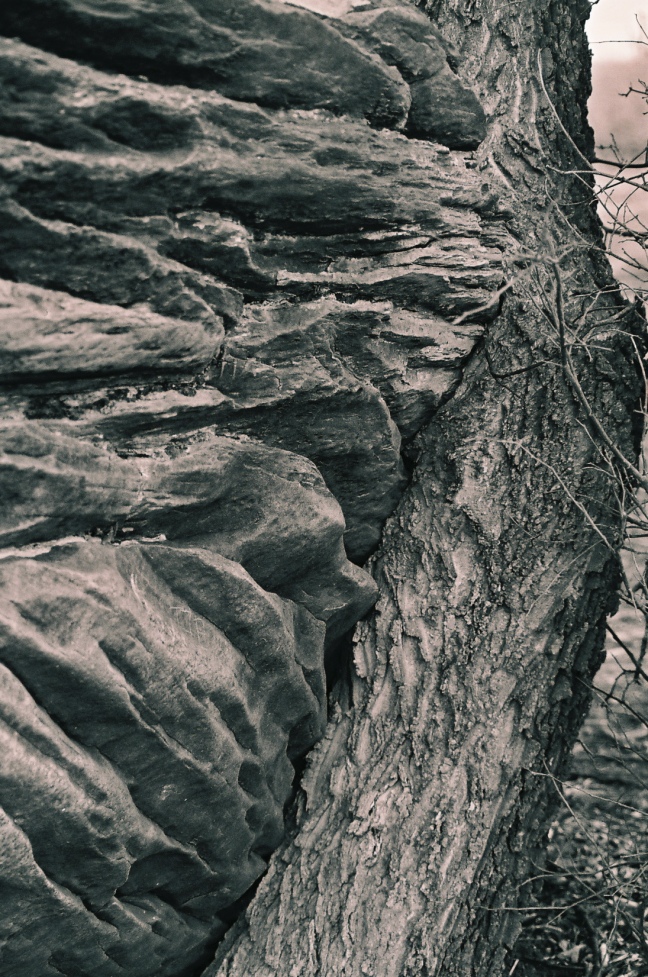
“Connection is the recognition of the intimacy of a division…
to make a division is to give substance form”
“Therefore shall a person leave his father and mother and shall cleave unto another
and they shall be as one flesh”
Genesis 2:24
The Cleaving
How do we come to know, believe or accept this ancient concept? It has mited its way to the deepest reaches of Being (Dasein): Heidegger’s rift, linguistics address, each individual body’s pulse or breath or tremor. That only the separateness may truly join. Only the differences are recognized as similar. Only the rifts require a bridge.
I do not know. It is a reality I feel with as much pain as hope or joy. That cleaving is both the splitting apart, the splintering wood and severing rope, AND their clinging together, their sealing and sealant. It undoes me. As a metaphor, concept or signification it rings true and carried dark howls and bright screams out of the depths of me.
And yet it comes so naturally. Fight or flight. Attack, retreat. The extremities of the urges to join and drive to cease. In the utterly intimate action of cleaving, we expose and unite – right in the most susceptible, vulnerable, life-threatening places.
The “cutting out,” “cutting off” – to cleave – you know what I’m referring to – when that which is most important to you becomes unreachable. That impression that you are being “given up on,” that someone is “letting go,” even actively removing themselves or casting you away, chopping the cord – the umbilical torn, gushing, pulsing, the infant left writhing and wailing in the dumpster or thorny woods, a closet or dark alley. Cleft.
In truth: that severing of relationship, whether momentary or fatal, is a life-threatening, death-dealing blow. Abandonment. The dawning that you are at the front and there will be no reinforcements, you are cut from the supply train. There is shock, there is scream and then a canyon of void with no other side. It is we at our most disastrous, mortally dependent state.
We in the face of absence. We without response – no face in a mirror, no echo of sound, NO THING. Cleft.
Individual, alone, solitary entity. Facing the reality: we are insufficient to our needs, incompetent to our existence, impossible to self-sustain. We in our fragility. Our valid, appropriate, ontological FEAR.
Whack! In anger, in grief, in silence, in bruise, we are severed, ultimately exposed, whether through small offense or enormous rejection – we have been cut. Past the bone. The reverberations tumble and crumble out far and wide, seemingly ubiquitously, regardless of the specific instant’s severity. This is “the cleaving” done as much to us as by us in our madness to survive, to be real, to be verified and validated.
In the “drawing near,” in the “clinging” of to cleft, on the other hand, we are born. We become. As another reflects or responds to our raw broken mortally wounded finitude and fragility, we get glued to the vitality of these limited lives we have in us. As these fearsome exposures are clasped, bonded, covered by another – transfused and salved, bandaged and wrapped or dressed by another – we know we are possible, we feel we exist and we matter, we join toward world and its being, brief though it is.
These are our chances and capacities: to effect, to mean, to act, create or be. It is in the drawing near that what life there may be is acknowledged, fostered, affirmed. Con-firmed. Cleft – grafted into the ongoing reality of things, parting through wholes, participating and enhancing of semiotic systems. As if life does not really belong to us, but we must belong to it, by belonging with one another.
“Leaving,” “cleaving.” The leaf cleft from its branch will not survive, but cleft or grafted to another stem or soil or root may for awhile yet, live on, grow, produce, change and become.
We continuously leave and cleave to varying extents, and these just may be the principal elements of our thriving. Cleft we perish, shrivel, die away. Cleft we heal, nourish and grow life. Both options/realities occurring in the cuts, the core places, the sources.
Here we panic, here we rejoice. Here we suffer, here we love. Here we become, and here we cease to be.
This mysterious activity necessitates both significations, counter-intuitive though it seem. The need to be cleft exposes the places needing cleft. Awareness of the sources for supply determines the crucial treasure, dependency, and gifts of supply.
We are chopped to the truth of death
and joined to the reality of life
Cleft.
Student Magazine of IISER Mohali
Music, Musicology, and related Matters
a photographic pilgrimage to Orthodox Christian monasteries across the continent
Meandering Through a Literary Life
Orthodox Christianity, Culture and Religion, Making the Journey of Faith
Erik Kwakkel blogging about medieval manuscripts
"That's the big what happened."
Networking the complexity community since 1999
 All my Words are Silent