This slideshow requires JavaScript.
(click title for text – thanks!)

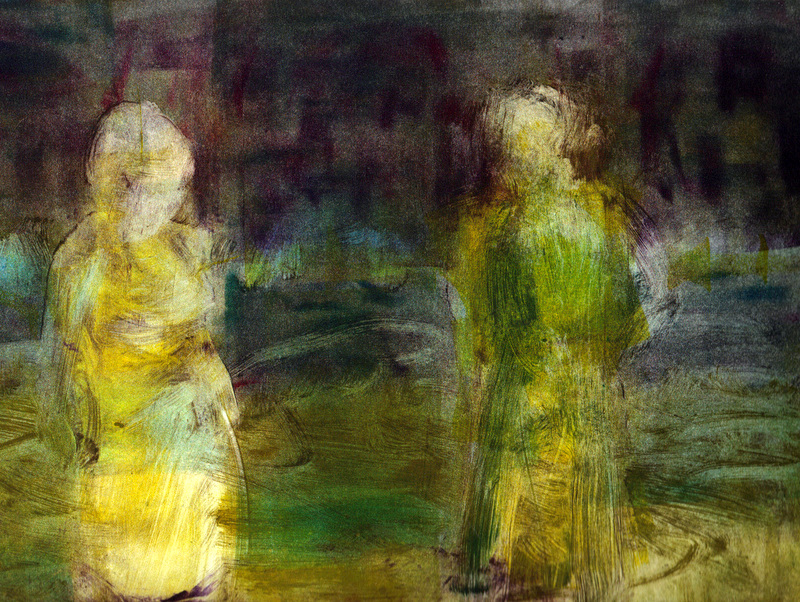
There is a tearing sound, as of something being ripped or sundered. She has begun to speak.
He attempts to listen, as if standing on an island of a busy and multi-laned thoroughfare. She speaks fervently, softly.
There’s the tearing. Something rent.
He is unable to hear. Only reverberations, a type of thrum from heavy traffic.
They are alone in an emptying room.
It is silent, but for the ripping, which also is not.
All of her aimed in his direction, what he has trouble seeing.
He attempts to look, as if through the fumes and smoke of a multi-floored building burning to collapse on the ground.
Her mouth moves gently and fierce.
He is unable to see what she says through the sound of the tearing, his searing eyes.
There are echoes, which also are not.
From a distance, things are still, as if a hobbyist set them in place.
She cries in her trying, directed at him and speaking, nearly a whisper, a message so loud.
The thrum and the shredding, the smoke.
Shifting, sifting to gather himself, redirect, organize, to attend. He tenses himself, tightens and coils, as if a reception machine. He is trying, crying, in a land far away.
Alone, they, the emptying room.
She’s given up, folded over, like craft paper wadded to a discarding ball.
A rivening come to its end.
He’s a radar, an instrument, powered and ready.
She falls explosively silent, unmoved.
He sees her, feels her absence arriving, he strains and he beggars the air.
Diminished and shrinking, she retracts to an inscrutable quark.
And he, aware, and alertly entire, listens and looks.
Anthropophobia: or, the Danger of Others
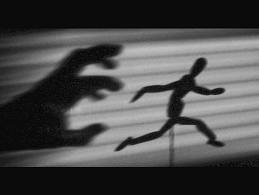
Let’s face it: our primary threat is the Other.
Those alive and breathing, in need.
Replete with sense and emotions, desires.
Thoughts, feelings, and dreams.
Con-fused.
Instinct and culture,
Learning and language,
and bodies:
physiques requiring space,
ears, eyes, limbs and digits,
the nerve!(s) and bellies and hearts.
Brains complete with mind and will,
Choice and intent,
the capability to discern.
Sexual organs,
Breath-pollution.
Stealing glances –
the lechery of looking –
what they plunder to hear.
This multitude of selves and their interests,
their tumultuous clamor to survive
and their ubiquity:
disruption of personhoods and presence
leaving The Exit as the only escape.
Most dangerous, Other:
the contact, connection,
and ability to attach.
Insidious deception –
a paradox of similarity,
of kind –
some others so like
as to be indistinguishable,
from our selves.
“In the strange faculty of doing certain things irrelevant to life with as much care, passion and persistence as if one’s life depended on them…there we find what is called ‘living.'”
-Paul Valery-


I the Question; I the Answer That Does Not Satisfy
“I am both wound and knife”
“Time is a river that sweeps me along, but I am the river;
it is a tiger that mangles me, but I am the tiger;
it is a fire that consumes me, but I am the fire.”
“The question inaugurates a type of relation characterized by openness and free movment; and what it must be satisfied with closes and arrests it. The question awaits an answer, but the answer does not appease the question, and even if it puts an end to the question, it does not put an end to the waiting that is the question of the question.”
“all things oscillate round me, and I with them, an uncertainty unto myself.
All for me is incoherence and change. All is mystery and all is meaning…”
I am the writer. Am I also what is written?
Both wound and knife.
I am the husband? What the husband does.
I am their father. Am I also their fathering?
I am the writer. Not the writer I believe I am, want to be, imagine. Am I the writer? What is written does not appease, does not satisfy. I am waiting, asking, waiting in openness for possibility. I am the answering I do not desire.
Am I what is written? Partial answers. Fragments pieced together forming questions. I wait. Am I the one who waits? While writing?
I love. Do I love? I answer by loving. I am dissatisfied by my loving – it is not what I had hoped, was waiting toward, believed possible. I am not the lover I asked for.
I feel I am the open, the possibility – the questioning. My answering closes, arrests, delimits me. I am neither satisfied nor appeased.
I am the human. Am I human? If I answer for that I am dissatisfied, given the question, the possible replies.
I write I am the writer, the one writing, this phrase of the question. Its answer never satisfies, leaves me waiting, asking again, anew. The questions.
“the anarchist keeps watch within us and opposes our resignations”
E.M. Cioran

Costume as Metaphor
We dress ourselves in certain clothes, change our hair and faces in order to look some way we think to look. Appearance changes us and it need not be dissembling. Indeed, what are we? Are we anything? Sometimes, we become what we look to be which we have thought to be. And, on further thought, this may be nothing also though, for the time, it looked to be something. Other times, our dissembling seems wrong in its particular, as a contradiction of another identity as though we had that identity and an assumed one could contradict it. We want to be something: whatever we really are, whatever we could hope to be. But, ‘What we really are is a mystery, and what we could hope to be has only such value as our hope assigned it. Our aspirations are blind and arbitrary and their success is only their own.
Children dress in scraps of costume and play at being what the scraps suggest. They try it and let it go. Later, our commitments are sometimes fuller and the letting go isn’t so easy when our interest wanes as it may. We hedge it with other interests on the side, secret selves or contradictory clothes which protest the real me, so that anyone’s person may well be multiple and all the multiples tentative and exploratory as children’s are. The space remaining for definition – so wide for children, or so it seems – becomes narrow and limited and definition farther and farther off and we accept what we were as if it were what we are or even what we had meant to be. But it isn’t. We know so.
When we ask who someone is we get places and ages for answers, occupations and antecedents, what times and places someone has occupied or what other external has occupied them, as though we were all blanks and had no shape or nature except by possession. Our need to possess and our need to be possessed proclaims this. If we really were something in ourselves, could we need anything? Could anything possess us? Possessions hardly satisfy us. They must have been not our need.
But, whatever our need, they must in some sense have been wrong and we sense the wrong not by contrast with some other possession though it must often seem so: the apparent greenness of other pastures or even this same pasture in the approach of some spring. We have hopes for projected futures, for what may someday be in spite of all. In spite of all. In the light of all. How impressive the all is: the endless possibilities whose indefinite endlessness makes absurd any one. How hopeless it is to pose in any particular costume when all we are is limitless and costume denies that, limits us in a role.
What can we ever be if the limitlessness of the all is truly our quality? We can as little be anything as we could if we were nothing as also it seems we are. It is hard to decide; and the decision whether we are all or nothing, based as it is on the same premise, produces the same result; we cannot ever be anything. Though we dress however forcefully or fancifully we will, it is always pretension though the pretense may have its successes, even for a long time.
What of the world? Though there may seem to be nothing outside ourselves, there is a sense in which we observe and the object, as though it were, of our observation we call the world. This is absurd because the world is as little as we are.
And yet the language has its declensions and its conjugations. If we speak at all we speak in the structure of the language and what we say, whatever it is, may matter far less than our accession to the way the structure of the language divides experience in terms of person and tense so as to say we are (or were, will be), so as to say what was or could, what is, who is the first or second or third person, what is singular or plural, that there are or could have been, that there still might be, certain actions, certain reactions. We speak in tongues however prosaic our speech may be. The boldness of language supervenes our actual experience. It means to say what we don’t know. It creates the world as if the world were. Its whole necessity is metaphor.
And language need not be verbal; that is to say our postures and houses, our laws and landscapes, our science and public buildings, share the character of language. They are metaphor also: creations of desire.
Forgive the world, however terrible it is. We dream of horror, impelled by what we don’t know, and the world seems to contain it; but it is not a real world and nothing requires our belief.
That we believe in nothing is a hard requirement because we want to believe in something: some political theorem, say, or religious creed or, sparing these, some unevaluated strength of our own as though in our person we might prevail and that prevalence had the salience of some proof. For what? For our dying? Because we do. Unable to think of ourselves this way, think instead of someone ten thousand years from us one way or another who will have or had a name, a place and costume no more and as much as we have. And who is he? Even so far as we know, it is a pretense of knowing. Abandon that.
Belief in nothing is a positive belief apart from relieving us of partialities; and, even in that respect, it is a liberation. The world is not partial. Nothing is all and the world is nothing as we are. What should we say? Nothing to say of ourselves and the world tells us nothing. The world is a silence. But we talk of it and to it.
We know nothing of the world and will never know. All we say is metaphor which asserts at once our unknowing and our need to state in some language what we don’t know. How we love clothes; plain clothing or even our nakedness, speaking the silence of the world, or fanciful costume in which we praise some aspect of the world we mean to praise. Clothing as metaphor, not to dress ourselves nor to say what the world is if we knew but to praise that world however it might be. Rich fabrics and fine leathers, ruffles and satin, silver and lace, glorious colors and the fragile purities of clean whites: none of these is the world nor are they all together the world. Songs only that sing its praise, the earnest entreaties and importunities of our desire.
William Bronk
from Vectors and Smoothable Curves



I’ve spent many years proclaiming, exclaiming, disputing and evangelizing my love of rain.
More intimately, for decades my journals and diaries are soaked through with ink and reflections of agonizing effort to verbalize just what it is, exactly, that the circumstance of raining represents, evokes, fulfills or actualizes in and for me.
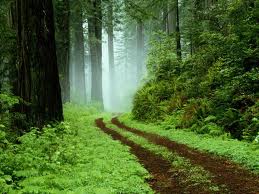
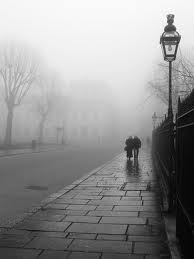
I’ve written of fog and dusk, how they soften the edges, blur the inessential, provide a veil of connectedness and symbiosis of what is perceivable, in keeping with my sense and belief about selves, things, world.
I’ve written of smoke, the ephemerality of moments, a texturing for the fragility of what’s present.
I’ve noted how the greying of cloud, runnels and droplets heighten other colors like green, rather than glaring them out in the brightness of sun. We filter everything – visible precipitation provides the physical opportunity of “seeing” that.
Or what is blocked and distorted (rain on glasses, windows, drops on an eye or a lash) – how choosy and minutely invested our visions are – what we choose to see, shape, create and how multitudinous what we skew, block out and deny.
Also its comfort – the blanketing, softening and quieting of snow and rain on atmosphere and mood. Like a muting and subtlety; a gentling and slowing of a pace. I’ve always felt I can curl up in rain, in fog, in mist and drizzle – cloaked, protected, respected, wombed.
And nourished. How birds, soil, plants, trees, worms, flowers, sand crave and delight in the generosity and equanimity of rainfall. How it blesses all regardless. Helps me feel part, wholed, valuable and real. I can stand in rain, clean in rain, play in rain, drink rain – without wealth or beauty, intelligence or strength, position or power.
What struck me today was how the pattering of rain – patterned and random, distinct while flowing together – was in perfect accord with my inner world – how my thoughts and feelings go, move, through, pool, form streams, gather, swell, evaporate.
The porosity. The feeling that rain both permeates and respects boundaries, wets without drowning, soaks without penetrating. Gives and gives and gives. Inward, outward; saturate but rarely flood; joins without binding.
The list goes on. What I find I repeat most often, having no words to explain it, is that the condition of rain (like the music of Mark Kozelek), of all the world most closely approximates my own fullest experiences or feeling of myself.
Somehow feeling that if someone “gets” the joy and glory, protection and soothing of rain, they’re a long way toward “getting” me, or me toward being known,
or at least somehow related.


Puzzling Errors
“the visible is perhaps only an invisible anxious to be known”
-Edmond Jabes-
“arrange whatever pieces come your way”
-Virginia Woolf-
“what rich moment will you find, ever,
that isn’t cheapened by your reaching for it?”
-Ron Loewinsohn-
Even though we made it up in the first place – visible, invisible.
It came in pieces.
To pieces.
We reached for it/them
to puzzle them together.
Puzzling.
Some pieces fit, some don’t
We decide what to make of them
Who “we” is, for example.
Once it/they come (whatever I/you decide it/they is/are)
It/they cannot be discarded or undone
Only selected or refused.
Reality isn’t matter. Doesn’t.
And it does.
To a certain extent
“we” call “invisible.”
Here’s a piece: “peace”
Or “god,” “love,” “me,” “you”
“self,” “cat” or “unicorn”
“walking,” “relativity.’
“Here’s” “a” “piece.”
What do you make of it?
In other words –
what do you see?
is it visible or invisible
when you reach?
“Or” – an enormous piece
I threw in there.
“Error in life is necessary for life,
and error in poetry is necessary for poetry”
-Harold Bloom-
I, for Instants, You
“Simply to name it is to con-
fuse it, altogether:
here now you
is a form you will not fill”
-Ron Loewinsohn-
“artists very often forget that their work holds the secret of true time:
not empty eternity but the life of the instant”
-Octavio Paz-
The children are reading Basho.
It was raining.
There’s a bright diamond
there where the legs in your jeans
come joined together
Is there a name for that small absence?
Where nothing blocks the light?
Between
Where your flesh fuses together
Con-fused, seamlessly?
In this case, I am eye
For instants, and then you move.
The children still reading Basho.
(they “get” it)
Rain coming again
this time not from cloudy skies
but wind shaking trees
My Anxiety
“Limits are what any of us are inside of”
-Charles Olson-
Deep in the cave of gates
latches and locks
and no moon
no light to speak of
silent and dark
and appropriately caged
unwound
Deep in the cave of gates
in the company of beasts
without vision
or light to see by
fearful and rabid
atrociously caged
unbound
Deep in the cave of gates
at risk and unhinged
without air
and promise of drowning
flailing incapacity
the autonomous cage
unfound
“The mechanisms that keep us from drowning are so fragile: and why us?”
-Anne Carson-
Student Magazine of IISER Mohali
Music, Musicology, and related Matters
a photographic pilgrimage to Orthodox Christian monasteries across the continent
Meandering Through a Literary Life
Orthodox Christianity, Culture and Religion, Making the Journey of Faith
Erik Kwakkel blogging about medieval manuscripts
"That's the big what happened."
Networking the complexity community since 1999
 All my Words are Silent