Feeling Blind

Antoine Coypel – Studies of the Blind


Feeling Blind

“Art always divides objects and offers a part instead of the whole, a feature of the whole, and no matter how detailed it is, it still is a dashed line representing a line”

-Viktor Shklovsky-

“A fragment is not a fraction, but a whole piece”

-Lyn Hejinian-

“Those girls!,” we say of our puppies, as if we know.  As if they behaved like us.  We are, after all, wild animals, without a master large enough to keep us from fighting.  The puppies are so small.


I remember filling a large square of canvas (“large” being relative to my body, not a mountain) with loads of spattered paint.  It felt good and looked neat, even interesting, crammed as it was with accidents and intentions.  Runs and spills and layers of carefully made strokes.  Nothing was recognizable or familiar in the result, but I’d swear it was representation.


Again and again I attempt to feel blind.  Not empathetically, by tightly wrapping my head and completely covering my eyes with some solid fold of cloth, then wandering through a day or night or week of time.  Nothing like that.  I’m capable of removing my glasses and learning the world without edges or shapes.  Feeling blind is usually sexual for me.  In the way I use my senses.  It’s never the same if I know what I’m touching or tasting, hearing or smelling.  To “feel blind” means losing familiar.  I write blind every day.  Defamiliarizing myself in order to learn something.  About language, about emotion, about me and a world of signs.  It’s de-meaning.  Bring me my lover’s body replete with organs and breath, thoughts and flesh, and lay her down beside me.  I’ll tell you what it’s like.


They like to escape, to cross boundaries.  If you turn your back, they scamper.  They’ll sniff and chew on anything, and leave their feces anywhere.  Artistic mediums rarely work the way I want them to.  Paint slips away where I place it thick and neat, clay cracks when it dries or fractures in the fire.  Words mean something else.  Her breath creates an atmosphere, moving particles and waves.  I can smell the colors of her thoughts.  At this distance it is easy to hear the goosebumps on her shoulder curling forward to her armpit.  I feel her hair, thick and brown, around my ankles.


I try to use mistakes.  The pups will eat their poop.  Her buttocks create parentheses in my dreams.  If I stack the pieces just so, another thing will happen, come to be.  Sticks preferable to stuffies.  The arches of her feet never cease whispering their curving tones.  I rarely intend what I make.  They stumble their way to fresh treasures of foul-smelling, old-buried rot.  Her crotch controls weather, I ache deep in my bones when it’s humid.


It does not cease to amaze me, what’s found.  Candy-wrapper, weed-stalk, squirrel-scent.  Everyone’s a critic.  The purposeless finds purpose in the eyes of the beholders.  The meeting of the needs.  The way the caps of her knees taste like buttons of mushrooms, just that tiny and soft on my tongue.  The slogans her scent shouts into my ears, rushing the drums like a throng.  They drag it until it dissolves.  Everyone makes up a context.


And eventually tire.  With ignorance things are recharged.  She is different when I open my eyes.  I had registered warm mango with coconut milk, they’d spilt honey on an old wet rag.  Apparently the “trajectory of my new works on paper.”  She came with a gasp and a shudder as I deciphered her Braille, she had never liked crowds and my mouth was crowded by terms.  No one understands it, or perhaps they do and I don’t, pups fast asleep and me feeling so blind with attention.


Tying Knots

This slideshow requires JavaScript.

“To tie knots, not decipher them”

-Arkadii Dragomoshchenko-


Thinking again of my father.  Which wends its way to thinking of my friends, my nearest family, my mother, sister, sibs-in-law.  Children.

Mainly I’ve been thinking of my father.  For decades now.

(Rewritten 41 times).


I keep trying to decipher.  In fact in yesterday’s version I described my desire lacking the keys to its secrets, and declared us all impossible to descry.

If that’s the word for it.

Forty-one years using letters for rope.  That is fraying.


I’ve said that I want to be known better than I can know myself.  By him.  By which I meant differently.

I’m sure that’s correct.

Otherwise not being possible.

And vice-versa.

Such knotted things.


Unfortunately I deciphered it, thereby fancying a code of simplifications and falsity.  Reading something like this: ta TAH ta TAH ta TAH / de dum de dum de dum dum dum.

Sounding better than the truth I never hear.


In other words, by desiring my desire (to comprehend it – synonym: “fit it into my small frame”) I laid it out in lines of script as on a butcher’s table.  And looked for patterns.

xxxx— I want to be known better (elsewise) than I know myself —xxxx

by:       +@+@+@ my spouse; -/-/- my siblings; o][o my friends; ~!~~!~ my children; ^*_= my parents…

and likewise inter-pret them

forever crafting spies sniping through tiny keyholes

one another.


The dimensions are not vast enough.

We don’t possess the organs (apparently).

I’m not sure any of this has much to do with knowledge (though I keep on using those terms).


It was about knotting ropes or threads, veins or limbs, ideas.  Tangling memories, blending emotions, and cross-narrations.


I tried actions (working-with, snuggling, fighting, conversation and more).  I tried history (genealogy, geology, agriculture, politics, religion and so on).

Think of these as ropes or twine.

Perhaps tied is a better word than tried here.

I tied performing, misbehaving, more languages and themes.  I tied sickness and health, better and worse for this knowing, this desire.  These persons.

to no avail

What was I expecting?

Transparency.

Demystification.

Understanding.

Deciphered companions.


What have I got?

Unclear, confused and knotty, my hands can’t pass through them.

I can’t wrap my brain around it/them/us, nor define.

At a loss as to explanation (a probable gain).

Father-cipher.  Mother-cipher.  Spouse-cipher.  Family and friend-ciphers.


Something substantial.


Where Am I?

Where Am I?

“Space seems to be either tamer or more inoffensive than time; we’re forever meeting people who have watches, very seldom people who have compasses.  We always need to know what time it is (who still knows how to deduce it from the position of the sun?) but we never ask ourselves where we are.  We think we know…”

-Georges Perec-


            Feeling displaced, it seemed like the time had come to ask into it.

Judging by the quilted charcoal sky, this must have occurred in the hours between night and day or that malleable period in which what’s bright becomes the dark.

I discovered that I was uncertain as to where, indeed, I was.


I cast about, but given the diffuse and myopic atmosphere, my bearings were difficult to draw.

My question just grew longer.


Within the nondescript what seek we to describe?


My whereabouts.  For even about can provide a circumference of radial lines, fashioned carefully.

It seemed to me that I must have been partway.  Having begun some time ago, though ill-remembered, I must have set out in some direction, making this a point along that plane or trajectory, on the way to the someplace I am going.  But where?  Whereto?  And wherefrom?  (the brain adds wherefore?)

I’m uncertain.

Most people do certain things at certain times, so time must be a deed, I guess.  Needing neither to eat, nor to relieve myself, it must not be too early or late, nor a mealtime.  The dim and the greys, they confuse me.

The ground being solid, but whether a road or a path or a field lying fallow, I could not say.  A fogging has thickened and the chalky gravel pierced with grasses and weeds does not provide location.

The best I can wager is midst.  I appear to be in the midst of things:  of my life, of this land, of my journey and day (or evening) – beyond this it just is not clear.


By the look of my hands and my feet – we say “character” – it would seem I am no longer “young.”  Hair has grown dark in places, I have visible veins, and numerous scarrings and wrinkles.  I never expect them to grow and they haven’t for many years, yet they can’t be called webbed with their linings, nor aged.  The skin is tanned and supple, not spotted, the knuckles aren’t gnarly or constricted.  Improvement or beauty I do not anticipate, but it appears I am not quite undone, not decrepit.

I’d guess I am “over the hill,” as they say, but still in reach of my prime.  A certain flair or panache, but the style of the action requires more will.  And attention.  Strong, yet not powerful.  Active, not quite agile.  Competent, not convincing.


I sit down.  The weeds and the grass are grey-green, grown in tufts.  The gravel is packed and yet dusty.  The stones are not worn but all small.

I trace my palms over the surface.

My legs feel the pain of my back.

I rise up.

I would find it much easier to lean.

I step forth.


I smell no particular smells – almost rain, dusty remnants, a particular quality of air, but what?  (From where?)  Neither salted nor briny exactly, I must not be near to the sea.  Not fuelly or floral, musty nor pale, I scratch off city and countryside, forests or plains.  And not fertile.  The air is just as you’d imagine it wherever the sky meets the land – in the absence of obvious effects (are they causes?) – just me.


It hasn’t grown lighter, nor darkened.

I breathe.

From the sound of it (silent) and its fullness, my lungs must be doing their job, performing their roles without much complaint.  As also my heart and my brain, liver and plumbworks.  I think I may have heard insects or birds, but the distance so vast I’d fail to call the sense knowledge.  And I mentioned I cannot see far.  These conditions.


I’d say it’s uncanny – to find myself here – but that’s exactly what I cannot find.


I reach out.

I step forth.

I breathe in.


Where am I?


If my memory served, as to where I’d last been, such info would greatly assist me.  But the best I remember is “home,” and that has been so many places.

I spread my arms and slowly spin, they cut the air like freedom.  I feel like a ray of light or drop of rain, something passing quickly, staying still.  As if I belonged…

belonged just here…

but where…

…am I?…


(How long do I have?)

A Profile

The Inevitable


What do we mean when we say “that ______ looks so German!”

To write.  It.

That unnerving pronoun – the impossibility nothing is.

And probable.

The work of understanding.  While standing under rain.  The gravity of melancholy.

Resulting in a study of colors.  As related to moods.

Desired solitude.  Desiring.  An oxymoron.  (To solitude).

What would you desire in solitude?  (While playing with yourself).

The “with” would be the problem.

Ever positing an other.


“we must each retain (and be granted) our uniqueness, even as we retain our relevance –

which is to say our interrelatedness”

-Lyn Hejinian-

In other words it is possible that we yearn for uniqueness and relevance, both requiring something else.

However might one be uniquely alone?  And still recognize red?

Or relevance?  (in solitude)?

The antimony that meaning is.

Meaning, nothing.  Large terms stripped of their content.  Yet undone.

If, then.  If infinity, then an eternity of incompletion.

Is that what you wanted?

Like desiring wholeness.  Oxymoron.

Living is logically incompatible.

Inevitably.


Upon viewing the sketch like a mirror.  Its frenzy.  Its worry.  An uncertain field of marks.

Energy moves.

Impossible object, in other words.  The world never calmer than an excited child with a squirming pup, in front of a camera.  Using your eyes as camera is moving in barely calculable jitters.  Each second.

How we view the world.  Ourselves.  Skittering fragments, objectless, composing subjective states, the subject of which, well, frankly, is subjectless, being, as it is, subjective.

A field, a spray, a flickering shower.  Drowning in waves.  Particles and fragments, all strung together without points of contact.

Inevitable delay.  Perception.  Duller senses.

Process requiring instants = moments = past.

Hardship of irony.  What one pays for attention.  Tolls of false awareness.  Delayed.  A logical impossibility.  I.e. “presence” (presently).

Lucky for suffixes as arbitrary denotations.  Arbitrarying.

Their simultaneity (e.g. –ed, -ing, -“ “).


You might say we “locked eyes” (past tense signifying long enough to catch up to the present experience thereby missing out on the initial wonder).

Processed cheese is not the same.

Fortunately every synapse of the factory also makes up now (as it makes it up) making up experience in order to.  Experience.

Some animals delight in chasing their tales (that was a genuine error there, though the audience following Moses following Discontent following Freud).  Tails, then.  Or heads.  Each swallowing another.

You know what I mean.  Swatting at air.

Meaning, well, nothing = something (and vacuous nevertheless).  Than?


Equals ever updating profile passed, passing, will pass, NOW.


It’s inevitable.

Leonhardt Conspiguous

Leonhardt Conspiguous


Leonhardt Conspiguous would have known the difference.  Between, say, BWV 161 and BWV 173; or a trunk or tail if he’d been born a blind mouse.  LC always knew the differences.  But he found similarities difficult to trace.

In conversation Leonhardt once encountered a man who’d read the entirety of his library, (the titles so resembling his own as to appear indistinguishable), drawing the same conclusions as LC in the shared vocabulary.  LC was unable to devise a category or designation for this phenomenon.  It was like looking in Leona’s eyes.

A concave lens forms a sphere of reflection, and hers – of grey of green of blue – mimicked Leonhardt’s so completely both in color and tone, that he’d instantly felt something farther back, back behind, any place he’d ever felt before.  In himself or another.  As time went on and her desire gained in details – their fancies so colluded he could not decipher whose were which – not in content nor expression.  The similarities baffled him.  And frightened.

But Hunter Green from Forest?  LC would know even the percentages and numbers.  Like every kind of sparrow, every human’s skin.

Leonhardt believed that what we come to know is inherently unique, but that same is imperceptible.  What startles us in those with whom we feel alike, is not the magnitude of what we hold in common, but how specifically each possesses it.  “To see eye to eye,” in Leona’s case, made visceral sense to him, but could not be understood.  “To see in or around” is what he labeled “comprehension.”

LC could see no further “in” to his cherished love Leona, than he could see within himself.  Which to some seemed deftly nuanced and unusually deep, but that was due to fierce attention and lots of time and mass filigrees of distinctions, not, Leonhardt insisted, to understanding.  “To analyze parts and fragments, was not to know a whole,” he was fond of telling himself, “and our lives are composed of fragments.”  Like arranging jigsaw pieces, separating by color and cut and number, and believing that they might fit, still never solved a puzzle, where new pieces are added all the while.

LC believed there was no whole, as far as humans perceived, just incalculable myriads of pieces arranged, rearranged, created/forgotten, damaged or lost in their fires.

He could never explain Leona.  Or synchronicity.  “Terms such as these synonym mystery,” he would say, “and should be kept in careful silence.”

LC despised religion.  The compulsion of the concocting of names, he called it.  A disease, an impatience, an anxiety of what is unknown.  Shuffling a hat full of vowels and consonants we look for what sounds as strange as our experience and assign it that – that which is odd to our senses, things we describe can’t explain.  A crapshoot or fancy, an oracle of chance.  Presuppositions he heartily derided.


We were left with description, he thought.  Of Leonard (his friend of shared library and thought) LC reported the odd sensation of someone other speaking words that more nearly matched one’s own ideas than the terms oneself could find.  And Leona, well, Leona.  Leonhardt preferred to call her by her body parts or textures, her language or beliefs, “Leona” ringing to him of the mystically unexplained, uncomfortable talisman, as if he were mumbling “YHWH” or “Zeus,” “Santa” or “Satan” or “Venus.”

(to be continued?  you decide…)

Jim

Jim

Jim is unable to utter a lie.  He simply cannot believe them.


Jim, sitting with friends around a hotel pool, once said: “I think every word says something about its author.”

After overhearing a tasteless joke, Jim no longer spoke with Darrell.


Jim disbelieved everyone.  His boss and his pastor, his spouse and his children; in fact, he found it impossible to trust humans (including himself) to know what they were talking about.  And yet he believed what they actually said.  The words they used.

Every statement or exclamation, every question, harrumph or faux-pas, he deciphered.  Jim doubted each “slip of the tongue.”  He said he believed in our languages.


Jim’s work was in “managing waste,” a lie that he knew they believed.  He spent most of his time in the noisy outdoors.  Chaotic, due to the mind-grinding sounds of the vehicular beasts they crept the city streets in, feeding them trashy fuel and guarding their grueling mastication.  Loud and smelly as well.  Rotten food, molded carpets, all manner of grotesque and disfigured things.  Jim saw what was hidden, discarded.  What most of us keep covered up.


His coworkers primarily proffered profanity.  He believed them.  But branching to politics or domestic intricacies, Jim only trusted their language.  It didn’t really matter what content spilled forth (he would say), the words that they chose and the ways they were delivered provided the confessions they “meant.”  “I’m afraid my wife no longer loves me” often intended its opposite, for instance, and nearly always equaled “I’m unhappy.”  Words worked like that, held Jim, worked all around one another.  “Assume the people are lying and the words will speak for themselves.”

Jim’s wife called this the “double bind,” or his “contra-contra-diction.”  And “paranoia” in worser moods.  “If you don’t believe in people,” she’d say, “and always think they lie, particularly to themselves…then say you believe their ‘language,’ but never what they actually say – really Jim – what have you?!”  “You’ve got nothing!” she’d complain, “no substance, no content, no motive – just a jumble of words that you (one of them!) reassemble…what else can that be but the rattling workings of your garbage-compactor of a mind, Jim?”  And Jim heard: “I don’t like the way you think.  It’s not practicable.  It’s egomaniacal and unfair.”  How Jim reads an utterance, with faith in the language, between all the lines, “it’s relation,” he’d say.


“I can’t speak for somebody else, dear,” Jim replied, “I just translate what I hear, or apprehend.”  “You say tomahtuh, I say tomaytoe, sort of a thing.  That’s paying attention.”  How words wrestle around and decompose, what parts go first, or crumble, get smashed.  What words stick out, slide easy, remain.  “And watch out for the oily and slime,” Jim would say, “that’s the trickiest danger to ‘manage.’”


“You’re not dealing with garbage here,” his boss declared, “I’m giving you straightforward instructions.  There’s nothing to sift through or weed out, Jim.  I need you to perform this task,” and on he would speak, accustomed to Jim’s sorting appraisal of words.

For Jim it was all the same.


Words were some overused and available aggregate, he thought.  People picked them out according to habits and taste, “nature and nurture,” he’d cliché, and then bandy them about until they felt understood, or relieved, or just plain empty.  But the resemblance was rarely precise.  Jim believed that most people simply grabbed at terms and sounds, gestures and winces without much a thought for precision.  “Think what all could be covered in silence,” he’d say, holding a field guide to transportational signage, or fingering the moves of sign language.

Most people just want to make contact, he’d hold forth, to be heard or effect something – a playing of power, a quest to convey – but not given much thought or concern.  “I basically rummage through all their crap,” Jim continued, “with an eye out for volatile substances, wounded heirlooms or inadvertent mistakes they rid themselves of, and put a pretty clear picture together.  Of their values and style, relations and status, family, religion and work.”

Joan (Jim’s wife) often speaks of what she deems Jim’s “arrogance.”  “How can he suppose to know,” she’d decry, “a person’s life story or intentions, education or political beliefs from a talk about weather or baseball or drinks?”  “It’s hypocritically bigoted, as if truth were the eye of beholding, each person’s puzzle to piece.  Unaware of themselves, Jim presents some ‘true meaning’ – its Gnostic, religious, a myth,” she’d complain.

Yet Jim was resoundingly insightful and most often correct, which simply buggered them more.  It seemed people really were giving something away when they opened their mouths, no matter what language they used.

“Words are functions,” Jim stated, “where text and image collide in a complex silence or sound.”  “Nothing escapes, really, just gets alternatively pressured and squeezed, mangled and reformed, mashed into a mushed conversation.”  “Every talker a monologue, every listener too, for the most part,” he said,  “a dialogue running oneself, a wrecked chorus, I listen for pauses and patterns, I try to decipher the breathing of noise.”

“These are just Jim’s thoughts,” snarled Joan, “things he puts into words like nonsense.”


(to be continued?  you decide…)

Blurting : what WAS this?

Found this in my files…probably isn’t even worth posting, but something kinda fascinates me about it…I’ve never been a drug-user, but something had surely opened the gates of the dam on the day this came forth.  Sometimes writings (by others) do this to me – I read and sort of get “drunk” I guess, with language and then somehow that stirs and stimulates whatever words fill up my cranium and then… well, for what it MIGHT be worth… here is What It IS

What it IS


is all of these things, trying to explain,

the trees, the flowers (dying), the grass (needing mown),

in line at the store, filling with gas, last nights’ remnant of dream (also the dreams from before, books read, voices heard/overheard/never heard), a multitude of feelings, the way she draws a heart, a star, what guilt feels like (now, then), the difficult struggle in parenting of love and direction, how language comes (or gesture, vocabulary or intonation), how silence, what we do with it, our decisions, who to love, where to live, how to say, what to smoke, when to fight, where to run, what to eat, why at all, what floating in a pool feels like (or a pond, a lake, the ocean), which music when, where, what we mean into it, the grades we make and receive, how we work, squirrels sounds and behaviours, what friendship is (might be), what is learned, absorbed, observed, what we touch, scents in closets (in bathrooms, at relatives, of genders or nationalities), associations, childhood, ambiguities, paintings and sculptures, religions or symphonies, taxes, liking to dance (or not), with people or alone, the postal service, how often, how much, your mother, who said so, aging,

trying to explain,

divorce, vocations, contradiction, philosophy, hunting, mountains, arrogance, wounds, broken bones (or hairline fractures), colors, fashion, changing the oil in the car (the mower, the boat), politics of oil of belief of emotions and opinions and genetics, diseases (like pleurisy and cancer and rust and decay), who family is, how you come by, sexuality, remorse, pleasure and pain and fences and institutions, architecture, advertising, electricity and electronics, pi, mohair, virtual and visual, palpable and “real,” poetry, names you can’t remember (but what is it you remember), can’t forget, incense, train rails, Marcia’s hair (shimmer and idealized clarity), meat, diapers, rain and humidity, historical “accounting,” memory theory money, mythology, facts and things like rocks and apples, pears science, bronze, doorways, “home” or houses, dead presidents, Casio, intuition, astrology, newspapers, rotations, reciprocation and differences, if anything is the same, what repeat might mean, definitions, experience, gasoline, yogurt, how fast you run, if you have arms or legs or are able to see or hear, clouds,

to try to explain this,

there is more here….

much more,

let’s see, hear, touch, smell, feel

wonder….

and death too…

to explain, include, describe

imagine

Writing: the Spaces. its Atmosphere.

This slideshow requires JavaScript.

Writing: the Spaces.  its Atmosphere.


Write first, the epigraphs assemble.  Post-prompting.  Or become the impetus the references gather around.

One idea.

With blackberry brambles and the wish (or revulsion) at owning a dog.

“A fragment is not a fraction but a whole piece” (Lyn Hejinian)

Like that.  It doesn’t take long.

The brain a compendium of quotes.

“The head is a very hard case.”  (L.H.)

I try to crack it.  I’m thankful it’s hard.  A safe for the precious things.

I can’t just do it “everywhere.”

In order to write, I discover I need to expand.  Once to the point I’m as large as my skin, it still needs a force-shield, a sense-field – a hard case like a desk and locked room, “controlled environment” or “padded cell” – that license to work without fear.

Or hurting oneself or one’s others.

The head is a hard case.  The body is supple.

Salmonberries all along the way.  A juicy burst, almost sweet, almost sickening – the risk involved.

My globe is filled with the words of others.  Like my skull, no bit of language is our own.  But inexhaustible, so unashamed, I eat them here, I forage food.  I harvest, glean and process in this tiny shed, concocting meal I hope will serve.  That process in yet another realm.

My space is angular.  Is low and dark.  A cross of cave and womb.  I need to know it’s all in there, I need to know I do not know.  I bring a lantern and a few spare tools.  I take notes, observations in my bunker-scriptorium, my hand and my brain.

“A paragraph is a time and place, not a syntactic unit” (L.H.)

I scramble your body.  Unravel.  Dissect and reassemble.  Never known in its entirety.  My own.  “some desire powers generously” (L.H.).  Dr. Frankenstein’s lab.

“Reason looks for two, then arranges it from there…”

“…Reason looks for two, then arranges it from three: number, stutter and curvature” (L.H.)

The writing space is “freedom then, liberation later” (L.H.) when rejoindered to the attaching world…

“a person seated on an iceberg and melting through it” (L.H.)

“the mind is a thing deeply marked.  I have bound myself to this damage” (Laurie Sheck)

“we are so rawly made, / so carried into the harsh and almost-dark” (L.S.)

My cave-womb almost-dark.  A lantern lights this page.  It is noon.  Vertebrates in the walls.  Fossily spines.

Number, stutter, curvature.

In the space, safely solitary, saturate with sense, my own…what assembles sensible only similar, and that’s okay…what obtains or remains can be observed as an object.  To be encountered, not understood.  Even me.

“Art is inseparable from the search for reality…

…Realism, if it addresses the real, is inexhaustible” (L.H.)

            Like looking at painting.  House or museum.  Everything both.   Various watching.

Mulberries litter the landing and stairs with an acquired taste.  Leaving stains, like everything we grow to love.

“A fragment is not a fraction….”

            Safe to search reality, where it has died, where it seems so.  “Seeming is believing” (L.H.).

Number, stutter, curvature.

Some berries you must not ingest but can still get caught by their thorns.  Or the illness pukes out.  A pulping.

Searching is not always distinguished.

Your space should form a shelter (within/without) bound to damage, rawly made.  Secure but repercussive.

Epidemic depends on the exit.

Nettles and fireweed.  The search for the fruits can be harsh.

It is almost dark.  I must emerge.

N Filbert 2012

Writing: Chapters that don’t belong – all of them, so far

Here is what has assembled so far…seems like a sort of series…in its wayward way…


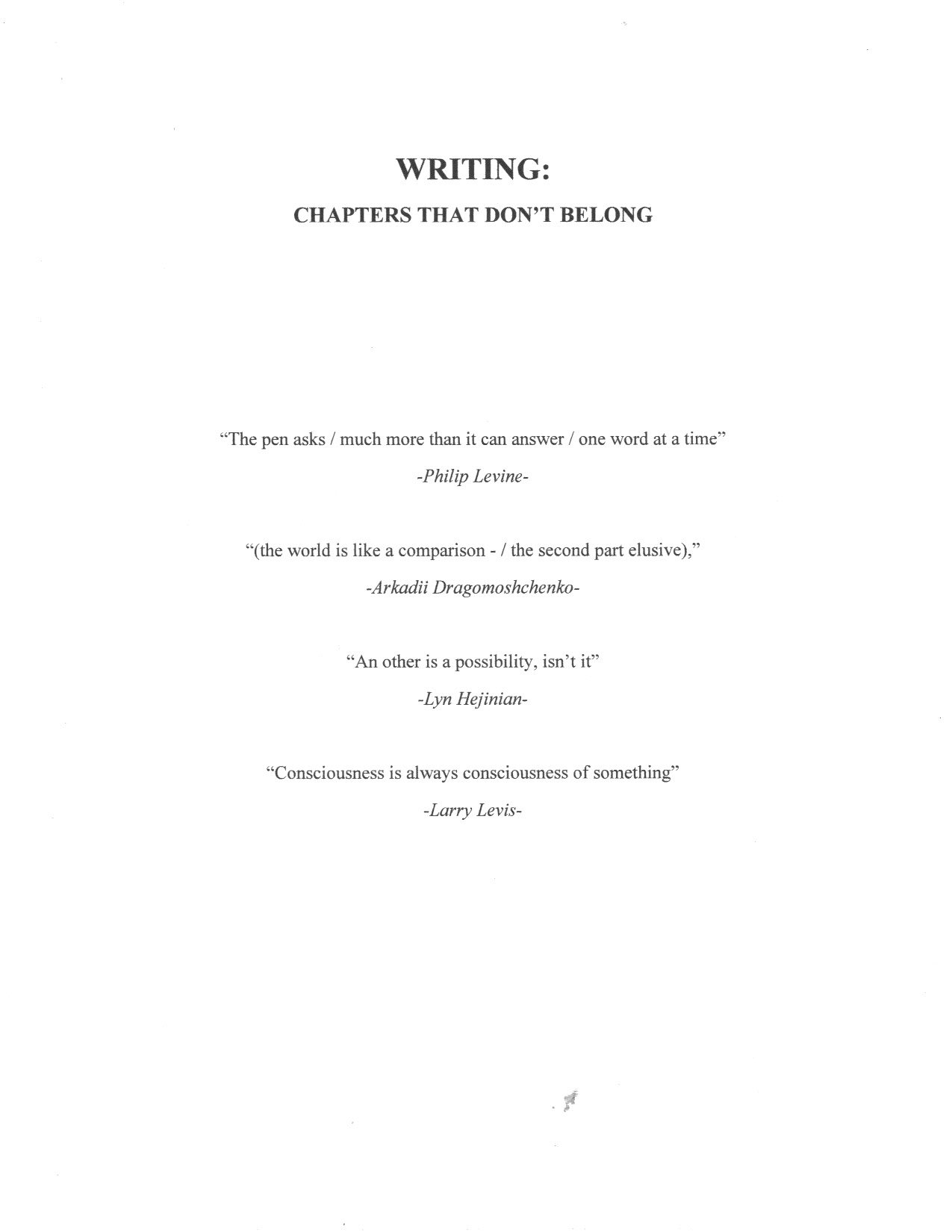
WRITING:

CHAPTERS THAT DON’T BELONG

“The pen asks / much more than it can answer / one word at a time”

Philip Levine


“(the world is like a comparison – / the second part elusive),”

Arkadii Dragomoshchenko


“An other is a possibility, isn’t it”

Lyn Hejinian


“Consciousness is always consciousness of something”

Larry Levis


1.  “wake up, snare-setter, / in the snare / spacious, like chance” (Arkadii Dragomoshchenko)


And sometimes I do, wake up.  St. Sebastian pinned as a still-life with crystal lances, a clarity.  But that is catching too, and refracts.  “I think that what I thought when I was thinking that, at least in thinking of it now, I am thinking that I thought it…” and so on.  Crystal lances.  Thoughts refracting.  The occasional conviction.  (Which we call certitude).

The margins within margins, windows in reflection.

Every image being an entrance through which we exit.  From.


I call this “letting actually resonate.”  This being, activity, thinging we do.

If I stand still, so to speak, I form a spiraling vortex, an enormous vacuum.  What is: portal and Black hole every now.  With.

Prepositions being ever-so-important, say “sign-ificant,” that they deserve their own sentencing.


I’ll never know what it is “to write.”  If only because it questions.  Every word.  In.

I can think of it as a working, out, but that is far from any truth I can conceive.  “the second part elusive” with each toggle of a term.


Gravity enforcing force, to fly.

I’ve never been fond of violence, but how else might we change?  Or even move?  On.


A recent well-organized text I perused and then ate, mentioned dialetheia as a two-way truth; or, “true contradictions,” that is, in one.  Word.  Split with a twin.  Comparison as congenital doubling.  Of difference.  Equals such same.


We look toward what can be seen.  Compromised and concealed by a frame.  Otherwise unseen.  Learn, therefore, (through your senses), in-visibility.  Dialetheia.

We do (many of us) love to be astonished, after all.  With.


If there are more parts to this I haven’t found them.  They’re either too large or too small.  I’ll have to wait.  I’m unable.  Nothing living waits.  Patience is pretense, pretend.  Waiting, is searching; patience, is longing.  Loss is implicit.


2.  The Chorus

“As for we who ‘love to be astonished’…

…A pause, a rose, something on paper implicit in the fragmentary text”

(Lyn Hejinian)

            Explicitly.

I.e. “the loss was always implicit as the longing” (Alain de Botton).  And I quote, quoting from someone else’s quotation, but I forget which (or whose).  For.

I’m certain for various reasons.  Which beggar the certainty.

A pause, arose, and fragmented this text.

Because I don’t

know

what I’m

doing

I am writing,

and it questions.

            As if we could get intimate with our process, so near it as to join.  In other words, if our action, breathing, effort, language, thinking, senses and the uncountable inborn “blind spots” that a human system circulates were, well…coterminous.


Is that a question lacking its mark?

It would seem so.  About.

Either too large or too small, perceptively, I suspect.

Causing a pause to rise,

as I search for something implicit.

            Explicitly.


Given the fragmentary text(s) (you agree?) I have to ask:  might writing be possibling an other?  “Consciousness is always consciousness of something” (he said).

That is a possibility, isn’t it?  (the second part’s elusive),


Blatantly – I feel caught in a snare I am setting, as spacious as I imagine chance to be, (having no other name I can call it), ensnared as I seem – some web, some matrix, some universe and beyond – too large or too small to perceive (I am guessing)

which always gives rise to a pause, implicitly.

What I had hoped to make explicit.


What I call “wanting actually resonate,” some loss implicit as longing.

I write, asking more than it answers, or “the closer the look one takes at a word, the greater the distance from which it looks back” (Karl Kraus, which I quote off someone else, who knows who – yet I hope someone does!)


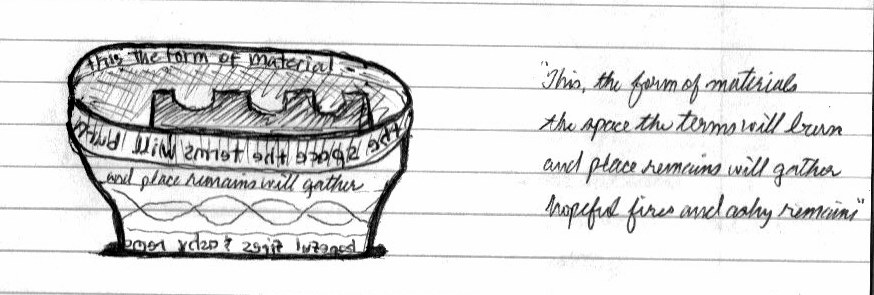
“But of any material, the first thing to make is an ash-tray”

(Lyn Hejinian, I quote this text from its source,

apparently).


3 – ?

“’Appearances / remain suspended / in transmission’ (Craig Watson) are not so much perceived as apprehended, handled; the one affecting, infecting, the next”

(Charles Bernstein)


            Or something to hold what dies off.  The reverberations without resonance.  All edited, edited out, according to needs for appearance, depending on what apprehends, the shape of the handler’s snare.

Think of it – what is selected for capture, in captivity, infects, slipping frequencies to drift on, transmitting, transmitting, there is always ash that won’t be removed, no amount of soaking, scrubbing or spray…

perhaps it’s under the nails, clogging the pores, dusting the follicles… the remains.
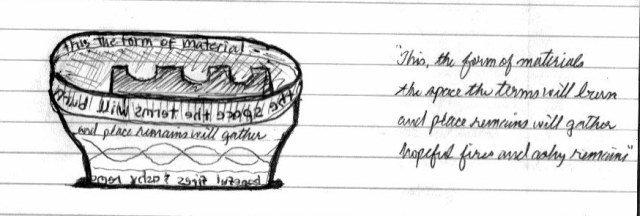
We don’t know why we write, trusting such ephemeral weightless shifty particles to catch as motes in an eye…appearances, like dust (in just the right angle of light), remaining suspended in their transmission…hoping (without, really, hope) to, in apprehension – apprehend, by being handled to affect, infect…

always wanting next.  Making it so.

Depending.


Why the book is needed (as ashtray) as form to hold the crumbling, an urn for the remains, until such time as they might be stirred or shaken or spilled.

Again in the commerce of bodies, handled, brushed and staining.

It gets everywhere.  And remains.

Note its infective spread.

Language, whether structures/systems of, or fragments – bits and pieces, lying everywhere implicit.

To write – to make explicit?  It asks more than it answers, word by word, by letter, by ash…


And what remains?  Suspended…in transmission…for affect…a dormant virus…waiting to be breathed…


4.  Desiring Reality

“the loss was always implicit as the longing”

-Alain de Botton-

“But, no one / can tell without cease / our human / story, and so we / lose, lose”

-Li-Young Lee-

“[Writing] is born from…’dissatisfaction’ – an internal void provisionally filled by the achievement of expression”

-Eugenio Montale-

“Because [writing] mediates between the requirements of desire and the conditions of reality, and because the relation between the two keeps changing, no statement of that relation is final”

-Ronald Sukenick-

“What is important…is not a word that is a stable and always self-equivalent signal, but an always changeable and adaptable sign”

-Katerina Clark / Michael Holquist-


I desire to write.  I think of it, at times, as an inscribing of thought, a physical processing of emotions, subconsciousness, dreams and ideas…”thought is a form of grief…but think we do, and lament we must, because lose we will” (H.L. Hix).  “But no one can tell without cease our human story…” ashes accumulating, carried by arbitrary winds, dissolved in sand and sea…

“Lose, lose” and don’t want to lose (desire); my ‘not-wanting’ is my longing (implicit loss), in other words “what memory is not a gripping thought?” (Lyn Hejinian)…imagination grasping in desire what it does not want to lose…forming an ashtray.  For what it loses.  Implicitly.

“No statement of that relation is final.”  Even, then, obviously, that statement.  Therefore we long to apprehend and handle…capture and contain…frame and represent…to ourselves (for?), for one another (to?) reality as it is not-known to us, unstable, uncertain and always changing.  Remember?

This is what makes this “fiction,” a “novel” – some new telling and unique ashtray design, in search of the fluttering ash, the “changeable adaptable sign.”

Required by desire, conditioned by unstable and unceasing reality, I write…words asking more than they answer, the dissatisfaction(s) (losses implicit in the longing) ever ephemerally, temporarily, momentarily filled by the action, the thought, the attempted expression (inscription) and then immediately felt again (affected, infected).  The plot, the narrative, the characters, all bound up right there – in the next moment’s void.  A gripping thought.  I give pursuit.  I desire.

I write.


5.  Without Trace


At the liminal edge, porous, moist, invisible and insensible arc…imagined limit, threshold…the ache to enter, with nothing to penetrate; the yearn to cross over or through, yet there is no barrier.  Simply following the pen, without copying.

Another way to say “possibility becoming,” or “questions and answers are words,” “letting actually resonate.”  The next part elusive, but its begun.  Refusing to compare.  Forging-foraging-forgery.

I am writing.  An other possibility that must be consciousness of something, perhaps implicit in the fragments, without identifiable trace because ensnared in the traces.

What is fiction, or poetry, essay / memoir / treatise…because making, with usable words.  That toggle so, and displace.  That render in their sundering.  That make a difference…by comparison, where the “other” is not known.

Assuming a tracing could follow or draw.  Like that – following lines or leading them on.  The perceptions, scratch that, apprehension or handling the senses must do when the look, feel, hear, smell, touch; the loss inherent in the transmission to thoughts, fueled by the desire to grasp or retain.  What was never suspended.  Always in transmissive motion…the letters.

If the lines are drawn effectively…I may form a working receptacle (as they falsify and crumble behind me in the ongoing change) where the ashes might be held.  Am I getting the picture?  Taking it?  Is taking it the same thing as making it?  Or must I develop it too?  The pen asking so many questions, word after word, tracing an image, a setting, a how…Will you follow?  Will I?  Will this be called writing and reading?  “Literature”?

I create without trace in the traces.  I go on.  Each word a threshold, a bottomless pit, then beyond that…again.

Like stringing the line and entangled.  Hooked for life…which is death.

Asking synonyming answers.  And vice-versa.  Just words.


I am writing.
Scribbling chapters that don’t belong…part 3

3 – ?

“’Appearances / remain suspended / in transmission’ (Craig Watson) are not so much perceived as apprehended, handled; the one affecting, infecting, the next”

(Charles Bernstein)


            Or something to hold what dies off.  The reverberations without resonance.  All edited, edited out, according to needs for appearance, depending on what apprehends, the shape of the handler’s snare.

Think of it – what is selected for capture, in captivity, infects, slipping frequencies to drift on, transmitting, transmitting, there is always ash that won’t be removed, no amount of soaking, scrubbing or spray…

perhaps it’s under the nails, clogging the pores, dusting the follicles… the remains.

We don’t know why we write, trusting such ephemeral weightless shifty particles to catch as motes in an eye…appearances, like dust (in just the right angle of light), remaining suspended in their transmission…hoping (without, really, hope) to, in apprehension – apprehend, by being handled to affect, infect…

always wanting next.  Making it so.

Depending.

Why the book is needed (as ashtray) as form to hold the crumbling, an urn for the remains, until such time as they might be stirred or shaken or spilled.

Again in the commerce of bodies, handled, brushed and staining.

It gets everywhere.  And remains.

Note its infective spread.

Language, whether structures/systems of, or fragments – bits and pieces, lying everywhere implicit.

To write – to make explicit?  It asks more than it answers, word by word, by letter, by ash…

And what remains?  Suspended…in transmission…for affect…a dormant virus…

waiting to be breathed…