“Whereof one cannot speak…” More Writings Unearthed

this repeated event of searching for blank pages only to find potential fertility in those already filled…

entries uncovered from March 2015

silencio

“WHEREOF ONE CANNOT SPEAK, THEREOF ONE MUST BE SILENT”

-Ludwig Wittgenstein-

HO SCIENCES, LOGICS, TECHNO-LOGICS AND MATHEMATICIANS!

PROGRAMMERS, DOCTORS, PHILOSOPHERS & ANALYSTS!

You have your discourses and discoveries, practices and spheres of operability!

You designate your domains through terms and definitions –

What is allowed and disallowed.

Vowed and disavowed.

Then silence.

EXPERIENCE

Whoever’s drawing lines of this and that, of here or there, of yes and no.

Whomever feeds the fuel of contradiction, against the singing speaking styles.

Whoever revels in dichotomy, clarity and divisions –

DIVERGE and then stay silent.

In complexity you must not speak,

on recursion and convergences be still,

traversing intersects and margins,

knotting nexuses and networks,

these zones your symbols will not call,

fringes disciplined discourses unable to name, locate, determine (undermine?)

WE UNDERLINE

AND HIGHLIGHT

HERE

REVEAL in complex approach – our work of ambiguity – perplexing and puzzling, unfathomable and obscure – in-determinate we sing, in language hard to cipher, discourse discomposing and dispossessed, polyphonious and multi-vocal, holding harmonies in dissonance

sing-speaking over/under/with

**********************************

Whereof can I speak?

I speak of pie.  Fruit pies.  My mother’s.  Yet I cannot speak, for I have never figured out how they can be the way they are.

I sing to love.  Great love.  Experiences and events so totalizing in kind that one fears one will not survive them.  And then does.  Yet I cannot speak to it because I am unable to account for it, explain it, or…

WRITING MEANS CLIMBING THE STEPS OF OUR LACK

-Edmond Jabes-

as if the aim of writing were to use what is already written as launching pad for reading the writing to come

Rambling

Fits and Starts

How oddly and uniquely our dear bodies exhibit the effects of stress.  For some days now, exhausted and craving rest, I wake ever-so-early in a kind of sleepless sleepiness.  Wanting only to burrow in, immerse in comfort and calm, be tenderly near the one I love, instead I toss, turn, disturb and achieve none of my wishes.

Is this another emerging effect of aging?

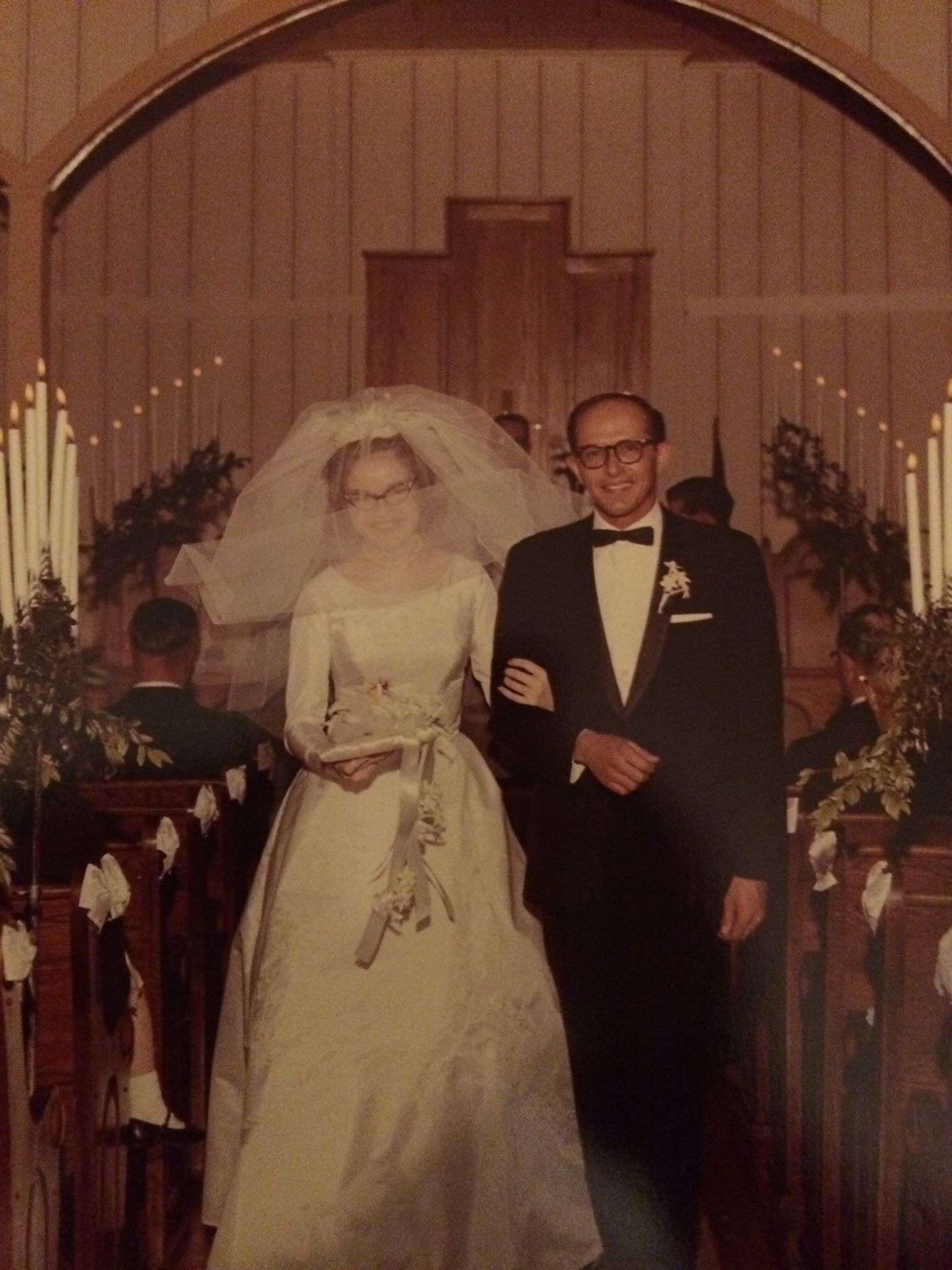
My parents soon will celebrate 50 years of marriage – an example of what Andre Gorz describes: “If you join with someone for life in marriage, you share your lives together and you refrain from doing what might divide or damage your marriage.  Building your life together as a couple is your common project and you never finish reinforcing it, adapting it, reshaping it to fit changing situations.  We will be what we do together.” (Letter to D)  

mom and dad wedding

which means that I also approach 50.

So there’s also that – a kind of nostalgia, melancholy, joy, awareness…

I’m one to search and seek and inquire without end.

One to wonder and ponder and interrogate my experience with hopes of understanding it – but increasingly I find that apparently my being simply wants to be SO ALIVE.  Sometimes I feel that is what is happening with my waking body – that it doesn’t want to miss.  Anything.  The presence of my beloved next to me in sleep (Gorz describes what I am experiencing in that regard very well also: “how love is the mutual fascination of two individuals based precisely on what is least definable about them, least socialisable, most resistant to the roles and images of themselves that society imposes on them”), the particular quality and type of that morning time, house-sounds, obfuscated consciousness…I, one of those who have “just worn different identities on top of each other, though none of them were mine”…sometimes it feels…and that this particular kind of love slowly strips and erodes those away to the irreducible, undefinable reality of each ONE of us…

FITS & STARTS

I shoulda wrote a letter.  There are the griefs, the emotions mistrusted, the longings delta’d out, and a million wishes.  “The past is still the past : a bridge to nowhere.” And then there is SO MUCH NOW.  The children and their emerging, engrossing creating lives; my wonder/love – a thriving, amazing individual who loves me and has so much of her own; there are the animals, the leaves, the waters and the breezes.  The breaths, the touches, the thoughts.  The feel of it all.

The word/concept/term “Mashup.”

Perhaps that is what is going on in my sleepless sleepiness.  My habit of reading has always been to read 30 or more books from various fields, genres, authors, subjects, literatures in order that my mind would have to do it’s weird mysterious complexity/chaos/emergence/dynamic/creative adaptive process of making some new idiosyncratic sense of a kind of global dissonance – our inherent ability to be a Convergence Creator.  To not be caught obeying, devoting, under the sway of some authority or perception or ideology not a Mashup.  Perhaps the thickness of being alive to what is life, attempting to attend, note and notice, enthralls the entirety in a similar manner – experience is a Mashup – so many sources, so many responses, so many interactions, so many affects and effects, roles, obligations, identities, loves, fears, perceptions, interpretations…and perhaps I’m currently simply immersed in a particularly cogent nexus of complexity and chaos – the operation toward adaptive emergence and some temporary convergence being administered in clumsy and cluttery fits & starts…

Perhaps each now is realization & threshold.  And, as a friend recently pointed out…“hope is such a restless state”.

hope butterfly

Where the Summer has Gone

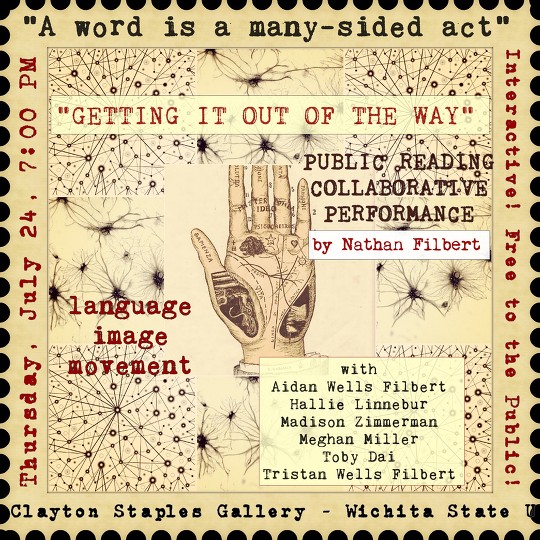
GetOutWayJuly

WordPress peers and inspiring friends – new love, new work, busy summer offspring and the above explain my lack of involvement here.  Autumn approaches, new semesters, school year beginning, and so on.  I SO hope to be active in your company again.  I appreciate your comments and patience.  What a large thing life is.

As I catch up on your works – I am SO thankful for the talents, visions, expressions, idiosyncratic thought and emotion that each of you have found a particular and meaningful (and SIGNIFICANT in whatever medium) way to realize in this forum.  I appreciate it greatly and am truly humbled and grateful for these odd and generative connections.

thereading

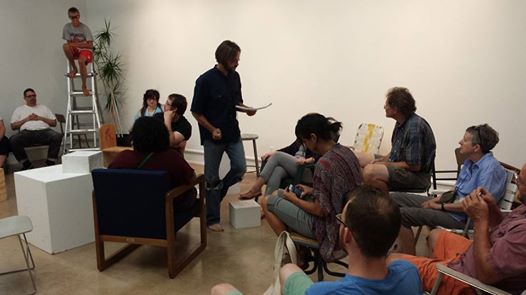
image from the reading replete with lifeguard (son), hostess handing out favors (buttons, nipples), stewardess serving odd mixtures of airline snacks, a priest blessing and moving people around, a waitress and a dapper emcee, a basket of fortunes created by my daughter, and myself wandering the space reading pieces and climbing on things.


Where we exist…how

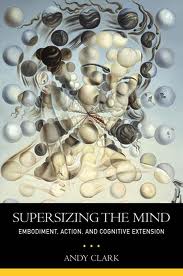
I was going to type a long set of excerpts…but so much nicer for you to get some of the full sense yourselves… if you have the time… it’s worth it – to interact with a resource external to yourself and see how that creates what we commonly think of as “cognition”… like my hands typing this message that you are going ‘outside’ of yourself to utilize toward meanings….

Clark - Supersizing(click on the picture for extended excerpts…and extending your world)

ReWritten / ReWriting

accidentally opened a file from the past that seemed related…

reading-writing

The Pleasure of Reading

In other words (than what?  than which?) we all of us are readers, all of us writers.

That is a pleasure.

And all of us, always, doing both.  Simultaneously.


Speaking of my textbooks (were we?) – information sciences, developmental and behavioral psychology, reference services, librarianship / and the research to the side – physics, evolutionary biology, neuro- and cognitive sciences / my pleasures – novels, poems, stories, others’ blogs, visual, aural, literary artifacts / my relational – wife, children, family, friends, society, culture – gestures and vibes and dialogues and signs / my “self” – sensations, perceptions, formulations of these, reformulations, adjustments and maneuvers.

In other words, at all times, I am reading, even if only my lack of memorable dreams, or pulses and breaths.  And writing it all in actions, movements, responses, adjustments of speaking and writing and making.

It is a metaphor, obviously.  Perhaps.


Roman Jakobsen purported that “all meaning is a form of translation, and multiple translation (polysemy) is the rule rather than the exception.”  (I am translating his text just now into another con-text).

Wolfgang Iser’s (perhaps, anyway insofar as I am translating it here) concept of actual text (text as it is recorded by an author) and virtual text (actual text as read by a reader).

This is an aspect of the deep living pleasures of reading/writing for me.


An author/speaker/artist/scientist/mother/etc. has an urge or sensation – a possibility of action/behavior/message/idea (a virtual text) and translates it through multiple processes and levels of activity through some medium into an actual text/painting/utterance/experiment/recorded idea/sound, etc.  There it is in the real world – a physical artifact in time and space – added – if only for a moment.  Transforming (simultaneously) its maker into a recipient (translating a now existent text/sound/behavior/gesture/sculpture/experience for him or herself) and if any witness/participant/auditor/recipient or reader is in his or her environment they are simultaneously interacting (via translation through their own tools, language, perceptions, sensations, mood, etc) with the actual text, writing a virtual text (translating) of their own.

And it goes on.  And can be done innumerable times, this process, whether using an identical actual text over and over, or simply writing/reading life as it occurs, making it occur.


Paul Ricouer:  “stories are models for the redescription of the world.”  Possibly.  Or at least redescriptions (translations) of models for redescription.

Iser: “the relative indeterminacy of a text allows a spectrum of actualizations…literary texts initiate ‘performances’ of meaning rather than actually formulating meanings themselves…the reader receives it by composing it.”


Language, action, behavior as possibilities rather than certainties.

So that I can encounter with all I’ve encountered/experienced an actual text by psychologist Jerome Bruner translating these very quotes and contents with all he has experienced and translate it with the multiple translations of family life and being a human organism and novels and pains, poems and stories, paintings and laws, translated with data and education, emotions and animals, translating with you and a computer, internet, digits and bits, translating into…


a great pleasure of reading is writing reading

or, “a writer’s (reader’s) greatest gift to a reader (writer) is to help him become a better writer (reader)” – Jerome Bruner (parentheses mine).


literary texts as “epiphanies of the ordinary”

-James Joyce-

Abroad – Notes from the Petrie Dish

Melancholy Musings

“Meaning, if there is such a thing, involves more than what there is.  Minimally, it involves a truthful assessment of what living a finite human life adds up to.”

-Owen Flanagan, The Really Hard Problem

“I’d tell you all you want and more, if the sounds I made could be what you hear”

-David Foster Wallace-

“You are – your life, and nothing else.”

-Jean-Paul Sartre-

This slideshow requires JavaScript.

“That Spring when life was very hard and I was at war with my lot and simply couldn’t see where there was to get to…” So begins Deborah Levy’s succinct “response to George Orwell’s 1946 essay ‘Why I Write,’ entitled Things I Don’t Want To Know.  It speaks to me.  Sentences like “Smoking cheap filthy sock-tobacco under a pine tree was so much better than trying to hold it together on escalators.  There was something comforting about being literally lost when I was lost in every other way.”  And here I am in London, far from home, wandering scattered Lego streets, half of the time having an idea of where I am, where I might go.  Like life with children – the half provided that’s never lost – versus the “self:”


I am the sign, I am the letter,

I am the language that cannot be come to terms with.

I will go to my resting place

                                                and will not be born again.

I am what is scattered and cannot be gathered up.

I am small, I am silence,

                                                I am what is not found.

Charles Wright


“It occurred to him that he would disappear into a hole in a girder inside him that supported something else inside him.”

-David Foster Wallace-

– that sort of thing, left to one’s own musings.  Levy speaks of her notebooks as “always gathering evidence for something I could not fathom.”  Dan Beachy-Quick speaks of the blank page as “one version of chaos…the movement outward and the movement inward are simultaneous…that we enter writing to threaten the security of the knowledge we possess before we read it…” knowledge that isn’t reason – “but the plank that, in reason, breaks.” (from Wonderful Investigations).

As a kind of practice, as it turns out, (Beachy-Quick also says “language offers a method of experiencing death without dying” and “Life, world: we die into it.  Words kill us.  We lose the tops of our heads.  Then we open our eyes.  Then we walk out of the poem into the world.”) I recently labored over messages to those significant to me (including myself) –

what would I want to say or have said if I were to leave the living?

Beachy-Quick suggests that “poetry is birthed from such awful realizations – a fact which denies the fact of one’s own being, that says the self, even the godlike self, is not sufficient unto itself.”

Here some parts from The Letter to Myself:

“I believe the world has had enough of me, and I of it.  Life is generous: overabundant with pain, surprise, people, noise, joy, danger, grandeur, poverty, tastes and sights, sounds and smells, anguish, glory and grief and their very complex mixtures.  As are we – individual organisms – capable, unique, agentive…

      We cannot capture life.  It is ‘more than.’  As mine ends, I find myself desperately wanting to summarize and somehow represent it, but I find no words to do so.

      Aside from the brevity of the fullest portion of my lived experience … with ease what I most grieve is not seeing my children shape and become themselves.  That is the question I most toil over – have my children had enough of me? 

      In the main I have experienced myself as a person whom others accommodate, adjust to, endure.  In classes, families, and communities of practice, even in friend groups, I’ve never FITTED – conjoined smoothly – BELONGED.

      My children have never known another father, so they might find me definitive, ‘right’ only, unique and special.  But my parents have known other children, spouses other partners and lovers, friends other friendships, teachers other students, bosses other employees and so on…and none would consider me ‘best’ or ‘only,’ definitive or unique.  No one has chosen or selected me as theirs.

      I know I’m not alone in this, nor do I need to be the BEST anything, but I would have loved to have been chosen, claimed, selected and pursued – not for being the best, or special, not for characteristics or qualities, talents or things I do well – but for being me, for the am I am.

      How “uniquely me” turned out was never quite enough for others, or not the ‘right’ enoughs.  I surely don’t blame others I‘ve encountered – no one was obligated to choose me, or owed me selection, I simply was not suited to my contexts.


      I hope that my children and loved ones are able to discover and co-generate contexts in which they thrive.


      I had my moments, my ‘times’ – the births of my children, my weddings, days of writing and travel, dialogues with friends and multitudes of sensations and aesthetic and enriching experiences – I do not lack,

            but it’s a struggle my organism is tired of. 

      I want to say that in my life with my love I realized it – I knew myself as a unique person with particular qualities, capacities, failures, weaknesses and strengths.  I accomplished and risked, expressed and developed more of myself during those years than perhaps the entirety of my life until then…

      …in the end it’s only rambling, ever trying to grasp something of experience…ever unable…

      Perhaps something, but not what I mean to.  Always less, never enough… I’m sorry.  Thank you for enduring me this wonderful long.”


To speak up is not about speaking louder, it is about feeling entitled to voice a wish.  We always hesitate when we wish for something…A hesitation is not the same as a pause.  It is an attempt to defeat the wish.  But when you are ready to catch this wish and put it into language, then you can whisper but the audience will always hear you.”

-Zofia Kalinska, quoted in Deborah Levy, Things I Don’t Want to Know 

So speak up, practice, be gentle with yourself – “the story of this hesitation is the point of writing” – into and out of yourself…the activities where things con-fuse…

I wish to write.

I wish to parent.

I wish to love and be loved.

I wish to learn.

I am thankful the “I” is “what is not found,” for then we can keep searching (together), and in the searching, the interaction, perhaps begin a “truthful assessment of what a living finite human life adds up to” –

to matter and to mean.
Over the Atlantic

I apologize in advance and beggar your patience regarding the length of the following post.  It is not often that I have over 10 hours straight of anonymity and limited distractions to read, study and write.  I spent yesterday and last night flying from Wichita to London for a week-long course examining over 10 specialty libraries there.  For the course I must keep a diary online, and while not about “library business” per se, this is about the journey…

de botton - heathrow

Over the Atlantic

I have no idea what time it is.  I have been airborne for perhaps four hours, having left Houston around 7:35 PM after an hour of mechanical fix-its, preceded by departure from Wichita at 3:36 PM earlier this same afternoon.  We seem to be flying fast enough that my electronics are scrambled and I haven’t worn a wristwatch since high school.  I’ve been lucky enough to have booked onto an half-full flight, allowing me the pleasure and benefit of a two-seated section all to myself.  Almost a work-cubby – two tray tables stacked with books and an empty seat for sundry supplies.

At all times I pursue readings that might deepen and expand both my abstract and subjective life – I’m certain that could be stated better – perhaps that challenge and enhance my lived experience.  Most honestly: that cause me to think, help me make sense, prompt change and give me pleasure.  Writings that move me, would be another way of saying it.  In the cabin I have arranged Focusing by Eugene Gendlin, Elegy Owed by Bob Hicok, Impenetrable Screen of Purest Sky and Wonderful Investigations by Dan Beachy-Quick, Light Everywhere – Cees Nooteboom, Buddha’s Brain and Just One Thing by Rick Hanson, Infinite Jest by David Foster Wallace, A Thousand Plateaus by Gilles Deleuze and Felix Guattari, and Art as Therapy with  A Week at the Airport by Alain de Botton.  Which could be explained in so many ways.

Traveling internationally, one is limited for selection – in fact it’s by far the most difficult portion of packing – which books will I need – not knowing how the movement and context will affect me?  So I choose:

  • fresh books by authors that have earned my confidence (my top choice for this trip was Leaving the Sea by Ben Marcus –  missed in the mail by a day);
  • books that I know meet my needs on departure (many my third or fourth reading); and
  • books I long to swim in but rarely have time with the insistent daily needs and benefits of home. 

Whenever I’m struggling with depression, I reach for Wallace and books of wisdom – on staying present, taking steps, coping skills, the breath and body.  Reality therapy, as it were.  Poetry helps as well, with its attention to detail and sensual triggers.  Books that remind me that I’m alive, regardless of  felt experiences or circumstance.

I will finish A Week at the Airport on this flight, I’m almost there – or maybe I won’t, saving the “Arrivals” chapter for that moment in my journey.  It is the account of de Botton’s stint as writer-in-residence at London’s Heathrow Airport (my immediate destination), and in his inimitable and typical fashion – exposing those human universals embedded in the familiar, or overlooked, or hardly spoken.  What he asks from other writers, he provides (and I quote): “I was looking for the sort of books in which a genial voice expresses emotions that the reader has long felt but never before really understood; those that convey the secret, everyday things that society at large prefers to leave unsaid; those that make one feel somehow less alone and strange.”  Maybe that is my true criteria – “those that make one feel somehow less alone and strange” – for the books I end up digesting do just that.

Here are some of the portions I have highlighted:

Departures

  • “Entry into the vast space of the departures hall heralded the opportunity, characteristic in the transport nodes of the modern world, to observe people with discretion, to forget oneself in a sea of otherness and to let the imagination loose on the limitless supply of fragmentary stories provided by the eye and ear…to sense viscerally, rather than just grasp intellectually, the vastness and diversity of humanity”
  • on the parting of lovers: “We might have been ready to offer sympathy, but in actuality there were stronger reasons to want to congratulate her for having such a powerful motive to feel sad.  We should have envied her for having located someone without whom she so firmly felt she could not survive, beyond the gate let alone in a bare student bedroom in a suburb of Rio.  If she had been able to view her situation from a sufficient distance, she might have been able to recognize this as one of the high points in her life.”  – (I know this feeling and need this distance)
  • on taking ourselves with us:  “There is a painful contrast between the enormous objective projects that we set in train, at incalculable financial and environmental cost – the construction of terminals, of runways and of wide-bodied aircraft – and the subjective psychological knots that undermine their use.  How quickly all the advantages of technological civilization are wiped out by a domestic squabble.  At the beginning of human history, as we struggled to light fires and to chisel fallen trees into rudimentary canoes, who could have predicted that long after we had managed to send men to the moon and aeroplanes to Australasia, we would still have such trouble knowing how to tolerate ourselves, forgive our loved ones, and apologize for our tantrums?”
  • on unfamiliar workspaces:  “Objectively good places to work rarely end up being so; in their faultlessness, quiet and well-equipped studies have a habit of rendering the fear of failure overwhelming.  Original thoughts are like shy animals.  We sometimes have to look the other way – towards a busy street or terminal – before they run out of their burrows.” 

Airside

  • “Despite the many achievements of aeronautical engineers over the last few decades, the period before boarding an aircraft is still statistically more likely to be the prelude to a catastrophe than a quiet day in front of the television at home.  It therefore tends to raise questions about how we might best spend the last moments before our disintegration, in what frame of mind we might wish to fall back down to earth…”
  • Or, as a “Terminal Priest” expressed to him: “The thought of death should usher us towards whatever happens to matter most to us; it should lend us the courage to pursue the way of life we value in our hearts.” 

need I go on?

Yet on I fly…listening to and “Gustavo” from the new Sun Kil Moon album Benji on repeat; performing breathing exercises while silently repeating blessings on those I love to the quivering thrum of this airborne albatross; catching glimpses of “Before Midnight” on face-sized screens where perhaps mirrors should be; and reading and reading and reading and trying to conceive…

stories imagined and rejected

in which the yachtsman drowns

in a remembered winter

and exists as a poem,

.

but the last thought is of

her, the woman who disappeared,

who everything was about, the yachtsman, the bay,

the poet.  The air it all breathed

is the loftiest fabrication, a life

possible now it’s no longer

possible.

-from Cees Nooteboom’s poem penobscot

and worrying about “how modest and static a thing a book would always be next to the chaotic, living entity that was a terminal,” our relationships, our lives.

14 February 2014

Inebriation

currently absorbing…

This slideshow requires JavaScript.

Reading/Writing: Complex Transactions

“Every reading act is an event, or a transaction involving a particular reader and a particular pattern of signs, a text, and occurring at a particular time in a particular context…the reader and the text are two aspects of a total dynamic situation”

Louise Rosenblatt

Rosenblatt - Making Meaning

Writing and Reading: A Transactional Theory

by Louise Rosenblatt

(click to read full article)

“Writing is always an event in time, occurring at a particular moment in the writer’s biography, in particular circumstances, under particular external as well as internal pressures…the writer is always transacting with a personal, social and cultural environment”

-Louise Rosenblatt

louise rosenblatt

An Example of Structuring – Priorities

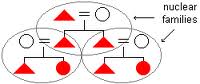
1.  Family

Nuclear Families


2.  School

Scholarly Pursuits

3.  Prioritization of Personal Pursuits

Structural Prioritization of Readings: Fall 2013

(please click on image for display)

Readings