(The First Good Novel)

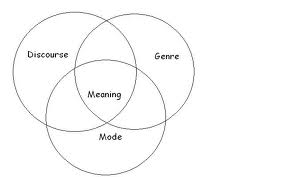
Meaning

In any breaks in necessity – between semesters, breaks at work, children otherwise occupied, no “required” readings or commissioned work, etc… – with each passing season, I gradually discover what matters most to me (literarily speaking, which, for me, involves much of my lived life) – perhaps I might refer to it as my meaning-making-factory-resources (Blanchot says of Borges that he is “an essentially literary man – which means that he is always ready to understand according to the manner of comprehension that literature authorizes).”  At this point in my living, over four decades along, and a large percentage of the pie devoted to reading, those voices I turn to, their messages and efforts, have become quite consistent.  Each year there are new ones, new threads and concepts, theories and expressions that very significantly impact my living – but they tend to find their place as commentaries, extensions, additives and queries to what (I suppose) now forms my central “canon” of sorts.

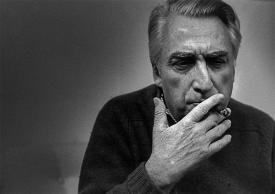
This struck me, following my return to Bakhtin and Blanchot, and as we prepare for vacation how I immediately reached for Soulstorms by Clarice Lispector and The Museum of Eterna’s Novel (The First Good Novel) by Macedonio Fernandez.  In searching for this image of Fernandez:
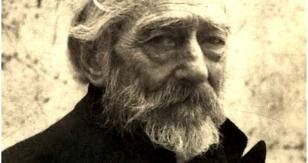
Macedonioa host of Google’s “related images” arose – including Borges, Lispector, David Foster Wallace – and I got that vision of how pantheons develop and connect and gradually form a kind of woven semiotic pattern – a “worldview” or “Innenwelt” I guess – it begins to make sense what’s connected to what and whom to whom throughout time and space of world-being.  Beckett, Blanchot, Dostoevsky, Pessoa, Rilke, Cixous, Kafka, Bakhtin, Jabes, these visions and verbals I return to again and again and again and again – inexhaustibly – and although my copies are nearly glutted with markings and underlinings – and they feel intimate and familiar (on the one hand) – that I also feel I am always learning them anew, freshly, with EVERY read.

These things astound me.
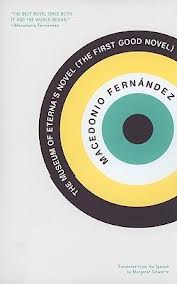
Museum of Eterna's Novel

Of this particular book (which I often say is the very best novel I have ever read, repeatedly), Adam Thirlwell writes “It is a novel which does not want to begin.  Or, perhaps, it is really a novel which does not want to end…The aim of Macedonio Fernandez’s novels is to convert all reality into fiction (or the other way around).”  “The real subjects of this lightly playful novel are the grave ones of death and love.”

“In his novel, Fernandez tests the possibility that all philosophical questions are only meaningful in relation to human relations: that all questions of infinity are really questions about love.”

and so on.
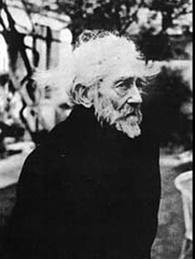
Macedonio 2

Macedonio is, for me, a hero the likes of Bakhtin, Blanchot, Beckett – those writings and writers I will never “get over,” never “get around.”  Writings I can only ever “go through.”

Perhaps these writings are characterized by the question – “What is it to be real?”  I recently discovered in one of those “shock of recognition” moments that although I’ve studied theology, philosophy, classical music, art and literature and now information sciences and systems theories – that none of the CONTENTS of these fields sustain my passions – it is the relationships between them – the ligaments and synchronous reverberations they emit – the MEANING-making effects of their pursuit and inquiry that is REALLY what drives me toward, into and through them.  I’m not looking for truth or necessarily facts or any answers – but for PROCESSES and PRACTICES that enrich, enhance and extend my biological life in relation to the world I’m “thrown into.”

Borges wrote of Fernandez: “Macedonio is metaphysics, he is literature” and that “writing was no trouble for Macedonio Fernandez. He lived (more than any other person I have ever known) to think.  Every day he abandoned himself to the vicissitudes and surprises of thoughts as a swimmer is borne along by the current of a great river.”  The novel’s translator writes: “The method is madcap; the intent is desperately human.”

Perhaps that is what I’m after – to be “desperately human.”

and now we’re heading off to the wilds – to be desperately human with-world with-family – replete with above-mentioned authors and without wi-fi or internet services!

P.S. (also from current reading – The Waste Books by Georg Christoph Lichtenberg):

“Be attentive, feel nothing in vain, measure and compare:  this is the whole law of philosophy.”

and

“To grow wiser means to learn to know better and better the faults to which this instrument with which we feel and judge can be subject.”

All the best!
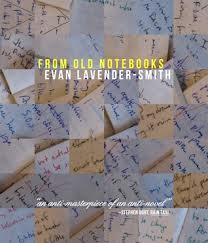
Mirror-Mirage

“Contemporary authors who construct a thick barrier between themselves and their readers such that authorial vulnerability is revealed negatively, i.e., via the construction of the barrier.”

Lavender-Smith - FON

“The scientist and philosopher are like identical twins in a world without mirrors.”

Evan Lavender-Smith

In the Mix: Against Obsession

This slideshow requires JavaScript.

Making Trouble….er…Making Meaning (via Jay Lemke)

I personally attempt to read every writing I am able to obtain by my favorites.  Some of my blog entries may therefore be redundant, as redundancy is a way that I am able to sense patterns and make connections and thereby forge what I experience as meaning.  The following is one of the summary writings (nah, that’s not quite right – even with redundancies and retellings I rarely find a summary-type writing by my favorites – there’s always difference – and that is what snags me!)… Okay, for your interaction, pleasure, and engagement, without further ado…

Making Meaning, Making Trouble

by Jay Lemke (1995)

Furthering Fathering

Fathers Day gifts arriving early….

already ecstatic…

trusting always that these might inform…

all of us

Thinking about Origins

Along the networks of transductive reading, the following productive co-constitutive readings…

“The beginning is not the same as the origin.  When the beginning emerges, the origin recedes, leaving in its wake a past that becomes our future to form a circle that never closes…It is important not to convuse beginning with origin.  Origins are always obscure even when beginnings are not.”

Mark C. TaylorField Notes from Elsewhere-

“What if, instead of placing self-self interaction at the center of development, we were to posit relation as key to experience?  Relation, understood here in a Jamesian sense, is a making apparent of a third space opened up for experience in the making.  This third space (or interval) is active with the tendencies of interaction but is not limited to them.  Relation folds experience into it such that what emerges is always more than the sum of its parts…”

Erin ManningAlways More than One

bear with me – this is extended, but so merits reflection (I think)…

“What if neither skin nor self were the starting point for the complex interrelational matrix of being and worlding?  Being and worlding depend on the activity of reaching-toward.  Reaching-toward foregrounds the relationality inherent in experience, a kind of feeling-with the world.  This tending-toward is a sensing-with that does not occur strictly at the level of the sensory-motor.  It happens across strata, both actual and virtual.  A looking becomes a touching, a feeling becomes a hearing.  But not on the skin or in the body.  Across strata, both concrete and abstract, that constitute an assemblage.  This assemblage is a sensing body in movement, a body-world that is always tending, attending to the world…”

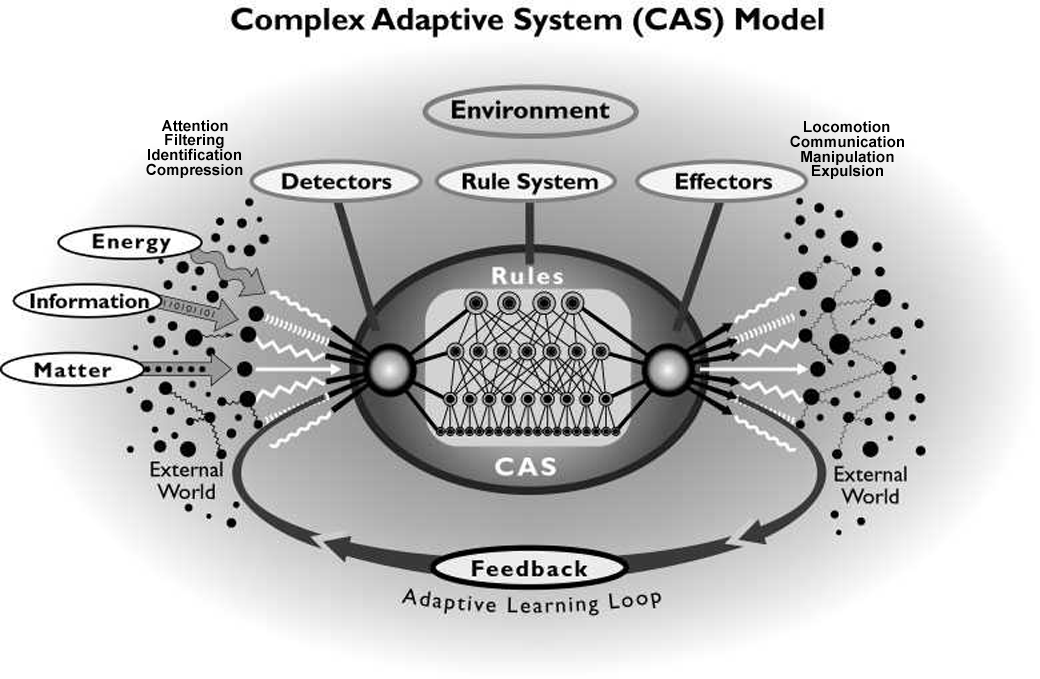
complex adaptive systems diagram

“…In equal measure, the world also tends toward the becoming-body.  Body-worlding is much more than containment, much more than envelope.  It is a complex feeling-assemblage that is active between different co-constitutive milieus.  It is individuation before it is self, a fielding of associated milius that fold in, on, and through one another.  For the associated milieu is never ‘between’ constituted selves: the associated milieu is the resonant field of individuation, active always in concert with the becomings it engenders.  Becoming-self is one of the ways in which this folding (body-worlding) expresses itself, but never toward a totalization of self – always toward continued individuation.  ‘To think individuation it is necessary to consider being not as substance, matter or form, but as a tensile oversaturated system beyond the level of unity’ (Gilbert Simondon).  Self is a modality – a singularity on the plane of individuation – always on the way toward new foldings.  These foldings bring into appearance not a fully constituted human, already-contained, but co-constitutive strata of matter, content, form, substance, and expression.  The self is not contained.  It is a fold of immanent expressibility.”

one more paragraph worth considering?….

senses of self are less bounded phases than fractal phase-spaces composed of interweaving strata.  ‘Once formed, each sense of self remains fully functioning and active throughout life.  All continue to grow and coexist’ (Daniel Stern).  No stratum is ever completely disarticulated from another in the creation of emergent senses of self.  Rather, strata veer through and across one another in the associated milieu’s intensive fielding.  As the infant ages and becomes verbal, for instance, their sense of being a coherent, willful, physical entity – foregrounding strata phasing toward organization – may intermesh with the frustration of not being able to express the feeling-vector of intensity that remains a key aspect of the tending toward coherence – foregrounding the strata phasing toward the virtual or immanence.  Every becoming is tinted with this double articulation.  There is no stable pre- and postverbal state.  There is no stable identity that emerges once and for all.  Becoming-human is expressed singularly and repeatedly in the multiphasing passage from the feeling of content to the content of feeling, a shift from the force of divergent flows to a systematic integration.  This is not a containment toward a stable self.  It is a momentary cohesiveness, a sense of self that always remains colored by the interweaving of forces that both direct and destabilize the ‘self’s’ proto-unification into an ‘I.’  With all apparent cohesiveness there remains the effect of the ineffable that acts like a shadow on all dreams of containment.  For double articulation reminds us that singular points of identification always remain mired within the complex forces of their prearticulation, prearticulation not strictly as the before of articulation, but the withness of the unutterable, the ineffable – the quasi-inexpressible share of expressibility – within language.  There is no self that is not also emergent, preverbal, affectively oriented toward individuation.”

Erin Manning, Always More than One

“That from which I emerge approaches by withdrawing”

-Mark C. TaylorField Notes from Elsewhere

reflections….?

“Transductive Reading”

Warning:  an unfortunate side-effect of immersion in summer, family and graduate studies is the near-impossibility of crafting fragments of writing into art.  For the time being, then, if you choose to read this blog, it will consist primarily of recommendations, snippets, quotations and reflections with hopefully a weekly creative venture of flash fiction or a poem or two.  The following will fall under the “Reflections” category.

I mentioned “transductive” a few posts ago.  As defined by Gilbert Simondon, a transductive relationship is “a relationship whose elements are constituted such that one cannot exist without the other – where the elements are co-constituants: e.g. humanity and technics are indissociable” (from Bernard StieglerTechnics & Time, vol 2: Disorientation).

I read books by piles.  From time to time I post an updated “currently reading” list, usually comprised of 50 or more books that I keep lined about my desk as a privacy barrier and womb-like conversational enclosure.  I dip in and out of these, ruled by something like mood or intuition – at times I sense exactly what voice or rhythm, style or subject I desire, crave, or need for some sort of equilibrium I lack, and slowly regain by engagement with these texts.  In other words, for my own sense of sanity, well-being, provocation or anticipated growth, I need a collective of minds and voices, styles and subjects to wake me, challenge me, inform me, soothe me, spur me on.  Here’s a smattering from each of the stacks surrounding me…

This slideshow requires JavaScript.

What I recognized today, is that the way I read is transductive – each voice, style, subject, mind I engage is co-constitutive of the others I take in.  

For example, today I’ve been primarily soaking in Mark Taylor’s Field Notes from Elsewhere, and Roland BarthesThe Preparation of the Novel lectures.  Barthes describes the urge to change, to purpose singly, “to invest / disinvest / reinvest” as an experience of the “middle-of-the-journey” – an impossible location, but “nothing other than the moment when one realizes that death is real” and time changes, everything is re-evaluated, re-purposed, the familiar is questioned and made strange.  I think (transductively) what Taylor refers to as “Elsewhere“: “not so much a place as a condition that renders whatever had seemed familiar utterly strange…the axis of the world shifts, even if ever so slightly, and what passes for normal changes.

These books are filled with insight, interest and intrigue (as are the whole swoop of titles in the slideshow), but today, today, I am revelling in the company and conversation these writings (surrounding me) construct and carry one, the opportunity I have to be in the midst of it, my mind like a circuit-operator, pushing buttons, pulling plugs, reconnecting, crossing wires, silencing…reading this way is kind of like the work of conducting a symphony – except the melding sounds occur only within the ampitheatrical shell of my own neuronally-linked brain…transductively.

These works co-constitute me, and come to co-constitute my transductive relationships with my loved ones, environment, world.  Taylor writes provocatively of all the betwixt and betweens of reality – “I am never sure whether light makes the mountains appear or the mountains make light visible…Darkness in the  midst of light and light in the midst of darkness…There is a texture to light that allows – no, requires – the tissue of vision to be constantly woven anew…

Paradoxes and contradictions form the very stuff of our lives…the challenge of teaching, writing, and, indeed, living is to join the abstract and the concrete in thinking about questions that truly matter” (Taylor).  

At this stage in my own biolography…I feel this acutely and persuasively.  The “before / after” of which Barthes writes so fluidly – that there is not enough time left to go on creating projects for the future, what lies behind has not achieved the “wanting-to-write” sufficiently…Elsewhere has been visited (or has visited)…and change, choice and directions must be purposed…

To Want-to-Write‘ (Vouloir-Ecrire) = attitude, drive, desire, I don’t know what: insufficiently studied, defined, situated.  This is clearly indicated by the fact that there’s no word for this ‘wanting to’ – or rather, one exists, a delightful exception, but in decadent, late Latin: scripturire, used just once (in the fifth century) by Sidoine Apollinaire, the bishop of Clermont-Ferrand who defended Clermont against the Visigoths (major poetic work).  What I mean to say is: since a word exists in one language, albeit only once, it is wanting in all the others…

     Why?  Probably because underrepresented, or perhaps, in a more complex manner, because here the relationship between the drive and the activity is autonymical: wanting-to-write is only a matter of the discourse of someone who has written – or is only received as discourse from someone who has managed to write.  To say that you want to write – there, in fact, you have the very material of writing; thus only literary works attest to Wanting-to-Write – not scientific discourses…an order of knowledge where the product is indistinguishable from the production, the practice from the drive (and, in that case, belongs to an erotics) – Or, put differently again: writing is not fully writing unless there’s a renunciation of metalanguage; Wanting-to-Write can only be articulated in the language of Writing: this is the autonymy I referred to…”

-Roland Barthes-

I’m there.  Elsewhere.  Wanting-to-Write…


New Feasty Arrivals – kudos Inter-Library Loan

How Literature Saved My Life by David Shields
The Preparation of the Novel by Roland Barthes


Stammering Great Literature

“Great literature is written in a sort of foreign language.  To each sentence we attach a meaning, or at any rate a mental image, which is often a mistranslation.  But in great literature all our mistranslations result in beauty”

Marcel Proust

“Having a bag into which I put everything I encounter, provided that I am also put in a bag.  Finding, encountering, stealing instead of regulating, recognizing and judging…It is an assemblage, an assemblage of enunciation.  A style is managing to stammer in one’s own language.  It is difficult, because there has to be a need for such stammering.  Not being a stammerer in one’s speech, but being a stammerer of language itself…writing does not have its end in itself precisely because life is not something personal.  The only aim of writing is life, through the combinations which it draws…and there is no method for finding other than a long preparation…”

-Gilles Deleuze-


Borrowed Mask 1.

The only rule,

the only law

of genius, of imagination, of abandonment, of truth,

is change.

.

Not reworking, but change.

.

What is this borrowed mask?

The same old song once more?

Will Apollinaire defend us

this time?

As he did Renoir,

                       his Arcadia, his nudes.

Who will bring back

the soul of art?

Who will bring it back

from the Underworld?

                      Picasso having played

                      Orpheus this go round.

2.

Never rework,

the influence being imaginary

at best, but isn’t that

enough?

.

Always new again,

though there is no new

                    matter.

No new paint.

Only rearrangement.

No change.

Nothing to be changed.

No looking back.

No back upon which

                               to look.

-Percival Everett-