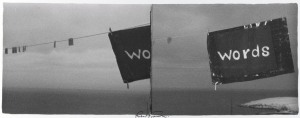
(ringing in the New Year 2012 to Max Richter’s soundtrack work for the film “Die Fremde”)
“The place I really have to get to
I must already be at now.”
Ludwig Wittgenstein

(ringing in the New Year 2012 to Max Richter’s soundtrack work for the film “Die Fremde”)
“The place I really have to get to
I must already be at now.”
Ludwig Wittgenstein
Greetings all – I’m not sure I’ll have much time in/on here over the next couple of weeks – will be spending my time with spouse and children! Here is a touch of holiday/end-of-year type thinking/experimencting and warm wishes to all.
Conditions
The conditions are few:
birth, life, death,
an elaborate moving context
in the midst of which,
in between, all at once,
we are
with various means
yet not meaning.
Given our capacities
we make
and are made,
each extrapolation
and experiment
without erasure.
Reach out or recoil
participate or refuse
(another participation)
subtle gradients
inter-action
each
given the conditions,
capacities,
possibility.
N Filbert 2011
Wanted to share a few poems from William Bronk’s collection “Death is the Place.” Reading today included M.A.K. Halliday’s “Learning How to Mean: Explorations in the Development of Language” – I am continually fascinated by the social construction of reality and the self, and the part the structuring of language assimilation plays (literally) in it. One thing that struck me was how the interplay of “observer” (the individual accounting for encounter and experience with not-self) and “intruder” (the individual participating in effecting not-self and being effected by through interaction) develops into growth: the apparently infinite expandability of the weaving of language-types and functions and uses with the world as we experience it, and ourselves as they are formed by our interactions with whatever is different and distinct from us. The utter reciprocality of experience, creation and shaping between self/not-self; intrusion/reception and the like – Derrida’s differance challenges and fascinates me. Which pressed me immediately into Bakhtin, of whom not enough can be read or said. Beyond that I spent a number of rewarding hours in Italo Calvino’s “The Literature Machine” – always refreshing and invigorating re: the uniqueness of literary language in the scope of languagings. Errol Morris’ “Believing is Seeing” is delightful – like a well-made documentary in language, tight, challenging and full of little surprises. Jesse Ball’s “The Curfew” – his slightly odd universes and quirky phraseology mesmerizes me. H.L. Hix’s work is gaining weight in my esteem…nice Ashbery-like music and reflection with tart Orr/Johnson/Stevens’ aphorisms woven throughout. I worked on an essay about life’s requirement of unending submission (in light of more rejections of my own – probably an attempt at soothing myself) and fashioned a couple of poems on the way. Here, from Bronk, death truly being the place always present that shows the shine on the flip-side, life, and keeps us cognizant of what almost counts for “truth.”
THE FICTION OF REAL
The false roles we play are a way to rid
ourselves of falsity and be real in a real
world as we need to be to realize
our potential. There is where the action is
and inaction is wrong. The need is for faith
and vision and, unless we believe, our fiction falls
and we with it, our civilization ends.
OF POETRY
there is only the work.
The work is what speaks
and what is spoken
and what attends to hear
what is spoken.
LOOK WHAT’S TALKING
It isn’t what we say of reality
is metaphor but reality itself
which is. Reality as God or as
cosmos or as, more often, both at once
-whatever-reality is metaphor
not more not less and, being that,
is real as can be and not quite real:
always brilliantly true and less than whole.
FOSTERING
Ed asks me
does the poem depend
on what is said
or language saying
but the poems are
acts of love:
they depend.
Thank you, William Bronk
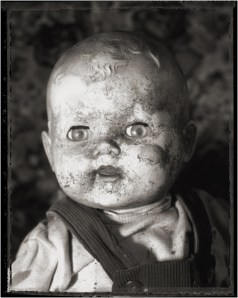
The Portrait
“nothing more than silver crystals arranged on paper or, in the case of digital photography, nothing more than a concatenation of 1s and 0s resident on a hard drive. Yet, when it’s a portrait, a person looking back out at us from a photograph, we could believe that the photograph has captured something of the sitter’s essence – something of the stuff that is in his head…we are programmed by natural selection to project ourselves into the world…we want to know where we end and the world begins…where that line is. It’s the deepest problem of epistemology”
–Errol Morris, Believing is Seeing–
Disabused of nonsense, I examine the paper. Silver crystals or programmed numerals, eh? Both I cannot see. What I see is an arrangement of darker and lighter on a grey scale, constituted by hundreds of gradations and variances. I see whites and blacks bastardized into shapes and forms making up the content of an 17”x22” piece of archivally produced watercolor paper, matted on one side. There the code has adhered.
My looking I will say “automatically” seeks resemblance in the shapes and differences I perceive to anything I may have perceived sensually before. It reports “rounded,” “textured,” “wrinkled,” “object” and “background” (notice three dimensions – space, time and substance) without question. But the paper is strictly rectangular, its surface has a subtle grain, but by no means “wrinkled or textured,” and it is patently two-dimensional, a flat plane.
But perception had bypassed even these errors and already concluded “head,” “eyes,” “face,” “mouth,” “nose,” “ears,” “clothing.” Beyond that “corduroy,” “shirt,” “doll,” “cracks” and “sand” or “dirt,” “young,” “infant,” perhaps even “toy.” Far cries from variations of color on pulped and compressed organic matter. And a radical leap from fact or “truth” (something corresponding to reality)!
Intelligent and rigorous as I propose to be, I am clearly susceptible to grand illusions. In fact I find myself incapable of convincing my mind or senses of the truth of the matter. I stopped myself short of providing name or narrative to what I perceived, but nothing held me from taking it as far as gendering a figure!
This “light-writing” – how do I read it? Clearly I read the contents of my own brain onto it. This piece of paper littered with variables of grey becoming a full-blown imagined, invented physical object in a context, instantaneously with it coming into view!
If this doesn’t prove me religious or mystical or addicted to fictions and fantasies, it indisputably labels me as primed from groundless faith and beggars my “rationality.” I take the bait, compose a scene and conjure an experience.
“To understand is to interpret. And to interpret is to restate the phenomenon, in effect to find an equivalent for it…it’s the revenge of the intellect upon art…upon the world!…to interpret is to impoverish, to deplete the world – in order to set up a shadow world of ‘meanings’…it is to turn the world into this world…it is the modern way of understanding something”
-Susan Sontag, Against Interpretation–
And did I deplete it? Instead of seeing the open subtle radiance of what was there before me, I took to deconstructing, categorizing and delimiting it. “Forming” or “fabricating” it toward narrower and narrower possibilities (allowances?). As if I were arbiter, de-Terminator, as it were.
Show me light and dark and I’ll dismantle, disentangle and simplify it down to specifics, something bite-size. But not available specifics, no, not the particulars there before me – in themselves – open and presenting – no, not those free existing presences, but to particulars I can re-cognize, things I am ready to see. What something in me wants to see, familiar or unfamiliar.
My socioeconomically-shaped brain saw light and dark dusted together and secured to a surface and re-presented it to myself in ways that supported or validated my trained and chosen view of things – a doll’s head wrecked from use or disuse, floating free as an object within a surround. I lied to myself to support what I’d accepted in belief, what reassured me. To make an order I could not understand into a reordering that I could.
This masterfully selected and developed photograph arrive to my body unnamed, with no captions or text, no intention or meaning. It presents a photographer’s interest – something caught in a person’s perception at a certain moment of time, an arrangement of world that we say “spoke” to him, albeit without language or sound.
The photographer’s eye then detached and defined, from a context endless in all directions, this frame of materials, of sight, and tore it away at just these parameters, from just this angle, and recorded it – took it. From there he expanded the size of what he saw, magnified it and brought it through darkness and an elemental chemical stew into light. He scanned the result, still looking for more, perhaps even seeing more than could literally be seen.
Further affecting this discreet tiny rip of the reality of the world, he manipulated it carefully, painstakingly, revealing and creating ever more extant artificiality, unto his own personal, private and unknowable satisfaction. At that point he produced a new object of matter into the world that we call a “print.” Jetting countless points of ink with the aid of a mechanical device onto hearty paper created for paints, he concocted (remember – always in tandem with machines, ever relational, in flux, at risk and imminently malleable) this single variable fingernail-thick object reflecting light to our eyes: a portrait photograph.
The elaborate efforts of a human at one end of an emblematic chain, toward the elaborate efforts of another human being at the other…a something we may, given incalculable and mind-bogglingly enormous situationally-specific conditions, come to encounter as “art.” And it is this I am declaiming to you here, with something very much like a religiously fervent belief.
N Filbert 2011
“Language is not predicated on the existence of meaning, but is an unpredictable outcome of a world that produced first fire, then birds.” -Ludwig Wittgenstein
“Responsible for creating Creation, for the reading veiled within reading, the word hushed amid disclosed words, for the silence, finally, of a trace disfigured by a thousand traces, the silence of the Void at the heart of radiant Totality?” -Edmond Jabes
Do we ever want to produce work suitable to our talent?
(spawned by a quote by Danilo Kis in interview – that “next time he’ll try something easier, more suitable to his talent” 🙂 never did, which made him great, no?)
Dec. 14, 2011
precious breath
two birds showering in rain
delight
two lovers on a swing
Winter needn’t always be cold
side by side
and separately
mutual enjoying
radiance
music
what counts for heartbeat
the pitter-pattering
and thumps
what serves as warmth
conflict change relief
sky goes on
releasing resolving remind
there are first days
and still others
go on…
N Filbert 2011
A Depiction of Language
A moonbeam –
soft and aqueous substance
originating between me and thee my hello-ing gesture –
a tender amorphous bridge your response
.
A spear –
forked tongues jetting out and piercing
punctuating pores of the face brutal slap-shout
bulleting pellets and rebuff
.
Clouds breathed back and forth –
exchange. CPR.
At least one body to at least another his melodious expression of love
mouthing bubbles to be tasted on the tongue and its passage through
the orchestra shell of her heart
Spit and kisses –
a whistle, a sneeze
particles and organisms information posited –
systematically forging highways and rails process
.
A jetstream
a rope bridge demand and reprieve
chaos and string at once,
cosmos and culture
.
growing itself, itself growing
like that, to and fro, an oscillation, a medium –
teeth tapped toggles its composition
parasitically nested inside the ear.
N Filbert 2011
What Is: Real
It’s the initial question, it seems to me: the Unanswerable One.
The query and experiment, the apparently necessary or natural one, the one seemingly inherent, the one for which there can be no verification or results. No development, no progress, no advance.
It would appear that we can add to what we “know.” We seem imminently, even outrageously capable of “belief.” And we pass judgments accordingly – basing them on descriptions and experience.
Things like pain and harm, pleasure and enjoyment. And on things like survival, like getting to “be.”
But the question remains, all the same. Always here, always unsatisfied.
And we are always here, and then always gone.
But the question remains: the Unanswerable One.
No proofs exist.
-N Filbert
Deaf Beethoven
Terrible things will happen to us even as
we hold each other to hold them off even as,
elsewhere, atoms disintegrate and stars
explode and niether are they of consequence
to what really happens without we know
if it does or how, the real unmodified
and deaf to what the deaf Beethoven heard.
-William Bronk
“any problem that has an answer isn’t important enough”
-Gary Miranda-
“The only really difficult and insoluble problems are those which we cannot formulate,
because they have the difficulties of life itself as their content.”
-Franz Kafka-
Student Magazine of IISER Mohali
Music, Musicology, and related Matters
a photographic pilgrimage to Orthodox Christian monasteries across the continent
Meandering Through a Literary Life
Orthodox Christianity, Culture and Religion, Making the Journey of Faith
Erik Kwakkel blogging about medieval manuscripts
"That's the big what happened."
Networking the complexity community since 1999
 All my Words are Silent