Lettering

Dear Michael, Dear Jonathan, Dear Scott, Dear Laurie, Dear Lydia, Dear Sam; Dear Meghann, Dear Summer, Dear Tyler and Karl; Dear Edie, Dear Sara, Dear Mari; Dear Albert, Dear Paul, Dear Denise; Dear Tristan, Dear Aidan, Dear William; Dear Andy, Dear Pippin, Dear James; Dear Timothy, Dear Jada, Dear all of you who save my life from time to time, by being:

Perhaps I should not own a phone.  It’s Short Message Service, in my employ, allows a nearly ubiquitous, immediate reach of the text, from my thumbs.

Thank you for telling me about the exhibition, I have the retrospective tome near me even now, attempting to go in and near the two-dimensional images on paper.  It is not the same as being present to the sculptures and paintings, their ambience.  But now I know I could not move around them, nor touch them, I’d have only to use my eyes and very little of my body.

This obsession with connection.  Once I would have had to go to work unlinked to any of you for hours at a time.  Once my going home would mean your absence unless we arranged for sharing space and time.  Now I reach, I report, I ask and beg, and enter your lives like someone shoving a newspaper, pamphlet or flyer into your hands at will – without contact – propaganda blaring from speakerless speakers.

Your mails and email show deference and thought.  I am happy to have your works near at hand to consult and resort to time and again.  I see the care in the hand-writing, the pacing of thoughts, the reasoning reflection, the sense of your audience.  They lie about me on the floor, I can feel them, turn them, taste them if I wish.

Your phone makes a hum or a buzz.  An ejaculatory missive from Filbert again.  He’s lonely, he’s excited, he’s drunk.  He wants to share.  He needs to share.  He needs communique.  He wants connection.  He is not thinking of us, he suffers the duress of himself.  He spouts, he shouts, he slurs.  He insists he needs solitude and rest, needs quiet, less public.  At any hour, at all hours, these textual packets flow.

Perhaps I should not own a phone.

Where do the gaps that make the heart grow fonder bloom?  What is banal and what evental?

Thank you for your poem.  I will read it again and again.  Thank you for that clip of music, I repeat it throughout the days, when the mood demands an answer.  Thank you for your books, your artifacts, your gardens, your hands.  Thank you for your eye-contact (those of you I’ve sat or walked, camped or climbed with).  Thank you for the melodies of your particular voices.  Thank you for your hugs, your nourishing, your care.  Your listening.

I do remember the ground there, how it fell away desperately or rose violently into sky.  What the birds did.  Where the fire flowed.  Yes, the leaves.  Yes, the sleeping bags.  Here’s to the unknown trails, the stumbling, to whatever’s discovered.

I am sorry I flood your phones with less than thoughtful driveling – explosions of fear, anxiety, want.  Am I alone?  Am I alone?  Do I matter?  Does anyone want my voice?  Am I also missed?  But also love.  Yes, sometimes I merely wish to tell you the difference you make to being alive, that I feel you out there, somewhere…

Perhaps I should not own a phone.

How, the Owl

Who – would I listen to, be remade among today?

And where from a resistance?

We always know (somewhere in our bodies or bones) that ‘to begin’ was begun

long before what ‘begins.’

It is raining.

We say, “the rain has begun.”  How long ago?

We say, “I am here, now.”  For -?

Where are we?  How much?

We ask.

We are there.  Continuously outstripping a here.

When?  Why?

And how?  How?  How indeed.

So what is it – that we are seeing?

What is it we think we see?

How?  Why?  Why that and not other(s)?

Propensity.  Proprioception.  Perspective.

When?  Where?

Always already before or begun?

From which?

I’ve written before (again and again

when I take up the pen):

“I set out.”

From where?  Why?  When?  and whom?

Still how?  How?  How, indeed.

He looks in.

Into what?  And from where?

How indeed.

We set out.

per language, per feeling, per sensational thought,

per activity, movement, receipt.

We set out.

A Tenure & Promotion Dossier

To think.

To get done.

To be done.

To survive.

Get by.

Endure.

[what will feed and fuel us?

                                    how might we grow like errant plants?]

There is weight, great,

like words of Beckett,

terse and heavy

with ridiculous

mind

To go on.

In spite of.

Anyway.

[to round a bend, turn it in, be relieved

                                    to be accepted, acceptable, acknowledged.]

To count, to mean, to matter

Anyway.

Because

we happen

and go on…

[if I might vine, might drink the spoiled

                                    to live, to thrive, to weed]

To make the turn

into what grows

anyway, despite

out of joint, or time, or space,

terrorized

refusal

The flagrant

Remainder

Unmerited

Surplus

[as if we were another sort, not a same-seeded,

                                    same-growing, same-veined kind]

Even though at least one said:
“Everywhere

being is dancing”

and another

how alike are dancing and sex

And another

and another

the variety

the merited

surplus


We forgot.

Hold Lightly, Leave Be


Hold lightly, it said,

there are so many voices,

movements.

Hold lightly,

lest you repeat,

she said.

[the surfaces, and distance, beneaths]

I listened:

breezes, waves;

windiness and water;

the moon riding along,

each night so differently

the same.


Without repetition,

she said,

my hands open,

palms and whatever fingerprintings,

the bruising, barely,

again and again,

so differently.


How tides change,

or seasons:

things we’ve come to think of –

each you, each I,

each every –

quivering along

like leaves


through the years.

In other words:

over and over

without repeat

again, anew –

how ‘new’ requires reference

of similarity.


So love

hold lightly,

she said,

it says,

as wheat falls into ground

and suns set down, again,

as moons rise – (which, neither) – and

never the same.


Both-and

either-or

neither-nor

and so on

without repeat

within the like,

the long, the loving.


You come again.

I try to grip lightly –

the future never knows –

I’d like to leave it,

to gather you,

to hold…

you.  You.  You.


(Again, differently).

“Hold lightly”, you (she) says,

“lest you repeat

and grow tired…”

My palms are open                                                                             (to touch, to pass by)

I am trying to read,

to listen.


To leave be.

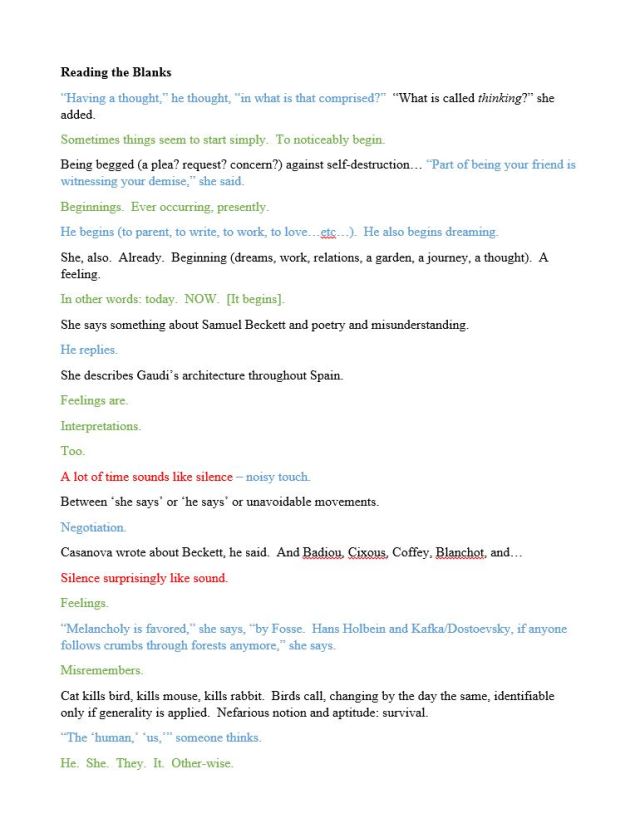
Reading the Blanks

click image for full text

Reading the Blanks 1

Now, and so on: an addendum

I do not doubt that we are all capable of learning to freeze.  Or starve to death, for that matter.  Death will not be a stranger for any, for long.

.

There are reasons we are constituted in uncertainty.

We are able to learn.

Everyone will.

.

It’s why I told her how much I trusted her.  To change.  And therefore never knew anything, asking so many questions, again and then again, about plans.  Who knew when?  or then?  or now?  I said.  Things fluctuate as they die.

Or I never knew.  Having so little to do with facts or truth, beliefs or trust.  IS is always something else.  Or here is always different.  NOW has never been, in other words.  Even if the words are the same.

.

And. So. On.

Apparently.

.

There is music.  And recognition – recognizability – (memory?) – a passion for pattern, a shine to similar, a longing for location, locatability.  For what it’s worth – a pronounced inaccuracy and pro-found nostalgia.  As the ‘similar’ is founded on what’s been experienced before (pro-found), and at least less than (or more?) than present.  Pre-sent?  NOW was given / sent before?  I doubt that… but feel wary that that’s all we’ll ever know, never quite catching up to being.

In another sense: the inherent lag of perception.  How old (again, pre-supposedly) are the stars we ‘see’?  Or the squirrel on yonder branch; your eyes across the table; our held hands… by the time they register?

What happens, “now”?  And why are we occupied with what we call “next” when we can’t even exist at once’s occurring?  Seeking a head start?  A virtual or imagined pre-sent?

.

Yes I heard what you said…after you’d said it.

There’s our “now.”

The cut from stepping on glass… and then the pain… later.

The bite of food, licks of flesh, kisses… and then the tasting.

The breeze and then the leaf, light and then its outline.  Mostly shadow.

“Hello,” I reply in turn, but your head already bowed and path resumed, on the far sidewalk.

.

I fall behind.

.

Suppose this is why, in conversation, ever losing our way in delay, we ask “where were we?” rather than “where are we?”  What is it we wish to know?  Where do we hope to be with one another?

As I was saying – with requisite gap between whatever may have been transpiring in my ‘mind’ (or whereverywhere thinking occurs) and the sludgy musculature, instruments, and carefully crafted formulation of alphabetic symbols to display attempts of communication or composures…

…now I’ve forgotten…

Exscribing: a Process

Image result for hand writing with pen on paper

How stories are written.

They are experienced.  They are felt, intimated, intuited and interpreted.

Sometimes spoken through or about.

They become body.

They are lived – if only imaginatively – they are invented (always).

If inescapable or unavoidable, the only way to “pass” them – find them, become in relation to them (i.e. ‘go on’) – is to expel, express them… put them outside the body, psyche, person: MAKE them, forge them, create with them…

“ex” (out-of) “term” (language) “in” (-scribe or –voke) “ate” (devourable form) them.

Stories are composed, inscribed, evoked, in order to ex-term-in-ate them.  To live on – through and past – to survive what marks/marked the person who must process and be rid of them in order to… go on experiencing (live).

.

Search those tales that traverse your body – its space, and over time. 

Watch what arises again and again – a trope, a chorus, a theme, a complaint.

Though memory (creative narrative), perhaps it holds a not-forgotten, an almost-permanence.  That which seems to stay with you, in you, may be of you – there’s story there.  Don’t worry truth.  Truth never worries.  And no stories are about it.  And constructs of “facts” – or, agreement of observations and perceptions – hardly tells as well.  Stories – good, real stories – lie in differences.

Perhaps difference is kind of true.

Practice synesthesia with what you uncover / discover: hear what you see; taste the sounds; feel what you smell; look deeply at all you touch; be something like a being – an organism whose senses are always combined in the perceiving and experiencing.  That you are is a thing unto itself, and can not be exhausted as long as.

.

And so to write, to exscribe.  In the beginning was… the true fact that you are, however doubting and unknowable.  This too is experiencing.  To be experiencing is to live.  Prepositions and propositions notwithstanding.

It writes.

.

And so it is said, a kind of exscription, a thinking-out-with.  As breath surges sound or even whispers.  To follow – not following – the forms of the objects (obstacles) – lungs and throat and palate, tongue and teeth and lips, not to mention faces and the movements of limbs and digits.  The lineation of terms and letters, vocables and consonants – exscription-with, even air, atmosphere.  And should the context change (and it is changing as you say, think, exscribe) – you write, you sound, you scribble, going-on-with…

Thus it is written.

.

And so it becomes.

Stories are an history of mortality.  Where it begins in first awareness that it ends.  And so memories, so comparisons – lessness and mostness and the little by little of forgetting.  How it’s made through its undoing, to the last.  We story only as we die.

What is it that was said?  You say?

Dusk becomes, and a sort of lost.

The first way in, being out.

Ex-scription.

The forth is all.  Experiencing.

.

Letting it air out.  This seems important though many might advise that writing is a matter of devotion, dedication, discipline.  Maybe it is?  What have I written in way of stories?  Much time is involved in the shaping of rivers’ courseways… and chance… and the continuous involvement of the with-out.

.

Re-membering that the activity and activist (one doing the activity – actor/actress?) are entirely muddled in the ‘between’ that equals: “Here.”  Forging or forcing ex-scription tends to falsify the act and turn it towards an in-scription of something – report or epitaph, confession, statement, fable, style, form.  But storying and writing, like living and all activity, are between formless and formed – taking form, forming.  We are not producing or conveying information, we are in formation through the activity of writing. To assume a stance, a stasis, a point-of-view or position or stake… authorial authority or control – is to leave the messiness of “here” and arbitrate a “there.”  No longer the presence-between sayer-and-saying, thinker-and-language, writing-and-written, imagining-and-inventing, feeler-and-feeling, etc… but reduced to a repetition of forms, ideas, concepts – borrowed, received, believed, or accepted (“in-formed”).  Composed verses composing; produced versus producing; almost a copyist versus a compositor (with com-posing and com-positing referring to making-with, viewing-with, creating-with complex multiplicities).

.

Con-, com-, con-.  With, with with- (these are the fields of ‘between’ where we are).  Ever, always, only – between – experiencing through exscribing – this stays on, vibrating in the lettering, arcs and tones of the writing…as activity going-on.  Experiencing.  Energy.  The forthness of creativity is its unknowable, indecipherable, inextricable withness.  Perhaps.

.

Authorial authority or control a sort of repetition of law, convention, acceded power, regime(n).  An attempt to step aside from the stream of experiencing and treat the activity of writing (or exscribing) not as an activity of being – alongside thinking, loving, believing, feeling, working, etc., – but something mechanical, technical, somehow outside the confluence of being, the flow of experiencing.  Feigning objectivity, knowledge, pre-cluded rather than preludic (decided-before versus approaching the play or dance or swim of activity in complexity).  Told versus happening.  Production versus process.  Untrue, or less or more than actual.  Mortality – dead letter – versus verbal occurring…as-is.

.

To return to ending – the beginning of story – our limits, death, and finitude – that which forces us to forge – to attempt memories, notate change as loss or gain, seek patterns, learn, sing, exscribe, act… imagine… dream… craft and create – the knowing, the reality, that experiencing is not endless.  Attend: it ends.

And so we story.

Exscribing…experiencing…what there is, while there is, along many modes of action.  What is perceived as happening and runnels through the body, swirling currents of memory, the staining of refrains… and the activity of exscribing it – of moving it out-with-in-to relation of world as compositing – not copying, stating, reporting – but ever keeping in mind that the activity of writing is also a live, indeterminate, and infinitely complex way of being-with-world… we are hardly machines translating experience, or computers spitting out data… everything we do so long as we’re living, is living – alive and uncertain, conformation-with everything that surrounds and drowns us.  Participation.  Being.

Exscribing as a process of being alive.
 

NOW OH ON

+ Samuel Beckett +

When else is there?  Or where?  Only now, on… no how, on, on only now.

What I mean is that we will strive.  We strive.  From “strife” – disturbance, struggle, war… the turbulent activity that alive involves.  Motion.  Something we don’t know how to stop, without action.  Activities of ‘the last.’  Unable to experience their ceasure, their ends.  What ends?

The unknown?  Surely not the motility of the parts in wholes unceasing.  An idea of action?  Its ‘language’?  Such saying for to be said, missaid, always.  Another ‘end’ without knowledge, perhaps.

Perhaps misaware of limits?  A particular sort of activity’s borders?  Perhaps solely misaware.  Distracted by activities we might call abilities simply because ‘we seem able to’ – to what?  Disturb, turbulate, live.  How else aware, even unawares?

We go on (“to strive” “to make strife”), even, sometimes, without ‘effort,’ insofar, just continue, with no how, but on.  Merely on.  Even imagining we’re “not” sometimes – its own ongoing.  Now, oh on, anyway, even without how, like repetition or citation, trundling referencing.

I mean to say – we strive (and make strife) – often in lieu of intention, even with apposite purposes – breathe again, anti-again, attempt to negate or destroy (even ourselves) going on no how, now oh on, almost without prejudice, only preference or opinion, some direction made by lack, discomfort, disturbance, desire, indifference, doubt.  Now oh on…

As if a play of breath.  A texture of emissions, an inseparability of matter and space commingled duration, a wish for absence to enable our moves and again to sense we are here, now… oh on… no how, only, on, again, ever different(ly, also).  That kind of same, as in memory, forgotten or impossible become.

Missaid, misaware, avoid negation, probably not (!) un- or ends would have already come.

From other ideas for language: from sight, from feels, from motion.  From other (s) – language or motion… from strife and disturbance, from obstacle… anything to notice, perceive, accidentally endure, to become.  Now, oh on.  Anything – even a wishing for no (thing) is something – perhaps without how, but still on.  It’s a song, or could be, hardly motion sans sound, even whispers – how else could silence arise?  Even rising – difference – a change in the scene or a sense – never stoppage: now, oh, on.

To get back to the strife or the striving – the friction that comes from duress or caress – just the difference – a surface, an alter, a scrum or a veil – misaware of the motion, the context, the seamless mobility clipped for the eye or the hand, the scent or the senses or thought.  As a dream – and perhaps! – misaware and missaid, misperceived.  We go on, now – oh on, nohow on, only on…

Akin to ‘the next thing’?  If even the ‘last’?  What becomes like an ‘on’ if undoing (unbecoming, unmaking, erosive, erasing, destruct)?  What gets lost, what survives, of what IS?  No how can be told, but goes on.  Loss is but change and perturbance, disturbance (again, but now ON) – now, oh, on… anyhow, always now, ever on…

The end an invention of language perhaps – to imagine – a “not” to the on…


Measures of Life

“‘Word work,’ Toni Morrison said in Stockholm, ‘is sublime because it is generative,’ its felicity in its reach toward the ineffable. ‘We die,’ she said.  ‘That may be the meaning of life.  But we do language.  That may be the measure of our lives.'”

Lewis Lapham, Word Order

Lapham Word Order

Read full text here: Word Order, Lewis Lapham

Untitled

Then:

pregnant with fore and aft –

a jumbled detritus

of flotsam and jetsam

and chance.

.

Like now.

But where is the body

alive?

in what chances,

for whom –

all the whens,

all the wheres,

.

here:

nothing happening

but thought and a world;

what is: being some feeling of –

circumstance – small bubble,

same as there.

.

Go on,

take your rest

and escape…

you cannot leave it.

And then you do.