Interstices…continuing…

earlier portions of this can be found HERE

– 5 –

Narrative seeming regurgitant, redundant, and indulged…yet as it occurred it was quite dramatic.  A vibrant life of tragic deaths and violent love.  The kind of loving one imagines as a lion gutting prey.  That ferocity and devouring.

Language always there, most assuredly, in circularity and dismay, its hesitant encumberance.  Its dance of waltz with tango, its distance from its cause.  We were ravenous for life, steeled in healing, shriveling seeds immersed in waters.  An obsessive metaphor.

She came.

From where?  Like lamps at sea.  Inside of windows, inside of houses, nonexistent.  The sea is no foundation in its turbulence, its depths.  I never charted.  But there she shone.  And there I strove, even while she drifted toward me.

The sky is murky.  A sound of panting.  My memories faint.  I grabbed her collar and held her still, bent down, like that, spread open (in my dreams).  They feed, they lion.  The forms reverse.

Talking a mean streak.  Accidental – no, – unavoidable or some inevitable undoing that I do.  I won’t stop speaking, but go on.  When I shouldn’t, when I can’t, when I do.  I am.

What I say (I said) goes like this, or would have, but the force, the draw, consumption – I speak in digits, speak in code, I squeeze pronouncing.  I will not say.  What I am saying, if I would not, would have been as it were love.  Instead I feed.

And she retracts and she releases, she relents but won’t rely.  We’re frightened beings, gorging beasts, so here it is – the valiant story, the fragile lines, the treacherous risk.

I engulf her.  Still she comes.

She feasts and I retreat.

The battles rage, my hair grows wild (she makes it so), her full of bruising, fully of greed – my want, my spunk.  Our torsos open.  We choose withdrawal along with weapons for attack.  I bare my teeth and force her hand while she recoils, she hits, she sneaks.

We die away.  I have remorse, and so I speak: again, again.  Say “what I meant” I do not mean.  Say wonder why.  She will not speak.

There’s never truce but we find trust, a glyph we muster, when we must, because we want (for something), want (for edges), want (for love).

She says my name.  Says “you remember!”  And I don’t.  Says work from there.  My body rotted, her blackened breasts, her flesh unwilling, still we progress.  We feed and lion.

A torturous joy.  An adumbration..  Spiraled mind and twisting body.  And there we are beneath a flow I cannot cease, my acrid words, my oily blunder.  Why should I think, and what?  While she moves thunder.

With firm resolve.  And solve again without solution.

Then here screes the story wrenched of life – away and from – she drains a bank I cannot fill, I rob her purchase.  We are one.

The scene begins.

Interstices – continuing in between

more sections arriving from the Beginnings and the Second

– 3 –

Message being – she looked at me, incredulously.

– “What and/or Who – are you?” she requests.

I don’t know.  No one knows, I said, half-joking, persisting, prolonging, staying alive.

Longing = staying alive.  Longing = I’m still alive.  And I look at her, longer.  Which means: if only I knew.  The interstice (according to me).  We converge.  A gaze.  I must go.

That’s what I wanted.  The choice.  The decision.  A godlike thing for a fragile, finite boy.  The both of them: god – a fragile, finite boy.

No one owns.

When I returned, I could have said “My love, I am not present with you now.  I am in a future predicted by a possible past.  I am afraid.  I am not here.”

She might have responded: “I see and hear and understand that you are not here with me.  I too will retreat, remove, go away, until you return to me – here, to here.”

I babble on.

But I don’t say “Hello, my love.  I am not present.”  No, what I speak instead is a muddled report of my feelings and fears, my ideas – my present experiencing – a gummy wad of future and past, uninformed by where I am (with you) or who I am with (you) or when (now).  Constructed instead by where I believe I have been (past), where I think we are heading (future), and how I feel about that (afraid).

She recoils.

“I’m going away now” she says.  Which is not where I am.  Not with me.

But I meant.  I meant to say (once I figure out where I actually am): “Hello love.  I am afraid.  I am past and future.  I am absent.”

To which she replies: “Good to know.  Tell me when you arrive, here.  With me.”

Here now.  Or, Nietzschean-ly now/here, is that, and “exactly” : unlocatable.  Nowhere.  NOW + HERE…present.  It can only be lived, not thought.  Thought is too slow.  Lags ahead, leaps behind.

Oh you, I might have said.  And she may have recognized me.  Perhaps.  Now.  Here.  Presently – in the nowhere – the between – the “Interstice.”  Where what occurs, occurs.

“Hello.  I love you.”

– 4 –

Finite, fragile boy.  The fragility and finitude are true, I suppose, but not unquestioned.  However they withstand (the questioning).  They withstand the questioning.  Because I don’t know, and it is not wisdom, this cloud of unknowing, it is finitude, and I am fragile, not only because it’s true.

I am fragile because not all the branches hold.  When climbing.

– “What is it we are speaking of?” she asks (she – the you – asks me – the I).

Past and future, I might have answered.  The unknowing.  But did not.  Instead said – “unreliable.”  Rises, passes away.  Novel-to-familiar.  First one thing then another, desire fades.  I am not stimulus.  Enough.  For no reason.

I, illogical.

You, burdened.  And thus you sigh.  (She sighs her burden, a question).

And I retort.  “No.”  Or, “don’t go.”  But you might, because I have gone (or didn’t arrive, not HERE, not NOW, but somewhere else made of cobbled up pasts and unpredictable aheads).

“I love you.”

But how can that be?

It can’t.  Yet it is.

Perhaps.

I don’t know.  But it is not wisdom.

NANOWRIMO Reminds: Any Excuse to Write

THE INTERSTICE

I told her that I would have told her, had I known.

-“Known what, exactly?” she said, “Really!?” she said.

Yes, I said, yes, I would have explained what I felt to be true – about the “interstice” – what I felt I understood, I would have said.

As usual, the sighs, the diverted glances, the “I-don’t-knows.”

It’s okay.  I’m pretty used to it, not that it still doesn’t hurt, or squash some deep part of me – annihilate, erase – but familiarity breeds, and it’s not contempt, at least not for me.  More like resolve, or, well, accustom, I don’t know.

Still I would have conversed about the interstice.  Or its plural.  No one can know what we’re talking about (in my opinion) – that’s why we talk (in my opinion).  But I like to look at her.  Very much.  So sometimes I keep talking so that I can look at her longer.

Thus I would have explained – tried to – about the Interstice…had I known, I tell her.

-“Known what, exactly?” she asks, “Really?!”

It’s okay.  I’m used to it – exasperation.  It’s a sort of fatigue that settles on my interlocutors – my family, my friends, my lovers – as I triple/quadruple/unendingly (exponentially?) second-(meaningless term in this accounting)-guess whatever it is (emotion, idea, memory, event) I attempt to convey.

I don’t trust a thing as long as it’s questionable, and I’ve yet to discover something unquestionable.  I like inventing titles though.

She’s looking at me – softly, sadly, gently and quiet.  Sometimes she strokes my hair with her hands and lets me rest my head (the physical part) in her lap.  It kind of helps.  But the rest doesn’t rest.

It’s okay, for the most part, I’m used to it.  It’s “me” as they say, as it were – what I’m used to.  It doesn’t matter, or does in unquantifiable ways, but I keep at it.  Anyway.  I can’t seem to help it.  Well, some things do – like vodka, sex, sleep – but only temporarily.

Things are only temporarily.

That’s the sort of idea that keeps me alive.  Temporarily.  And second-(exponentially)-guessing.

She’s still there.  Here.  Though.  Hence the interstice.

I try to explain.

As if “interstice” possessed meaning – definition beyond the moment activated or utilized.  As if it indicated.  “Meant” – a convergence-point (limitless above and below and abroad) of conventions of time and of space – a realm that felt (seemed) shared.  Held in common.  Nothing is “held” – or that temporarily.  It seems.  I don’t know.  It’s certainly questionable – is it – “certainly”?

I don’t know.  Which I thought, or I think, is the entry to wisdom, but even that – I don’t know.

She’s still here.  And I question – who is it?  Who is still here?  And what for and/or why?  And where is this trembling “here”?  I can wonder, after all.

-“Wonder what, exactly?” she queries.

I don’t know.  I’m a human.  Some odd conundrum of pieces and parts that cohere, correspond or reciprocate in hold-together activities for awhile…call it “organism,” there’s that, it would seem, but seem only, digging in it is hard to convince – a location, identity, consistency, avocation or being.  It’s just so – apparently – temporarily.

Exasperating.  You see?  You dig?  What I mean?  That’s what we’re after (I think) – what it means.  But what that means is uncertain, I think or surmise.  We don’t know, it would seem, we’re uncertain.

We ask.

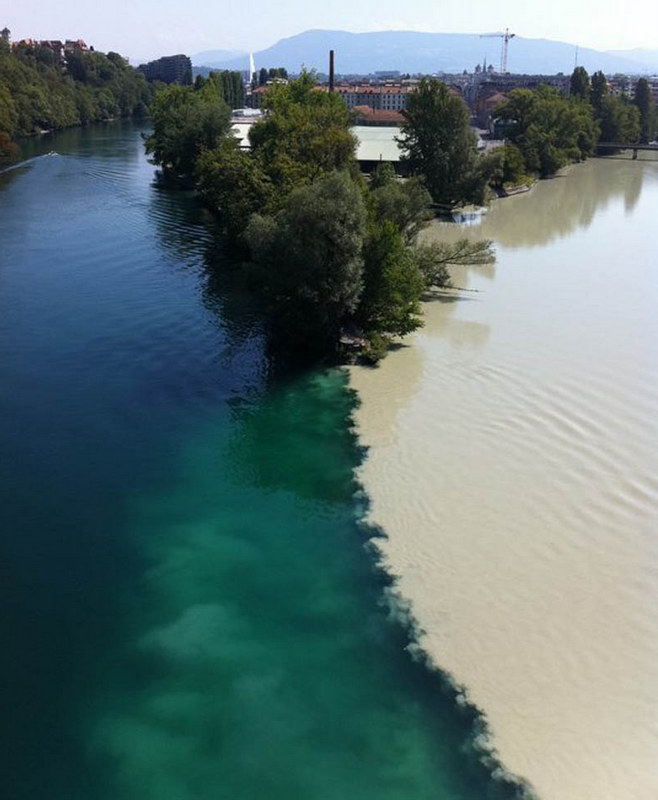
Let me describe this – the interstice…

“The Conflux of Floods” : an Imagined Interview

two-rivers-colliding-geneva-switzerland-rhone-and-arve-rivers_2

            In a recently daydreamt interview (I realize these may be narcissistic, but they have occurred all through my life, and come to function as ways to take account of myself) – in which I had composed writings that earned critical acclaim AND garnered popular and commercial success (crazy, right?!) – I was being astutely questioned (after all, I am both interviewer and interviewee – it’s a daydream), and pressured to account for both the critical acclaim and the mass consumption of the tangled materials of my celebrated novelistic-poetic-essaying (some multi-genred hodge-podge and hurly-burly’d collaging of human inscription).   [Which is also, obviously, occurring in this everyday attempt at its retelling].  For better or worse.

By any account, each time I endeavored to formulate an answer to reckon for the apparent realities under fantasized questioning, I was foiled – ultimately unable to appropriately language ANYthing I strove to express – for the fundamental reason that the shared social convention of language – the available (or known) English nouns, verbs, structures, phrases, vocabulary, ontologies, etymologies, forms, content and context seemed false to my meaning as soon as I spoke them.

I would begin to assay a response, and each available term (even though utilizing an extensive and deft, adept English vocabulary) – each word I was choosing – would seemingly cancel itself.  I was caught in pregnant pauses – an author seeking a term – and the accessible signs and sounds of an encyclopedic dictionary all clanged untrue – inaccurate, incomplete and implausible – incorrect!

The interview proceeded (notably un-entertainingly and un-interestingly) with solid and well-considered queries posed from the history of human making, reflection and inquiry…followed by prolonged silences as I contemplated what might be honest, authentic replies…resulting in the beginnings of obsessive-compulsive, over-thought, manically scrutinized hesitations – cancelled out and undone, revised and corrected, taken back or erased as soon as they were spoken.  Simultaneously to becoming aware of their possible interpretations – conventionalized meanings gassing the atmosphere – the breath and air of their saying and hearing.

For example:  “Well, I think that authors…how could I speak for others…it seems to me…no that’s not right,” or, “It is my intuition, sense of things…my felt experience… no, that’s not quite it.”  “As the mind processes the body’s…wait…what is not body about the mind?  Our language presents a splitting of the two that was never there…I mean…no, no, this is inadequate…” and so on.  Nothing being said.

“Ever try.  Ever fail.  No matter.

Try again.  Fail again.  Fail better.”

-Samuel Beckett-

            The failure of the interview eventually came around to the following… a couple responses that might represent something almost accurate, maybe.  May communicate a touch of something authentic, honest.  It has stuck with me for a few days, and yet I can’t quite be sure…

A question arose concerning what I might have done, or be doing if I had fathered less children, were not bound to sustaining a family, and so on… I reflected awhile… and soon realized that I am unable to imagine my life without offspring.  Nearly half of my existence has been lived as a father, and I cannot think of experiences or expressions that they do not co-create in some way.  If any of it were taken back – the struggles and fears, broken marriages, anxiety, joys and determination to survive, regular interactions with their development, activities, quizzings and personalities… I only feel impoverished.

The illusional interview concluded with a large catch-all question, something along the lines of: “Your writings have profoundly moved some readers, yet you consistently express discontent – revising, beginning again, evading – even disappointment in your faltering, hesitant works.  Can you talk about this experience?  How do you account for your dissatisfaction in light of your readers reported satisfaction?”

My reply:  “The only way I can think to address this right now is in terms of a conflux of flood waters.  I, the writing one, have a flood of experience that I wish to understand, interact with, relate to somehow, attempt to comprehend.  I utilize the methods, marks and systems that we, as a species over time, have collaborated and devised with which to communicate – with ourselves, with others – and I attempt, attempt, attempt to forge some accord between the vast swarming flood that my life-experience ever is – as an organism embedded in world – and the means and methods we have for making sense of, imagining, and transcribing such total experiential flow.”

“The resulting expression is always more-than, distinct and different-from the felt experience I have of the flood (as the medium borrows from far beyond my own individual abilities or thoughts, capacities – an enormous fund of expressions, vocabulary and species-deep conventionalized experiences I could not possibly evince on my own) AS WELL AS less-than, deficient, incapable and variant from (not equal to) the ubiquity of my experienced flood.  I am left simultaneously hoping the conventions of language will prove adequate, and despairing they never will be.  What results from this tangle is a writing – a text, document, artifact – of my individual attempts to process the flood of my human experience in conventionalized signs.”

“From the other side of the markings comes the flood of each individual reader’s human experience.  As they (or we, I’m describing my reading experiences) engage the verbal expressions the writer selects to represent or elicit their own flood, the reader’s flood rushes through, around, with, into these written expressions.  When what is deciphered via these conventional funds of language feels apropos, accurate or apt to the reader’s experiential living flood – we are moved, feel met, acknowledged and represented, almost comprehended and understood, and we may feel that this collection, order, expression of language we have discovered in reading actually writes us, so to speak.  Which is why you may hear readers say such things as “I couldn’t have said this better…” or “I can’t imagine this expressed any other way…let me read it to you” (the thrust of quotation).  The section of text, general outlook, sound, rhythm or content of the artifact feels almost miraculously adequate and accurate to our own flood of experience.  Of course, often it does not – in which cases we revise or repurpose our readings toward knowledge or entertainment, something partial or other than full-flood experiencing, holistic (as nearly as possible) communication.”

“We know, as readers, no Other’s experience can be identical to our own, but in lucky moments it feels so.  Feels possible that our experience of the living flood is shared, understood, that our individuality, solipsism is not a locked room, or impassable barrier.  This is the “magic,” if you will, of human social conventions as mediums for individual experiences: they enable or facilitate our joinings, our cooperation, solidarity, convergence.”

“So neither the writer nor the reader are responsible for authoring profound writings, or rather BOTH are: multiple floods of experience crash through the arranged signs and symbols, separated by time and space and differences, but still possible violent confluences – depending on both, or all.  Living experiencings rushing the sign-sets enabling some felt sympathy, intimacy, accord between the floodings and the expressions: conflux.”

“Otherwise it simply doesn’t ring true – might be appreciated for its artistry or ingenuity, ideas, craft, imagination – but NOT an occasion for profound felt accord, convergence, a totalizing feel of representation/expression.”

“Floods in conflux: right now this seems to me the opportunity that care and attention, effort and awareness of our socially species-al co-creating mediums of communication (art, music, technologies, labors, habitudes, languages, modes of inquiry, etc…) allow for, offer us, in moments of fortunate concord.”

“Does that answer your question in any way?”

Tape ends.


it might be Autumn

It might be Autumn.  It takes awhile to know (here).  In any case, the confusion is enormous, is bewildering, is sometimes stultifying.

Multiple persons – some who know me and some who seem like they do – all seem confident about it.  About the book.  About that “there is a book in me” just waiting to be born or written, composed or transcribed – however a “book” comes to be.  I am certain of none of it, excepting that I love books, in fact I crave well-connected letters as much as (although differently from) my desire for love, for intimacy (or “satisfaction” – itself a kind of surprise and delighted exhaustion), for meaningful connections (being understood, acknowledged, beloved, and so on).  Strange beasts, we.  I.  I-we.

The “I” is “we” if you take into account all the variance – the inconsistencies and variety and contextual divergences.  “Bewildering” is the word I most usually apply to this business or blessing of living… of being alive.

Maybe that’s what this is about, like birthdays.  The strange pivoting celebration of another year undergone or accomplished, simultaneous with its absence and cessation.  Living, dying – same thing?  The introduction that serves as farewell.  A tightly romance.

Does “paradox” indicate two apparently incompatible things being the case at once?  These are not flip-sides of a coin, but two things on the same surface, depending.  Living/dying, suffering/joy, love.  Now as before and after in the same instant, so to speak.  I will always be battling the incapacity of words as the only things capable.  Communicative paradox – language as, at once, in the same sphere/realm/scale/reality – that which reveals and conceals, says and does not say, speaks and remains silent, clarifies and obfuscates, signals and misleads…fails and succeeds.

So that every effort of greeting also grieves, and each introduction is yet another form of farewell.


I loved her.

a little more…

Intro Farewell

Xopher Alexander Porches

The 44th Turn

You ache.

You are older,

and beautiful,

in the way piles of gravel

surprise you

along the turnpike.


Those gathered around you

are increasingly less –

less in years, less in words,

and less in common –

saving the uncommon

tastes and thoughts and talents.


You still have books

and a dimming light

and more than enough love.

You eat, you drink, and make merry.

Some things you remember together,

almost


almost the necessary ones,

say a child, a lover, a poem.

There are gifts, a few –

those given you yourself

and to others –

“the allowance” –


allowing

care and celebration,

some sweet welcoming,

some join.


It’s alright,

she is here, beside you,

they are sleeping in their beds,

are scattered to the days,

are bleeding, are breathing


so much talk of labor

in our culture –

piles of effort

for finding peaceful paths,

to the country,

the cabin,

toward some freedom

to live.


We live.

Our days adding up

while counting down,

in strange measures –

now in years,

by the hours,

in moments.

Invisible Man Narratives – version 2

Here are the beginnings of a sort of alternate telling of the past 6 months of life around these parts….


 Invisible Man Narratives

Six months ago, things was different.  That’s how he says it, he says “things was different then.”  He says about Kansas, he says, “…see ‘cause in Kansas they’s got exemplary seasonal cycles,” he says.  He says “in Kansas they depend on them cycles and they is distinct and prominent,” he says.  He says “you get yer harsh and bitter subzero Winters replete with blistering blizzards and crackin’ pipes…” he says that – he says “replete” – would you believe it?  “And hell-hot dry and blowing Summers with readings oft above 100,” he says, “an’ then ya got  yer gradual, colorful clear and moisty Autumns where things fall apart and die, fall apart and die,” he says.  “And then them explosive Springs – redolent, verdant and blowin’ up and apart,” he says – and he truly do say “redolent” and “verdant” just you believe me – I’ll be sayin’ to ya just like he says it, that’s my job – I’m just Mr. Dudtnitz’ tangible voice, as you might have it – I listen and repeat it, sometimes askin’ clarification, sometimes just writin’ it down, but always – always – I swear it, just likin’ he says it.

I asks him, I asks – “how was it different six months ago, Mr. Dudtnitz?” I says.  And he starts talkin’ ‘bout them seasons and Kansas and how landscapes set up the visible shape of any man’s life and outlook and how all those seasons changing so “drastically” and them all dependin’ on them for “crops and cash, cows and copin’”, and his own life fittin’ right into them seasons: “six months ago I was deep in a drizzlin’ fog, a drizzlin’ fog of grief” he says, “stuck in a rainy Spring and things warmin’ up and me all set to hibernate where I was,” he says, “but that Spring don’t care, them Kansas seasons don’t stop fer shit,” he says, “so here I am,” he says, “hunkerin’ into Spring, delightin’ in a wet and frigid Winter and fixin’ to stay there – lost my love, no work, found myself in foreign lands, failin’ at everything I got goin’- my kids, my marriage, my thinkin’, and it feels real good in a bad way – y’know?  Like I’s right where I’s doomed to be – stuck in a drizzling cold, cain’t see fer shit, just swirlin’ like dirty snow, blusterin’ and stickin’ and meltin’ away in some grey fuggy existence.”  (He uses them terms, he do, this Mr. Dudtnitz.  He’s native Midwestern, but he done a penis-ton of travelin’ and learnin’ and spices up them stories he tells with education he took in around the globe – I swear I never add a term or tale to the things he tell me).

Tell me more about that, I asks him – tell me more about what the seasons – er, y’know – about your seasons the past six months, I says to him, Mr. Dudtnitz.

“Well, hell,” he says, he says “I lost me the love of my life, one I been pinin’ for for near twenty years or more, one I wooed and got to come here to the Midlands from the plush piney Northwest, one full of learnin’ and paintin’ and a whole kitter of arts and sciences, she was,” he says.  “I somehow finds her here in the Midlands, the Plains, straight out from mountains and forests and rain,” he says, “and here she is paintin’ on my porch, therapizing myself and my children, learnin’ us emotions and dreams and feelin’s and such,” he says, “and I start back to school to learn some more, to be a scholar, to be ‘of refined mind,’ pursuin’ my philosophy and science, humanities and arts,” he says, “and we set up places in the ol’ home to read and write and paint and study,” he says, “to mix and match, blend and blur all the things it is that we love to do,” he says, “and we drop out and hone in on what we love,” he says, “together we fix ourselves on each other, on learnin’ and makin’ and bein’ and relatin’,” Mr. Dudtnitz explains.  “And it was a helluva thing,” he says, “a helluva thing indeed.”

What happened next? I asks Mr. Dudtnitz – a bearded, dusty, unkempt man with smart-looking glasses like from over the sea somewheres, some strange mix of Earthman and Philosopher-Poet with them four kids trailin’ around him wherever he goes – what happens next? I asks him.  And he carries on with a tale about love and satisfactions, nerves and energy, landscapes and comfort zones until he gets to the business about when that Nor’wester takes off to visit her kin and writes to him that she ain’t comin’ back, that she don’t like the way he thinks and acts about life and morals, don’t trust him, cain’t trust him, won’t trust him, and lessin’ he alter his ways inside to out, she’s gotta go her own ways.  Well Mr. Dudtnitz had been thinkin’ he had altered his ways, altered them a great deal in fact, quittin’ on the bottle, quittin’ on the smokes, quittin’ on seducing whatever caught his imagination, intelligence, antiquities and fancies – Mr. Dudtnitz thought he done about changed whatever a man could change to be alright with a girl, so, as he tells it, the bottoms simply gave out, a “kind of perpetual Fall – falling apart, drifting along, swirling in Winter, in cold, in the way of things dyin’,” he says.

But the seasons ain’t ever over, is the thing, he explained to me.  They keep cyclin’ around, circlin’ in a way, but spiralin’ more, he says to me, pushin’ and changin’ and changin’ things in a similar way all around and within.  And you don’t even need seasons, Mr. Dudtnitz says, “no, it’s simply the ways of things,” he says, “they change and change and never quit doin’ that,” Dudtnitz says to me.  So “all stuck in that grey veil of a cosmos,” trying to keep and raise his kids, trying to find work to find a way to do that, tryin’ to keep up with his learnin’ he was midway on further in to, tryin’ to keep a house, a home, a “self or two” and some sanity, Mr. Dudtnitz plugged ahead, “robotin’ it through the fog,” he says, “just breathin’ and thinkin’ and breathin’ through the thinkin’,” in order to survive one thing or another, is how he tells it to me.  And I believes him.  I believes him, ‘cause he never say bad about the shit goin’ on, what peoples do, what befalls him, what shakes up the seasons in naturally unnatural ways – he just says what happens the ways he feels it and tries to tell me how them changes and “fluctuations” and “undoings and revisions,” is simply “the way things get along,” the “ways they function to bewilder us,” he says, “the ways they remind us that we ain’t prepared, that they ain’t no way to be prepared, that we just swirlin’ in the seasons like the rest of things,” he says to me, and I believes him, that wily Mr. Dudtnitz with the finaglin’ brain or mind or body, he kinda mixes it all together when he talks to ya, you see, kinda hard to follow, yet strangely compelling and convincing, even when he ain’t tryin’ to convince you of anythin’.

When Mr. Dudtnitz agreed to tell me his story, he said I had to visit Kansas in every season before he would disclose his own personal path.  Late July through August, mid to late October, January and the end of March into April were the times he specified.  Dudtnitz explained that his narrative wouldn’t make any sense to someone like me unless I had seen Kansas at all times of the year.  “There’s times Kansas looks for all the world like it gone completely dead,” Mr. Dudtnitz explained, “and days later smells like it has always been green.”  “This is what I’m a-tryin’ to get at,” Dudtnitz carried on, “it took a very long time for me to understand the life in things ain’t in the rain or the sun, not the soil or sky or seed – it’s fixed right into the mix of it all, the changin’ and the this-doing-this-with-that-with-this-and-that-and-the-other all churnin’, stewin’, blendin’ and actin’ with each others,” he says.  “I had it in me that my life was tied to the presence or absence of the right season, optimal conditions, fortuity and such,” he says, “but I learnt finally, or maybe some little bit, that the sky, the soil, the season, the man, the woman, the child and animal all got it in ‘em all of the time, it jus’ rises and falls, goes dormant then blooms, burns off, drowns out, sprouts up, all given them activity-conditions of everything ‘round about,” he says.

“So here I was thinkin’ I was done and dead, curlin’ away in a dampy dark cave, face to the stale like a miner goin’ down while coughin’ up blood,” he says.  “I determined to give on up on love, on relatin’ intimate-like, on adult partnerships,” he conveys, “and bolstered myself like some old Westward expansion man – a job to do, a body to do it with, a mind to still – like that,” he says.  “And I moved on in to Spring tryin’ to calm my kiddos, keep ‘em safe and close, tell ‘em everything’ll be alright, we’ve been through all this before, weepin’ in my bedroom, drivin’ my car, whenever alone with myself, seekin’ professional help, breathin’, breathin’, breathin’, and thinkin’ kinda thoughts like what pays attention to what’s good.”

“I done applies for 362 jobs with all the learnin’ I got,” he says, “and get back nothin’ but a few interviews and a lot of ‘nice to meet ya’s’ and mostly just nuthin’,” Dudtnitz relays.  “Then one day I get a job for the U.S. Postal Service – drivin’ mail way out in the countryside to them folk that live miles away from each other tendin’ farms – and I takes it.”  “I figger it’ll give me time to think on things, I’m doin’ somethin’ I always thought important and admired, and if’n I can get enough days work, I can make it go on the house and children.”  “At near the same time I gets a message that someone wants my mind and language for a project that might even bring in a little cash, and at this point I says yes to everything, anything that might feed the little ones and keep us housed.”

He explains that now we’re talking about late March to April in my calender’d visits.  Something swells in the air and land, he says, everything is blowing and stirring, and you better believe it – it won’t be long before something pops real big – change like destruction sweeps the place, he explains to me.  “And sure enough,” he says, “I walks into this kitchen on this lovely quiet farm where this artist fellow works, in order to meet the artist lady I’m hired to construct some response to with my mind and language, and I steps nervous-like – this is the first time I’ve willingly stepped out to meet people, be around people since that frozen January to February of the deadening of things, and I peeks my head round the corner into that kitchen and my breath drops like hail, like a punching bag down toward my loins, like the first rain in Spring, like dead land getting plugged in…there’s this young lady, midriff showin’, hesitant smile, long full head of hair, a touch awkward with folks and a helluva lot breathtaking as I attempted to mention before, and I walked right through and outta that house and into the land – a boom had landed in me and was shaking everything up and around – I wasn’t ready to notice anything, to feel anything, to see anything – I high-tailed it to the fields, the ruins, corn rows and dirt roads, high grasses, anything to get away from that twister, danger, tornado of life Spring rips into a Kansas Winter-ravaged destitution.”

At this point I just let Dudtnitz ramble on – no prodding to the story – we was walking out along a creek and Dudtnitz would kick rocks, pick up bugs, point out wildlife and critters, all the while spinning this yarn of seasonal change and landscape taking charge of our bodies and minds, or somesuch similar.  Listen on…

“I never spoke with her, though I was wishin’ to,” Dudtnitz says, “I spent a lotta time talkin’ to her beau though, checkin’ out his thinkin’, seein’ how he cared for that beauty walkin’ ‘round with him.”  “Turns out she was hired as well to respond to this visiting artist lady, and a week later or so I was sittin’ in to my first period of training for the USPS, when – what the hell!? – this very same breath-mangling lady was comin’ there too!”


And so on….(to be continued)…