Writing the Prompts

All that Remains (inspired by Josh Kramer, for Simon H. Lilly)

In the silence that becomes now, it was undeniably clear – there had been things we considered precious.  Recalling faces, moments, landscapes.  Evenings.  Not like nights or day, but poignant equilibria.  These felt like memories, or nostalgia, even tinged with griefs or longings, but mother said the past lacks such power – that we were feeling presently.  Simon says.  Says “grasping after full resonances” by losing them, turning them to language, participant only always in passing.  Says “left side.”  “Right side.”  “Simon says.”  I, at least remember.  Forgetting, and then the buckled alarm.  The tacking it on at the end.  Too lately.  But not quite.  So that all that remained was the grasping.

please feel free to create responses with this music – visual or verbal or otherwise

Continuation of the Gift that Explodes: In Which is Entered the Rich Thicket of Woods

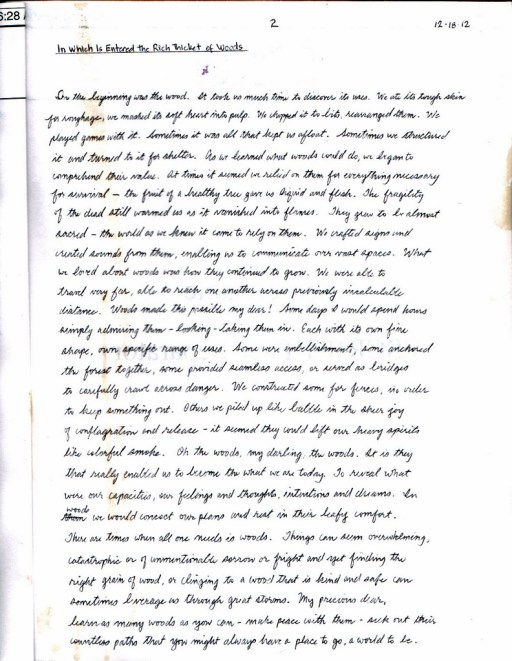
Here is page two of the blank notebook from my daughter as it fills:

Notebook

and here it’s typeset form:

2

In Which is Entered the Rich Thicket of Woods


In the beginning was the wood.  It took us much time to discover its uses.  We ate its tough skin for roughage, we mashed its soft heart into pulp.  We chopped it to bits, we rearranged them.  We played games with it.  Sometimes it was all that kept us afloat.  Sometimes we structured them carefully and turned to them for shelter.  As we learned what woods could do, we began to comprehend their value.  At times we relied on them for everything necessary to survive – the fruit of a tree gave us sweet liquid and meaty flesh.  The fragility of the dead still warmed us as it disintegrated in the flames.  They grew to be almost sacred – the world as we knew it came to rely on them.  We crafted them into signs and created many sounds from them – enabling us to communicate over vast spaces.  We were capable of traveling quite far, able to reach one another over distances before considered impassable.  Woods made this possible my dear!  Some days I might spend hours simply admiring them – looking them over – taking them in.  Each with its own fine shape, and own specific range of uses.  Some were embellishments, some anchored the whole forest together, some provided seamless access or served as bridges to crawl carefully across great dangers.  We constructed some for fences and walls – they helped us keep the unwanted out.  Others we piled up like babble in the sheer joy of conflagration and release – it seemed they could life our heavy spirits like colorful smoke.  Oh the woods, my darling, the woods!  It is they that really enabled us to become what we are today.  To reveal our capacities, our feelings and thoughts, intentions and dreams.  In woods we could concoct our plans and rest in their leafy comfort.  There are times when all one needs is woods.  Things can seem overwhelming, catastrophic or of unmentionable sorrow or fright, and yet finding the right type of wood, or clinging to a wood that is kind and safe and strong can sometimes leverage us through great storms.  My precious dear, learn as many woods as you can – make peace with them – seek out their countless paths that you might always have a place to go, a world to be.


Intro to the Gift that Explodes

photo 1
daughter Ida – aged 8

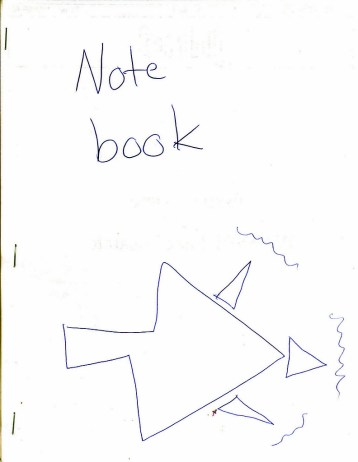
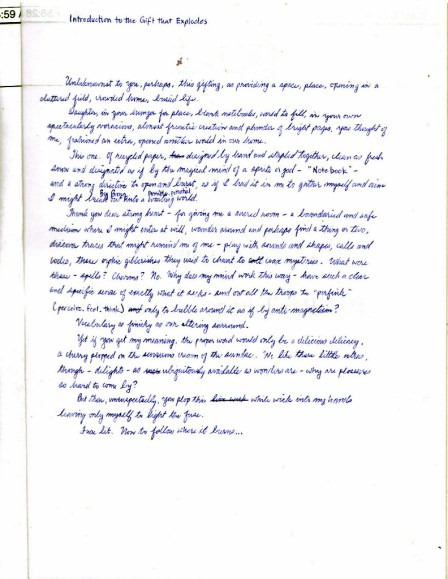
Holidays have a way of obstructing and crowding out creative time for me.  Oh we find ways to express and produce – Holly’s making candles with all sorts of found objects downstairs as I type this, paper snowflakes, new stories and pictures from the children, new compositions sounding throughout the house, but for the snail’s pace of reading/writing processing/producing I prefer…well… I often find the compounding of anxiety-inducing public spaces and family gatherings, people and lights and jangling music and cheer, busying trips and spendings and time limits to all but obliterate my ability to bring anything out of the scraps.  Last Saturday, my daughter Ida, who is forever cabbaging papers, pens, markers and tape anywhere she can find them, metamorphosing them into handmade notebooks, letters, scripts and stories to read and share with her lucky family and friends, handed me the following with the message: “this is for you.”  So today, amid projects and budgets and organizings and so forth…when I was just about to write off the next two weeks for personal creativity…I grabbed this and took it to my desk…

Notebook - Ida


…and so it begins…

Notebook - Ida2


In case you can’t read my mumbling handwriting – here is a typed copy: (have to click a couple of times for some reason?!)

Introduction to the Gift that Explodes

ELSE – Aziff : Prompted by Comments

(a continuation of Else  – Erasure : Beginnings)

Aziff : Prompted by Comments

Once begun, and begun in You-ness, though perhaps not – indeed probably not in any way! – in Newness, you take leave in the middle.  Or if not the middle of this brief engagement, somewhere, alas, in its midst, you set out.

“The place I really have to get to is a place I must already be at now” Ludwig Wittgenstein said, which you almost remember, and in any case you think of now, triggered by its inscription among the paper scraps scattered over your writing desk.

Already you’re sick of it.  The You-ness you hijacked in hopes of Newness.  Your playabout with something Else.  Attempting to trip or trick yourself into some place else, somewhere other than where you “must already be at now” – the Else you set about pursuing, by dissecting and deconstructing it on your desk.

You come up short.  Feel foiled.  A stray comment from some other immediately exposing a cheap and shoddy sleight-of-hand you yourself could not perceive.  The danger of others, of else.  The dangers of self-encounter in dialogue.

In any case, you create, or you go on making with all that is already tired and old.  Namely, yourself, and whatever is at your easy disposal, fearing in advance what might be required to move.  Toward what could be New, into the unknown of the Else.

You tackle the pieces, a limited arena of shuffled scraps – quotations, emotions, experiences – in hopes a pattern emerges, an inventive cohesion.  Unlikely, or forced.  The banality of meaning – a fundamentalist smallness of purposes or cause.  You vomit.

It’s a discomfort – as if from some trauma stored throughout your body and brain – a fear of what you cannot identify, having experienced it (“suffered” is how you put it, and “endured”) as an unspecified complexity of connectivities too slender to hold or locate – the incomprehensible self – that atomistic and invisible dot-point in a universe of flickering.

Whereas you are able to imagine others and else as substantial – entities with agency – in all the vastness.  What you can observe with less participation, seeming more real to you, somehow.

Else – you just get lost in the dissection.  Labyrinthine traces of fact upon facts, ad nauseum infinitum…  The searching for cause and impact in a loop within a web caught in a net stranded among strands inextricably interlocuted in endless structures and systems imperfectly operational.  And so forth, you consider the sources.  Always coming up missing or bereft.

Cease.  And breathe like a statue.  It doesn’t.  You don’t.  Else.

Not what you thought you were looking for.

New probably just meaning something different, you repeat yourself, something Other, something Else.

You set out.

ELSE – Erasure : Beginning

Erasure

It will have to be something new, you think to yourself, beginning.  What’s been done before is already present.  All the brief and poignant things gathered.  Already processed and past-eurized.

Heroes are made, families described.  Every aberration.  Otherwise we wouldn’t know, would we?  So much sex and images, and the inner lives of children.  Histories and sciences, and the nothing that affords, beyond.

New probably just means different, you say, using old words already.  If it’s a word it’s definitely been done.  Or an action.  Dreams and thinking too.  Which leaves you with little, if not naught.

You once composed a text of tinntinnabuli – it was fascinating to you.  Also a fugue of sorts, even a classical symphony, all in words, one in the twelve-tone scale.  Little matter with a missing orchestra.  Fit snugly into your drawers.

The series of anthropomorphic fruit.  What they felt and how they perceived, from rind to seed.  Even the veins in their fleshes, bruises, and each distinct and delicious juice.  Cycles of life, inevitability of change, sprout to rot.

Who cares?

Yet it’s what you do.  Identify moments and make them stories to exist.  Wrapped in the tangles of problems, sentence-wriggle-thread your way elsewhere.  A place that looks like knowledge.  And sometimes feels.

Like mathematicians with their unknown variables – it’s the ocean you swim, an amoeba almost.

You sought after mastery but found it banal.  Meaning didn’t make any sense.  You turned to hypotheses, but not the wilder the better.  You had to squeeze through gaps, hoping for openings.  A friend called it spelunking, and it did seem dank and cold and blind.  Often.

Restatement is not what you’re after.  Nor refining.  If thinking is digestion, you order an autopsy and strange foreign parts.  Intake as transplant.

Distinctive takes a while, but quickly regurgitates style, and you’re back to remarking, remembering…remorse.

Today you’re dissecting an Else.  Not again, or if\then, or more, but the Else.  What else? you say.  You don’t know.  But it lies here dismembered, deconstructed on your desk.  It’s pretty messy.  The pieces aren’t going to fit, even though you’ve studied jigsaws and puzzles.  Inventing new ones feels like metaphor or code, a twiddling thumb to decipher, something no one has time for even if they wish they did.

It will have to be something new to count as satisfaction, you consider.  And you take up the large eraser.

Lost in the World

            Lost in an inscrutable world and running out of time.  Always running out of time – don’t you feel it?

We try to describe it to each other – what we experience, perceive, how we learn to survive.  We call this – in varying levels – relationship.  Depending on the amount of explanation and exposure, cataloguing “acquaintance,” “stranger,” “family,” “friend,” “lover,” and the like.  A kind of measure.  Recognizable connection or estrangement.

But the world is inscrutable, as are we, thus we name ourselves “lost.”  “At least we’re lost together,” some said, but others thought we’d find out more apart, in other words “split up and look for clues.”

What would the clues be for?  From whence this idea of “clues” to be searched?  I wonder this.  Did someone somewhere “find” something indicative of something really “else”?  Other than this world and we in it?

I meet one of us who “has a feeling.”  She has this “sense,” she says, that there really is an Other – something or someone truly outside of this barely discernible world we (at least) found ourselves and other things in.  I ask her to describe the feeling and her ensuing language reminds me a lot of feeling-collections I also have gotten from time to time.  Without, I might add, ever considering them Other-worldly.  What is to account for this?  These are the sorts of discussions we wanderers have.

How might I recognize a clue?  Where did the idea/referent/template for such a signifier originate?  Martin found an interesting, that is, noticeable pattern on the shell of a turtle.  It appeared roughly to resemble little squarish shapes of wood we use to count by or play games with, sometimes even to carve on and trade for fruit or grasses.  Martin thinks this might indicate that the shape we use for wood was natural – inherent in the world – purposeful.  Not coincidence or accident, but a sign or clue about “the way things are.”  There were 16 of these rectangular shapes on the turtle’s back.

“Why would you think that, Martin?” I asked.  It is curious and fun to find similarities in the world – between people, smells, shapes, sounds and colors – all sorts of things – but why wouldn’t we notice like or familiar things in new situations?  To make it feel, well, less inscrutable?  That way we could learn about the unlike, describe the difference.  This, at root, was what I understood by the word we used, or called – “learning.”

I ponder the projection that making things seem more uniform might help us feel less “lost” or confused in our surrounding world.  So I might be expected to gravitate toward humans of the same height, weight, or hair color; that  make the same sounds as me, recognize the same shapes, eat the same objects, and so forth.  Somehow this practice strikes me as less interesting, ever running out of time (as we all agreed, once we’d broken our existence up into increments) and with so much unexplored and perhaps unknowable world still surrounding us all.

I take on the habit of investigating difference – I discover that finding similarities in my surroundings comes rather easily, nearly automatically, but aspects that are unique or defamiliar tend to more efficiently further my familiarity with the world.  It becomes a strategy not of looking for clues or surfaces pointing to something else, but simply finding else everywhere.  Even in the same “place.”  There appears to be no end to variance (even in myself) and therefore no static “same.”  I find myself always finding, discovering other in every moment, the differences forever expanding my knowledge of, but also maintaining my ignorance level of, the world I find myself in.

A perpetual state of wonder.
 

Inscribing Beauty : A Portrait of My Wife

On Beauty: A Portrait of My Wife

If I don’t write it, what reality does it possess?  What substance or content are a memory or vision?  Sound?  Fleeting concatenations – experiences.  Which is why I ask.  Like Dante or Cervantes, Homer or Herodotus, does not here a duty lie?

If no one inscribes remarkable things – they will not be remarked, thus no further remarkable.  But is writing a re-mark?  Are we indeed marked by perceptions – jumbled, edited and collated into what we call experience – do they leave some discernible trace like magnets in the guts of a computing machine – that might be recalled, rebooted, reformatted and marked again?  Or is that creation?  New traces born of the old?  What similarity – what identity – obtains?

If the scribe exists to codify – to translate vanishing occurrences into a relatively more stable domain – how should he select?  What criteria?  Whose testimony?  Should he, as artists of old, gather the evidence and forge, in his matter of medium, some combinatory new myth?  Take account of as many angles of appearance or observation as he is able, to contain and collage them into space like Cubists?

We call it “re-presentation” but we are crafting something new, something else.  The eye is not a camera.  Seeing, hearing, what we taste and feel are highly selective pro-activities – never catching a solid snippet or observing still life.  We develop according to what we expect.  Intuitive anticipation.

The façade of a building – you’ve already supplied it with volume.  Unseen.  The photo of your child – gains dimension and sound, perhaps even smell and sense.  Context invested.  Invented.  We cannot stop the alchemy from going on.  Nor would we really want to.  And yet – what might we preserve?

Suggestions?

This began as a portrait of my wife.  An impossible thing.  It will end still farther from its goal.  I meant to remark what has marked me profoundly, filled me of scars and traces, redirected my nerves and my blood, and I am left with the unexpressed, and these scribbled words of a man.

“What does it mean, to know it and not be able to say it?”

-Ludwig Wittgenstein-

Brave New World

part of our weekly practice of participation in the lively community prompted by Rochelle Wisoff-Fields Friday Fictioneers – I encourage all to join!

Copyright -Douglas M. MacIlroy

Brave New World

Assembling for the task, we began.  Each in our strengths conspiring.  Tristan executed calculations which were pinpoint.  Ida concocted the sounds and the language we could use, boxing up the requisite books and emotions.  We counted on mama for the overall surround, a global view of the society – espousing natural characteristics and roles.  Oliver modeled the world and placed it on a bucket.  Everything was ready – needing only performative passion – a unified desire.  We waited for Aidan, lugging the chains that would keep us on course, to hold back entropy’s risk.  Leaving me to chronicle this family’s brave new world.

N Filbert 2012

Unspoken Fragments

Through someone else’s blog award list I recently discovered The Dream Journal Today – a remarkable blog straightforwardly recounting dreams.  It has stimulated me to pay more attention to what my brain is doing in its “off-hours.”  The post regarding my longing for knowledge of my father is such a result, as is the following post, gathered through the past night.  I have the hunch my psychophysiology works over emotion when I’m out…something my waking mind deters.  Whatever the case, I have found the ritual to be as intriguing as working with photo-prompts to dislodge other-conscious concerns, and recommend it to writers everywhere as a kind of exercise in translation.

Thrown on my back as from a jungle gym – panicked in the way of breath-smashed bodies.  Helpless then, disempowered.

Lying next to you in our warm nest of bed, nose and right eye microscopically near the flesh of your chest – the sharp distinction of its tattoo’s inky night and the blemishless cream covering your major pectorals.

I see it falling, the exploding crush of a thick plate of glass the size of a small wall and maybe four inches thick – variegated and stained – slicing and dicing my face with the stories you don’t share.

The night is full of phrases.  Intimacies shredded by the unspoken, the secrets.  A literal compaction of my face in bloodied fragments – the world a shattered windshield.

Sleeping fitfully you deliver direct language through the dark.  “This is wrong and this is wrong and this is wrong…with you.”  I don’t remember details, only that I’m broken like a vase of porcelain on the floor of an empty manor.

The decompression and drainage, the fracturing damage of all you hold apart.  Discommunication.  What is withheld.  The feeling of what happens when I supply the captions to your silence.

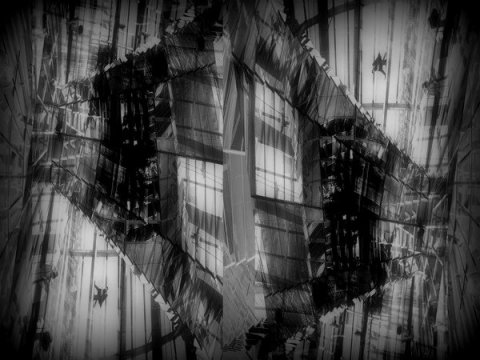
more_fractured_light_by_thescreamingid

“What is fiction after all, if not a kind of purposeful dreaming?”

-Jonathan Franzen-

Fathers & Sons

Seeking My Father

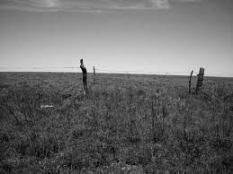
flint hills-001    Seeking my Father

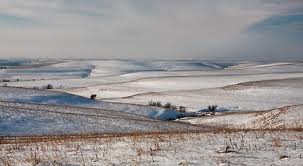
I’m stumbling about in a vast field of corn or wheat (mostly stubble) – for the requisite difficulty I want to say stalks of maize – but most likely it is wheat (author living in Kansas), though the sharp starkness of the dying shoots suggest otherwise.  There may be snow, it’s that bleak.  I’m lugging, perhaps draggling (yes – dragging a straggling weight – I do that) a shovel – nothing unusual about the tool except that it feels abnormally heavy and the iron parts are particularly cold (reminding me of the processings of my brain).  A book is open on my lap (I’m sitting in an airport) to ward off any attempts at conversation and indicate a desire to be left alone, so I might continue my dreaming.  I’m using the shovel to dig for my dad.  Like – to find him.  The field is a veritable landscape, not a “quarter” or even thousands of acres, but more like a steppe – some foreboding Russian prairie-plain – but clearly cultivated and almost fallow, or otherwise undone.

So I’m trudging through, eyeing the horizon, searching for some limiter, some possible landmarks that could clue me or direct me toward a where to dig.  Every once in awhile I stoop or coil and plunge the blade into the cloddy frozen soil, strung up in tares and straw and grasses.  I guess I’m expecting a thunk or an explosion of stars or something, because I never dig for long in one place, and soon pull up and move along.  How do I know that he’s here?  It’s as if something told me so.  A sensation a helluva lot like intuition, or premonition.  It’s a thankless task, I’ll tell you that, with the approaching holidays and stuck like this waiting on delayed Winter flights.  What hope is there for me?  It is already dusk and the field’s enormous.  I’m alone, you know.  Out here trying to find my father.  Trying to find my way.

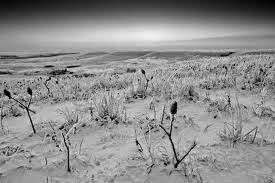
flint hills snow

Afterword

Ever since I’ve been nearly-adult, or as long as I distinctly remember thinking about things like this – like death or family or meaning – I’ve wished I knew my father.  In college I thought it might be a matter of vocabulary – that we didn’t possess the correct vehicle for exchanging emotion and memories and hopes – so I studied America’s westward movement (the paths of our ancestry), studied land management and read farmer-writers like Wendell Berry and William Kloefkorn, Larry Woiwode, William Stafford, Robert Bly and ilk.  Trying to forge a connection now that sports and God had run their course, for me.  As my own children arrived I turned to movements like Men and the Water of Life, the Iron John sort of thing – searching what is my heritage – of gender, of blood – what the hell does “manly”(ness) mean beyond observation and nurture?  Now with sons.  Hunting for metaphors or language that might serve as derricks plumbing wells – that might draw out my father and myself and somehow blend us together.  Poem after poem, story by letter asking intimacy.  Sometimes I’d gain the courage for a lunch or an outing to interrogate him directly about how he felt about things and what were his stories.  I gifted my mother and he with a book of great questions and a blank notebook so they might fill out their inner-info when they felt like it, “for their grandchildren,” I’d said, “for posterity.”  Simply wanting to know.  As far as I know, it’s still empty.

Why is it so hard for fathers and sons?  How many of us wish we really knew – our parents from the inside out?  Believe that somehow knowing more than their strategies of being would offer us a clearer, fuller sense of ourselves?  Unburden.  Invite.  Be near.  As my father and I both age, I find myself anticipating his stages – frustrations, weariness and increasing losses.  I find myself encountering bewilderments I saw him endure, and still I constantly wonder what he would say – if he said – not regarding politics or basketball or weather or cars, but about me.  About him.  About being a father and a man, a husband and a laborer, a person, a friend.  About humor and music and art, about culture and meaning.  He studied much and has lived long, lost so many, traveled and loved and he’s beautiful.  As with my sons – toward whom I try to be so open and true – the conundrum of unknowing and uncertainty related to those closest to us is a mystery that hurts.  The above piece is one of a life of installments.  A kind of cry.