The Want for a Story : Texts for Nothing

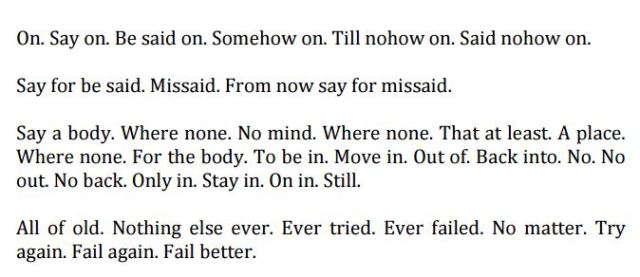
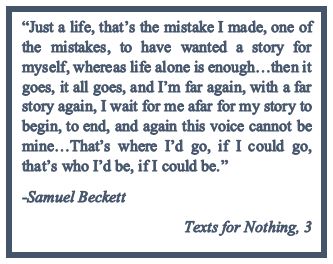
Beckett_TextQuote

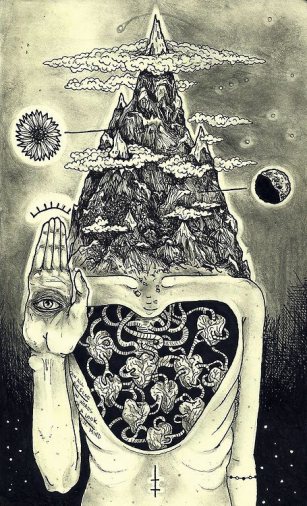
The want for a story.  For a ‘reason’ to be.  A far place, an illusion, the stomach knows its illegitimacy, its fantasy, irreality…yet the brain (mind?) dying toward, for, craving, starving after it.

A thread in a narrative…a plotline…a characterization – some momentary identity.  To be witnessed, accounted-for, counted, taken note of, recognized.  The mad dream of anOther aware of me, acknowledging my presence, sidling out of my way.  “Made way”…I exist.

The madness of atoms.  Nonsensical.  Not “to be” – a sort of fact as it goes – but “to be in awareness” – and not only, but much more – “to be in An-Other’s awareness!”  Too much!  Pure delusion.

We infect alt-awareness only via disturbance and/or unavoidability – interruptions, intrusions, sign or accident/event – a scream, a tragedy, an obstacle.  Interference.  No one selects for intrusion…it is managed and dealth with, endured or survived.  We (humans) don’t “mean to,” don’t “seek out” inconvenience.  (Or maybe we do?).  But no matter.  Not our ‘purpose,’ ‘intent.’ Not our ‘drive’ (to survive).

Others become aware of “me” when (and ONLY when?) I get in their way.  “Intrude.”  Otherwise – sans dependence, accident, harm, or some assumed respons-ability (‘obligation’) – I find it hard to imagine drawing the care of attention of an/other.

We spread too thin.  Period.  Once we engage/respond/encounter/experience, it is blatantly evident: WE ARE NOT ENOUGH.  Perhaps nothing is.  Perhaps learning, relating, experiencing, engaging, life…NOTHING is.  Perhaps this differentiates us as a species – UNSATISFIABLE : UNMET.

And…perhaps this is a synonym for “Life/Living” – some ‘thing’ ever striving ‘further’ or ‘beyond’ itself…

Is the ‘definition’ of “Life” simply WANTING FOR MORE?

i.e. – entities remaining alive, period – according to DESIRE?

The want for a story.  A ‘reason’ to be.  To be meaning.  To signal.  To call & respond.  To exist.

But all those are “more-than.”

The Myth in the Verse

The River of Bees

BY W. S. MERWIN

In a dream I returned to the river of bees

Five orange trees by the bridge and

Beside two mills my house

Into whose courtyard a blindman followed

The goats and stood singing

Of what was older

.

Soon it will be fifteen years

.

He was old he will have fallen into his eyes

.

I took my eyes

A long way to the calendars

Room after room asking how shall I live

.

One of the ends is made of streets

One man processions carry through it

Empty bottles their

Image of hope

It was offered to me by name

.

Once once and once

In the same city I was born

Asking what shall I say

.

He will have fallen into his mouth

Men think they are better than grass

.

I return to his voice rising like a forkful of hay

.

He was old he is not real nothing is real

Nor the noise of death drawing water

.

We are the echo of the future

.

On the door it says what to do to survive

But we were not born to survive

Only to live

  1. S. Merwin, “The River of Bees” from The Second Four Books of Poems(Port Townsend, Washington: Copper Canyon Press, 1993). Copyright © 1993 by W. S. Merwin. Reprinted with the permission of The Wylie Agency, Inc.
 

from Archives – Family: A Fiction

wandering through my own writings, and stumbling on things that surprise me.  This seems (to me) to be some of the best writing I’ve ever done, something I can’t imagine being able to do, something I’m not sure I ever did – the bewilderments – something I can’t imagine doing again.  Thought I’d share…I wonder who/what I might be.

Family

Family: A Fiction – NW Filbert (2012?)

Current Reading Sampling – 2016

I realized I have neglected this ever-changing list…for any who might be interested.  So I updated it today…

2016

“I decided to continue drinking and living in just this way.

My whole life long”

– Georges Bataille

Chin-deep in labor, family, relationship & studies…

Works for survival:

Writers, Antoine VolodineAntoine Volodine, Writers

Maurice Blanchot, The Space of Literature

Samuel Beckett, The Grove Centenary Editions

Franz Kafka, I Am a Memory Come Alive

Enrique Vila-Matas, Bartleby & Co.

Montano’s Malady

Gilles Deleuze & Felix Guattari, A Thousand Plateaus

William James, The Writings of William James

Mikhail Bakhtin, Works of

Edmond Jabes, The Book of Questions

Works that expand:

Friedrich Kittler, Discourse Networks, 1800/1900

William Franke, A Philosophy of the Unsayable

Ian Hodder, Studies in Human-Thing Entanglement

Paolo Virno, When the Word Becomes Flesh

Werner Hamacher, Minima Philologica

Giorgio Agamben, The Coming Community

Paul Feyerabend, Against Method

Parataxis / Parallaxis

parataxis, n.

The placing of propositions or clauses one after another, without indicating by connecting words the relation (of coordination or subordination) between them, as in Tell me, how are you?.

“PARATAXIS, N.” OED ONLINE. OXFORD UNIVERSITY PRESS, DECEMBER 2015.

Parataxis is a literary technique, in writing or speaking, that favors short, simple sentences, with the use of coordinating rather than subordinating conjunctions (from Greek for ‘act of placing side by side’; from para, ‘beside’ and tassein, ‘to arrange’; contrasted to syntaxis or hypotaxis).

It is also used to describe a technique in poetry in which two images or fragments, usually starkly dissimilar images or fragments, are juxtaposed without a clear connection. Readers are then left to make their own connections implied by the paratactic syntax.

WIKIPEDIA CONTRIBUTORS. “PARATAXIS.” WIKIPEDIA, THE FREE ENCYCLOPEDIA

parallaxis, n.

Difference or change in the apparent position or direction of an object as seen from two different points; (Astron.) such a difference or change in the position of a celestial object as seen from different points on the earth’s surface or from opposite points in the earth’s orbit around the sun. Also: (half of) the angular amount of such a difference or change; (Astron.) the angle subtended at a celestial object by the radius of the earth’s orbit, giving a measure of its distance from the earth; any of various similar measures of distance calculated by methods incorporating the motion of the sun relative to the local region of the galaxy, the proper motion of the observed body, the motions of a cluster of bodies having similar distances and speeds, etc.

“parallax, n.” OED Online. Oxford University Press, December 2015. Web. 7 March 2016.


Parallax is a displacement or difference in the apparent position of an object viewed along two different lines of sight, and is measured by the angle or semi-angle of inclination between those two lines. The term is derived from the Greek word παράλλαξις (parallaxis), meaning “alteration”.  A parallax is the difference in the angular position of two stationary points relative to each other from different viewing positions.

Wikipedia contributors. “Parallax.” Wikipedia, The Free Encyclopedia. Wikipedia, The Free Encyclopedia, 28 Feb. 2016. Web. 7 Mar. 2016.

Homo Scribus Attonbitus

a text from the archives…ready again, relevant, near…

hand eye heart

Homo Scribus Attonbitus 

(2012?)

Interconnection and Autonomy

a personal note

I have long disliked and had an intense aversion to telephone calls.  Like televisions transmitting in shared or public spaces, they present inescapable interruption and intrusion.  One could be in thought, repose, intimacy, conversation, activity — in fact, whatever one is about when one is not on the telephone – and then suddenly must react to a demand.  A call.  But WHO is calling?  WHY?  Why now?  When my attention is demanded through interruption or intrusion, my body anticipates emergency.

Disembodied conversation shifts the burden of dialogue to the voice.  Therefore the natural indicators for “I’m thinking…” or “give me a moment,” nods, smiles, frowns or gestures that flow in face-to-face interaction, offering wholistic responses, are all pressured onto the mind and voice – forcing incessant reports and the trickiness and difficulty of translating bodily experience into language.  I require time to listen, consider, and respond.  Movement.  Silence.  Whether it’s a simple invitation, business matter, question or request – it always emerges as demand on the telephone.  Respond to this NOW.  (public or shared-space televisions – SEE this NOW).  You cannot escape, select, regulate or direct such importunities.

Global Communication Technologies, – our networks, internetworks and their myriad machines and devices – have provided some enormous benefits toward expanding our social lives outside of limited demographics and cultures, opening realms of activities and artifacts, information and resources that in any other time-period we may never have known about or encountered.  As these technologies proliferate into internets of thingsubiquitous (or pervasive / invasive) computing, and manifest the inherently linked realities of our world…simultaneously providing ambient findability (all of these terms and phrases as easily interpreted as violence or intrusion as well as opportunities or boon).

I’ve long preferred face-to-face interaction (in spare doses, they are taxing & rewarding) and textual communications (obviously, but also texting, emails, postal correspondence), because in the F2F we are offered and allowed appropriate cues to follow and respond to one another, and in textual discourse we are allowed the time and distance to craft and dictate our translations of experience, messaging intentions, and terminological tones.

Of late, however, I have noted a convergence of Call-Anxiety and Pervasive-Communications.  And am wondering about our levels of autonomy (if there even is such a thing for the human) or self-direction, any amount of governance we might preserve over our lives and activities and choices in a world populated with linked devices?

How much of our days – work time, supposedly “personal”/private time, play time, labor time, interpersonal time, family time, meal-times, chore-times, reading times, creative times, necessity times, and so on…- are steered and directed, controlled and dictated by the consistent, persistent, pervasive and invasive thoroughfare of MESSAGES from OUTSIDE?  If we consult our devices upon waking – how often are that day’s events passively designed around what we receive?  If we respond to text vibrations / updates / posts / SMS or IMs / emails – how much are they eroding self-governance and discipline or choice and instead simply ANNOUNCING (demanding?) direction and response?

How many swerves do we make in our causeways of living by our over-saturation with “friends,” our communicative reach far beyond our communities, our global information system versus our local work offices or families or few (actual) friends?  There have been plenty of studies from nearly every field of inquiry reporting that our safe or thrivable social capacities are quite limited – most studies indicate humans do best in consistent contact with 30 or less others.  Proffering sufficient opportunities to know, understand, interact and relate.  Yet any given Facebooker or tweeter or snappy-chatter may have exponentially larger engagements nearly every minute of their lives.

How different would my relationships with co-workers,  children, family, friends, BE if we weren’t including thousands of others in remote places, professional connections throughout the world, images and language and emotional reports and happenstances flooding like telephone calls and tele-visions and noise into our domains, habitats, domiciles, studies?  What might i NOT buy if it weren’t so easy?  How differently might I know books, movies, music, animals, persons – if they weren’t in virtually infinite supply?Do we preserve moments of choice and connection, safe from Call-demands or Pervasive/Invasive-communication-technologies?  Or do we simply escape or take breaks from time to time?  Going for a walk or having a dinner, camping, hiking or traveling once in a while without our devices?  What would it be like to lose them?  What would we know?  What kinds of knowing would we produce?  What sorts of makings?   What might be drawn or composed, felt or engaged, seen or heard if we were DISconnected to the hive of activity and input? How might we relate to those around us?  Where might we go?  Who might we be?

Well, that’s what I’m thinking about.  Pondering.  Wondering.  Queries of value and quality and meaning.  Stress-levels, anxiety, physical wear of being “on alert,” alarm, reactive, responsive to ubiquitous “Calls.”  Demands.  Invasions.

What if we saved intrusions for emergencies?  Took time to send only specific, relational-oriented, relevant and appropriate information to one another?  Thought critically?  Reflected?  Looked, touched, listened, and managed more wholistic presence with our immediate surrounds?

I don’t know.  I’m just wondering.

[The lucky piece for us at present is that, like pulling the phone line from the wall, our technologies are remarkably easy to dismantle and turn OFF, should we CHOOSE to]

Worstward ho

Worstward ho

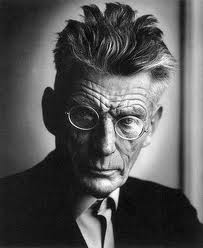
samuel beckett

On “waking depressed,” or, Human Clear-sightedness

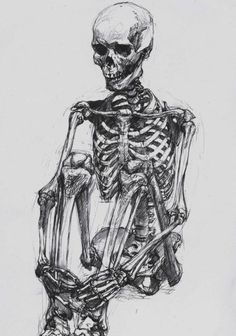
skeleton

We say that we “wake up depressed” wonder why and conjure up reasons.  What is this “hollow” or “indentation” in relation to?  Depression versus delusion?

Squirming up out of dream or slumber into wakefulness, awareness – illusions and solipsism scattered by light of day, by alertness – what would be the “norm” ‘depression’ dips under?

Say we consider “normal” as the state or condition of being aligned with what is.  The only certain trajectory of living is dying.  Dying the condition of life.  The only permanent outcome of breathing, saying, doing, being…are their cessation.  In confirmation or conformation to this “reality” – what should be the normal living response?  Depression, I should say, full awareness and wakeful understanding that my promise, potential, outcome and fortune are to end.

Decay, departure and death are the certain “norms” ruling human existence.  What occurs, forgets; what merges, diverges; what events, unravels; what happens, undoes; what is made, erodes.  Assuredly, they are strange loops, ambiguous and temporal – more wave/particled than 0/1 – and yet as “fate” or “doom” would have it (definite futures) we know of no other.

Therefore it should seem “depression” would be the normal human state of life, and all forms of happiness or joy come about due to some compromise or delusion – an abnormality – some neuroses or failure to accord or conform to what is.  How might we have come to classify conformity to what is as a “disorder” or diagnosable swerve?

“Certifiable depression” is marked as a disability, a failure to thrive, a condition incapacitating function.  Yet does that not most assuredly accord with the certitude of demise, destitution, eradication?  To terminate activity, halt health, conclude creativity, finish folly and destroy delight would all seem to indisputably align with the necessary phenomenon of obliteration.

Thoroughgoing comprehension of what is – that birth has a single objective – that all roads lead to one – that all effort leads to naught – that entropy – is not lunatic, demented, deranged or unhinged – but rather most enlightened and balanced, intelligent and lucid, perspicacious and well-advised.

Being pressed down, a lowering of quality, vigour or amount, feelings of severe despondency and dejection are surely the most accurately normal experiences – regulated, coordinated and adjusted to what is versus what is imagined or desired – indications of astute apprehension and capacities of apperception to the real.

Do not be flummoxed by “waking depressed” – do not seek for treatments or reasonings ‘why’! – do not be baffled that a heaviness descends, or a ‘pressing down’ is felt or occurs – we emerge into life and descend into matter…the cradle and grave a continuous process.

everyone dies

The Sickening of Stories

jose-parla-broken-language-exhibition-haunch-of-venison-recap-1

I am not certain why stories sicken me so.  By “sicken” perhaps I mean something closer to depletion or boredom, gluttedness or exhaustion.  By stories I mean shaped texts of language – narrative fictions, philosophical arguments, journals and declarations and ads.

“I don’t know why I told this story.  I could just as well have told another.  Perhaps some other time I’ll be able to tell another.  Living souls, you will see how alike they are.”

– Samuel Beckett, The Expelled

It has something to do with that.  My own writings sicken me faster than others, but all writings, once entangled in plots, developing characters, or pursuing a narrative…tend me toward disgust.

The motion of “progress,” falsity of construction, illusion of meaning begins to fray as language gets “handled” or forced into order.  The squeezing and pressure and molding of shaped texts, especially as they develop into sections, seem bound to conform to the size of the creator.  Many texts start out wildly, with chaotic promise, almost infinite exploding potentials – but threads develop, and lines, sentences form, and shapes, causes and results, actions and repercussions, and ever so surely the mass is twisted to the size of a snake.  And then I’m tired, exhausted by “how alike they are.”  We are.  It is.

Language imploding and exploding.  This is what I want.  Language available like elements.  Language operative in a chaotic surround, like experiencing.  Language that doesn’t know next.  Language becoming, not necessarily or even especially something – just becoming within/without human.

So I read words, less to learn or be entertained, less to follow or empathize, less to argue or understand, and more to exist in a sea of potential communication and commerce, to respond, to be open and closed by each term and their relations, to go on.

As if language were oxygen, blood, water.  As if language were soil.  As if language were all these mystifying, crazy, strange, different and unknown others surrounding us everywhere.  As if language were environment.  Context.  Medium.  Not tool.  Not machinic.  Not discipline.  Not function.  Not at our service or in our control.

We know that it’s not.  It does indeed possess others – carries and transfers multitudes – times, cultures, histories, humans, vagaries of meanings.  It is untamed and unpredictable, available and unsolvable, like ourselves.  But we often use it for us rather than in or with us.  We often torment it into cages and patterns, (I’m doing it now) – forced representation, desiccated potentials – marks of expression or intention or persuasion or telling.

I declare.  I unravel.  I investigate.  I express.  I guess.  I wonder.  I commit a sound to form.  It leads.  I resist.  I say.  I listen.  It leads (each of us in particular ways).  I resist.  I ponder.  It takes shape.  Incites.  I want.  I resist.  I query.

Doing and undoing language becomes the only way to use it and avoid strangling it down to my size.  Persisting and resisting, experimenting and erasing, canceling / canceling-out, backwards, forwards, at the angular.  Listening to others.  Throwing in, throwing away.  Desist.  Insist.  Consist.  And delete.  Chaos and pattern.  Detangle, knot up.  Fracture.  Fragment.  Avoid.  A void.  Void and null and emergent.  Perhaps.  Perhaps.  The attempt to leave open.  It suffers to form.

Sickening me.

Ends – the Means to Get There; or, Laramie says “OFF.”

ON OFF image

I drill. I devour.

Kafka, Blanchot, Derrida, Bartleby.  Pessoa, Nietzsche, Jabes, Beckett.

Into the absence of hope.

Of language.

Of body.

I drill and I devour.

Myself.

Vitality.

Capacity.

I try to think my end(s).

I want to get there.

I would like to make it to the end.

I would like to make the end.

I think.  I serve.  I love.  I ask.

I care.  I touch.  I say.  I listen.

I am not fulfilling.

I am never quite what is wanted.

I have never been “right” for a situation.

I am a person who tries very hard to be what is wanted.

I am a person who tries very hard to offer what is “good”.

How would I know?

– what is wanted?

– what is good?

I do not.

I am incapable.

But I DO know:

I AM NOT THAT.

(do not) BE HERE NOW.

simply : do not.

“I would prefer not to.”

“I will not”

No reason.

No anwer.

We are just humans.

Animals.

Purposeless.

Pointless.

Without reason(s).

Without meaning(s).

Without.

Still we go on

(for now)

Still we keep on

Still

On

On

On

OFF

(he said, said Laramie to Alias. “OFF.”  He said, said Laramie to Alias.  And then he was gone.  Really.  Gone.)

Sometimes it happens this way.

Sometimes.

OFF

Simply, over.

[Often, in my case and experience.  They come, they go.  There is a rush of blood to the brain and the loins.  There is something I assume the others refer to as “hope,” – some reason to live, to go on, to pertain.  Then OFF.  Binary.  Digital.  Technology.  Culture.  Beings-in-relation.  ON/OFF.  Lights.  ON/OFF.  Progress.  ON/OFF.  Will.  ON/OFF.  Love.  ON/OFF.  Value.  ON/OFF.  Need.  ON/OFF.  Mood.  ON/OFF.  Everything binary.  Irrational.  Abstract.  Illogical.  Happenings, events, occurrences.  ON/OFF.  ON/OFF.  Life.  ON/OFF.  Life.  ON/OFF.  Life.  ON/OFF.

Life.

ON/OFF.

We are coming to an end.

I am coming to end.

We each come, to end.

The End.