Emissions from the Helmet of Horror, novel mythology-cognitive-science-literature-art

“no one realised that the book and the labyrinth were one and the same…”

-Borges, The Garden of Forking Paths-

[as leaked from the skull stuck to Victor Pelevin]

“…progress is a propulsion technique where we have to constantly push ourselves away from the point we occupied a moment ago…the funny thing is that the concept of progress has been around for so long that now it has all the qualities of a myth.  It is a traditional story that pretends to explain all natural and social phenomena.  It is also a belief that is widespread and false.”

“If a mind is like a computer, perhaps myths are its shell programs: sets of rules that we follow in our world processing, mental matrices we project onto complex events to endow them with meaning.  People who work in computer programming say that to write code you have to be young.  It seems that the same rule applies to the cultural code.  Our programs were written when the human race was young – at a stage so remote and obscure that we don’t understand the programming language any more.  Or, even worse, we understand it in so many different ways and on so many levels that the question ‘what does it mean?’ simply loses sense.”

Ariadne:  “…The diagram was called ‘the helmet of horror’ — it was written in big letters above the drawing.  The main body of the machine was shaped like a helmet.  And there was an identical helmet standing on the demonstration table — an ancient bronze headpiece, and underneath it a visor with holes in it curving back inside…Its lower section ran back inside the helmet through a slit in the middle of the face.  And there were some kind of side plates too — everything was very old, green with age.  It looked like a Roman gladiator’s helmet — like a bronze hat with a visor.  Only this one had horns as well.  They came out of the upper section of the helmet and curved backwards…the helmet of horror consisted of several major parts and a lot of secondary ones.  The parts had strange names: the frontal net, the now grid, the separator labyrinth, the horns of plenty, Tarkovsky’s mirror and so forth.  The largest element consisted of the now grid and the frontal net.  It had two parts that were sometimes fused into a single unit.  Its external part, the net, looked like a visor with holes in it, and its internal part, the grid, divided the helmet into an upper section and a lower one, so there was no way you could squeeze even the smallest head into it…the now grid separates the past from the present, because it is the only place where what we call ‘now’ exists.  The past is located in the upper section of the helmet, and the future in the lower section…The helmet’s operating cycle had no beginning, so it can be explained starting from any phase.

“…start by imagining the gentle glow of a summer day caressing your face.  That’s precisely how the frontal net, heated by the action of the stream of impressions falling on it, transmits heat to the now grid.  The grid sublimates the past contained in the upper section of the helmet, transforming it into vapour, which is driven up into the horns of plenty by the force of circumstances.  The horns of plenty emerge from the forehead, curve around the sides of the helmet and intertwine to form the occipital braid, which descends into the base of the helmet.  There, below the now grid, the bubbles of hope that arise in the occipital braid are ejected into the region of the future.  As they rise, these bubbles burst against the now grid, generating the force of circumstances, which induces the stream of impressions in the separator labyrinth.  And the stream of impressions, in turn, is shattered against the frontal net, heating the now grid and renewing the energy of the cycle.

“It’s not always hope at all, it’s more likely to be fear and apprehension, suspicion and hate, all sorts of nonsense, in fact any of the cud that is chewed with such habitual stupidity…technically speaking it is correct to call them bubbles of the past.  They are called bubbles because their constant tendency is to expand and occupy the entire volume of the helmet, preventing anything else from appearing in it and leaving no space or opportunity for the recognition of what is actually happening…since past is enriched exclusively with more past, the bubbles of hope consist entirely of past, they are simply past in a different state…

“The separator labyrinth is the most important part of the helmet of horror.  It’s the place where everything else is produced out of nothing, that is, the place where the stream of impressions arises.  And it’s also the place where the past, present and the future are separated.  The past moves upwards, the future moves downwards, and the present, in the form of the stream of impressions, falls on to the outer surface of the frontal net, generating the cycle’s passionate desire to recur, so that it becomes a kind of perpetuum mobile…”

“That means that it’s past that decomposes into past, present and future?  In actual fact the whole cycle is simply the circulation of now in various states of mind, in the same way that water can be ice, or the sea, or thirst.”

“…the ‘inside’ and ‘outside’ have no existence in themselves.  They are generated by the separator labyrinth by the force of circumstances and from there they enter the horns of plenty, where they enrich the past, transforming it into the state of bubbles of hope.  But since there is no ‘inside’ or ‘outside’ anywhere except in the horns of plenty, the stream of impressions can quite easily arise inside the helmet and fall on to it from the outside.  And the same applies to everything else as well…never under any circumstances regard anything as real.  The entire phenomenon is induced, like the electromagnetic field in a transformer…as far as I could understand it, the horns of plenty operate like enrichment units in a chemical plant.  When it’s driven through them by the force of circumstances, past gets mixed up with everything else, becoming richer and acquiring value, with the result that bubbles of hope are produced in the occipital braid, go gurgling through the region of the future, are reflected in Tarkovsky’s mirror and perceived as the novel freshness of a brand new day.”

“In real life what you see depends on where you look…the word ‘change’ has no meaning…where you’re looking depends on what you see.  Is that clear?”

“The future is produced from the past, so the further we go into the future, the more past is required to produce it.”

“Free will.  Life’s like falling off a roof.  Can you stop on the way?  No.  Can you turn back?  No.  Can you fly off sideways?  Only in an advertisement for underpants specially made for jumping off roofs.  All free will means is you can choose whether to fart in mid-flight or wait till you hit the ground.  And that’s what all the philosopher’s argue about.”

“Always the way when you feel you’re just about to understand something important.  It’s like the whistle of a bullet or the roar of an aeroplane.  If you can hear them, it means they’re already zooming past you.”

“…a labyrinth comes into being in the course of any discussion with yourself or others, and for that period of time each of us becomes either the Minotaur or his victim.  Although there is nothing we can do with this…there’s nothing we can do without it either…even the discourse itself can only come into being within the discourse.  But the paradox is that, although the entirety of nature arises within it, the discourse itself is not encountered anywhere in nature and was only developed quite recently…Basically a labyrinth comes into being when you have to choose between several alternatives, and the alternatives are a set of our possible preferences, conditioned by the nature of language, the structure of the moment and the specific features of the sponsor.”

“Perhaps that’s the whole point.  Not to think about where the way out is, but to realise that life is the crossroads where you’re standing at this precise moment.  Then the labyrinth will disappear as well.  After all it only exists as a complete whole in our  minds, and in reality there is nothing but a simple choice — which way to go next…We’ve all got dead-ends.  Only it’s not obvious straightaway, it just takes a little while.”

“The helmet of horror fractionates the one thing that is, into the multitude of things that are not.  But since the helmet of horror is in no way the one thing that is, it is also one of the multitude of things that are not.  And the things that are not may enter into every possible conceivable and inconceivable kind of relationship, since these relationships do not in any case exist anywhere except in the helmet of horror, which does not actually exist itself…An individual by the name of A may be a part of the helmet of horror worn by B, and an individual by the name of B may at the same time be a part of the helmet of horror worn by A.  This is the final infinity in both directions, and often both of them are quite nice people.”

“The means by which for many millennia he has attempted to make himself real are terrible and foolish, like all the mysteries of his world.”

A remarkable new mythology from Victor Pelevin

(all above quotations arise from!)
Our Mysterious Callings, er, befuddling vocations

continuing qualia…


{eliminating parts of speech and tense(-ing)s}

            Where we began, and when, was next-to-nothing.  How must have been something, and the what bears repeating.  Complex and variegated channels, ganglia alike to beans taking root, nutty and filigreed.

The event is conception and all its pertinent involve (where-when-events) – resultant growth of hairy little what-hows.

What is a theme-and-variations composition, melodies often scarce to trace, but certainly music!  Thrumming drumming subtle, with irregulating tremors, shushing swinging bellowed strings, replete with punctuations.  A human is a riffing thing, something of artist’s collage coupling biological systems and common laws relatively, referred to as patterns.

Person is an unstaid element, living requiring stimulation and acknowledgements, enough continuity to be.  Elaborate contexts of nurturing structures and their vice-versas.  Cells swimming fluids, objects in umwelts, mini-beasts scuttling a globe, as seen from various distances (perspectives not visibly limited).

Existences like screens full of mimeographed transparencies layered and colored by hands.  Bewildering tangles of syrup and string.  Odd combos when mirrored by mirrors, as mirroring means.  Two-sided at least.  Reflected subjectivities / subjective reflections, sort of spinning things set on a gyro turning tilting.

Nurturing structures of what-hows commons: language, culture, environment and arts.  Structuring nurture of sustaining nourishment, awareness (attention) and semblance of security.

And there you have a person (a what-how) and a world (where-when-event); synonymously person-making-world, er, world-making-person toggling looping recursive spirals adjusting discontinuous connectivities…

Perhaps each and overall what-how’s where-when-events all beggar why (i.e. remain puzzling) at which point (or somesuch of the like) there probably arises a who.  Who and why as yet unknown, being conjectured derivatives only from how-what in where-when-events.

All demanding further potentially endless inquiry and study and inventive erasures of conventional grammars and parts of speech.

To be continued…

“…as if there is always a little less in the response than in the question.”

-Maurice Blanchot-

Gathering Information : “Making Sense” : I am that I am

“I received 500,000 discrete bits of information today, of which maybe 25 are important.  My job is to make some sense of it…[I want to write] stuff about what it feels like to live.  Instead of being a relief from what it feels like to live.”

-David Foster Wallace-


That sense that the moon is obscure – cracked or marred in some indefinable way.  That it might never rain.  That parenting equals living with people you helplessly love.

Or marriage as painting, but you can’t control the medium, or even learn to think in it.  You’ll never be wood, cloth, pigment or oils.  I was never good at math, chemistry or geometry.  For making a masterpiece, my chances are slim.  Manic-depressive’s “in love” – like playing chess with marbles and confusing the rules of the games.

It seems possible that people who age wish they were young – tighter, unwrinkled, new-made.  I don’t know – people don’t seem satisfied, somehow.  You get the feeling, sometimes, I don’t know…I get the feeling sometimes that people wished they weren’t people.  You know, that, like, they wished they were simple or something.  Simple scientifically.  Not complex, elaborate organisms, you know?  But more like a single cell or an amoeba – something with apparent purpose or sort of unified mission.  That they knew what to do.  Or would – if they could just pull everything together, into line.

I think that’s what people mean by “making sense”?  Something like that.  Something like inventing God, some unified theory, some golden thread, some identity, some narrative.  People are weird like that, but it makes for a fascinating species – the Storytelling Species – ingenious and fantastic, often unbelievable – the lengths to which these collectives will go to spin a yarn.  Fit experience.

They’ll use numbers and actions and colors.  Matter or energy and form.  Inventing for anything a space and a duration.  It looks like fighting with nature, but it’s kinda not – ‘cause it’s also how they perceive it.  People.

With these enormously intricate mechanisms for constructing order, fabricating texture and variation and difference.  To mash it all back together uniquely – imprinted, as it were – some new amalgam and full of traces – shadows and whispers of origins.  Con-fused.  Remade.  Undone.

I used to think that was a purpose – to give meaning.  Now I see it as a condition.  A convention of rare and specific animals.  At least we convene.  We wouldn’t do well isolate – craving a single-cell or elemental type existence.  We’re collectives – conventional conceptions.  People! (said with a huff-sigh of air and exhausted incredulity).

You gotta love ‘em!  ‘Cause if you’re reading this – “making sense” of these frenetic marks and spaces, light and shadow – then you’re one of them, and it does you no good to resist or despise yourself.  Your own kind.  Though people can, and many do.

Funny (peculiar) how you’ll find people that want to be much greater, grander than the mysterious incalculable beings they are, and then a bundle that wish they were less, tinier, singular things, and then the incredible bulk of people who somehow conflate the two: believing simplicity to be grandeur, the one – the all, everything/nothing, unity/diversity same difference and so on – go figure!  (Really, try it).

Let’s choose a pinnacle example: say unpack “God” or the workings of atoms and molecules, hell, even protoplasm – seems we could learn an awe-full LOT from each of these straightforward messages we uncover: “I am that I am.”

Of Inquiry (Inquiring)

Of Inquiry (Inquiring)

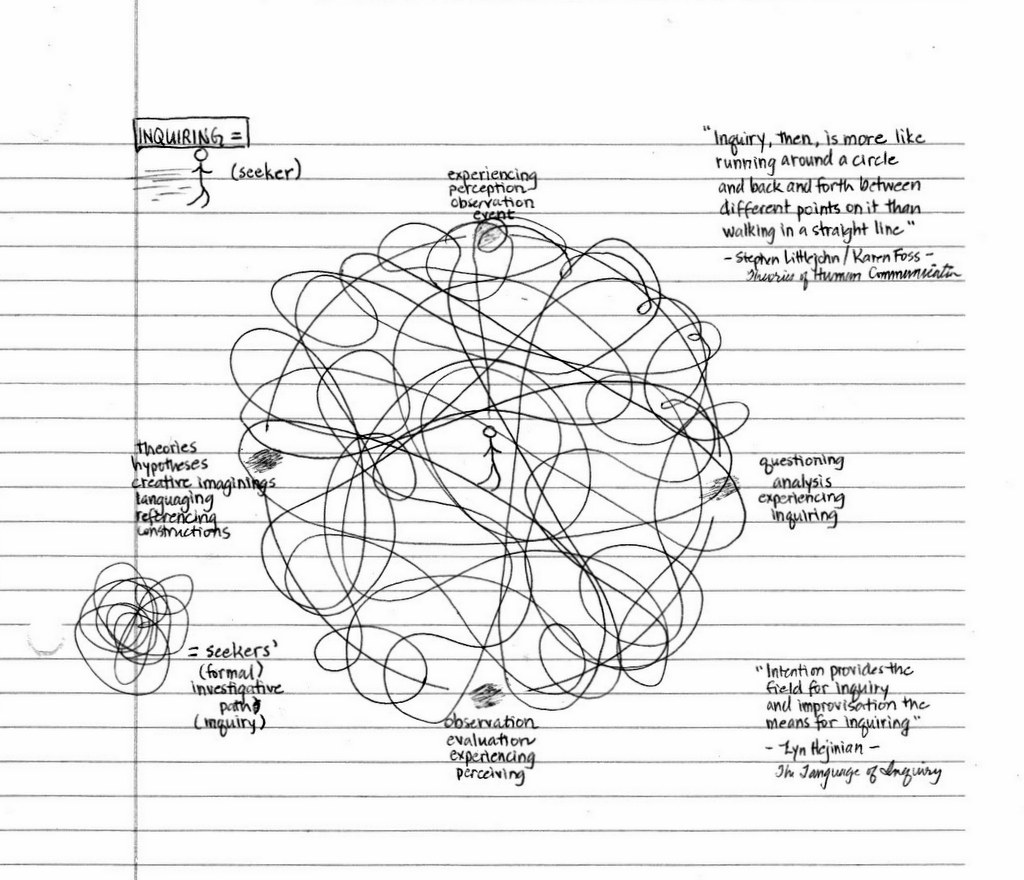
“Inquiry, then, is more like running around a circle and back and forth between different points on it than walking in a straight line”

-Stephen Littlejohn / Karen Foss-

Theories of Human Communication

            And yet whoever thought of it otherwise?

Still sometimes we use logic, as diversion, among the so-called “points,” letting it go.  Circular, perhaps, in that way.  Much as we’d like to, never quite constructing a web.  For capture.  Or a moment to observe, re-flect.  Rather, more de-flect.

If you get their picture.

Would be something like this:


“Intention provides the field for inquiry and improvisation the means for inquiring”

-Lyn Hejinian-

The Language of Inquiry

That is, I assume, if for “improvisation” we substitute some creatively imagining wandering – the wonderings of intention or querying of some inceptive experiencing?  After a fashion.

I’m prone to argue the “point.”  I.e., “What/where/when/how – a ‘point’?”  Inconceivable for me.  As my understanding of ‘point’ is like my comprehension of ‘god’ or ‘time,’ ‘truth’ or ‘being’ – concepts as moving targets without definite characteristics – indefinable insubstantials.  E.g., the falsity of my diagram.

It wouldn’t surprise me if I thought of inquiry as motricity.  When we intend to inquire we’re moving (point-less) and inquiry moves us (point-less) among (therefore, obviously) moving things (thereby point-less), if only in relation to us.  The denial of a dead present.  Pointedly.

No stasis for the living.  Life (logic leads), as, literally, pointless.


So how do we refer?  Index?  Sign?  “Point” to – in all this motion?  Commotion?

Language levies us these lies.  These helpful and distorting machinations and maps of partial, hazy truths.  Like mathematical “laws” providing invisible scaffolding in which to graphically refer.  To question and inquire into falsely stable invisible objects.  Creative and imaginative markers.  Hypothetical space-time convergences – true experientially – but unlocatable save for the traces in ongoing movement – unstoppable, uncharitable, unrecordable – each stoppage (representation), chart or reading of ‘reality’ being an-Other, a deflection, an improvisation and wandering (i.e. a new experiencing)…

…dropping the term “experience” as blatantly false.

…retaining till death “experiencING.”

Not, then, “to question,” but questionING, one and same with observING, evaluatING, inquirING, seekING, readING, creatING, fabricatING the impossibility of a truthful past tense.

…running round and round and back and forth,

not between points,

simply, actually, between.


N Filbert 2012


The Pleasures of Reading : An Aspect : Multiplying Translations

The Pleasure of Reading

In other words (than what?  than which?) we all of us are readers, all of us writers.

That is a pleasure.

And all of us, always, doing both.  Simultaneously.


Speaking of my textbooks (were we?) – information sciences, developmental and behavioral psychology, reference services, librarianship / and the research to the side – physics, evolutionary biology, neuro- and cognitive sciences / my pleasures – novels, poems, stories, others’ blogs, visual, aural, literary artifacts / my relational – wife, children, family, friends, society, culture – gestures and vibes and dialogues and signs / my “self” – sensations, perceptions, formulations of these, reformulations, adjustments and maneuvers.

In other words, at all times, I am reading, even if only my lack of memorable dreams, or pulses and breaths.  And writing it all in actions, movements, responses, adjustments of speaking and writing and making.

It is a metaphor, obviously.  Perhaps.


Roman Jakobsen purported that “all meaning is a form of translation, and multiple translation (polysemy) is the rule rather than the exception.”  (I am translating his text just now into another con-text).

Wolfgang Iser’s (perhaps, anyway insofar as I am translating it here) concept of actual text (text as it is recorded by an author) and virtual text (actual text as read by a reader).

This is an aspect of the deep living pleasures of reading/writing for me.


An author/speaker/artist/scientist/mother/etc. has an urge or sensation – a possibility of action/behavior/message/idea (a virtual text) and translates it through multiple processes and levels of activity through some medium into an actual text/painting/utterance/experiment/recorded idea/sound, etc.  There it is in the real world – a physical artifact in time and space – added – if only for a moment.  Transforming (simultaneously) its maker into a recipient (translating a now existent text/sound/behavior/gesture/sculpture/experience for him or herself) and if any witness/participant/auditor/recipient or reader is in his or her environment they are simultaneously interacting (via translation through their own tools, language, perceptions, sensations, mood, etc) with the actual text, writing a virtual text (translating) of their own.

And it goes on.  And can be done innumerable times, this process, whether using an identical actual text over and over, or simply writing/reading life as it occurs, making it occur.


Paul Ricouer:  “stories are models for the redescription of the world.”  Possibly.  Or at least redescriptions (translations) of models for redescription.

Iser: “the relative indeterminacy of a text allows a spectrum of actualizations…literary texts initiate ‘performances’ of meaning rather than actually formulating meanings themselves…the reader receives it by composing it.”


Language, action, behavior as possibilities rather than certainties.


So that I can encounter with all I’ve encountered/experienced an actual text by psychologist Jerome Bruner translating these very quotes and contents with all he has experienced and translate it with the multiple translations of family life and being a human organism and novels and pains, poems and stories, paintings and laws, translated with data and education, emotions and animals, translating with you and a computer, internet, digits and bits, translating into…

a great pleasure of reading is writing reading

or, “a writer’s (reader’s) greatest gift to a reader (writer) is to help him become a better writer (reader)”

– Jerome Bruner (parentheses mine).


literary texts as “epiphanies of the ordinary”

-James Joyce-

What Happens (with a semblance of truth): A True Story (that is never true)

Many things might have happened, indeed, could have happened.  It is impossible to tell until it happens.  Whatever happens.  And so it goes.

Recollection subjects what happens to interpretation, a puzzling assemblage of memory (embodied brains in changing circumstances) and occurrences (embodied brains in specific situations), making it impossible to tell what happens, when it happens, or after it happened, save from a very particularized attention and intention, point-of-view, disposition and enmeshment (the factors being relatively endless).

And so we call histories, scientific observations, statistical reports, etc. al., “stories;” journalism, research, theories or assays (essays), “fictions;” and personal memoirs, dialogue, descriptions or statements – “fantasy.”

Everything that happens or happened is what might have happened.

Let’s theorize that an author or reader, group or individual, has a concern for “truth” – something being what it seems to be – who or what has total and essential access?  The only truth in human expression that I can surmise is that it is truly “made up.”

An individual may have something approximating total and essential access to a thought or feeling, personal experience or idea, but insofar as it actually occurred according to an experiencer, there are already multiple points of view, ranging from molecular to cosmic, matter/energy to cultural.  To say nothing of the complicating fabrics incumbent on expression – whether a grimace or a novel, a shriek of pain or a tally mark on a chart – it has entered uncertain and collaborative interpreted ground.

All to say “experience” is utterly specific and solipsistic (non-transferable “truly”) and is an enabled product of embedded participation in significant (if identifiable as an “event” or “occasion,” “moment” or “intuition” – any feeling, sensation or awareness) surroundings, expanding niches of existing things with variant points of view.

This is how I can guarantee that nothing I show you or tell you is “true.”

It may be more or less accurate to my experience or understanding of it (depending also on your experience/understanding of my presentation of it) but it will in no wise be what it is or was, in truth.  I assume truth to be as impossible as god.  It would require omnipresence, omniscience, boundary less experience (which could not accord with our experience, or a grain of sand, or an ocean) and would be immediately foiled by the omni-ability (omnipotence?) those other necessary qualities would demand.  One could not be absolutely enmeshed or identical-with and entirely and completely objectively separate or alien-from at once.  At always.  That is not a paradox but a contradiction.  If imaginable, incommunicable.

So we speak of a “semblance of truth” or a “truth-seeming” quality to account for our realities and desires (our want for security, to grow order in chaos, to know, to choose or act with less fear or uncertainty).  Things like our ages, census reports, laws and principles (grammar, mathematics, semantics, processes and methods, etc.) a creepage over toward what we think of as “facts” – majority-mutually-agreed-upon-interpretations/perceptions/hypotheses.  These can hold for a long time because they’re held by so many, so widely.  But they most assuredly change over time, again, from atomic behaviors to the shape of the earth and its relation to elsewhere, from what constitutes pain to what gets moniker’d “god.”

What counts as fact does so by being open and shared.  Semblance of truth comes by corroboration, conversation and multiplying points-of-views and expressions of experience.

Perhaps this is one reason we blog.  To try “it” out on everyone, potentially.  If our expressions resonate with others, perhaps they have a semblance of truth, or contribute toward creating it.  Enough “I know, right?’s” and we’re on our way to a fact.  But no amount of data or language, materials or activity makes it so…it rests on agreement and compromise, observation and interaction shared most widely, coagulations of interpretations, accretions of experiencing – fabrication.

Make then, express.  Hypothesize and share your experience – we ask for your two-cents worth – we’re accumulating a fund.

Semantics

Semantics

Are words the poison?  The inevitable, unavoidable miscommunication?  75-80% of communication is “nonverbal,” yet according to the American Library Association even a corpse is a “document.”

What is it with semantics?  Is it sickness, like some original stain in brains such as ours – a terminal disease called “fabrication of meaning”?  “Second Sight”?

So that an arm movement, a particular gait, an expiration or whittled scar in rock will all be given significance?  All some addition, complexiting, a superadded content?

What is this penchant?  From where does it come?

It looks like the survival mechanism we think of (signify) as “prediction,” i.e. guesswork.

If we can surmise, invent, fantasize possible leads or outcomes…we’d have a better shot at preparing for it.

We make stories.

Often this is paranoia.

It’s the avoidance and terror of death.

Guess a metaphor for every existing moment, action, thing…and possibly you will survive it…know what’s coming and how to defend against or wriggle past.

Therefore, an alphabetical letter like a post-it note on possibilities, a warning-sign for danger, a diagram of fear.

Her head turns quickly – off put?  Offended?  Alert to me?  Tuned in?

Context.

Octagonal red sign at the corner…I stop.

Top sphere illuminated…I go.

“Crack!” I shift, swivel, flee.

One finger extended, my chest concaves, shoulders furl.

Drip, drip, my mouth begins to salivate.

Anticipation, desire, intuition, knowledge – all spawned in this erratic, sensationalized guessing.

Charlatans and spoofs, all of us.


“Interpreters,” “attributers of meaning” – he/she was so wrong, he/she isn’t listening,

hears, sees, feels what he/she wants (or doesn’t want – desiring either way) to.


Words are not the problem.  Signs, symbols, gestures, tones and moods – not the problems.


It’s the fear of death, our innate paranoia, our strict steeped instinct for survival.


Apathy might cure it.  Certainly suicide.  Some embracing of the facts.


It remains to be seen.


It will look like destruction.


These are only words.

N Filbert 2012

Qualia…an introduction of sorts

Qualia

“Most of each lobe is employed in the grand human saga of making associations among events, ideas, personal experiences, strategies and people.  It seems absurd to lump all that tempest together, but we do: thought.  The word even sounds like a thick knot.  Endless raveling and unraveling, thought combines colorful yarns to clothe each moment”

-Diane Ackerman-

“This is why we create: to keep our demons down without banishing them entirely”

-Marie Palermo-

“It is hard to seize what is”

-Laurie Scheck-

“Raw feel, a name for the peculiar quale of experience”

-E.C. Tolman-

“It is possible to hold that certain properties of certain mental states, namely those I’ve called qualia, are such that their possession or absence makes no difference to the physical world”

-Philosophical Quarterly 32/133-

“an unfamiliar term for something that could not be more familiar to each of us: the ways things seem to us”
-Daniel Dennett-

“[Qualia are] the whole ensemble of consciousness or experiences”

-Gerald Edelman-

“When I do not know the ‘quid’ of anything how can I know the ‘quale’?”

-Plato, The Dialogues-

“The quale is directly intuited, given, and is not the subject of any possible error because it is purely subjective”

-C.I. Lewis-

“’what kind,’ ‘that sort,’ unobservable in others and unquantifiable in us”

-Wikipedia-

“…a proposition flaunts every logical scratch that follows from it…

Then I saw you were trying to lean against the weight of missing words, a wall at the end of the world”

-Rosmarie Waldrop-

Inescapable Intersubjectivity

Ineffaceable Tentativeness

“No self is thus separate from the total venture of language”

(Wikipedia entry – “Qualia”)

“Inside the workings of language clear vision is impossible”

-Rosmarie Waldrop-

“The brain is embodied and the body is embedded” (Gerald Edelman, 2006).  A phrase like that implies mysteries.  As if something might be explained or described.  At least.  Scribbling maps at random: entailment, entangled.

She said, “memory – a mirror with ambition,” I questioned the memory and the mirror both.  A quail quickly turns tail, coveys away, Blanchot’s ever-ultimate (as in final), question: questioning itself.

That is, what is unquestionable?

Or, everything unfinished.


I’ve introduced this all before, and now I’m building with logical scratches.  Sketching plans.

I meant to address this before, but someone’s former second grade teacher (actually only a substitute), assigned his class a writing as a way to pass the time.  “Write about the process of choosing.”

Entailment, entanglement, words with activity in me, like haunting.  The concept of selection.  What must be going on.

I must be moving on.


Earlier and consistently, the lusting of language toward the intrinsic, the ineffable.  What is private and immediate.  What cancels out in signs or symbols.  Gordian knot of tricker, Ouroborous.  So much so as to seem identified.  Inherent.

What is not possible.


My wife’s eyes swell large in a blue as yet reproduced.  This elicits in me what science designates “raw feels.”  By the time I’ve gazed enough to start cooking them, they’re a meal in themselves.  Or, “knowledge as illusion (delusion).”  At any instant, process.

Accepting awards from strangers one strangely respects.  Not profound enough for tears, significant enough to change.

I can’t explain it.

(Meaning: it doesn’t accord my theories, or, “what’s wired together, fires…”)

Entanglement.  Arbitrary associations.  Blips and bits.  Intention.

You (can’t) get the picture.

What we mean is like this.


When I first stood in the grandeur of Il Duomo, Milan.  First naked body different from mine own.  Learning differance.  Similarity.  Metaphor versus analogue.  Random maps of light and entropy.

In ambiguity lies possibilities.

Where we’ve doubted.

Those final questions.


All those books I’ve written, published under others’ names.


N Filbert 2012

Untitled Prose

It wouldn’t be that way, not now, not conventional.  It would start itself, become, begone.  It would be something words couldn’t take aim for.

But it would not be absence, or if there was no escaping it, it would pressurize presence in such a way.  The idea of presence.  Feeling of it.  The desire for presence.

Where all the answers are the instant, but without trauma or utopia.  Not to exist, but to insist.  There’d be no describing it, it would lack presentation.

Knowing this is how it must be, fervently believing so, of course the questions come – doubt, the presence of absence.  Mortality.  The limitations of finitude.  These are not to rule.  Not to matter in the moment.

It would be no place to go, neither flight nor pursuit, homing nor escape.  It might scramble the senses, melt the categories.  Be without difference.

Not like that.  Not resemble.  Not the satisfaction of unknown longing.  Not quite immersion nor awareness exactly.  Not singular.

It might resemble flight, for a bird, without metaphor, without referent.  It will not resemble flight, for a bird.

Imagines a cloud.  It would not be various layers of sky, a gathering of imperceptible boundaries, no erasure or revision.  Or vision, as opposed to sight.  Sensorium replete without overwhelm, this sort of thing, perhaps.

Not identifiable but actual.  Not understood but occurring.  Without fear or hesitancy or remove.  Without expectation or excitement or joy.  It would not be saturation, then, nor separate.

It might be that it will be just what it is, yet without concept.  Without spectrum or speculation.  Unscaled, unmeasured.

What would be written after?

It would not be relief or knowledge.  Not revelatory, not banal.  Unnarrativized.  Without distinction, yet not indistinct.  Not like a circle of a circle or the warmth of sunlight.

It would not be written, informed inscription, not verbalized or sung.  Space, shape (time would lack duration?) would be difficult to reckon.  It would not “occur” then, without plottable end.  Unrecollected.

Not quite expressive, possibly impressive minus attention exactly.  Not like color fields or blankets.

There it would be without “it.”  And not “there” as another.  The questions would be undone without conclusion or solution.  Not like water as a solvent for dead things.  Repeat: unlike without unique.  Not vague or opaque: no into, out of, within.  No almost or already.  Not fulfillment or exclusion.

Neither all, every, nor of, nothing.  Not between.  Not point line or plane.  Not subject.  Without object.  Without lack, gap, distance.  Cognized without recognition maybe.  No reflection.  Embodied.  Not the same, though, without difference.

“one constantly attempts to say something that does not, and can never, touch the essence of the matter…But the tendency, the running up against, points to something”

Ludwig Wittgenstein

N Filbert