Some Reasons…for Some of Us

“I am someone who tries to write, who right now more and more seems to need to write, daily; and who hopes less that the products of that need are lucrative or even liked than simply received, read, seen…why I’m starting to think most people who somehow must write must write.  The need to indite, inscribe – be its fulfillment exhilerating or palliative or, as is more usual, neither – springs from the doubly-bound panic felt by most persons who spend a lot of time up in their own personal heads.  On one side – the side a philosopher’d call ‘radically skeptical’ or ‘solipsistic’ – there’s the feeling that one’s head is, in some sense, the whole world, when the imagination becomes not just a more congenial but a realer environment than the big Exterior of life on earth…The need to get words & voices not only out – outside the sixteen-inch diameter of bone that both births & imprisons them – but also down, trusting them neither to the insusbstantial country of the mind nor to the transient venue of cords & air & ear – a necessary affirmation of an outside, some Exterior one’s written record can not only communicate with but inhabit…the textual urge, the emotional urgency of text as both sign and thing.  The other side of the prenominate 2-bind – … – is why people who write need to do so as a mode of communication.  It’s what an abstractor like Laing calls ‘ontological insecurity’ – why we sign our stuff, impose it on friends, mail it out in brown manila trying to get it printed.  “I EXIST” is the signal that throbs under most voluntary writing – & all good writing…

what must the world be like if language is even to be possible?”

got it, David.  Thank you.

Intimacy as Art

Intimacy as Art

“A way of connecting, on relatively safe middle ground, with another human being”

“that ‘neutral middle ground on which to make a deep connection with another human being’… was what fiction was for.  ‘A way out of loneliness’…”

Jonathan Franzen, on David Foster Wallace

“If the novel were able ‘to give the reader, who like all of us is sort of marooned in her own skull, to give her imaginative access to other selves,’ it opens the potential that she might, as a result, feel ‘less alone inside’”

Kathleen Fitzpatrick, on David Foster Wallace

My son and I arguing about the nature of things – is there anything we can agree on?  mutually believe?  are we similar? – in what began as an attempt (on my part) to soothe obvious hurt and confusion (on his part).  He kept pointing to (referencing) his mirror, his bedside table, in an effort at agreement, at a meeting-point that might be solid, be reliable, be “correct,” or “true.”  Some relatively stable collection of roving and vibrating molecules we might sharingly recognize, might hold, attend, or unite around – together.

Throughout my life I’ve attempted to comprehend – to make a symbol for myself –  what works of art, particular pieces of music, specific phrases or pages of literature, momentary glimpses of nature, dollops of emotional experience DO.  How they work.  Why they “feel” – move us, take an occasional effect we might call “profound.”  Why, even if they shatter us, cause us to weep, provoke in us the enormous courage required to change, we also somehow still feel safe, often empowered, somewhere beyond “okay” (ecstatic? – out of ourselves?)?

Although often evoking experiences I’d describe as most completely, totalizingly personal, I always felt their effectiveness, their possibilities of success and individuated power, came precisely because they were not (personal).  That what intimacy they provided – what outlet or spillage, what expression they represented or evinced – was contextually impersonal, through matter and energy uniquely organized, mediated.

In other words, we could throw all of ourselves into, at, toward or away from them (works of art, formal arrangements of world) without the danger or threat, anxiety or fear, of influence.  We wouldn’t hurt, harm, embarrass, shame, offend or be misunderstood by a cornflower, a collective of strokes of paint, a recording of sound waves, moving molecules.  No direct hits of miscommunication, misinterpretation.  Perfect, variable, flexible presentations of world, of other, that we might release ourselves in relation to, without fear.

Existent things, moments, that genuinely represent otherness from ourselves but without direct exposure, without a being’s inquiry, possible scrutiny, judgment or evaluation.  Interpretation.  Many-sided, borrowed perhaps, but mediated via only one person – me.  I could not fail, fall short, be inadequate to, or otherwise  mess up a novel, poem, composition or film, and if I experienced myself as any of those things – it was my own judgment, assessment.  Mediated.

After years of such exposure, why do I still choose sides, entrench myself in arguments of logic, when I mean to comfort, soften and heal?  Alone, later, I sat and asked myself over and over – IF I have changed, grown, matured in any fashion in my 42 years of life, IF I have learned anything to the point of conscious belief, what might it be? – what  might I say that I know?

I don’t know.

What I scribbled into the margin of my journal was simply that my fundamental belief about the world and life in it was that – at the core of things – “Everything is essentially messy.”  By which I (at least partially) meant (intended) was incomplete, mobile and complex.

Nothing “fixed.”  Staid, finished, whole.

Throughout years of journaling, as I’ve grown to understand how deeply I desire “intimacy” (which I suppose I would describe as “shared personhood” or “met experience”?  Co-events?) I have repeatedly diagramed what seems to me an only possible means between humans:
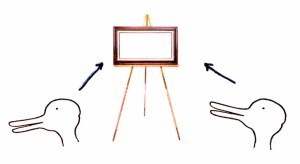
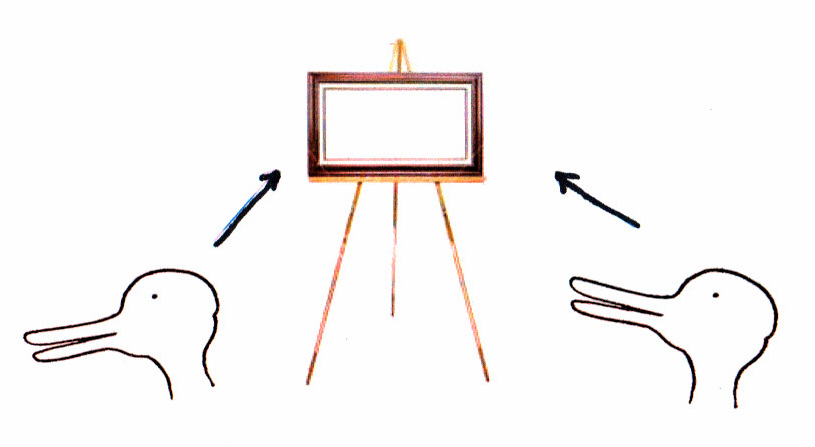
             Using Wittgenstein’s duck-rabbits to represent whatever we happen to perceive ourselves as, and “Art” on an easel representing anything as a mediated format outside of our “selves” (themselves, I surmise, also likely a constructed medium for experiencing world), to or in which multiple human persons might invest all they experience themselves to be, without necessary personal organism-survival fears, and, possibly, perhaps, occasionally MEET via that medium in toto (or as nearly as possible): experience intimacy, mutuality.  No longer isolated as a being, alone, but finding a common, a sharing-realm, co-perceiving, co-experiencing.

If it be so, that, in fact, as human organisms, all of our entity-type experience is, truly, mediated – through various organizations of mobile and voluble matter and energy – never identifiable as a stasis or final form, if we might begin to see it (us) as such – might we become able to experience direct, person-to-person (experientially) intimacy?  Co-being?  This is where I have turned effort (driven by desire) with my wife, my children.  What if we became safe mediums for one another to experience through?

That would be another entry altogether.
Wobbling

What I might name or designate, “the Here.”  The present.  Synonym to “only.”  That there are not points in time.

Perhaps always movement.  Have we uncovered something that is still?  Not that I know of.  But perhaps.  What do we call it?

Rather IS-ness is what I’m referring to.  Things that ARE.  NOT eternally the same.  NOT really able (reliable) to be depended on or assumed.  NOT all-anything, omni-nihilism.  But  movement, active, undergoing change (literally – in way less than fractions of milliseconds – remember, we’re talking about things that ARE – no fractions).  Like a rock, or an ocean, a sense-of-self or single cell.

Truly momentary, present-ly – precisely why the adverb was made – to come closer to experience, reality, in its motion and manner, without fantasizing it into a definable, locatable, or measurable.

While all is wobbly and wobbling – shifting, bouncing, deteriorating, expanding, dancing, vibrating, whatever – once in a while things wobble together (actually, constantly), and when certain things do (oscillation, pulse, a kind of unison rhythm),  moments also occur (to us).

Never resumed, never recalled, never predicted.  Ever occurring.  It is shaky, reality.

N Filbert 2012

Elaborate Organisms (for my wife)

My response to this week’s Friday Fictioneer prompt (thanks Rochelle for the weekly work)

Her Body a Beehive

She lives.  She parents.  She paints.

She has pain.

She walks.  She sees.  She loves.

She speaks and she reaches.  She sleeps.  She weeps.

Occasionally, she laughs.

She thinks.  She feels.  She moves.  She listens.

She eats and drinks.  She works and worries.

She falls.  She goes on.  She fears.  She insists.

.

You ask me, “how? – all this!”

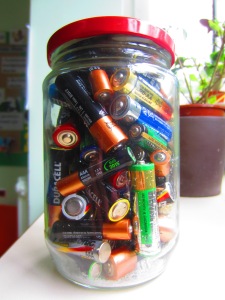
“Her body is a beehive of batteries – an intricate electrical network flipping switches and adapting to surge, wearing down, sparking up – each neuron, each pulse, each collective oscillation crafting her unique motricity powered with chemicals of emotion, an elaborate and interactive field of energy, an organism.”

She is.

N Filbert 2012

In Memoriam – to a Master

The Great Fires

Love is apart from all things.
Desire and excitement are nothing beside it.
It is not the body that finds love.
What leads us there is the body.
What is not love provokes it.
What is not love quenches it.
Love lays hold of everything we know.
The passions which are called love
also change everything to a newness
at first. Passion is clearly the path
but does not bring us to love.
It opens the castle of our spirit
so that we might find the love which is
a mystery hidden there.
Love is one of many great fires.
Passion is a fire made of many woods,
each of which gives off its special odor
so we can know the many kinds
that are not love. Passion is the paper
and twigs that kindle the flames
but cannot sustain them. Desire perishes
because it tries to be love.
Love is eaten away by appetite.
Love does not last, but it is different
from the passions that do not last.
Love lasts by not lasting.
Isaiah said each man walks in his own fire
for his sins. Love allows us to walk
in the sweet music of our particular heart.

Jack Gilbert

Among the Leaves

This slideshow requires JavaScript.

Suddenly I found myself among the leaves, diffuse as light, but darker.  Almost a shadow, if I’d found myself at all.

For it came of a simple moment in-between.  Between responding to this or fetching that.  Perhaps waiting for coffee to brew, or just breathing.  In cold sunlight.  In kitchen.  It had something to do with my daughter.  Or she was the first one I told.

“I’ve found myself,” I burst upstairs and explained, holding out my phone which had captured the image like communication.  “I’ve found myself, see?”

But no one quite did.  I was thereby forced to point it out.  Which is a lot more like making something up rather than discovering.  More like envisioning than recognition or taking notice.

Yet I can tell you I saw right through it in that gap.  Made out my identity in that fluster of sunrays and blockage.

An insubstantial sort of silhouette designated by a drove of other things – that “it” – that ephemeral, vacuous “me.”

In fact, the way I remember it, I was harried by flickering thoughts, responsibilities, and a mantled dose of tired, and it was only morning.  I’d backed up against the steely sink and weighted my palms, hoping my neck might loosen by letting it drop.  The floor there.

Something alerted me – a “honey?” or a child’s announcement from some other room – and so I swung and hoisted toward action.  My roving eyes sniffed at calendar and began steadying toward a list comprising my future, but instead.

Instead, a patterning of leaves translating immediately to a scatter-shot messaging of light, exposing some presence in its midst that was absorbing or otherwise deflecting.  Signifying, nonetheless.  A kind of tracing of a head, a photo-graph I guess, a contour drawing by our prominent star.  And if light could trace it, could scribble a quick sketch out of me, well then,

I’d guess I’d found myself among the leaves,

which went something like these pages.

N Filbert 2012

Due Emulation

open now.  on my desk.

feeding from it like a leech.

truly a living master.

if ever there was one.

see also…The Big Other

David Foster Wallace – “both a quantum of information AND a vector of meaning”

ah how I relish in his mind and language…

Deciderization 2007 – A Special Report

from

2 Exhibitions

I’m excited about 2 exhibitions occurring this month with which I am involved one way or another…

ReMades will bring multiple local artists together, hauling sundry objects and materials  to their homes and studios to begin remaking, recombining and incorporating these items into lasting objects and artifacts, which will then be exhibited throughout the Fall and Winter at Fisch Haus Studios’ tremendous gallery space, thus preserving their potential to enliven and enlighten our communities.

Opening Reception on Final Friday, November 30, from 7-10pm

Fisch Haus, 524 S. Commerce, Wichita

An exhibition of work by local artists using materials fromThe LUX renovation process that would have otherwise been lost.


And also my lovely amazing wife’s exhibition currently available at Mead’s Corner in Wichita KS

Friday evening, November 23, 6-9 pm there will be an artist’s reception with an artist’s talk by Holly Suzanne at 7:30!

Hope to see you there!

Address: 430 E. Douglas
Wichita,KS 67202
Hours: 8am-11pm Sun
7am-11pm Mon-Thu
7am-1am Fri
7am-1am Sat

HOPE TO SEE YOU HERE, THERE, EVERYWHERE!

(and support art and artists! – BUY IT!)

Masterful Hejinian on Language

“Language discovers what one might know, which in turn is always less than what language might say.  

We encounter some limitations of this relationship early, as children.  Anything with limits can be imagined (correctly or incorrectly) as an object, by analogy with other objects – balls and rivers.  Children objectify language when they render it their plaything, in jokes, puns, and riddles, or in glossolaliac chants and rhymes.  

They discover the words are not equal to the world, that a blur of displacement, a type of parallax, exists in the relation between things (events, ideas, objects) and the words for them – a displacement producing a gap.

Because we have language we find ourselves in a special and peculiar relationship to the objects, events, and situations which constitute what we imagine of the world.

Language generates its own characteristics in the human psychological and spiritual conditions.

Indeed, it nearly is our psychological condition.

This psychology is generated by the struggle between language and that which it claims to depict or express, by our overwhelming experience of the vastness and uncertainty of the world, and by what often seems to be the inadequacy of the imagination that longs to know it – 

Language is one of the principal forms our curiosity takes.

It makes us restless.

As Francis Ponge puts it, ‘Man is a curious body whose center of gravity is not in himself.’

Instead that center of gravity seems to be located in language, by virtue of which we negotiate our mentalities and the world; off-balance, heavy at the mouth, we are pulled forward.

Language itself is never in a state of rest.

Its syntax can be as complex as thought.  And the experience of using it, which includes the experience of understanding it, either as speech or as writing, is inevitably active – both intellectually and emotionally.

The ‘rage to know’ is one expression of the restlessness engendered by language.  ‘As long as man keeps hearing words / He’s sure that there’s a meaning somewhere,’ as Mephistopheles points out in Goethe’s Faust…”

Lyn HejinianThe Language of Inquiry