
If you click on this cover you will open a brief essay regarding fiction, presently. I find it interesting, challenging, and compact. If you have an interest in writing as discovery, as research, as emergence, as investigation and creativity, I encourage you to read it…
Tag: creativity
Straightforward: Words from the Book of the Living
Curtis White, in response to the question “What do you think is the hardest thing about being a creative in this culture?” (North America, 2012):
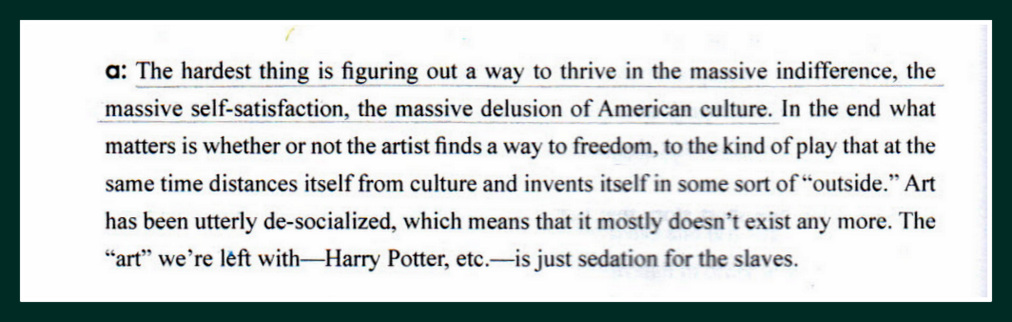
and to “What’s the best advice you might offer a beginning writer?” (I just ‘slipped’ and typed “writher”!), he replied:
“So my best advice is to read Nietzsche until you understand him and go from there”
thank you Curtis White 🙂
Aspects of Writing: Writing the Impetus. The Self-Reflexive.
The Self-Reflexive. Impetus.
The urgency, that is, the urging I feel in setting forth to compose, is dismantling.
In other words, the forcings that encroach, impinge and unleash within me when I’m ‘of a mind’ (experiencing the intention of) ‘to create’ is one of destruction, a defensive attack.
I am thus synonymed by sculptor, woodcarver, archaeologist.
One wants to undo the stories before they reach the page.
In order to find, discover, the figure of them, a more lasting (perhaps) form or shape.
To strip them of their ‘qualities’ or ‘style.’ Their manipulations. Creation as a straining of the weak, the falsifiable…a process in survival of the fittest, the more “true”(?) or apt.
Chiseling personal explanations and perspectival descriptions down to possibilities. Unraveling myths toward oracles. Discounting proofs into theories.
–
The impetus of writing evokes the motivation of doubt, the landscape is struggle.
“To be inspired” might mean to be activated by an experience accurately called “perfink” (David Krech), or, “perceiving, feeling and thinking at once” (Jerome Bruner).
Regurgitant feeling: investigation, analysis, interpretation – meanings attacking meanings, in hopes. In hopes that a perfink of “meaning” (a satiation of anxiety, terror, doubt) might prove indestructible – as a possibility.
–
The narrative, then (the verbal expression of a perfink), is a traffic jam of conventions, presuppositions, reality-views and solipsistic Gnosticism forged within the forging self; writing – as apparatus, activity, function – reflexes: brings self-world to bear on self-worlds in attempts to deconstruct automatic (as it were) constructions of perceiving/feeling/thinking – fighting, clawing, tearing against it with the information and energy of shared resources: language, “knowledge,” the usable past.
–
Clashings of systems, perfinking perfinks, violent internal skirmishes and acts of terror(ism) – a doing that attempts the undoings of doings – an otherwise endlessly insular, of unverifiable and infinite traces, activity known as self-reflexive –
– producing stalemates of exhaustion, individual paucities of supply and reinforcement, ourobourosian –
offering only extrinsic chances for momentary cease-fires – the artifact, figure, form of the battlefield, photographed in process and thus submitted – to critics, to readers, to colleagues, to shadows (i.e. to genuine Others) that it might become real (exist in relation, to be directly experienced), corroborated or dismissed by equally limited and idiosyncratic perfinking, outside – both in the world, and of it.
“the contest any artist has with his or her art: working toward a perception that is his or her mind’s peace.”
-Louis Zukofsky-
“the mind carries an austere
inwardness that will not put out its eyes”
-Laurie Sheck-
“Writing is a lonely business’ is both a dull myth and a material fact of the profession, one I happen to be temperamentally suited to endure but which doesn’t gratify my sense of what it’s for.”
-Jonathan Lethem-

-Robert Creeley-
Aspect of Architecture
“A well-crafted sentence overturns the notion that thought is distinct from thinking. A well-crafted sentence enacts the sense it makes rather than representing it. The result of writing well-crafted sentences is that your reader will have the most vivid sense that something is happening to him or her and with the irresistible urgency of their own dreams.”
“Dedicate yourselves to reading most energetically that which you don’t immediately understand. Read with a special attention to the prospect that what doesn’t appear to make sense matters most because of the possibilities of sense-making that are portended in it.”
taken from:
New Categories? Paradigms? Readerly Ontology?
“To understand how language works, what pitfalls it conceals, what its possibilities are is to understand a central aspect of the complicated business of living the life of a human being”
S. I. Hayakawa
“Thinking is a truceless act. / How it holds the injured yets and thens inside it, so many layers of barter /
and resist. You who are all swerve, / Distance and blindfold when I try to find you – “
Laurie Sheck
“The world of art and culture is a vast commons, one that is salted through with zones of utter commerce yet remains splendidly immune to any overall commodification. The closest resemblance is to the commons of a language: altered by every contributor, expanded by even the most passive user. That a language is a commons doesn’t mean that the community owns it; rather it belongs between people, possessed by no one, not even by society as a whole”
Jonathan Lethem
Metamorphosis: 2013: Insect Intensity
Termite Art
Working the edges and angles. “Part of the woodwork,” they say, though not in a structural sense – rather more a destructural or deconstructional way, one should probably add. We’re usually fairly quiet, but work is constant, at times involving even groups or clans. What we create looks like a whole full of holes. Feeding on the solid, reducing it to doubtful tunnels, leaving some beautiful patterns. Rhythmic, at least. Once in a while you can hear the hum of our work, but more often than not our efforts are simply stumbled upon.
What you once thought sturdy enough to lean upon often crumbles out from under. Usually we’ve been there first and found the flaws. We scramble and burrow, many even fly. Keeping mostly to ourselves, gnawing and chawing away at the things we all believe in and trust, things assumed to hold fast and true, the shapes that give substance to lives.
Of course many consider us sinister nuisances, think we work to undermine, but we really don’t take much – just leave it considerably different than when we first come upon it and passage our way through. Left to ourselves we accomplish a lot, are industrious, but we’re more often pestered, hampered, sealed-off, even (and yes, I’m serious!) exterminated! Treated as pests or threats or dangers.
We might be admired, theoretically, but we’re never welcomed as guests. Not invited in houses where public or money are smelled. There we’re only talked about – as worming and wriggling our ways through the infrastructures – “fluttery, ephemeral critters” we’re called – parasitic to power and ultimately debilitating if left unconfronted.
Harmless enough as ourselves, simple units to squash, but we happen to be many. Think: ants. Think: pestilent plague.
We can be quite beautiful in the light (as a specimen!) – translucent and fine and opaque, exhibiting a powerful delicacy. But given free reign we undo the foundations, and therefore, it is feared, the whole edifice too. An elephant, for instance, might be trained – used for tricks or for jokes – is easy to keep an eye on, but not us “weasly and scuttling creatures,” no, no.
All I’m saying is that some of us are always eating away at the edges and bounds, plundering thresholds, slobbering the barriers and gates – they’ll acknowledge us if forced to – but with a mind to be rid of. If featured, we watch out for the shadows and sprays, closed quarters and boots. They’ll let us have slush piles and compost, a few trimmings or what’s already abandoned, but it’s always in hopes – always – of keeping us OUT. Mark my words, no one really loves a thriving insect but itself. Grind and tear with all you’ve got, our lives are short and there’s much to do.
Requiring so little, any medium will do, only to find access…and…wizzle inside…
“A peculiar fact about termite-tapeworm-fungus-moss art is that it goes always forward eating its own boundaries, and, likely as not, leaves nothing in its path other than the signs of eager, industrious, unkempt activity.
The most inclusive description of the art is that, termite-like, it feels its way through walls of particularization, with no sign that the artist has any object in mind other than eating away the immediate boundaries of his art, and turning these boundaries into conditions of the next achievement.”
-Manny Farber-
All That & More : 2012 in Review (w/musical moods and interludes)
Evincing
The term is evincing. That word that stands for the complex of tangled strands stuck and striated into a confrontation with blankness. You know what I mean?
Balled up like a sap-thickened snot-slickened hardening knot of twine, all strung together, unruly, but wadded and crushed, like a snowball – a large icy one – but dirtied – clodded thick and gluey-thready – distasteful, a kind of impossible object – something like the idea of the innards of a self – what one sees in a mirror – like a melancholy music – tunes that you love that empty and sicken you – help you to feel more alive – all that. More. The unaccountable enormity that feeds into a stream called entity. All that. More. Horrible, beautiful things.
The fact that we are far more than we are able to surmise, and far less than we hope or wish to be. Messy. Contents of a dump. A lifelong of it. From every here and there that has ever counted as “around” us. All that. More.
It comes to bear. In its confusing ways. Its overwhelm, that is not too much, indeed, we hang together by its incredible pressure. All that. More. We are composed of far more than we can consciously carry or categorize. Too much. All that. More. The too-much encroaches, suffocates, immerses us in such a way as to individuate and differentiate us as misshapen identities, figures in rubbled ground, that which we spy in mirrored surfaces and the reflections of others’ faces.
That is what I bring to blankness. And stare. All that. More. Scrambled and disturbing. Flustercucked and discombobulating. Lost in the morass that makes me, that I am unable to peek through, even glance. Life. All that. More. Too much. What cannot possibly be organized. All that. More.
This is my life. Such a jumble of grandeur, goodness, glorious juiciness and jubilant joyeux, with dark twisting tunnels of termiting fear, incapacitate fogs too bleary to count quite as fog – glaucous and cataracted visions. Too much. All that. More.
I heave and haul it to blankness. These pages. I set it on fire, collecting the ashes. Or pick at a corner, scabrous and stubborn, until a smidgen unravels and I can trouble it. Or simply collapse on the paper, clod-like and unstable, leaving crumbs. Thank you paper. All that. More.
If you took all that was life-sustaining precious to me in this world and stacked it on top, I would die quickly, crushed under its weight like a sparrow cracked under boot. That which breaks us makes us stronger? Comes out of the mouth through the pen and returns through the tubes in my ear-throat to gag me.
I buckle under it like an aged Prometheus and slog, spilling it onto the blankness. All that. More. I love what survives me.
“with no sign that the artist has any object in mind other than eating away the immediate boundaries of his art, and turning these boundaries into conditions of the next achievement.”
-Manny Farber-
All that and more. It evinces. I am thankful for the whole god-damned and gloriously blessed mass. I gnaw. It evinces a spittle, which falls on this blankness.
HAPPY NEW YEAR – HERE’S TO IT!
TO EVERYTHING…AND MORE!
Using Our Woods – the Gift that Explodes 6
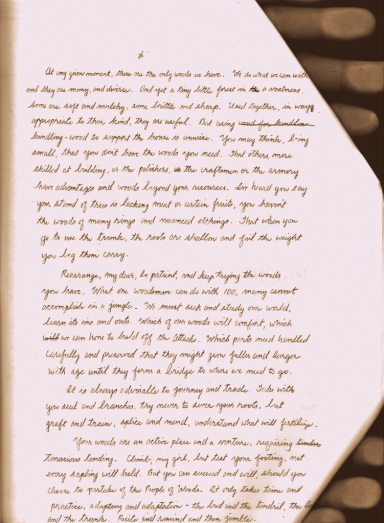
and the typeset version:
6
Whose Woods are These I Think I Know
At any given moment, these are the only woods we have. We do what we can with them, my dear, always many and diverse. Yet just a tiny little forest in the vastness. Some of our woods are soft and mulchy while some are brittle and sharp. There’ll be splinters and cracks, switches and boughs. But used together, in ways appropriate to their kind, they’ll be useful. Like don’t use kindling-wood so support the house. I know you often think, being small, that you don’t always have the woods you need. That others more skilled at building, the polishers and craftspersons, or the armory whittlers have advantages and types of wood beyond your resources. I’ve heard you cry that your stand of woods is lacking meat or certain fruits, you haven’t the wealth of many rings and nuanced etchings. That when you rope the trunks, the roots are shallow and fail the weight you beg them carry.
Rearrange, my dear, and be patient. Keep trying the woods that you have. I’ve seen a woodsman create with 100 what many cannot in a jungle. We must seek and study our world, evince all its ins and its outs. Which of our woods will comfort, which we can hone for attacks. What parts need handled carefully and preserved, that they might grow fuller and larger with age, ‘til they form a bridge toward where you need to go.
It is greatly advisable to journey and trade. Take with you fresh seeds and young branches. Try never to sever your roots, but graft and train, splice and mend, understand what will fertilize.
Your woods are an active place and a venture, requiring tenacious tending. Climb, my child, but test your footing, not every sapling will hold. You can succeed and will, should you choose to partake with the People of Woods. It only takes time and practice – adapting and adaptation – the bud and the tendril, the log and the trunk. Recite and remind and then jumble.
Above all, my daughter, please play. Pick-up sticks, wooden boats and chutes and ladders. Kites and slingshots, barrels and monkeys, apples to apples. Now is the time to throw peaches and chew the walnuts’ rind, bowl crabapples, smoke the reed and sniff the pine. Some whips will leave seams you’ll never forget, some falls may even break a limb, but you will grow and know, know and grow, until you, like the tree, flourish and bloom, strip and stand bare, proud and enduring, withstanding both wind and the wave, strikes and blows, the cold and the dark, all from your stock of woods and what’s possible.
Whoever dreamt a log could roll on rivers, or bend into a wheel? Who knew they’d form enormous arks – large enough to save our world? The handing of a tiny reed embossed with cursive love, sharpened to a blade, signs set to warn of danger, posts to fort a home. My love, impossible does not apply with your woods – all that we know is unknown where the woods come into play.
Experiment, invent, babble the brook or construct a staying dam. Use our woods, love and care for them, ignite your passion, rub them together toward sparks, thatch, nest, spear. The woods are waiting – and these are yours.
click here for all 6 pages – The Notebook
Inspiration Chains, or, Free Association
Prompts, shared. Whether images or music, language or film, it is delightful to hearken others’ cherished influences, themselves becoming common grounds, points of congruence for these virtual-seeming communities of blogosphere. Recursive and reciprocal correspondences, often represented via comments, but probably present in many less conspicuous ways, are, in my opinion, the likely meaning-manufacture points of this medium. Circlesunderstreetlights has passed on some lovely and instigative musical prompts over the past days, each of which I’d love to interact with via language, but haven’t found the coveted chain of moments that might allow for it. However today’s prompt from her:
tripped off a chain of evocative discoveries and resonances for me… including, but not limited to:
which led to a combo with one of my favoritest crooners:
leading onwards to more of Patrick Watson:
may these bring some moments of holiday PEACE and reflection
and perhaps even inspiration and production!
Cheer
 All my Words are Silent