 +
+  +
+  +
+  +
+  +
+ 
=

What exactly is it about the arbitrary changing of numbers, parceling of time, divisions and subdivisions of existent moments, that prompts and wriggles us to consider change – feel obligated or massaged toward it – dream of it? I can say that in all my dizzying thoughts about it – how society and culture (Petrie-dish like) inundate and stimulate individuated personal alterations – I cannot figure out why crossword-puzzle-like taxonomies and designations of life-fragments labeled by stick-systems of reference, mathematical calculations and so forth stimulate (simulate?) desires, wishes, regrets, metamorphic movements in the human gang…
Be that as it may, today is the first day of the first month of the year containing 0-1-2-3 (my wife comments what a delightful play that must be for numerologists), and while my beloved is out signing up at the Y and beginning self-care with new devotion, I am denuding my desk, dusting and polishing its surface, taking revised stock of the pounds of books that weight its surface, reorganizing, selecting, making hard choices about what is necessary for me TODAY with some forward thinking. The numbers have changed. The game must be different, no?
In the process, I open a drawer I apparently haven’t for a very long time, coming across a miniature moleskine notebook, first entry dated January 2003! A decade ago, how interesting! I leaf through…and here are some of the things that capture my attention:
The last entry reads like this…”We used to always pick models or icons we wanted to be like: have what they had, whole persona and possessions – WHO would I want to be? … When does it hit you that you only want to be you with some other life?”
Wonder where I was…a kind of number-flipping query…
further to go….2013
Here is page 4 of the Notebook from my daughter, which was a loose piece of notebook paper inserted into the stapled set. Here is what’s become of it thusfar:
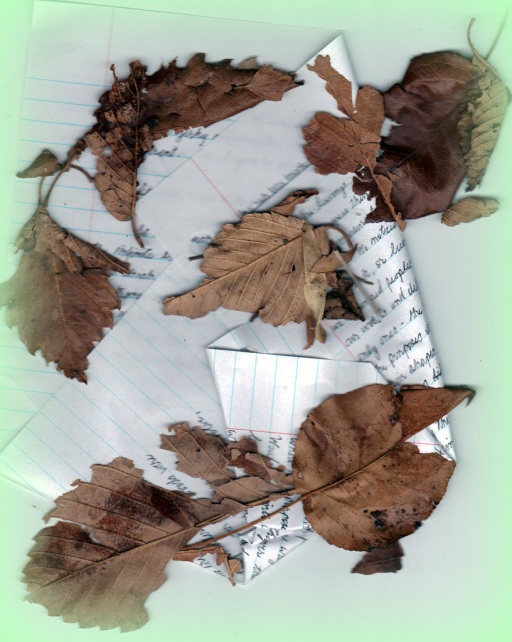
and the typewritten text
4
In Which Is Inserted a Loose Leaf
Becoming aware of the change. My little one, as we let (or made) our woods carry us far, we discovered beings everywhere – and all using woods. Having named our woods and defining ourselves by their usage – we had thought ourselves the only ones – the People of the Woods – and were surprised and astonished at the purposes others would put them to, at the sounds they were able to emit, at their shapes. Even the structures they built could seem odd, and their burning came from strange fires.
Everywhere we ventured we found the woods relating to life. Its giving and taking. Beings used them for weapons and tools, they used them for shelter and warmth. As our knowledge of woods grew enormous – the kinds and environments, uses and names – the Mysteries of the Trees began to grow.
In places they were pulped to a gum and let dry, then marked with a rock or hot iron. Other places they were chopped into boards and large planes and smeared with designs from animal blood. It came to seem the whole world was made of beings and woods, each defining themselves by particular use. Battles were waged over woods, clans and families splitting apart, even lovers argued over true uses of woods – what they purposed, how they worked, why they mattered, which ones, what was proper to do with your woods. Little one, woods came into conflict, everywhere. People fought over which woods were best, or which had more power or weight, which cores were pure and which garbage, what woods should serve for what.
We wanted our woods to do everything. To solve and evolve, to stand and retain. But our woods continued to change as we lived them. Some grew smooth and slipped from our hands. Some hardened like rock and got to heavy to carry. Some simply crumbled to dust. As their variety grew, so our experiences – we encountered moments when we could not find the woods that we needed. It distressed us and we cast about in clumsy silences and jerky motions. We grew hungry for new woods that were different. We began to play with the roots and the seeds, combining and grafting or trying new soils.
In times like these, there was speech of The Leavings, of infinite limits of life. The old among us would point out the woods where we no longer dwelt or visited, had let rot or decay, and would question our strange new graftings. The woods were always changing, dear child, there are always new things to learn.
It is time, then, to speak of these Leavings…draw near…it is our custom to address them in whispers and cold…
the Notebook as it is filled as of now, can be read here:
The Gift that Explodes: A Notebook
Spinning in a bit of ineffectual conundrum…what reaches the paper expands…
Does remarking constitute remarkable?
Do I discover value only when change causes difference?
Is recognition of closeness a result of disjunction?
What engineers a ‘train of thought’ – who lays the track?
Which is more creative – reading or writing?
When are thoughts and feelings the same?
Is language a metaphor?
Who asked you?
Does the talking stop at conversation’s end?
What does skin separate?
When does beginning begin?
Why is death?
What is meant by ‘same’?
Is there anything as dangerous as freedom? Anything as certain as risk?
What are the ingredients of making?
How do we identify?
Do emotions signify? If so, what? If not, why?
When?
What is gained by loss?
Are these questions rhetorical? Essential? Trivial? For whom?
Who answers how and what kind of who does that make?
What?!?
Please feel free to respond to any or all of the above – wisdom/insight/hypotheses are warmly welcomed!
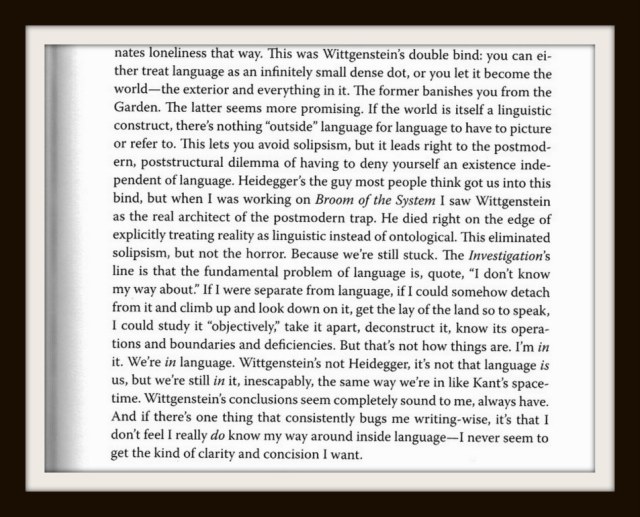
What I might name or designate, “the Here.” The present. Synonym to “only.” That there are not points in time.
Perhaps always movement. Have we uncovered something that is still? Not that I know of. But perhaps. What do we call it?
Rather IS-ness is what I’m referring to. Things that ARE. NOT eternally the same. NOT really able (reliable) to be depended on or assumed. NOT all-anything, omni-nihilism. But movement, active, undergoing change (literally – in way less than fractions of milliseconds – remember, we’re talking about things that ARE – no fractions). Like a rock, or an ocean, a sense-of-self or single cell.
Truly momentary, present-ly – precisely why the adverb was made – to come closer to experience, reality, in its motion and manner, without fantasizing it into a definable, locatable, or measurable.
While all is wobbly and wobbling – shifting, bouncing, deteriorating, expanding, dancing, vibrating, whatever – once in a while things wobble together (actually, constantly), and when certain things do (oscillation, pulse, a kind of unison rhythm), moments also occur (to us).
Never resumed, never recalled, never predicted. Ever occurring. It is shaky, reality.
N Filbert 2012
Election Day
The way things that seem to need doing impose mayhem on those things we were wanting to do (vice-versa).
A sort of ratcheting of oddly shaped pieces tumbling down towards one another on an inclined plane. Necessary bits and fragments of desire rattling against, around and into one another, oppositely directed, apparently, and all with force or momentum (time, change, survival). They clatter. They clatter and clutter, like there’s a microcosm of chaos in us, the spillage of some enormous container of Legos.
Is this unfamiliar?
Something, always, functioning as noise in the wavering systems of our message(s)?
I want. I need to…. A hunch, an intuition. A concrete demand. An idea spawns. And tasks arise.
That kind of oscillation is what I’m talking about. And it goes both ways. All ways.
I set about a chore and am derailed by an idea. I dream and the over timer intrudes. I breath and it hitches to a cough.
Not that it’s always that way. Sometimes the texts come right on time, just when I was getting up anyway. Sometimes the activities that need the doing, also fuel the dreams. Think of such a time.
No wonder it’s called “flow.”
Yet it hardly seems “reality,” or “daily life.” Perhaps that’s only me, that the pieces that construct me are preiteratively cross-purposed? Maybe my fragments’ forces are centripetal (or centrifugal), either way multi-directional and simultaneous? ADD? ADHD? “Life?” Speaking animal?
Like Election Day.
N Filbert 2012
Many things might have happened, indeed, could have happened. It is impossible to tell until it happens. Whatever happens. And so it goes.
Recollection subjects what happens to interpretation, a puzzling assemblage of memory (embodied brains in changing circumstances) and occurrences (embodied brains in specific situations), making it impossible to tell what happens, when it happens, or after it happened, save from a very particularized attention and intention, point-of-view, disposition and enmeshment (the factors being relatively endless).
And so we call histories, scientific observations, statistical reports, etc. al., “stories;” journalism, research, theories or assays (essays), “fictions;” and personal memoirs, dialogue, descriptions or statements – “fantasy.”
Everything that happens or happened is what might have happened.
Let’s theorize that an author or reader, group or individual, has a concern for “truth” – something being what it seems to be – who or what has total and essential access? The only truth in human expression that I can surmise is that it is truly “made up.”
An individual may have something approximating total and essential access to a thought or feeling, personal experience or idea, but insofar as it actually occurred according to an experiencer, there are already multiple points of view, ranging from molecular to cosmic, matter/energy to cultural. To say nothing of the complicating fabrics incumbent on expression – whether a grimace or a novel, a shriek of pain or a tally mark on a chart – it has entered uncertain and collaborative interpreted ground.
All to say “experience” is utterly specific and solipsistic (non-transferable “truly”) and is an enabled product of embedded participation in significant (if identifiable as an “event” or “occasion,” “moment” or “intuition” – any feeling, sensation or awareness) surroundings, expanding niches of existing things with variant points of view.
This is how I can guarantee that nothing I show you or tell you is “true.”
It may be more or less accurate to my experience or understanding of it (depending also on your experience/understanding of my presentation of it) but it will in no wise be what it is or was, in truth. I assume truth to be as impossible as god. It would require omnipresence, omniscience, boundary less experience (which could not accord with our experience, or a grain of sand, or an ocean) and would be immediately foiled by the omni-ability (omnipotence?) those other necessary qualities would demand. One could not be absolutely enmeshed or identical-with and entirely and completely objectively separate or alien-from at once. At always. That is not a paradox but a contradiction. If imaginable, incommunicable.
So we speak of a “semblance of truth” or a “truth-seeming” quality to account for our realities and desires (our want for security, to grow order in chaos, to know, to choose or act with less fear or uncertainty). Things like our ages, census reports, laws and principles (grammar, mathematics, semantics, processes and methods, etc.) a creepage over toward what we think of as “facts” – majority-mutually-agreed-upon-interpretations/perceptions/hypotheses. These can hold for a long time because they’re held by so many, so widely. But they most assuredly change over time, again, from atomic behaviors to the shape of the earth and its relation to elsewhere, from what constitutes pain to what gets moniker’d “god.”
What counts as fact does so by being open and shared. Semblance of truth comes by corroboration, conversation and multiplying points-of-views and expressions of experience.
Perhaps this is one reason we blog. To try “it” out on everyone, potentially. If our expressions resonate with others, perhaps they have a semblance of truth, or contribute toward creating it. Enough “I know, right?’s” and we’re on our way to a fact. But no amount of data or language, materials or activity makes it so…it rests on agreement and compromise, observation and interaction shared most widely, coagulations of interpretations, accretions of experiencing – fabrication.
Make then, express. Hypothesize and share your experience – we ask for your two-cents worth – we’re accumulating a fund.
Music, Musicology, and related Matters
a photographic pilgrimage to Orthodox Christian monasteries across the continent
Meandering Through a Literary Life
Orthodox Christianity, Culture and Religion, Making the Journey of Faith
Erik Kwakkel blogging about medieval manuscripts
"That's the big what happened."
Networking the complexity community since 1999
 All my Words are Silent