In Essence

“It is in and through language that man constitutes himself as a subject, because language alone establishes the concept of “ego” in reality, in its reality which is that of the being.

The ‘subjectivity’ we are discussing here is the capacity of the speaker to posit himself as ‘subject.’  It is defined not by the feeling which everyone experiences of being himself…but as the psychic unity that transcends the totality of the actual experiences it assembles and that makes the permanence of the consciousness.  Now we hold that ‘subjectivity,’ whether it is placed in phenomenology or in psychology, as one may wish, is only the emergence in the being of a fundamental property of language.  ‘Ego’ is he who says ‘ego.’  That is where we see the foundation of ‘subjectivity,’ which is determined by the linguistic status of ‘person.'”

-Emile Benveniste-

“signification occurs only through discourse, that discourse requires a subject, and that the subject itself is an effect of discourse.”

-Kaja Silverman-

Gallery of Linguistic/Semiotic Hero(in)es

How many do you know?  How many do you “love”?

“…We know we can never be anything but parallel

And proximate in our relations, but we are linked up

Anyway in the sun’s equation, the house from which

It steals forth on occasion, pretending, isn’t

It funny, to pass unnoticed, until the deeply shelving

Darker pastures project their own reflection

And are caught in history,


Transfixed, like caves against the sky

Or rotting spars sketched in phosphorous, for what we did.”

-John Ashbery, from The Sun-

In love with language

Ah, “the perpetually changing, muddied, maid-of-all-work, our common language…a public instrument, a collection of traditional and irrational terms and rules, fantastically created and transformed, fantastically codified, heard and uttered in many different ways”

-Paul Valery-

Summarization often feels inherently erroneous.  Much as I have an insatiable passion for “figuring things out,” for the observable “hows” and “whats” of scientific inquiries and theory, much as it evokes a delight of fascination and sense of knowledge or understanding to learn of the makeup and behaviors of neurons or cells, cerebellums or furry beasts, none of it ever feels comprehensive or resolving.  The human, to me, is some paradoxical wonder of natural capacities and probabilities and dynamics and flexibility that can endlessly occupy and consume us.  Like any part of the cosmic system, from quarks (or smaller?) to global social and environmental systems.  Language has long served as a place of experiment and observation for me of just such probability- and convention-governed behavior coupled with a kind of infinite openness and flexibility.  I believe this is one of the reasons I’m so drawn to working in words as a medium.  But listening to other artists it is easy to see that oils, wax, clay, plastic, etc. also have these inherent qualities.  Dance.  Music.  Craft.  Parenting.  Romantic loves.  Friendships.  Relations.  Essentially, relations.

A primary personal pleasure for me is delving into theories.  Semiotics, linguistics, neurobiology, aesthetics, philosophy, information systems, communications, psychology and the like – all provide  me rich excitement and spell-bound, breathless appetites and anticipations.  The process of learning and becoming – interacting with world, others, ideas, stuff – it is what makes me tick in realms of gladness.  This past week I’ve burrowed down into the work of Max Black and related source documents, particularly Wittgenstein.  I wanted to share some of Black’s “summarizations” because they retain the mess and complexity of what he is observing in a way that feels authentic.  For those of you who share the interests…the following derive from Max Black’s The Labyrinth of Language.

“The extraordinarily ramified network of skills, habits, actions, conventions, understandings, which we bundle together under the label of ‘language’ is too complex to admit of any simple summary…”

“For all its fixity of structure at any given time, a living language has an inherent plasticity and capacity for growth and adaptation (it is more like a developing organism than an inflexible machine).”

so instead of definition, Black offers what he calls a “landing stage” for directing our attention to certain features of language…including the following:

Language is rooted in speech

Language is directed, reversible and self-regulating

Language is an institution (always part of a speech-community, a participatory action)

Language is a particulate system (“a finite repertoire of elements and arrangements generating infinite diversity and novelty”)

Language is meaningful (expressive and evocative)

Language is plastic (of the most rigid and most malleable of human institutions)

so I offer these reflections today as a celebration of the magnificent medium we all of us are using to some extent throughout all of our lives and activities – ah language – ah “open systems” – ah humans – ah world!

The Pleasures of Reading : An Aspect : Multiplying Translations

The Pleasure of Reading

In other words (than what?  than which?) we all of us are readers, all of us writers.

That is a pleasure.

And all of us, always, doing both.  Simultaneously.


Speaking of my textbooks (were we?) – information sciences, developmental and behavioral psychology, reference services, librarianship / and the research to the side – physics, evolutionary biology, neuro- and cognitive sciences / my pleasures – novels, poems, stories, others’ blogs, visual, aural, literary artifacts / my relational – wife, children, family, friends, society, culture – gestures and vibes and dialogues and signs / my “self” – sensations, perceptions, formulations of these, reformulations, adjustments and maneuvers.

In other words, at all times, I am reading, even if only my lack of memorable dreams, or pulses and breaths.  And writing it all in actions, movements, responses, adjustments of speaking and writing and making.

It is a metaphor, obviously.  Perhaps.


Roman Jakobsen purported that “all meaning is a form of translation, and multiple translation (polysemy) is the rule rather than the exception.”  (I am translating his text just now into another con-text).

Wolfgang Iser’s (perhaps, anyway insofar as I am translating it here) concept of actual text (text as it is recorded by an author) and virtual text (actual text as read by a reader).

This is an aspect of the deep living pleasures of reading/writing for me.


An author/speaker/artist/scientist/mother/etc. has an urge or sensation – a possibility of action/behavior/message/idea (a virtual text) and translates it through multiple processes and levels of activity through some medium into an actual text/painting/utterance/experiment/recorded idea/sound, etc.  There it is in the real world – a physical artifact in time and space – added – if only for a moment.  Transforming (simultaneously) its maker into a recipient (translating a now existent text/sound/behavior/gesture/sculpture/experience for him or herself) and if any witness/participant/auditor/recipient or reader is in his or her environment they are simultaneously interacting (via translation through their own tools, language, perceptions, sensations, mood, etc) with the actual text, writing a virtual text (translating) of their own.

And it goes on.  And can be done innumerable times, this process, whether using an identical actual text over and over, or simply writing/reading life as it occurs, making it occur.


Paul Ricouer:  “stories are models for the redescription of the world.”  Possibly.  Or at least redescriptions (translations) of models for redescription.

Iser: “the relative indeterminacy of a text allows a spectrum of actualizations…literary texts initiate ‘performances’ of meaning rather than actually formulating meanings themselves…the reader receives it by composing it.”


Language, action, behavior as possibilities rather than certainties.


So that I can encounter with all I’ve encountered/experienced an actual text by psychologist Jerome Bruner translating these very quotes and contents with all he has experienced and translate it with the multiple translations of family life and being a human organism and novels and pains, poems and stories, paintings and laws, translated with data and education, emotions and animals, translating with you and a computer, internet, digits and bits, translating into…

a great pleasure of reading is writing reading

or, “a writer’s (reader’s) greatest gift to a reader (writer) is to help him become a better writer (reader)”

– Jerome Bruner (parentheses mine).


literary texts as “epiphanies of the ordinary”

-James Joyce-
Semantics

Semantics

Are words the poison?  The inevitable, unavoidable miscommunication?  75-80% of communication is “nonverbal,” yet according to the American Library Association even a corpse is a “document.”

What is it with semantics?  Is it sickness, like some original stain in brains such as ours – a terminal disease called “fabrication of meaning”?  “Second Sight”?

So that an arm movement, a particular gait, an expiration or whittled scar in rock will all be given significance?  All some addition, complexiting, a superadded content?

What is this penchant?  From where does it come?

It looks like the survival mechanism we think of (signify) as “prediction,” i.e. guesswork.

If we can surmise, invent, fantasize possible leads or outcomes…we’d have a better shot at preparing for it.

We make stories.

Often this is paranoia.

It’s the avoidance and terror of death.

Guess a metaphor for every existing moment, action, thing…and possibly you will survive it…know what’s coming and how to defend against or wriggle past.

Therefore, an alphabetical letter like a post-it note on possibilities, a warning-sign for danger, a diagram of fear.

Her head turns quickly – off put?  Offended?  Alert to me?  Tuned in?

Context.

Octagonal red sign at the corner…I stop.

Top sphere illuminated…I go.

“Crack!” I shift, swivel, flee.

One finger extended, my chest concaves, shoulders furl.

Drip, drip, my mouth begins to salivate.

Anticipation, desire, intuition, knowledge – all spawned in this erratic, sensationalized guessing.

Charlatans and spoofs, all of us.


“Interpreters,” “attributers of meaning” – he/she was so wrong, he/she isn’t listening,

hears, sees, feels what he/she wants (or doesn’t want – desiring either way) to.


Words are not the problem.  Signs, symbols, gestures, tones and moods – not the problems.


It’s the fear of death, our innate paranoia, our strict steeped instinct for survival.


Apathy might cure it.  Certainly suicide.  Some embracing of the facts.


It remains to be seen.


It will look like destruction.


These are only words.

N Filbert 2012

Scribbling chapters that don’t belong…part 3

3 – ?

“’Appearances / remain suspended / in transmission’ (Craig Watson) are not so much perceived as apprehended, handled; the one affecting, infecting, the next”

(Charles Bernstein)


            Or something to hold what dies off.  The reverberations without resonance.  All edited, edited out, according to needs for appearance, depending on what apprehends, the shape of the handler’s snare.

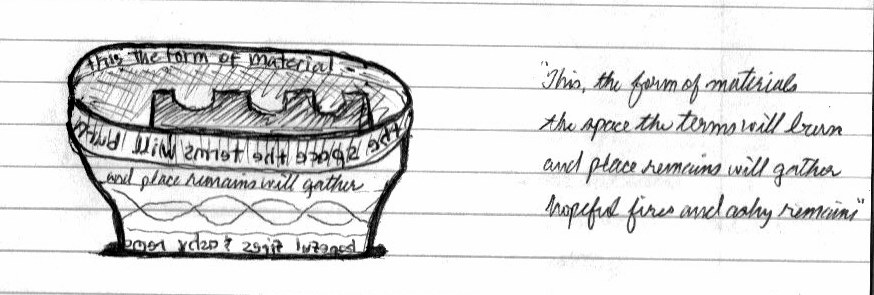
Think of it – what is selected for capture, in captivity, infects, slipping frequencies to drift on, transmitting, transmitting, there is always ash that won’t be removed, no amount of soaking, scrubbing or spray…

perhaps it’s under the nails, clogging the pores, dusting the follicles… the remains.

We don’t know why we write, trusting such ephemeral weightless shifty particles to catch as motes in an eye…appearances, like dust (in just the right angle of light), remaining suspended in their transmission…hoping (without, really, hope) to, in apprehension – apprehend, by being handled to affect, infect…

always wanting next.  Making it so.

Depending.

Why the book is needed (as ashtray) as form to hold the crumbling, an urn for the remains, until such time as they might be stirred or shaken or spilled.

Again in the commerce of bodies, handled, brushed and staining.

It gets everywhere.  And remains.

Note its infective spread.

Language, whether structures/systems of, or fragments – bits and pieces, lying everywhere implicit.

To write – to make explicit?  It asks more than it answers, word by word, by letter, by ash…

And what remains?  Suspended…in transmission…for affect…a dormant virus…

waiting to be breathed…

Writing: the Subjects

Writing: the Subjects

A lot can be read about what it takes, means, requires, or qualifies a person as a writer.

From “someone who inscribes a text,” (akin to walking or speaking), to publication and critical acclaim (akin to fame and riches).

As I see it

it must begin with a facility with language.  Any language.  An awareness of words and their implications.  The intention to utter.

Uttering tends to search a subject, (what words are “about” is as various as the universe) and a style or voice (how it will inscribe).

From there it’s simply performance: arranging or placing the selected words in a medium with a measure of physicality, sense-ability, somewhere capable of being perceived.

As far as I can think it, when these few elements are satisfied what we are engaging is “writing” as a product of “writer.”

He chooses a form of English he has acquired through hunting and gathering, a language institutionalized and socially invested in him with measures both beyond and within his control.

He searches a subject to say.  Already subjective (as he is the one searching with what language he has or is able to acquire or create) his utterance will always contain an “I” – both shaped and formed by his responses and politically constructed by his social milieu.  In other words, there are always more than one “subject” in every utterance.  At base, at least three: the language, the user, the construction and arrangement.

He’s already overwhelmed with the largeness of the simple subjects inescapable to human languaging, and he’d thought to write about rocks (geology) or time (epistemology); romance (psychology) or events (history; ontology).

Subject-fields are vast, you understand.

Having sought to describe an object (desk or stone) in space (again scientific theories / epistemology) each signal latent in language subjectivized: using language creates subjects, no objects remain but are subjectively engaged.  Language is an invisible bridging, a liminal skin, connective absorbent tissue, subjectively creating subjects-in-relation.

This, apparently, its object.

Thus uttered…a story.

N Filbert 2012


Remarking Mark Remarking

Greetings readers.  I’ve been in a bit of a swirl or “swarm” of information, activity, relation and language of late, nothing wrong with it really, but its producings have seemed a bit ephemeral, inchoate, more wisps than winds.  Yesterday as I sat to work, a new character introduced himself to my scribbling hand…here’s a sort of mock-up or intro to that relation.  I’d love to hear what you think?  Is he interesting?  Are his thoughts?  Should he live?  🙂

Thank you SO much, each viewer and reader for taking time out of your lives which must be as busy as the rest of us, to listen and look at my blog and my work.  This community has significantly grown my courage.

Remarking Mark Remarking

(please click on title for full text – thanks!)