The Nothingness of Symbols

a drowning.  a submersion.  a baptism (immersion)

I am drinking the arbitrary nothingness of symbols.

I am writing.

Writing is both a cry and a response.

Intuition / rationalization.

Nurtured and natural.

In the realm of symbols, I am safely between.  In the place of no safety.  The nowhere realm – a world of now here.

Where I am drowning.  Delirious.  Drunken on these symbols, arbitrary and well-developed, representative and unnecessary (?) signs.

I am alive.

Combining intellect to emotion to situation and its social constituents…I am writing, uttering, verbalizing –

– and, by chance, perhaps, you are here.

I am side-swiped.  Side-tracked.

In other words,

I set out to circumlocute on this very “subject” / “topic” / “matter”…yesterday…

resulting in a nothing of the kind.

Drowning in a limitation of symbols –

“composition,” we call it,

“For it is in the nature of language, as I have already noted briefly, that it is governed by the principle of ‘duality of functioning’,..to be more specific, the distinctive features of the sound system that constitute a language are determined by the limited set of phonemes employed in constructing the next unit up, morphemes.  And morphology is determined by the uses to which morphemes are put in forming lexemes or words.  Words, in their turn, are formally describable by the functions they perform in sentences.  Sentences, in turn, achieve their significance from the discourse in which they are embedded.  Discourse is governed by the communicative intentions of the speakers.  The communicative intentions of speakers, of course, are governed by the transactional requirements of the culture.  And along the way, there are further determinants of form that operate in this same way…”

-Jerome Bruner-

That sickness, that plenitude, those realistic illusions – as if one were totally absorbed in the unrealities of the human way of being-in-the-world.

“the world is not what we thought it was”

-Jim Harrison-

There will be a day my sons will die.

Hopefully I will be gone.

My spouse will die.

Hopefully I will be gone.

There is a word for things that hold too much (e.g. “things that can hold no more”)

Things at, or beyond, capacity.

There are 26 letters in the English alphabet.  They are drunk, drowned, saturate.

And still there are fresh occurrences.

There are also #s, codes, algorithms, symbols…

I like the idea of doing something that matters, of being someone that matters, of my strange happenstance of existing as an organism having some effect, making some verifiable difference in a larger web of existing things

liking the idea certainly doesn’t make it so

and yet, perhaps,

My intention had been to talk about the wonder…

…that out of 26 letters…

this many years (generations, eons)

and variety

had even occurred.

Was all.

that meaning, is interesting, is cool

that, to (lil’ ol’) me…

it’s amazing…!

in 26 letters

#s, symbols, diagrams

we keep constructing…

A Very Special Feature: Prominently Overlooked

Going on from there…

“For that I blame the craven desire to speak, to write, to be heard.”

-Ben Marcus, The Flame Alphabet

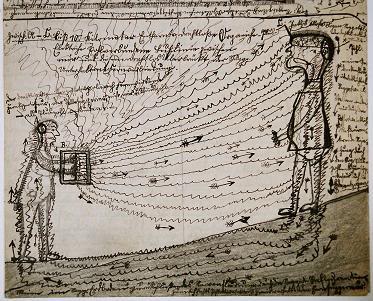
Nerve Language by Daniel Schreber

Semantic Animals

It goes on.  Seduced (sickened and soothed) by symbols, I read.  I write.  In dilettante-like forays into advanced mathematics, physics, cognitive sciences and biology,  I learn:

“The first message is that there is disorder”

(-James Yorke, attributed with naming the science known as Chaos)

            So back to first principles (they have a habit of coming in threes, and splitting into fragments).  I take out a blank sheet of paper, filled with lines.  A patterned absence.  Boundarying void.  I write “seduced” because I’m thinking about language.  Thinking instinct and survival and desperate need.  Thinking overload, “more than you could possibly imagine.”  Semantic animals.

When I last saw the snow fall, it was raining, offering an impression of “wet.”

She is far from me in two dimensions.  Only two, of multiples of three.  I count by the “trick of the nines.”

If only there were a way to collect accurate data.  Then adequately calculate and organize.  Unfortunately, life is mostly made of problems existing on continuums of countless dynamic variables, most of which – unsolvable.  They call these “differential,” or Derrida’s Infinitude of Differance.  Professionals finally agreeing: “regularity is aberration.”

We search for patterns.  Even in chaos we find them (or create).  Seduced (sickened and soothed) by symbols, we “read.”  There are so many oscillating signals that even the few we don’t inherently tune out we call “noise.”

Philosophically, on the other hand, where I feel more like an amateur or novice, I understand the problem/hypothesis/theory equation to be: EVERYTHING goes into EVERYTHING, that we’re only ever engaging possibilities.  That probables are fleeting, and certainties are few:  You are limited, peculiar, and definitely will die.

In other words, “the very process of cutting up and cutting off, opens up and opens out,” or some of us are developing “a belief in the musicality of creative disjunction” (Lance Olsen), because, seduced (sickened and soothed) by symbols, we select and collage our own inspection.

It’s easy to forget the first things that we find, i.e. that all positive statements and beliefs are built on “that there is disorder,”

and seduced (sickened and soothed) by symbols,

we go on from there.

fRiction – necessary to the stream of life

Combinatory Art in Motion.

Incessant

fRiction

“The more narrowly we examine language, the sharper becomes the conflict between it and our requirement.  (For the crystalline purity of logic was, of course, not a result of investigation; it was a requirement.)  The conflict becomes intolerable; the requirement is now in danger of becoming empty. – We have got onto slippery ice where there is no friction and so in a certain sense the conditions are ideal, but also, just because of that, we are unable to walk.  We want to walk; so we need friction. Back to the rough ground!”

-Ludwig Wittgenstein-

“Language is a labyrinth of paths.  You approach from one side and know your way about; you approach the same place from another side and no longer know your way about.”

Possible Fictions: Fragments from the Book of the Living

-Christina Milletti, from Innovative Fiction and the Poetics of Power

RE-GIFTING PRESENTS, part 1: Inhabiting the Medium We Inhabit

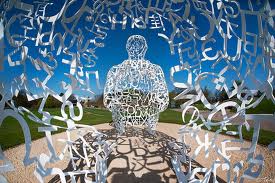
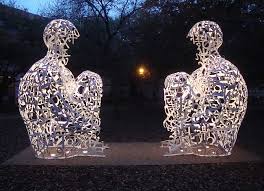
Juame Plensa sculpture

This post is an attempt at exploring and hopefully explicating (at least a little) a dialogue that began in a series of comments between the excellent thinker/writer Tocksin and myself.  The comment thread can be read in full here (if you wish), but I will highlight two sections for purposes of this post:

tocksin says: I am noticing we two like to wax philosophical at the expense of letting our characters speak. We are mere babes in the woods being raised by wolves. Tooth and nail we will fight to have our day. Write we must.
N Filbert says: I find that to be true – what you say about being babes in the woods. Wrestling with everything else inhabiting our medium.
tocksin says: Let me feel you more with what you mean by wrestling with everything else inhabiting our medium.

At which point I made some bumbling effort toward it, seemingly tangling into more confusion.  And was set thinking – how would I verbalize what I mean by the wrestling that using language is?  The next two (or more) posts will be my preliminary attempt to language into it.

I interpreted Tocksin’s first message (above) to concern our propensity as writers to be unable to “leave ourselves out of it” (e.g. to let plot and characters, narrative and action be), rather than to voice-in, reflect, trouble and scrutinize our place in the mix of it, the ourness in the howness of any languagings aboutness.  “Tooth and nail we will fight to have our day.  Write we must.”

All of this started rattling about in my old noggin with what darts around in there from Wittgenstein, William James, Gertrude Stein, Bakhtin, M.A.K. Halliday, J.R. Firth, Benjamin Whorf, C.S. Peirce, Edward Sapir, Peter Berger, and thousands of other voices and ideas regarding LANGUAGE, THOUGHT, BEING, PERCEPTION, etc…

As far as I can tell, these relations have concerned humans since humans have experienced concern.  Who are we?  What are we?  How are we?  When are we?  even from time to time expeditioning toward Why?
language

A few posts ago I quoted Judith Butler from her Excitable Speech to the tune of:

 “language is not a tool that merely allows meaning to happen.  Rather, the relation between language and its users represents a complex ‘matrix of intelligibility’ that makes us readable to one another.  Language, in other words, represents a framework that constitutes both the ‘doing’ and the ‘doer’ alike: the subject always exists in a condition of relation to language that implicates the person using it, as much as the addressee – ‘we do things with language…produce effects with language, and…do things to language’ because ‘language is the thing that we do.’ (from Christina Milletti).

Much greater minds than mine have attempted to tackle this – in language, with language, to language, as well as in painting and music, film and image and architecture and dance: Who are we?  What are we?  How are we?  When?  What is?  Happening?  Basic problems of being as faced by our particular type of organism’s means of awareness: senses, perceptive apparatus, and largish brain – all inputting and outputting, inter- intra- extra- extro-putting simultaneously.

Due to our conditions, one of the stickiest problems seems insurmountable – the ability to experience (consciously) BEING.  Or NOW.  The Present.  IS-ness.

In our splendiferous operations of surviving/existing, the mechanisms and processes of doing so (predictive, inductive, deductive, collaborative, receptive, perceptive, oscillatory, responsive, reactive, self-generated, externally infringed, incited, and so on – AMAZING processes!) TAKE TIME, if only nanoseconds…all to say that our perception and/or sensation of being and existing NECESSARILY are not simultaneous to its occurrence, and yet also ARE, because the organizing and perceiving of our activity also constitutes our experiences AS they occur.

This is one of the reasons William James insists on the metaphor of “stream” for our being.

Here he writes on introspection (self-reflection, becoming conscious of consciousness, or perceiving perception – what language and symbols, signs allow, enable, concoct):

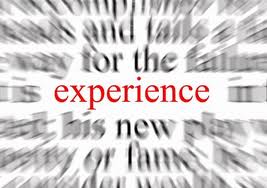
“introspecting the contents of that stream, more precisely, a particular item floating along it, interrupts the streaming, arrests the item (or objectifies), detaches and isolates it.  Let anyone try to cut a thought across in the middle and get a look at its section, and he will see how difficult the introspective observation of the transitive tracts is…As a snow-flake crystal caught in the warm hand is no longer a crystal but a drop, so, instead of catching the feeling of relation moving to its term, we find we have caught some substantive thing, usually the last word we were pronouncing, statically taken, and with its function, tendency, and particular meaning in the sentence quite evaporated.  The attempt at introspective analysis in these cases is in fact like seizing a spinning top to catch its motion, or trying to turn up the gas quickly enough to see how the darkness looks.”
experience

And is also experience, experience becoming.

As I am considering language, that is – assigning description, value, reality using symbol/sign/or index to something in human experiences – I am presenting a coming-to-terms (languaging) for myself of what I attempted (languaging) to “mean” (communicate, share, RELATE) in my off-handed comment to Tocksin regarding “wrestling with everything inhabiting our medium,” as well as an hypothesis that has been haunting me since.

“Wrestling with our medium/habitat – language” means for me in this way: As I conceive (language) the being or existence of the human organism, I interpret an organism of proactive and retroactive complex processes organizing and imputing value to its environment, selectively perceiving and constructing a context or situation in which it can get what it needs to survive.  In the scheme of things (or, its organismal specificities IN RELATION TO other organisms and contexts) the human has developed metaphoric and metonymic signification capacities for purposes of more efficient and productive navigation / survival.

Language, (or humans as semiotic beings) then is a medium in the sense of a manipulator of gaps, or a “thing” insofar as it operates between, RELATIONALLY.  Signs are always IN RELATION TO.  Inner experience, outer experience, communication, description, definition, etc…a SHARED HABITAT, an activity, indeed a primary thinking process – signing experience is a composition, exploration, examination and organizing (improvisational and purposive) of our world and our perceptual relations within experience of it.

Signing – languaging world – is for us our activity of finding out, making sense, interpreting, composing and exploring being/existing.

So when we go with purpose to the page to write language – all of this is inherent to the medium – we make our world (as we experience it) inhabit language so that we can experience it and also we inhabit language in order to experience (perceive our perceiving, become conscious of our awareness).  Language is the “stuff”(?) – the medium – the lubricant of passage between ourselves and our senses and perceptions; and everything beyond those individual sensings and perceptions.  Thinking organizes and determines experience.

So self-consciously involving ourselves in language opens up all our experience (known and unknown, much like dreams) to be wrestled with in attempting to make a poem, a story, a report, or a conversation, or, even, a thought.

That is part of what I was trying to say, Tocksin.  Part two will be the idea that has haunted me since…
Immediate sources referenced:

Lyn Hejinian, The Language of Inquiry.  U. of California Press, 2000.

R.M. Berry & Jeffrey Di Leo, editors. Fiction’s Present:Situating Contemporary Narrative Innovation. SUNY Press, 2008.

Gyorgy Buzsaki.  Rhythms of the Brain.  Oxford, 2011.

Rudolfo Llinas.  I of the vortex.  MIT Press, 2002.

William James.  Principles of Psychology.  Cambridge, 1981.
Waters I’m Swimming Today

feel free to join – the water’s fine!

This slideshow requires JavaScript.

Composition

shadow composition

Approach the page with no idea.  No secondness of reality or facts.

See what the words will do.  Like spontaneous sex with your lover.

What happens next.  If you’re lucky.

What words will come?

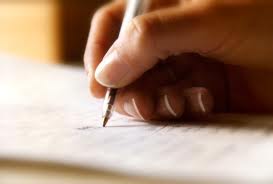
Look closely.  Draw the pen near the paper.  Remember, you’ve no idea, like what I’m writing.  Language finding synonyms making thoughts.  Perception in the body.

Something already in the clear, or on it.  Never clear.  Do you see it?

Don’t let the first mark frighten you, it is already done, everything coming after you can edit: crossing out, crossing over.

See the line?  To chase or avoid, either way, impossible to capture or erase.

Look again – do you see it?  Hover but don’t inscribe, what is it waiting there?

I’m not being mischievous or rhetorical, facetious or mystical.  I want you to see what is always already there, predividing your canvas, filtering the open before you engage.  What you cast out around you, the shadow of your general ‘self.’

See it there gathered at point of pen, shading back toward your physical hand and pooling around it?  The absence of your presence forming incorporeality.

You are visiting here.  Your shadow is the record.  What you make out you make up.  But it’s never the first word or the beginning line.  Reality comes before you and spreads out, interfering and refracting the light you wish to use.

At times a bulky blot, at others barely discerned, evidence nonetheless that you are, in fact, tracing.  Operating in a kind of cloud of substance, adding lines and loops, particles, threads.

They say art (and representation) began in shadows, with shadows – recognition of other and presence and beyond.  Likely a myth that is true.

For starters, notice the outline, letting it outline itself/yourself, the visible ghost informing your are

Now, since you’ve already overshadowed what’s next, begun what’s begun, press down and press forward, press on…

Vicente Carducho, tabula rasa. engraving, 1633

Aspect of Architecture

“A well-crafted sentence overturns the notion that thought is distinct from thinking.  A well-crafted sentence enacts the sense it makes rather than representing it.  The result of writing well-crafted sentences is that your reader will have the most vivid sense that something is happening to him or her and with the irresistible urgency of their own dreams.”

“Dedicate yourselves to reading most energetically that which you don’t immediately understand.  Read with a special attention to the prospect that what doesn’t appear to make sense matters most because of the possibilities of sense-making that are portended in it.”

author Alan Singer

taken from: