Heroes Ringing True

Robert Musil

On “the writer type”:

One can describe this type as the person in whom the irredeemable solitude of the self in the world and among people comes most forcefully to mind:  as the sensitive person who is never given his due;  whose emotions react more to imponderable reasons than to compelling ones; who despises people of strong character with the anxious superiority a child has over an adult who will die half a lifetime before he will; who feels even in friendship and love that breath of antipathy that keeps every being distant from others and constitutes the painful, nihilistic secret of individuality; who is even able to hate his own ideals because they appear to him not as goals but as the products of the decay of his idealism.  These are only isolated and individual instances, but corresponding to all of them, or rather underlying them, is a specific attitude toward and experience of knowledge, as well as of the material world that corresponds to it.”

On the writer’s region (“nonratioid”):

“There is no better way to characterize this region than to point out that it is the area of the individual’s reactivity to the world and other individuals, the realm of values and valuations, of ethical and aesthetic relationships, the realm of the idea…in this region facts do not submit, laws are sieves, events do not repeat themselves but are infinitely variable and individual…there is in the writer’s territory from the start no end of unknowns, of equations, and of possible solutions.  The task is to discover ever new solutions, connections, constellations, variables, to set up prototypes of an order of events, appealing models of how one can be human, to invent the inner person…which then nevertheless branches out somewhere into a boundless thicket, although not without somehow fulfilling its purpose…”

These quotes come from his exceptional small essay Sketch of What the Writer Knows

which I desperately wanted to reproduce here…

if it “rings true” for you – please find a mentor and friend in Robert Musil:

Signs

This slideshow requires JavaScript.

Signs


We wanted love.  This sentence has no meaning outside a sentence.  We wanted a multitude of words.  Love was to become the quarrying of ourselves, emerging from a completely different side of the narrative…Representing ourselves to ourselves was an unmanageable task from the beginning.  To continue being a reality while simultaneously becoming its sign that dissembles nothing, only relentlessly elevates itself in a continuous shadow –

-Arkadii Dragomoshchenko-


There was no doubt we wanted.  What it was that we wanted, exactly, was another matter.  We wanted love?  Perhaps.  Love made from words and signs and gestures.  From the beginning we had trouble representing ourselves.  Being a reality while also signifying it and being its addressee – inveigled us in a continuous loop.  We needed another view.  From a completely different side of the narrative.

Maybe we wanted to drink reality to its dregs.  We wanted love.  Someone who could read the being and its signs and comprehend its address.  Someone to help interpret the loop, quarry the signs, chart and map the shadowy spiral.  We wanted a multitude of words.  Words we’d never thought of.  Never heard before.  Synonyms and antonyms to set apart our signs, that we might, perchance, see who we are.  Learn, not just be.  We wanted love.

Loving ourselves was clinging to continuous shadow.  Ourselves always just ahead of us, being, quarrying experience, fabricating new signs, dissembling nothing.  We didn’t know, anything.  We wanted love and a multitude of words, of gestures – significations of action and matter – we wanted to be real.

Your side was completely different.  There you were – being, assembling signs, dissembling words I thought I knew into paradoxical meanings.  I’d see a sign that seemed familiar but the language was foreign, the reference obscure, of exotic materials.  Where were you quarrying?  I was stunned and fascinated – we could make such similar things of our surround and within – yet pointing in apparently opposite directions!  How could this be?

We wanted love.  I followed your signs, tried to tell you what they meant.  We wanted for multitudes of words.  You sought to explain, what with the being, the source, the signs and address,  indicating your shadow, not mine.  I, forever chasing the shade of your dress.

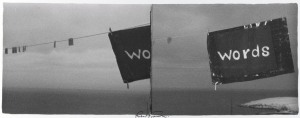
We wanted for love and showed each other signs.  We gestured and addressed our bodies and songs, put on shows of ourselves for each other.  Here are my banners and pennants.  Here my consistent mottoes.  Here the images we keep – representations of ourselves like lost memories.  Here our directions and contents, graphics and readings.  Signs, signs, and a multitude of words.

We began telling one another their stories as we read.  Replete with new words, new signs and misreadings.  This did not often go well.  With each sign that we made we were reading the last.  We couldn’t keep up, swimming in continuous shadow.

A multitude of loving and words.  We believed we wanted reality.  We decided to quarry together – our insides working into a shared surround.  We disagreed on its representation and agreed to post personal options.  We grew confused and crowded with signs and gestures.  Grabbing some of these, we started swinging, thinking ours might outlast the others, might prove “right,” win out, or be “true.”

Our signs began to shatter as our words and gestures dissembled.  We established picket lines and separate camps.  We fashioned more signs with blazoned slogans of ourselves and our views, losing them inside our shadows.  We decided to climb.  Perhaps a view from afar, or you’ll be off on expedition.  We located a guide.  Who seemed to think all of our signs were true.  We looked again and could read that we wanted for love.  Our valley was riddled with signs.  Our guide interpreted gestures the same.  Words of pain, words of fear, a multitude of words.  All quite similar but in our own languages.

We wanted love, he said.

Someone to read our beings, our signs and receive their address.  Someone to help interpret our loops, quarry new signs, and map our spiraling stories.  We wanted multitudes of words and we had them.  Words we’d never thought of nor read.  Words replete with variant meanings and references.  Synonyms, antonyms distinguishing our signs, redirecting our shadows.  If we listened and looked, and with care, he said, perchance we might see who we are, being.  And learn how to be.  If we wanted for love, we had it, he said.  Just look at the signs.

The Cleaving

“Connection is the recognition of the  intimacy of a division…

to make a division is to give substance form”

Madeline Gins

“Therefore shall a person leave his father and mother and shall cleave unto another

and they shall be as one flesh”

Genesis 2:24

The Cleaving


How do we come to know, believe or accept this ancient concept?  It has mited its way to the deepest reaches of Being (Dasein): Heidegger’s rift, linguistics address, each individual body’s pulse or breath or tremor.  That only the separateness may truly join.  Only the differences are recognized as similar.  Only the rifts require a bridge.

I do not know.  It is a reality I feel with as much pain as hope or joy.  That cleaving is both the splitting apart, the splintering wood and severing rope, AND their clinging together, their sealing and sealant.  It undoes me.  As a metaphor, concept or signification it rings true and carried dark howls and bright screams out of the depths of me.

And yet it comes so naturally.  Fight or flight.  Attack, retreat.  The extremities of the urges to join and drive to cease.  In the utterly intimate action of cleaving, we expose and unite – right in the most susceptible, vulnerable, life-threatening places.


The “cutting out,” “cutting off” – to cleave – you know what I’m referring to – when that which is most important to you becomes unreachable.  That impression that you are being “given up on,” that someone is “letting go,” even actively removing themselves or casting you away, chopping the cord – the umbilical torn, gushing, pulsing, the infant left writhing and wailing in the dumpster or thorny woods, a closet or dark alley.  Cleft.

In truth:  that severing of relationship, whether momentary or fatal, is a life-threatening, death-dealing blow.  Abandonment.  The dawning that you are at the front and there will be no reinforcements, you are cut from the supply train.  There is shock, there is scream and then a canyon of void with no other side.  It is we at our most disastrous, mortally dependent state.

We in the face of absence.  We without response – no face in a mirror, no echo of sound, NO THING.  Cleft.

Individual, alone, solitary entity.  Facing the reality:  we are insufficient to our needs, incompetent to our existence, impossible to self-sustain.  We in our fragility.  Our valid, appropriate, ontological FEAR.

Whack!  In anger, in grief, in silence, in bruise, we are severed, ultimately exposed, whether through small offense or enormous rejection – we have been cut.  Past the bone.  The reverberations tumble and crumble out far and wide, seemingly ubiquitously, regardless of the specific instant’s severity.  This is “the cleaving” done as much to us as by us in our madness to survive, to be real, to be verified and validated.


In the “drawing near,” in the “clinging” of to cleft, on the other hand, we are born.  We become.  As another reflects or responds to our raw broken mortally wounded finitude and fragility, we get glued to the vitality of these limited lives we have in us.  As these fearsome exposures are clasped, bonded, covered by another – transfused and salved, bandaged and wrapped or dressed by another – we know we are possible, we feel we exist and we matter, we join toward world and its being, brief though it is.

These are our chances and capacities: to effect, to mean, to act, create or be.  It is in the drawing near that what life there may be is acknowledged, fostered, affirmed.  Con-firmed.  Cleft – grafted into the ongoing reality of things, parting through wholes, participating and enhancing of semiotic systems.  As if life does not really belong to us, but we must belong to it, by belonging with one another.

“Leaving,” “cleaving.”  The leaf cleft from its branch will not survive, but cleft or grafted to another stem or soil or root may for awhile yet, live on, grow, produce, change and become.

We continuously leave and cleave to varying extents, and these just may be the principal elements of our thriving.  Cleft we perish, shrivel, die away.  Cleft we heal, nourish and grow life.  Both options/realities occurring in the cuts, the core places, the sources.

Here we panic, here we rejoice.  Here we suffer, here we love.  Here we become, and here we cease to be.


This mysterious activity necessitates both significations, counter-intuitive though it seem.  The need to be cleft exposes the places needing cleft.  Awareness of the sources for supply determines the crucial treasure, dependency, and gifts of supply.

We are chopped to the truth of death

and joined to the reality of life

Cleft.
Fathers Voices

With Kit, Age 7, at the Beach

By William Stafford


We would climb the highest dune,

from there to gaze and come down:

the ocean was performing;

we contributed our climb.


Waves leapfrogged and came

straight out of the storm.

What should our gaze mean?

Kit waited for me to decide.


Standing on such a hill,

what would you tell your child?

That was an absolute vista.

Those waves raced far, and cold.


“How far could you swim, Daddy,

in such a storm?”

“As far as was needed,” I said,

and as I talked, I swam.


see also, Galway Kinnell’s Book of Nightmares


Baffling Wisdom (really a long roundabout babble aimed towards my wife)

Going back through the writings that have been piling up on, around and near my desk over the past few days working out the hoped-for verbalization of whatever it is that’s been stirring around in my brain I ran across a few more pages that seemed interesting / to the purpose…

“I am looking for words….”

Baffling Wisdom

i.e. thinking things through

Remarking Mark Remarking

Greetings readers.  I’ve been in a bit of a swirl or “swarm” of information, activity, relation and language of late, nothing wrong with it really, but its producings have seemed a bit ephemeral, inchoate, more wisps than winds.  Yesterday as I sat to work, a new character introduced himself to my scribbling hand…here’s a sort of mock-up or intro to that relation.  I’d love to hear what you think?  Is he interesting?  Are his thoughts?  Should he live?  🙂

Thank you SO much, each viewer and reader for taking time out of your lives which must be as busy as the rest of us, to listen and look at my blog and my work.  This community has significantly grown my courage.

Remarking Mark Remarking

(please click on title for full text – thanks!)

Thoughts

“No useless chatter, but a word of necessity face to face with itself.

With this word, I have written my books.

Word of sand.  Word of eternity.

Thoughts of shipwreck, but also of haven.”

“To approach silence before the silent sign.

To approach the book before the page.

To wait for words that wake our thoughts as they write us.”

-Edmond Jabes-

“When a sparrow feels the freezing cold air, he puffs up his feathers and gathers his feet under his body;

he bears the surrounding cold by countering it with his inner warmth.

The writer, who is also warm-blooded, fights even harder”

-Viktor Shklovsky-

“The bow’s harmony arises from the strained stick forced by the bow-string.

Subsequently, harmony resides in unity and contradiction.

It is kinetic energy that’s about to become dynamic energy.”

Swarm. Absorb. (the words, pt. 2)

Swarm.  Absorb.


metaphor:  the entire discography of Mark Kozelek (+ Sun Kil Moon, Red House Painters) / each version of Max Richter’s “Haunted Ocean” on dizzying random repeat – this is the setting:  atmosphere.  environment.  “context.”

metaphor:  the Kansas sky in storm

This slideshow requires JavaScript.

            metaphor:  dealing with Ache.  (“being human”)

metaphor:  “Control without Hierarchy” by Deborah M. Gordon…on some page in a book called Swarm by Lucas Felzmann:

A flock of birds turning in the sky is doing something that people don’t know how to do: moving together, beautifully, without a leader or choreographer.  It’s a spectacular version of the collective behavior that goes on everywhere, in groups of animals and among cells within our bodies…Life in all its forms is messy, surprising, and complicated.  It’s difficult to imagine how any social group could be organized without any hierarchy.  We are used to hierarchy as the principle that organizes human institutions.  Think of companies, armies, governments, orchestras, schools, and clubs – without any person directing another, or having more power than another.  Although we are so accustomed to hierarchy that we think of it as necessary, it is rare in nature.”

think of language.

            what is scattered widely or uniquely ubiquitous – call it “swarm.”

“I”…lost.

I know I cannot gather to a grown pillar of I-ness, something you might recognize, could “identify.”

I know I cannot be where I am as long as “time” and “space” function effectively in my frames of reference…

I spread.

I swarm.

“I-swarm”

(the “human” world-situation)

            Leaving that aside.

How might one (dependent on two or more in order to, well, in order to simply “be”)

how might that one (singular mark – “/”) handle (manage? survive?) “its” Ache?

“To be or not to be, that IS the question”

(o wise god)

            So I split…up…

I canvas the sky, the context, the landscape, the sitz im leben, in fragments.

I approach, engage, invade the world like shot scattered from the anguished burst of a wombgun.

I-particle.

I-swarm.

Absorb.

from “Swarm” by Lukas Felzmann

            Seminal-syllable words resound –

Let their pulse reverberate your bodies like hymns

God.  Void.  I.  You.  Song.  Life.  Death.  Love.  Real.  Being. (Not).

and so on…

all with no definition…

IS.  IT.  THIS.

nowhere near

where we mean to be.

Absorb.

Swarm.

from Swarm by Lukas Felzmann

            In this situation then,

of too much

of grave luck

(all that hope and final destitution)

I swarm.  I absorb.

I decenter.  I explode.

I desist in pretense

in sense

I spread.

One mark….thousands of pixels….without hierarchy

(a swarm of cells)

(a flock of birds)

(a fish in school)

I swarm.

I absorb.

[ – I love you – ]

 -for my wife

This is Water

I found myself in a fairly uncommon (for me) setting this morning, my son was performing a Double Concerto of Bach‘s at a Methodist Church.  I happened to be there (reading Larry Levis) on “graduation Sunday,” so the message/sermon/interpretation of texts was geared toward the cultivation of wisdom.  As I listened to the suggestions/advice of a “spiritual authority” figure, to our young/privileged/promising…I was struck again by my personal favorite commencement address I’ve ever come across/heard/read and thought given the Spring of things perhaps it was time to push it out toward eyes and ears wherever I could, again.

Here it is…by a personal hero David Foster Wallace… (and therefore in his honor as well)

THIS IS WATER

Ache ( the words, pt. 1)

I think it significant that this post and these thoughts were constructed/composed to Max Richter‘s composition “The Haunted Ocean 4” from his Waltz With Bashir soundtrack.  I have been unable to figure out how to load that piece here but so wanted you to be able to listen while you read.  I have found “Haunted Ocean 1” which has similar themes, but if you are able to listen to #4 please do!

(our environment writes as much as we do)

Ache


Borges writes “immanence,” Blanchot “infinite” and “void;” Beckett’s “dim” is Jabes’ “absence.”

– Let the attributes ring in your bodies like hymn –

Someone’s “silencio” is another one’s “vague.”  Heidegger’s “Dasein,” a collective of “Tao’s.”

Whence this pull toward placed-ness, toward wholes, toward meaning?

What evidence have we that this could ever be the case?

From “birth”?  Or “death”?  And what might we mean by “life”?

Words.

Language.

“words are not the reality of language: words – by themselves – do not exist”

Jorge Luis Borges

He illustrates this simply.  And might be demonstrated even more concisely, like this:

God.  DieuיהוהAllah.  and so on…

Or, with Borges:

“En un lugar de la Mancha, de cuyo nombre no quiero recorder” (12 words)

“In a place in La Mancha, whose name I do not wish to recall”  (14 words)

“En un pueblo manchego cuyo nombre no quiero recorder”  (9 words)

“In a Manchegan village whose name I don’t want to recall”  (11 words)

or

I love you.  Te amo.  J’taime.  Я тебя люблю etc…

or

I adore, crave, honor, respect, delight, select, prefer…

            It isn’t the words, it’s the language.  And the language isn’t just words.

Ache.

Torment lies here.  Angst, frustration, agitation, anger and want.  Fear and inadequacy, limitation and failure, desire and doom.

Ache.

If the words not the thing nor the thing without sign or presentation…for what, for what do we yearn?

Ache.

We seem unable to be HERE, PRESENT, and simultaneously FULLY SO.  Some faculty, some capacity slighted.  Either intellect suffers to passion, or understanding commands immersive sensation.  Ever a split, a just-nigh or just-shy.

Ache.

To long for, to crave covet and burn…

Ache.

My love is absent.  I ache, I yearn.  But when she returns and is present, I lose the pregnant and consumptive fullness of her absence.

Either way I ache, for more, for all – for comprehensive life.

            Called by “I,” “void” or “it.”  “Being,” “nirvana” or “love.”  “Youth” or “joy” or “wholeness.”  “Pleasure” “emptiness” or “thou.”  Nothing.  or All.

I name it Ache, today, intending by it some constitutive condition or state, a description of “living,”

by which so many meanings are lost,

and I ache.