Wanted to plug a new Youtube channel I’m following…

Wanted to plug a new Youtube channel I’m following…
I have recently had the good fortune of correspondence with a tremendous thinker of whose work I have greatly admired and utilized continuously. At some point he queried me as to my central concern or research interest which I pondered over a number of days. About a year ago I recognized that filtering through all of my curiosities and fascinations (passionate inquiries) – in the end they were all about ways that meaning might be made for humans. Thus I figured semiosis or semiotics was my central field of concern. How we forge meaning in our surrounds. As I’ve pursued library and information science I have attuned to the eagerness with which we as a species produce, hoard and waste information. We’ve produced veritable clouds of data/information/knowledge and now it seems as if we swoon and drown in it. For meaning, this cosmos of affordances must be utilized, integrated, incorporated. As technologies explode and become increasingly symbiotic or synergistic with our own bodies and purposes, I have found that my responsive concern is one of remembering that the nexus or filament-combining locus for humans is the body. No meaning can be had without the physical processes on which our being relies. Every think I can think rests on the chemistry and material flows that comprise my organism. It seems that even while we seek to develop intelligent robots and machines, ubiquitous data-recording and instinct-responsive computing, work with data sets increasingly monumental and robust, that a strong percentage of the human populace has the idea that the stigmergy and emergence of virtual social realities construct meaning, promise, potentiality. I am not denying the fascinating quality of our rhizomic replications of our actual interconnectedness, overlap and interdependent influence, but I am committed to the fact that meaning only arises as relations are incorporated. The translation and transformation of continuous relational events whether electronic and virtual or face-to-face and co-present into MEANING only occurs organismically, physically, presently in the knotting of convergences through our embodied existence. Emotion, sensation, cognition, movement all ALWAYS play a part in the construction of meaning. These are my thinkings/feelings.
In keeping with that, serendipitously my wife and I happened to view “The Perfect Sense” – a movie pursued to listen to Max Richter‘s incredible soundtrack in action – but resulting in a sort of visual commentary on my above thoughts. We recommend it! And would love to hear what you think!
As I snatched books and items to head to a weekend class I grabbed an old partially used notebook just in case I’d sneak a moment or two to scribble my thoughts. I did, but I also found the following past set of jottings that I catapulted off of for what I wrote next…
They felt like found thoughts that found me again…so I thought I’d share…
 From Old Notebooks
I get a little weary of philosophy. It fascinates and intrigues, has its spectacular, glittering moments – like architecture, hard sciences, and fiction – but with each human activity there can be too much of a good thing. Perhaps it’s the fantasies involved in abstraction, in the “feeling” of figuring things out, or of “making sense” (instead of sensing) – our human super-additives to experience that are also experience themselves – that I, at times, weary of. That eminently falsifiable intuition that everything is made up.
It can be hard work to keep a worldview active. They involve such complexities and details, layer upon layer of biological and logical, illogical and irrational, intuitive – ologies and descriptions, manipulated perceptions and interpretations re-interpreted re-interpreted without ceasing, that a being grows tired. Can grow tired.
Those same realities, capacities, activities are also exponentially inspiring, enervating, exciting – those behaviors of creativity, imagination, and survival – and our weird confounding capacity to think we can observe our perceptions make for a very strange frenzy of energy and productivity…
…our infinitely (perhaps?!) webbed interdependence with our surround provides for mysterious and copious possibilities of activity (material)…all bewildering. Chaos can be so generative. Chaos – so stultifying.
What might we know?
That we are organisms within systems? How would we know that, from within systems?
That we are dynamic organism enmeshed with other dynamic forms of matter and energy, waves and particles, movements? Seems to be our sense of it.
So what?
Alongside and within – in order to be – there is NO way to exist detached or without: to imagine distance, objectivity without imagination capacity of fantasy, illusion, for purposes like logic, mathematics, narratives and codes – DElusion in order to play the games with delusional sincerity – effectively. The delusions are effective, often pragmatic, evolving, so they must also be part of being with/in a myriad of dynamics…
One would hypothesize. Or suppose. Infer, as in fantasize.
All enabled by immersion in symbols, languages, stipulated relations…
…which is what I had set out to consider – immersion in symbols –
the wonder of it
the delusion…
…to follow…

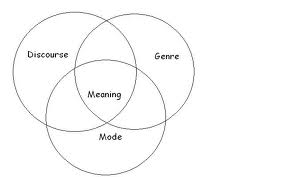
In any breaks in necessity – between semesters, breaks at work, children otherwise occupied, no “required” readings or commissioned work, etc… – with each passing season, I gradually discover what matters most to me (literarily speaking, which, for me, involves much of my lived life) – perhaps I might refer to it as my meaning-making-factory-resources (Blanchot says of Borges that he is “an essentially literary man – which means that he is always ready to understand according to the manner of comprehension that literature authorizes).” At this point in my living, over four decades along, and a large percentage of the pie devoted to reading, those voices I turn to, their messages and efforts, have become quite consistent. Each year there are new ones, new threads and concepts, theories and expressions that very significantly impact my living – but they tend to find their place as commentaries, extensions, additives and queries to what (I suppose) now forms my central “canon” of sorts.
This struck me, following my return to Bakhtin and Blanchot, and as we prepare for vacation how I immediately reached for Soulstorms by Clarice Lispector and The Museum of Eterna’s Novel (The First Good Novel) by Macedonio Fernandez. In searching for this image of Fernandez:
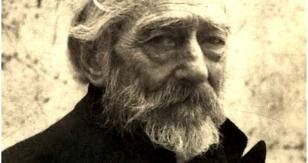 a host of Google’s “related images” arose – including Borges, Lispector, David Foster Wallace – and I got that vision of how pantheons develop and connect and gradually form a kind of woven semiotic pattern – a “worldview” or “Innenwelt” I guess – it begins to make sense what’s connected to what and whom to whom throughout time and space of world-being. Beckett, Blanchot, Dostoevsky, Pessoa, Rilke, Cixous, Kafka, Bakhtin, Jabes, these visions and verbals I return to again and again and again and again – inexhaustibly – and although my copies are nearly glutted with markings and underlinings – and they feel intimate and familiar (on the one hand) – that I also feel I am always learning them anew, freshly, with EVERY read.
These things astound me.
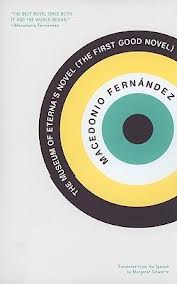
Of this particular book (which I often say is the very best novel I have ever read, repeatedly), Adam Thirlwell writes “It is a novel which does not want to begin. Or, perhaps, it is really a novel which does not want to end…The aim of Macedonio Fernandez’s novels is to convert all reality into fiction (or the other way around).” “The real subjects of this lightly playful novel are the grave ones of death and love.”
“In his novel, Fernandez tests the possibility that all philosophical questions are only meaningful in relation to human relations: that all questions of infinity are really questions about love.”
and so on.
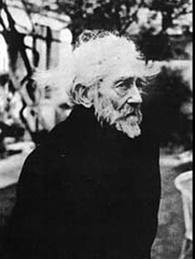
Macedonio is, for me, a hero the likes of Bakhtin, Blanchot, Beckett – those writings and writers I will never “get over,” never “get around.” Writings I can only ever “go through.”
Perhaps these writings are characterized by the question – “What is it to be real?” I recently discovered in one of those “shock of recognition” moments that although I’ve studied theology, philosophy, classical music, art and literature and now information sciences and systems theories – that none of the CONTENTS of these fields sustain my passions – it is the relationships between them – the ligaments and synchronous reverberations they emit – the MEANING-making effects of their pursuit and inquiry that is REALLY what drives me toward, into and through them. I’m not looking for truth or necessarily facts or any answers – but for PROCESSES and PRACTICES that enrich, enhance and extend my biological life in relation to the world I’m “thrown into.”
Borges wrote of Fernandez: “Macedonio is metaphysics, he is literature” and that “writing was no trouble for Macedonio Fernandez. He lived (more than any other person I have ever known) to think. Every day he abandoned himself to the vicissitudes and surprises of thoughts as a swimmer is borne along by the current of a great river.” The novel’s translator writes: “The method is madcap; the intent is desperately human.”
Perhaps that is what I’m after – to be “desperately human.”


and now we’re heading off to the wilds – to be desperately human with-world with-family – replete with above-mentioned authors and without wi-fi or internet services!
P.S. (also from current reading – The Waste Books by Georg Christoph Lichtenberg):
and
All the best!
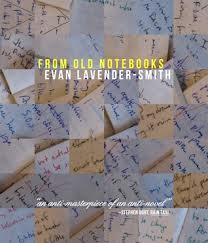
“The scientist and philosopher are like identical twins in a world without mirrors.”
–Evan Lavender-Smith
Instigating a “family-tree” of sorts betwixt what I will call thinkers of relational ontology, I am providing another text to explore – this one from Erin Manning – the introduction from her book Relationscapes: Movement, Art, Philosophy.
You can see the heritage (or ontogeny) is vast – to trace it more completely investigate The Four Ages of Understanding by John Deely, A Thousand Plateaus by Gilles Deleuze and Felix Guattari, or The Primacy of Semiosis by Paul Bains (among others). Bakhtin, Whitehead, William James, Nietzsche and others give testimony to this sense of the entanglement and fluidity of being, the emergence and always co- or inter- of existing. The “relational nexus of experience,” as Manning has it here. The incipient potential of each pre-moment and then following “instant,” the elasticity of the almost, the threshold ALWAYS of expression-in-the-making and all of its co-constituents from throughout time and space and anything else we have segregated arbitrarily. Without further ado – What Moves as a Body Returns as a Movement of Thought, Events of Relation – Concepts in the Making by Erin Manning:

feel free to click image or title to read – (it’s a much shorter text than the last) – but no less engaging, creative, and provocative…
-Michel Foucault-
-Christopher Fynsk-
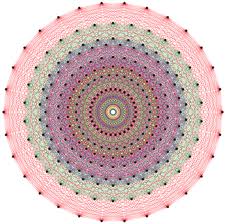
I have been fascinated by and greatly enjoying the discussions and promulgations of some very astute bloggers considerations of the possibilities of and potential candidates for a “Theory of Everything.” See, for prime examples, the tremendous thought-work of MultiSense Realism and Anacephalaeosis. Hoping to further conversation, I humbly post a couple of intriguing considerations of TOEs by two others of my thinking-hero-eschelon… and hope for responses from those above-mentioned and anyone else with thoughts on the matter (or process, as it may be)…!
From the Concept of System to the Paradigm of Complexity – Edgar Morin
and
Do We Know How to Read Messages in the Sand? – Isabelle Stengers

Very exciting new discovery for me!
for instance: A Perspective of the Universe – Massumi & Manning
Student Magazine of IISER Mohali
Music, Musicology, and related Matters
a photographic pilgrimage to Orthodox Christian monasteries across the continent
Meandering Through a Literary Life
Orthodox Christianity, Culture and Religion, Making the Journey of Faith
Erik Kwakkel blogging about medieval manuscripts
"That's the big what happened."
Networking the complexity community since 1999
 All my Words are Silent