On “waking depressed,” or, Human Clear-sightedness

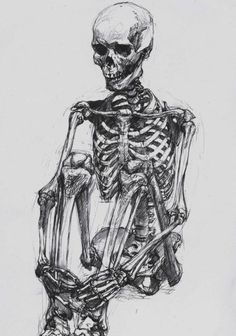
skeleton

We say that we “wake up depressed” wonder why and conjure up reasons.  What is this “hollow” or “indentation” in relation to?  Depression versus delusion?

Squirming up out of dream or slumber into wakefulness, awareness – illusions and solipsism scattered by light of day, by alertness – what would be the “norm” ‘depression’ dips under?

Say we consider “normal” as the state or condition of being aligned with what is.  The only certain trajectory of living is dying.  Dying the condition of life.  The only permanent outcome of breathing, saying, doing, being…are their cessation.  In confirmation or conformation to this “reality” – what should be the normal living response?  Depression, I should say, full awareness and wakeful understanding that my promise, potential, outcome and fortune are to end.

Decay, departure and death are the certain “norms” ruling human existence.  What occurs, forgets; what merges, diverges; what events, unravels; what happens, undoes; what is made, erodes.  Assuredly, they are strange loops, ambiguous and temporal – more wave/particled than 0/1 – and yet as “fate” or “doom” would have it (definite futures) we know of no other.

Therefore it should seem “depression” would be the normal human state of life, and all forms of happiness or joy come about due to some compromise or delusion – an abnormality – some neuroses or failure to accord or conform to what is.  How might we have come to classify conformity to what is as a “disorder” or diagnosable swerve?

“Certifiable depression” is marked as a disability, a failure to thrive, a condition incapacitating function.  Yet does that not most assuredly accord with the certitude of demise, destitution, eradication?  To terminate activity, halt health, conclude creativity, finish folly and destroy delight would all seem to indisputably align with the necessary phenomenon of obliteration.

Thoroughgoing comprehension of what is – that birth has a single objective – that all roads lead to one – that all effort leads to naught – that entropy – is not lunatic, demented, deranged or unhinged – but rather most enlightened and balanced, intelligent and lucid, perspicacious and well-advised.

Being pressed down, a lowering of quality, vigour or amount, feelings of severe despondency and dejection are surely the most accurately normal experiences – regulated, coordinated and adjusted to what is versus what is imagined or desired – indications of astute apprehension and capacities of apperception to the real.

Do not be flummoxed by “waking depressed” – do not seek for treatments or reasonings ‘why’! – do not be baffled that a heaviness descends, or a ‘pressing down’ is felt or occurs – we emerge into life and descend into matter…the cradle and grave a continuous process.
everyone dies

Ends – the Means to Get There; or, Laramie says “OFF.”

ON OFF image

I drill. I devour.

Kafka, Blanchot, Derrida, Bartleby.  Pessoa, Nietzsche, Jabes, Beckett.

Into the absence of hope.

Of language.

Of body.

I drill and I devour.

Myself.

Vitality.

Capacity.

I try to think my end(s).

I want to get there.

I would like to make it to the end.

I would like to make the end.

I think.  I serve.  I love.  I ask.

I care.  I touch.  I say.  I listen.

I am not fulfilling.

I am never quite what is wanted.

I have never been “right” for a situation.

I am a person who tries very hard to be what is wanted.

I am a person who tries very hard to offer what is “good”.

How would I know?

– what is wanted?

– what is good?

I do not.

I am incapable.

But I DO know:

I AM NOT THAT.

(do not) BE HERE NOW.

simply : do not.

“I would prefer not to.”

“I will not”

No reason.

No anwer.

We are just humans.

Animals.

Purposeless.

Pointless.

Without reason(s).

Without meaning(s).

Without.

Still we go on

(for now)

Still we keep on

Still

On

On

On

OFF

(he said, said Laramie to Alias. “OFF.”  He said, said Laramie to Alias.  And then he was gone.  Really.  Gone.)

Sometimes it happens this way.

Sometimes.

OFF

Simply, over.

[Often, in my case and experience.  They come, they go.  There is a rush of blood to the brain and the loins.  There is something I assume the others refer to as “hope,” – some reason to live, to go on, to pertain.  Then OFF.  Binary.  Digital.  Technology.  Culture.  Beings-in-relation.  ON/OFF.  Lights.  ON/OFF.  Progress.  ON/OFF.  Will.  ON/OFF.  Love.  ON/OFF.  Value.  ON/OFF.  Need.  ON/OFF.  Mood.  ON/OFF.  Everything binary.  Irrational.  Abstract.  Illogical.  Happenings, events, occurrences.  ON/OFF.  ON/OFF.  Life.  ON/OFF.  Life.  ON/OFF.  Life.  ON/OFF.

Life.

ON/OFF.

We are coming to an end.

I am coming to end.

We each come, to end.

The End.


Laramie Poeticus

Laramie liked to think himself a poet.  One attuned, natural, native to his world(s).  He liked to think he had unique feelings, perhaps an “insight,” an acute attention – that maybe he saw just a little bit more than others saw.  And was able to say so.

A farmer-cowboy type from the upper Midwest, he played a lot of sports and performed muscled labor – at times enjoying the solitude of pasture rides and the company of large mammals.  He felt a “care,” not sure for what, suspect he’d call it a kind of “connection” – with crop growth, animals, the waters and the skies.  And felt he could say so.  And he could sing.  Musician, farmer, cowboy, son.  Husband, scientist, laboring man.  Father, friend, and “poet” (he might say).  Laramie James Backstagger, dearly known to Alias.

“When you’re making it – forming words or music – do you feel somehow that you’re ‘getting it’?” Alias might ask, as they ambled the fields chopping at thistles, remedying fence.  “Do words add to experience or just chop it up?  Diminish?  Reduce?” Alias chimed.

Laramie would go silent, plodding along, smelling and listening.  Looking.

At times they’d play basketball, tennis (this was all in their youth, Alias having blown out his knees at the pigskin).  And careful.

They both went on to cities: education, enlightenment, the ‘experience’ of cultural promises.  They still had their debts to pay.

“I mean, when you ‘see’ it, or ‘hear’ it, are immersed – it’s not seeing or hearing or sensing – am I right? It’s just being – and then – ?” Alias prodded, “and then – what happens?”  “You hear language, or find it or forge it, dream times or ‘intuit,’ you consider ways you’d be able to MARK it – note it down (letters or score) – recount or recreate it – even extend or rescind it – and that all seems like media to me: communication: expression or history or talk…but reduced.  Reduced to what YOU can comprise or compose – not the ‘same’ as the moments, trembling in the web, and borrowing, borrowing, borrowing – from the wind and the trees, weather and bees, family and learning, working and friends – and our culture! – all funneled and cored to some desiccated fraction of bone – eviscerated – ‘HERE LIES LARAMIE’S TAKE’: some words or an etude or painting.  Even action.  Even sowing or reaping or pruning or care…’HERE LIES LARAMIE’S TAKE’ – wow!  Really?!  Amazing!  One moment made this?!  AND WHAT CARES?  WHAT MATTERS?  WHAT PURPOSE OR POINT, BENEFIT OR CONSEQUENCE…the next ‘now’?!”

Alias could go on and on like this.  Often doing what he’d just described or decried.

And Laramie’d slow, maybe stop, often sit, and stare out.  Have a smoke (he didn’t smoke, but pretended – his children and wife didn’t like it).  And Alias would drink and get wiser.  A little calmer and sad.  And all might go quiet, save the world always humming.

Laramie Backstagger sighed.

“Well?  Whadda ya think?” challenged Alias – “how is it for you when you speak, feel or sing?”

And how would he know, ailing Laramie?  Been too many years of conflicting events and results and mixed feelings.  Too many miles that worked out without working, or failed for the working too much.  “I’m uncertain,” he said, “I’m uncertain.”  “But you’re pushing at something in me.”

By now Alias was off on his own like a mammal, had concocted a scent for to trail.  Maybe the ache was for sharing the thing they were sharing: agreement.  Maybe to get through the whole business at once, simultaneously.  Maybe to not be divided and different or just pieces of things – to be doubled or tripled or multiple?  Harlequin – pieceworked and patched, back then and now and some future.  An assemblage, a collage wanting melding.

“All uncertain,” Laramie said.  “I can’t know, just I do it and feelings will follow.  New ones.  Pains from smashed understandings, joys from promising starts, aches at the poorness I lend them – but something goes on, carries forth – it don’t end with the birds and the breeze.  The words have it too, and the voices.  The shapes and the meanings and lines.  Even tones.  It goes on, both the good and the ill, and I’m part, or it seems such.”

“How ‘bout you?” Laramie wants to know.  “Why do you carry on and keep blabbing,” he taunts.

“Just to borrow,” Harlequin murmurs.  “Just to steal.”  “To have something to say.  To keep silent.  To wish that it might carry on.”  “It’s what we’ve got, all these things.  Try as I might, I don’t know what else to do, and at times feel compelled, god dammit.  Like Foucault or Blanchot or Spinoza.  Or Buddha or Christ, Kafka or little Jane,” (little Jane was the crazy old lady – lived two miles from the Backstagger’s farm – she’d sparkle to company no matter the cause and just cackle and croon – mixing nonsense and stories, opinions and facts, just talking and talking and talking.  No one knew if it ceased when they left, it never stopped within range of the hearing).

“I hear you” said Laramie, “I see.”  To which Alias always replied “But you don’t – I don’t know that.  Have no method of saying it’s true.”  And they’d keep walking on…toward night.


Context of Alias Harlequin

Nobody

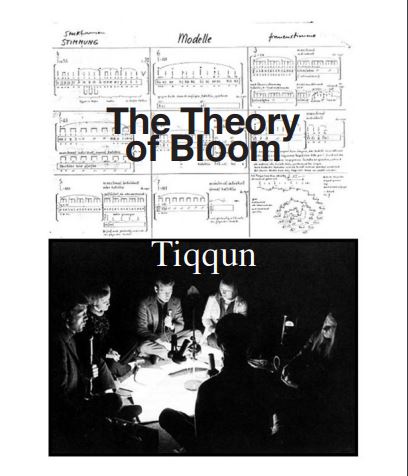
Theory of Bloom : Tikkun

Tikkun Bloom

The Absence of Center

“poetic language directs us not towards what gathers together but rather towards what disperses, not towards what connects but rather towards what disjoins, not towards work but rather towards the absence of work […], so that the central point towards which we seem to be pulled as we write is nothing but the absence of center, the lack of origin…”

-Francoise Collin on Blanchot

maurice-blanchot-4

Click to access Peter%20Pal%20Perbart.pdf

Click to access Peter%20Pal%20Perbart.pdf

Click to access Peter%20Pal%20Perbart.pdf

Click to access Peter%20Pal%20Perbart.pdf

The Need for Help

“I am affected not just by this one other or a set of others, but by a world in which humans, institutions, and organic and inorganic processes all impress themselves upon this me who is, at the outset, susceptible in ways that are radically involuntary.  The condition of the possibility of my exploitation presupposes that I am a being in need of support, dependent, given over to an infrastructural world in order to act, requiring an emotional infrastructure to survive.  I am not only already in the hands of someone else before I start to work with my own hands, but I am also, as it were, in the ‘hands’ of institutions, discourses, environments, including technologies and life processes, handled by an organic and inorganic object field that exceeds the human”

  • – Judith Butler –

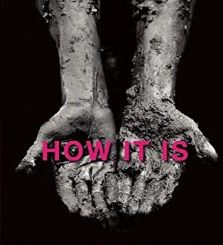
Howitis - Beckett

“Help!?”

He cried, it cried, I cried.  But help, it will not come, for me.  And why should it?  Who could owe me assistance, and why?  And what would it benefit another? Even how might the crying become?  Often silent, unheard; a gesture or tone; a constant “I am unable to do this alone.”  There’s no reason.  No reason that someone might help me.

Help has come.  Many times, and that greatly.  Otherwise I would not be alive.  Irrational, inconceivable, as ‘last measure,’ – the cry’s been expressed, even shouted or posted: “I need help or we will not survive!”  And it’s come.  Never “I.”  The yelp always weighted with “we.”  In deep over my head as a man, as a father, a worker and thinker as well – always “help!?”  Needing contact or touch or attention.  Needing hearing or care or advice.  Needing teaching, protection, support.  Needing money or sitters or transport.  Needing food.  Needing shelter.  Such needs.

I need help.  “I.”

Whatever effects or affects, I believe that I do try to help.  To have food for my children, and beds.  To respond to emotional traumas, disturbs – to hear and attend and comply.  To love others embodied and minded.  Within (my) reason, I do what I can to assist, especially those gathered about me.  I experience my’self’ as RESPONSE-able – once engaged there’s a sense that I must.  Some say that we choose to do good – but I question.  Many insist we always have  choice, yet I seem unable to abandon or neglect, unless, perhaps, my “self” or theoretically.  I am prone to the “people are people” – shaped by time and engagements – to behave in the world as they are, and continue the way that they be (in small measure).  The issues of scale and of time.  We do what we can to survive.  Some prone to survival of others, some not.  Depends on the value of “self,” so it seems.  I help, which develops that value (I hope).  To think I might matter, be dependable/depended on, be important – to someone, somewhere, at some time. Survive.

And I notice myself ever howling for help.  Help!?   As I age, I distinguish the needs.  Need for contact and talk – to think and to feel; needing help with evolving demands.  “Man,” “parent,” “student,” “professional,” – all extensions of what I once was – just a “human.”  I can’t even survive being that, let alone all these complex designations.  Artificial “helps” like alcohol or nicotine, religious belief or “self-help” seem to do as much harm as relief.  As babies and aged we are weakened…our “primes” occasioned by a nexus of supports.  In our weakness, we comprehend need(s).

I need.  “Help!?”

Without knowing what it is or might look like.  I know that I’m drowning.  I age.  I know no one owes it, the benefits would have to be rationalized.  I fail.  I can’t go on.  I must go on.  I go on.


You must go on, that’s all I know. 

            They’re going to stop, I know that well:  I can feel it.  They’re going to abandon me. It will be the silence, for a moment (a good few moments). Or it will be mine? The lasting one, that didn’t last, that still lasts?  It will be I? 

            You must go on. 

            I can’t go on.          

            You must go on. 

            I’ll go on. You must say words, as long as there are any – until they find me, until they say me. (Strange pain, strange sin!) You must go on. Perhaps it’s done already. Perhaps they have said me already. Perhaps they have carried me to the threshold of my story, before the door that opens on my story. (That would surprise me, if it opens.) 

            It will be I? It will be the silence, where I am? I don’t know, I’ll never know: in the silence you don’t know. 

            You must go on.          

            I can’t go on. 

            I’ll go on.

–Samuel Beckett, The Unnameable


Needing the Other

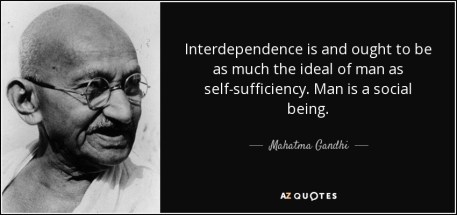
Ghandi - Interdependence

Sometimes we weep, “I need you so much.”


Do we grieve from the weight of the need?

Or the needing of differing things?

Do we weep that our need’s not provided?


We need.

And need differing things.

And need other than can be provided.


As long as the grief is not shame.

For what harm in need?

Like anything else,

we depend

-in truth-

on a world

made of so many

things –

to exist, to alive,

to continue.


And why not one another?


I am and you are

Without which we are not


That is need,

that is all,

that is fact.


Without air, food or water

the body declines.

Without commerce,

event,

the mind will not thrive.

Without you

what is I

will diminish.


That is nature.


There’s no shame in the needing.

No recall in the fail.

The “meeting” is all –

the approach and response,

the expression of need

and its answer.


Insufficient and varied,

incomplete and alloyed,

is never the fault of the need –

only moment.


“I need you,” I weep,

and I do, it is true,

and the you that is current

needs me.

That is all.

It is fact.

It’s the case.

We can change it, okay.

We can do.


But the need will remain,

because that’s how we are

dependent by nature

on nature, on world,

on persons and places and things –

on each other.


We’re human, you see?

Altogether because

We BE from the CAUSE

of each other.

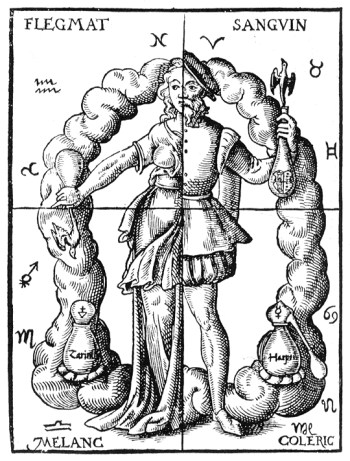
Anatomy & Physiology

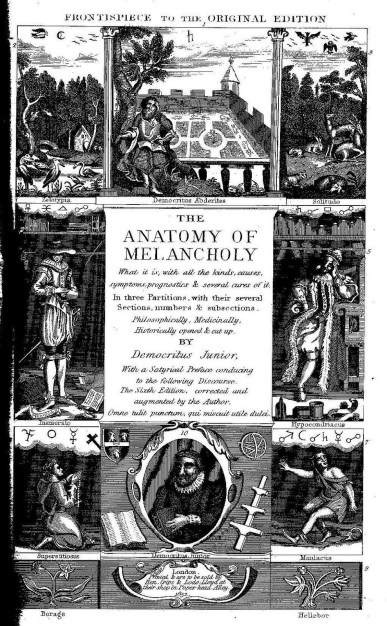
Burton - Anatomy of melancholy frontispiece

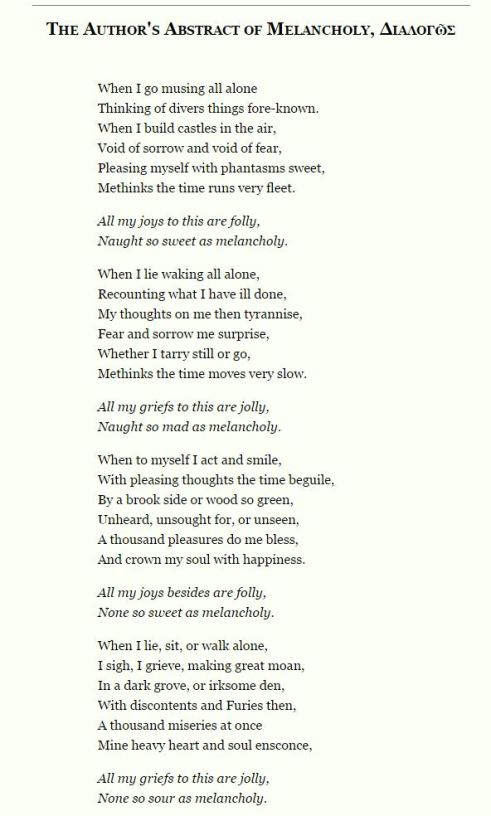
Burton - Abstract1

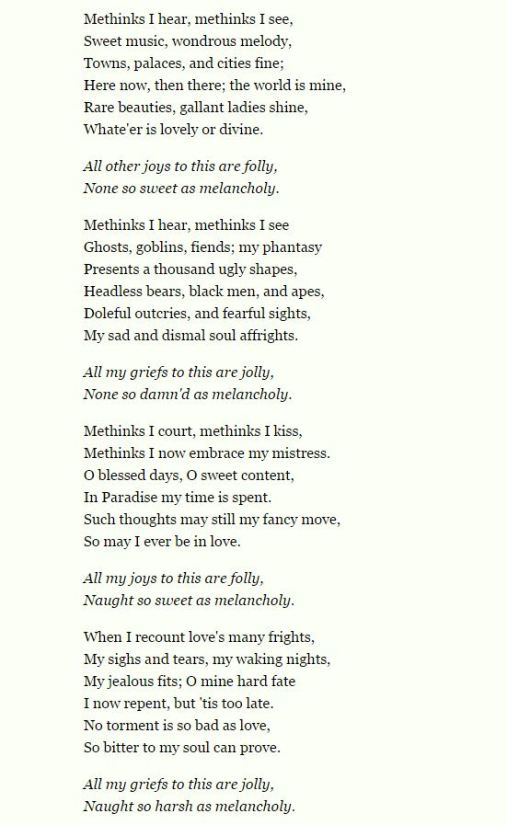
Burton - Abstract2

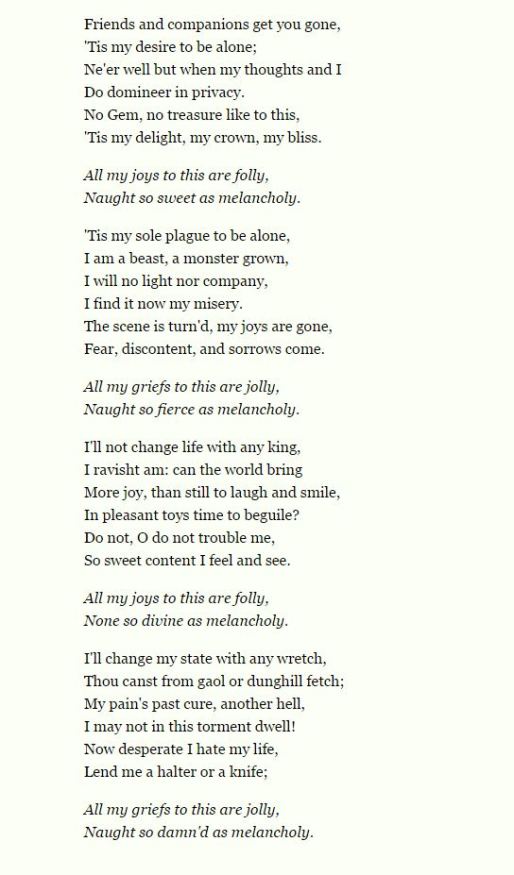
Burton - Abstract3

-Robert Burton, The Anatomy of Melancholy –

Burton - Moods

Pursuing what Eludes…Borrowing : Blanchot / Bataille

“Perhaps dread is always the more powerful; 

perhaps the joy granted to the only animal that knows it is not eternal is poisoned from the very beginning.”

Philippe Lacoue-Labarthe – Ending & Unending Agony: On Maurice Blanchot

reading dead profile

“Indeed, man is always in pursuit of an authentic sovereignty…We shall see that in a number of ways he continued to pursue what forever eluded him.  The essential thing is that one cannot attain it consciously and seek it, because seeking distances it.  And yet I can believe that nothing is given us that is not given in that equivocal manner…”

“Thus, at all costs, man must live at the moment that he really dies, or he must live with the impression of really dying.”

“INDEED, NOTHING IS LESS ANIMAL THAN FICTION…”

Profile

“It is not Hegel alone, it is all of humanity which everywhere always sought, obliquely, to seize what death both gave and took away from humanity”
“In order for a person to reveal himself ultimately to himself, he would have to die, but he would have to do it while living – watching himself ceasing to be…”

government-logo-US-Library-0018-1383-brand

“Man does not live by bread alone, but also by the comedies with which he willingly deceives himself.

In Man it is the animal, it is the natural being, which eats.  But Man takes part in rites and performances.

OR ELSE HE CAN READ:

to the extent that it is sovereign – authentic – LITERATURE prolongs in him the haunting magic of performances, tragic or comic.”

Georges Bataille – Hegel, Death & Sacrifice

Borrowing

“We are at the bottom of a ditch and there is just a parcel of air to be found, a parcel and when it is done, we push at the space, and another little space of air presents itself.  Who can talk of love?  There is only air – or none, and if there is none then there is nothing at all.”

“All of a sudden, he thought, all of a sudden, nothing is enough for me.”

“But if life is just that, just being reasonable, then there is nothing in it – nothing worthwhile.  So, the yearning that we have to keep dead things living – or to make unreasonable things reasonable.  That is why a person should live.

— Is it a paradox?

— I don’t think it is.  I think the whole thought makes sense together.  Neither side is complete.”

“I am alive, he thought, and now I am capable of living.”

–Jesse Ball, A Cure for Suicide

Ball - Gerard - Suicide