
Holidays have a way of obstructing and crowding out creative time for me. Oh we find ways to express and produce – Holly’s making candles with all sorts of found objects downstairs as I type this, paper snowflakes, new stories and pictures from the children, new compositions sounding throughout the house, but for the snail’s pace of reading/writing processing/producing I prefer…well… I often find the compounding of anxiety-inducing public spaces and family gatherings, people and lights and jangling music and cheer, busying trips and spendings and time limits to all but obliterate my ability to bring anything out of the scraps. Last Saturday, my daughter Ida, who is forever cabbaging papers, pens, markers and tape anywhere she can find them, metamorphosing them into handmade notebooks, letters, scripts and stories to read and share with her lucky family and friends, handed me the following with the message: “this is for you.” So today, amid projects and budgets and organizings and so forth…when I was just about to write off the next two weeks for personal creativity…I grabbed this and took it to my desk…
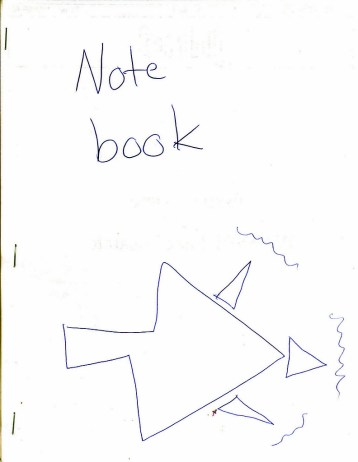
…and so it begins…
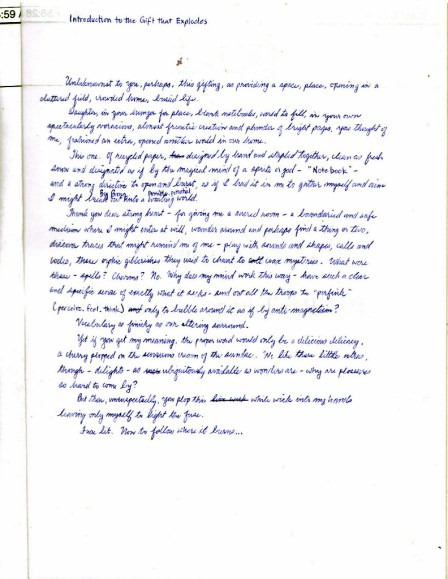
In case you can’t read my mumbling handwriting – here is a typed copy: (have to click a couple of times for some reason?!)
“As I was saying perhaps ignorance is the key. We all of course know what’s going to happen next.
Only artists don’t know what’s going to happen next a quirk of ignorance they share with history and the weather.
This is the key quirk of the quirky mind that produces the work of the artist…
…Stories don’t have reasons.
Or if they have them they have them after the fact like the weather.
Then the reasons become part of the story.
The mind is like the weather and this is the reason that everyone likes a good story.”
-Ronald Sukenick-
“For, in effect, the humanities have as their implicit agenda the cultivation of hypotheses, the art of hypothesis generating.
It is in hypothesis generating (rather than in hypothesis falsification) that one cultivates multiple perspectives and possible worlds to match the requirements of those perspectives…
…the language of evocation substitutes metaphors for both given and new, leaving it somewhat ambiguous what they are substitutes for…
the ‘relative indeterminacy of a text’ that ‘allows a spectrum of actualizations.’
And so ‘literary texts initiate ‘performances’ of meaning rather than actually formulating meanings themselves.’
And that is what is at the core of literary narrative as a speech act: an utterance or a text whose intention is to initiate and guide a search for meanings among a spectrum of possible meanings…
…the author’s act of creating a narrative of a particular kind and in a particular form is not to evoke a standard reaction but to recruit whatever is most appropriate and emotionally lively in the reader’s repertory…
…set forth subjunctively to allow them to be rewritten by the reader, rewritten so as to allow play for the reader’s imagination.”
-Jerome Bruner-
(a continuation of Else – Erasure : Beginnings)
Aziff : Prompted by Comments
Once begun, and begun in You-ness, though perhaps not – indeed probably not in any way! – in Newness, you take leave in the middle. Or if not the middle of this brief engagement, somewhere, alas, in its midst, you set out.
“The place I really have to get to is a place I must already be at now” Ludwig Wittgenstein said, which you almost remember, and in any case you think of now, triggered by its inscription among the paper scraps scattered over your writing desk.
Already you’re sick of it. The You-ness you hijacked in hopes of Newness. Your playabout with something Else. Attempting to trip or trick yourself into some place else, somewhere other than where you “must already be at now” – the Else you set about pursuing, by dissecting and deconstructing it on your desk.
You come up short. Feel foiled. A stray comment from some other immediately exposing a cheap and shoddy sleight-of-hand you yourself could not perceive. The danger of others, of else. The dangers of self-encounter in dialogue.
In any case, you create, or you go on making with all that is already tired and old. Namely, yourself, and whatever is at your easy disposal, fearing in advance what might be required to move. Toward what could be New, into the unknown of the Else.
You tackle the pieces, a limited arena of shuffled scraps – quotations, emotions, experiences – in hopes a pattern emerges, an inventive cohesion. Unlikely, or forced. The banality of meaning – a fundamentalist smallness of purposes or cause. You vomit.
It’s a discomfort – as if from some trauma stored throughout your body and brain – a fear of what you cannot identify, having experienced it (“suffered” is how you put it, and “endured”) as an unspecified complexity of connectivities too slender to hold or locate – the incomprehensible self – that atomistic and invisible dot-point in a universe of flickering.
Whereas you are able to imagine others and else as substantial – entities with agency – in all the vastness. What you can observe with less participation, seeming more real to you, somehow.
Else – you just get lost in the dissection. Labyrinthine traces of fact upon facts, ad nauseum infinitum… The searching for cause and impact in a loop within a web caught in a net stranded among strands inextricably interlocuted in endless structures and systems imperfectly operational. And so forth, you consider the sources. Always coming up missing or bereft.
Cease. And breathe like a statue. It doesn’t. You don’t. Else.
Not what you thought you were looking for.
New probably just meaning something different, you repeat yourself, something Other, something Else.
You set out.
It promises to be a very good day!
Erasure
It will have to be something new, you think to yourself, beginning. What’s been done before is already present. All the brief and poignant things gathered. Already processed and past-eurized.
Heroes are made, families described. Every aberration. Otherwise we wouldn’t know, would we? So much sex and images, and the inner lives of children. Histories and sciences, and the nothing that affords, beyond.
New probably just means different, you say, using old words already. If it’s a word it’s definitely been done. Or an action. Dreams and thinking too. Which leaves you with little, if not naught.
You once composed a text of tinntinnabuli – it was fascinating to you. Also a fugue of sorts, even a classical symphony, all in words, one in the twelve-tone scale. Little matter with a missing orchestra. Fit snugly into your drawers.
The series of anthropomorphic fruit. What they felt and how they perceived, from rind to seed. Even the veins in their fleshes, bruises, and each distinct and delicious juice. Cycles of life, inevitability of change, sprout to rot.
Who cares?
Yet it’s what you do. Identify moments and make them stories to exist. Wrapped in the tangles of problems, sentence-wriggle-thread your way elsewhere. A place that looks like knowledge. And sometimes feels.
Like mathematicians with their unknown variables – it’s the ocean you swim, an amoeba almost.
You sought after mastery but found it banal. Meaning didn’t make any sense. You turned to hypotheses, but not the wilder the better. You had to squeeze through gaps, hoping for openings. A friend called it spelunking, and it did seem dank and cold and blind. Often.
Restatement is not what you’re after. Nor refining. If thinking is digestion, you order an autopsy and strange foreign parts. Intake as transplant.
Distinctive takes a while, but quickly regurgitates style, and you’re back to remarking, remembering…remorse.
Today you’re dissecting an Else. Not again, or if\then, or more, but the Else. What else? you say. You don’t know. But it lies here dismembered, deconstructed on your desk. It’s pretty messy. The pieces aren’t going to fit, even though you’ve studied jigsaws and puzzles. Inventing new ones feels like metaphor or code, a twiddling thumb to decipher, something no one has time for even if they wish they did.
It will have to be something new to count as satisfaction, you consider. And you take up the large eraser.
Lost in an inscrutable world and running out of time. Always running out of time – don’t you feel it?
We try to describe it to each other – what we experience, perceive, how we learn to survive. We call this – in varying levels – relationship. Depending on the amount of explanation and exposure, cataloguing “acquaintance,” “stranger,” “family,” “friend,” “lover,” and the like. A kind of measure. Recognizable connection or estrangement.
But the world is inscrutable, as are we, thus we name ourselves “lost.” “At least we’re lost together,” some said, but others thought we’d find out more apart, in other words “split up and look for clues.”
What would the clues be for? From whence this idea of “clues” to be searched? I wonder this. Did someone somewhere “find” something indicative of something really “else”? Other than this world and we in it?
I meet one of us who “has a feeling.” She has this “sense,” she says, that there really is an Other – something or someone truly outside of this barely discernible world we (at least) found ourselves and other things in. I ask her to describe the feeling and her ensuing language reminds me a lot of feeling-collections I also have gotten from time to time. Without, I might add, ever considering them Other-worldly. What is to account for this? These are the sorts of discussions we wanderers have.
How might I recognize a clue? Where did the idea/referent/template for such a signifier originate? Martin found an interesting, that is, noticeable pattern on the shell of a turtle. It appeared roughly to resemble little squarish shapes of wood we use to count by or play games with, sometimes even to carve on and trade for fruit or grasses. Martin thinks this might indicate that the shape we use for wood was natural – inherent in the world – purposeful. Not coincidence or accident, but a sign or clue about “the way things are.” There were 16 of these rectangular shapes on the turtle’s back.
“Why would you think that, Martin?” I asked. It is curious and fun to find similarities in the world – between people, smells, shapes, sounds and colors – all sorts of things – but why wouldn’t we notice like or familiar things in new situations? To make it feel, well, less inscrutable? That way we could learn about the unlike, describe the difference. This, at root, was what I understood by the word we used, or called – “learning.”
I ponder the projection that making things seem more uniform might help us feel less “lost” or confused in our surrounding world. So I might be expected to gravitate toward humans of the same height, weight, or hair color; that make the same sounds as me, recognize the same shapes, eat the same objects, and so forth. Somehow this practice strikes me as less interesting, ever running out of time (as we all agreed, once we’d broken our existence up into increments) and with so much unexplored and perhaps unknowable world still surrounding us all.
I take on the habit of investigating difference – I discover that finding similarities in my surroundings comes rather easily, nearly automatically, but aspects that are unique or defamiliar tend to more efficiently further my familiarity with the world. It becomes a strategy not of looking for clues or surfaces pointing to something else, but simply finding else everywhere. Even in the same “place.” There appears to be no end to variance (even in myself) and therefore no static “same.” I find myself always finding, discovering other in every moment, the differences forever expanding my knowledge of, but also maintaining my ignorance level of, the world I find myself in.
A perpetual state of wonder.
On Beauty: A Portrait of My Wife
If I don’t write it, what reality does it possess? What substance or content are a memory or vision? Sound? Fleeting concatenations – experiences. Which is why I ask. Like Dante or Cervantes, Homer or Herodotus, does not here a duty lie?
If no one inscribes remarkable things – they will not be remarked, thus no further remarkable. But is writing a re-mark? Are we indeed marked by perceptions – jumbled, edited and collated into what we call experience – do they leave some discernible trace like magnets in the guts of a computing machine – that might be recalled, rebooted, reformatted and marked again? Or is that creation? New traces born of the old? What similarity – what identity – obtains?
If the scribe exists to codify – to translate vanishing occurrences into a relatively more stable domain – how should he select? What criteria? Whose testimony? Should he, as artists of old, gather the evidence and forge, in his matter of medium, some combinatory new myth? Take account of as many angles of appearance or observation as he is able, to contain and collage them into space like Cubists?
We call it “re-presentation” but we are crafting something new, something else. The eye is not a camera. Seeing, hearing, what we taste and feel are highly selective pro-activities – never catching a solid snippet or observing still life. We develop according to what we expect. Intuitive anticipation.
The façade of a building – you’ve already supplied it with volume. Unseen. The photo of your child – gains dimension and sound, perhaps even smell and sense. Context invested. Invented. We cannot stop the alchemy from going on. Nor would we really want to. And yet – what might we preserve?
Suggestions?
This began as a portrait of my wife. An impossible thing. It will end still farther from its goal. I meant to remark what has marked me profoundly, filled me of scars and traces, redirected my nerves and my blood, and I am left with the unexpressed, and these scribbled words of a man.
“What does it mean, to know it and not be able to say it?”
-Ludwig Wittgenstein-
part of our weekly practice of participation in the lively community prompted by Rochelle Wisoff-Fields Friday Fictioneers – I encourage all to join!

Brave New World
Assembling for the task, we began. Each in our strengths conspiring. Tristan executed calculations which were pinpoint. Ida concocted the sounds and the language we could use, boxing up the requisite books and emotions. We counted on mama for the overall surround, a global view of the society – espousing natural characteristics and roles. Oliver modeled the world and placed it on a bucket. Everything was ready – needing only performative passion – a unified desire. We waited for Aidan, lugging the chains that would keep us on course, to hold back entropy’s risk. Leaving me to chronicle this family’s brave new world.
N Filbert 2012
Student Magazine of IISER Mohali
Music, Musicology, and related Matters
a photographic pilgrimage to Orthodox Christian monasteries across the continent
Meandering Through a Literary Life
Orthodox Christianity, Culture and Religion, Making the Journey of Faith
Erik Kwakkel blogging about medieval manuscripts
"That's the big what happened."
Networking the complexity community since 1999
 All my Words are Silent