Haunted Man

[from a crumpled writing found under a car seat among additional trash, transposed to typing as a record of a mind’s mayhem and mistakes]

“Deliver me, prays the haunted man.  Therefore…”

Gunnar Olsson, Abysmal

I am Dostoevsky and I am Beckett.  I am Hegel and Heidegger and Holderlin.  I am Kafka.

I am not good enough for any of you.  I do not merit your time nor your attention, affection, sensibilities, your human talents, or your care… no conceivable reason to mention “love.”

But I love you.  I am the one who loves you.  The one who writes.  Who writes these words.  The haunted one, the Reader, the Librarian; the Lover, Scholar, I am me.  I love you.  I am haunted.  Words runnel through me, and with them thoughts, and with them feelings, and with them meanings, which means…nothing.  No matter, no space, no time.

The “haunted man” is a passage, a passing, a ‘type.’  Of no import, little reality, barely occurrence.

*

I am Blanchot, am Homer, am divine Scriptures, and Shakespeare.  Simply, small-ly, in my own way, this very general way, I am what humans do with language.  For one another, with one another, to one another, as.

*

Yards and houses, flesh and voices, signs and symbols, marks and sounds, music and rhythyms and gestures, as attempts to conjoin – join and connect – survive, discover, endure, be, become, in-volve… With no idea.  Or ideas that continually prove false and faulty.  Elaborate records of revision, perhaps better inscribed as simple songs of effort.  Urges only TO BE, and that, TO BE CONNECTED.

But what do I know?  I’m Pythagoras, call me Ishmael or Ahab, Everyman or Whatever.  I’m out-dated.  Assign me a number.  I don’t really care.  I really care.  I am here, and I, (at least) re-present, or present again, or presence, a sort of being.  Such as it is… with no “REAL” way to evaluate, estimate, “tell,” or “express.”

*

Satan, then, Jesus, Joyce, Proust, Alexander.  No matter, no space, no time, only IS.

A “tradition” (as it were, in our own words).  We.  Its + That + This.  US.  Humans strangely (apparently) in environments.  These ways of thinking, of being, of behaving and operating, of supposedly surviving (but with what evidence?  WHO or WHAT might know?).

How might elements arranged thus & so, survive?  I am Nebuchadnezzar, Mohammed, Hammurabi and Ishtar.  I am ab-original.

I am Nothing.  Everything.  No one.  Me.

Each time.

Each press of the pen: “Hello – ‘here’”

*

As simply as I can construct it (all of it, any of “it”) it goes something like this: accidents occur, accidents are weird, and accidents give way.

I, like all other(s), an accidental novel.  Occasional and Whatever.

WHAT HAPPENS TO BE… at any given point-of-measurement (i.e. as far as we have a capacity to render, sunder, and effect – “Reality” (for us)).  Some quirky, unlikely, ridiculous, painstaking, odds-massively-against, and over-dramatic assessment of a certain sort of being-in, being-with, co-occurrence, happen-stance, we fabricate “human.”

TO BE SOMETHING

(organism, constituent, element, participant, activity)

*

In many other words (for the sake or ability of ‘them,’ ‘it,’ ‘all’) I may as well be.  Be Hallie or Ollie or Aidan or Rhesus.  Chief Joseph or Samson or Ghandi or Jordan.  Be you or Sara or Maya or Jimmy John.

“no matter.  Try again.  Fail again…” no matter.

THIS TOO SHALL PASS.

“the venom of the serpents were within him”

Gunnar Olsson, Abysmal

HOW SHOULD I KNOW?

*

And so what if I were Bernhard or Bach, Napoleon, Attila, Montaigne or Dorothy Parker?  If I had the ammunition or energy (and weaponry?) – the rhetoric, the nerve, or the madness.  L. Sterne, Nagarjuna, Hafiz, JL Borges?

“No matter.  Try again.  Fail again…”

Titian, Beethoven, Plato/Socrates, Palestrina.  Michelangelo, V. van Gogh, and Chuang Tzu.  You.

“No matter.  Try again.  Fail again.”

(hardly Beckett)

“All I know is the text” – Samuel Beckett

“A voice comes to one in the dark.  Imagine.

…Deviser of the voice and of its hearer and of himself.  Deviser of himself for company.  Leave it at that.  He speaks of himself as of another.  He says speaking of himself, He speaks of himself as of another.  Himself he devises too for company.  Leave it at that.  Confusion too is company up to a point.  Better hope deferred than none.  Up to a point.  Till the heart starts to sicken.  Company too up to a point.  Better a sick heart than none.  Till it starts to break.  So speaking of himself he concludes for the time being, For the time being leave it at that” – Samuel Beckett, Company

“The words spoke by themselves.  The silence entered them, an excellent refuge, since I was the only one who noticed it.” – Maurice Blanchot, The Madness of the Day

So, speaking of himself, I only noticed it.

The small furry animal, almost humming in its purr, he had chance, so he thought, to please, to comfort, with a pet, a scratch, an acknowledgment, tender, while it butted and marked itself against him.  The illusion.  A kind of company in itself (or to).

The ungrammaticality of occurrences.  Of happening.  What happens to be.  Or is not.  When speaking to himself.  Without voice.  I was the only one, as far as I am able to tell – if in fact this is telling – who noticed it.  It seems words speak of themselves.  From elsewise and through whom.  He says, speaking of himself (or to).  Without voice.

Devising.  Illusion.  I devise, he says, speaking to himself, of himself, without voice.  Seeking – is he? – Am I? – Seeking…company?

A small child (another illusion, devised) passes by, walking a young dog and waving a nod of sorts – I don’t remember which, he says, but I returned a gesture and obtained a moment of calm in the chilly Autumn breeze.  There was a sun full of color due to the leaves in their change, and fall, and flutter (due to the nothing-shaped wind).  But what seemed a moment of warmth, of calm, devised by a child with a dog and a friendly (fearful) gesture, he thought (speaking of himself without voice), I was the only one who noticed it.

I take to reading then – others speaking of themselves without voice (or beyond it) – in order to devise… company? he wonders of himself, to himself.  For when reading, it surely seems the words are speaking only of themselves, no matter who pens them.  Such the character of the texts he chooses (I thought of myself, to myself, or an other I devised as myself, like puppets).  And in part read and read for the experience or feeling that I alone notice it.  That I might in fact provide the company I devise, yet hardly able to tell since I have not penned the words but merely notice – borrow, listen? (there are no voices) – the words seem to speak of themselves.  Without voice.  (He said of himself, devising).  Something like company.  Perhaps.

Even in the color-filled sunlight of Autumn days, I at times experience myself as being quite deeply in dark, he says speaking of himself, myself, devising voices, soundless, out of words that seem to be speaking only of themselves and their variegated histories and usages, and billions of potential speakers and hearers and interpreters – creators and devisers – filled with ambiguity and application.  Here with me on shavings of dead trees, providing stark living contrast to Winter’s day-night.  I get confused, he says speaking of himself.  Confusion too is company devised, up to a point, I suppose.  Obviously “fusion-with” implies an other, perhaps enough, I said, speaking to myself, without voice, here on dead leaves in black scars.  In mutilation.  Transgression.  Inscription.  Perhaps the words will speak of themselves and some other “I” will claim to be the only one that notices.

A strange delusion of company indeed.  He says speaking of himself, devising a voice, its hearer, and an himself as participant and therefore a company to keep.

Reading: “only a detour is adequate” (Agamben), and “in pursuing meaning we are pursuing our limits” (Allen), and was perhaps meaning a synonym or metaphor, simile or metonymy for company he thought, speaking to himself, without voice.  But with an illness, diagnosed by doctors – those scientific political powers responsible for providing facts or devising happenings, pronouncing occurrences – so in any case he is not alone, being-with his illness, I thought, speaking to myself in an absence of sound.  The words spoke by themselves.

Other things as well: the furry animal, its humming purr, its actions; the trees, the leaves, the wind, the light.  The child, the dog, the gestures.  The books, the authors, the words themselves.  Divisors of voices, of hearers, of selves.  Sick hearts, confusion, and company.  Am I the only one who notices? he says speaking of himself, speaking of himself as another.

So speaking of himself he concludes for the time being, For the time being leave it at that.” – Samuel Beckett


Untitled Fiction III

III.  “…with murderous care…”

Jon had said, to Jesse, about the fires.

So we persisted, Jon, Jesse, and I, and the deceased Beckett, with perhaps thousands of others, unbeknownst any to each around some mythical innermost.

“Fail better.”  The worst times are the ones in which one simply wants to quit failing altogether.  Unfortunately (literally) that necessarily entails a kind of “end of the world as one ‘knows’ [perceives, participates, experiences, or imagines] it” – either suicide, tragedy, ‘terminal’ illness – death of some sort.  Maybe silence, but that’s not certain.

The game table is always already laid, you’re always simply ‘entering’ it (LW points out this fallacy in his collections of numbered critiques of anything anyone writes or says or claims) actually (as far as we know) always already there (where you ‘find’ – what?!? – your ‘self’ – what?!?) and (again, perhaps, literally, unfortunately – or at the very least extremely limitedly) you can only occupy one position at the table (or wherever the action happens to be) at a time, that, unfortunately, always involves the very delimited…well, YOU.  These are the arrangements as they transpire.

Language can (and does), we surmised, go anywhere.  I try to record, invent, notate, mark, initiate.  It all seems unnameable.  Or of far too many names, references, usages, subtexts and connotations, inferences and denotations, already implemented in order to represent anything undone, reconstructed, deconstructed, novel or ‘new.’  “There’s nothing new under the sun” was already a cliché at the beginning / in the earliest phases.

Fires and voids all imagined early.  [Apeiron.  Chora/Khora.  Clinamen.  Flux.  Infinity.  ABSENCE.  The ‘Other.’].  I begin.  Again.  GWFH and Freud refer to this as “repetition.”  A hopeless hope of emergence.  As different or unique as it may seem, ever a plenitude of the pre-existing.  The already-there.

Been there, done that, Beckett exhausts from his grave alongside.  “He was found lying on the ground…a voice comes to one in the dark” Imagine.  Imagine.  Everything is already there.  The table set and set again, arranged.  Already there when you wake to it.  World.

It hasn’t…apparently…been given up.  Perhaps it is inexhaustible.  Limited though we be, we seem to be teeming with it/them… efforts at the unsayable.  Unnameable.  How it is.  What is the what.  Lost in the labyrinth of the occurrence, experience, now with shoddy, partial, biased and over-specified or eccentrically particular maps, guides, or rulebooks.  Ourselves.


The “Tense of Incoherence” ( Paul Valery)

“I am suspicious of all words, for even the slightest reflection shows the absurdity of trusting them.”

– Paul Valery, Monsieur Teste

“You know, dear you, that my mind is of the obscurest sort…I am composed of an unfortunate mind which is never quite sure that it has understood what it has understood without realizing it.”

– Valery –

FOR NO REASON

Delight.  Hope.  Survival.  

Homer .  Beckett.  Kafka.  Hegel.  

Language.  

Wittgenstein.  Heidegger.  Merleau-Ponty.  

Fosse.  Derrida.  Foucault.  Sterne.  

Imagination.  Philosophy.  Fiction.

WHAT CAN BE THOUGHT? (Philosophy) “on the verge”

WHAT CAN BE WRITTEN? (Literature) “on the verge”

Maybe I’ll just read.  Perhaps suicide (stop).  Perhaps create.  Perhaps avoid.  Perhaps participate with others (friends, family, children, pets, nature).  Perhaps think and drink.

WHO CARES?  NO ONE.  NO SOME.  DO I?

Selected “foods for thought”:

The Event – Martin Heidegger.  Monsieur Teste – Paul Valery.  Replacement – Tor Ulven.  Inexhaustibility and Human Being – Stephen D. Ross.  The Meridian – Paul Celan.  Verge of Philosophy – John Sallis.  and so on.  Potentials.

Directions for staying alive (as human being).  Follow something: desire.  hope.  beauty.  sex.  belief.  pleasure.  pain.  Try something.

Read history and imagine imagining a world that sensible.

Read science and imagine imagining a world that ordered.  

Read literature and imagine imagining a world.  

Read philosophy and imagine imagining that many questions.  

Read religion and imagine imagining that many answers.

Stop.  Say your own.  (thoughts, imaginations, feelings, perceptions) to someone or to nothing (write them).

And so on.

For no reason.

But perhaps staying alive / living a little longer.

WHAT DO YOU WONDER?  DESIRE?  WISH?  PROPOSE?

And so on.

WHO CARES?             DO YOU?

And so on…

…for no reason.

Thus the life of “the writer,” “artist,” “human,” “scientist”… WHATEVER – WHOMEVER HUMAN (so-self-called) BEING.

In other words… when we encounter “literature” we (perhaps, perhaps probably) are engaging a fellow human being in the NOW – amidst an odd tactic of applying (through a strange and meddlesome nigh-universal ambiguous medium) the operation of EVERYTHING he/she knows or has experienced to the point-of-NOW.  And we (weird, individualized organisms) either find correlation and correspondence with (some or much or little) of their ‘whole’ knowledge & experience (and thus, perhaps, probably, are moved by or like them) or… find very little correspondence or similarity with our ‘own’ knowledge and experience and therefore consider them banal, useless, uninteresting, untrue, or off-putting.

WHO CARES?  DO YOU?

I do.  It keeps me alive, surviving.  I drink, I read, I think.  Attempt to forget obligations, relations, and responsibilities (I can’t).  That I’m a FATHER, that i exist in a socio-economic scenario that requires the bulk of my life be passed in “bullshit jobs” that somehow appease ‘Powers-That-Be’ and allow me a place on earth and a terrible fight to try and defend or spend ANY portion of existence doing-what-i-want, or what ‘fulfills’ or causes me happiness / gladness / joy in being alive…

When I’m able to “snare,” “steal,” “TIME” – I read and write, make love, or drink alcohol – because these things make me feel GOOD or WELL as the sort of being I am.

Why is it I feel compelled to sneak, steal, or justify what gives me joy in being? (whether plant, ant, mammal, or any other cellular construction)?

I wouldn’t ‘rather’ be famous, or a president, powerful, or a businessman, artist, or ‘professional,’ or anything.  I REALLY just want to be a human-in-society valuable-to-the-rest because I happen to be one who loves language, literature, pretending, fiction, inventing, thinking, imagining what might be – this-wise, that-wise, which-wise, whom-wise, where-wise, when-wise…

WHY IS THIS NOT VALUABLE?  ACCEPTABLE?  SUPPORTABLE?  along with each alternate things-one-might-want-to-be as valuable-to-the-cumulative…

Humans seem to be multiplicitous, variable, and plentiful.  Many wish/desire/like to be strong, rich, beautiful, productive, etc.  Why can not there also be room for those who desire neither usefulness, beauty, riches, or power… but CANS at the verges… of language, thought, imaginings?  And are these really so different from those pushing edges of other characteristics?

Suddenly this entry feels like a wallowing or a requesting of pity.

That is not the feeling.

“I am composed of an unfortunate mind which is never quite sure that it has understood what it has understood without realizing it.”

  • Paul Valery

Continuing Reading Writing

“an ‘absoluteness of absence’ if writing is to be possible” – Jacques Derrida

Certain works by Samuel Beckett eventuate an environment of silence for me.  For instance, the brief poem “What is the Word?”

What Is the Word

folly –

folly for to –

for to –

what is the word –

folly from this –

all this –

folly from all this –

given –

folly given all this –

seeing –

folly seeing all this –

this –

what is the word –

this there –

this this here –

all this this here –

folly given all this –

seeing –

folly seeing all this this here –

for to –

what is the word –

see –

glimpse –

seem to glimpse –

need to seem to glimpse –

folly for to need to seem to glimpse –

what –

what is the word –

and where –

folly for to need to seem to glimpse what where –

where –

what is the word –

there –

over there –

away over there –

afar –

afar away over there –

afaint –

afaint afar away over there what –

what –

what is the word –

seeing all this –

all this this –

all this this here –

folly for to see what –

glimpse –

seem to glimpse –

need to seem to glimpse –

afaint afar away over there what –

folly for to need to seem to glimpse afaint afar away over there what –

what –

what is the word –

what is the word

– Samuel Beckett

Perhaps the what where is always what we’re attempting to tell.  Perhaps that’s eternal recurrence / return.  The when is always known.  Always NOW.  The folly, truly folly, of our attempt to tell the what where that is our being, our being NOW, always being NOW, no when needed, no whom known, just what where presently…occurring.  Is this always what we are attempting to say?  To find words for?  To tell?  What where, now?  Always NOW – whether reading or writing, assailing past, present or future – it is NOW that it’s occurring, but what? where?  And what is the word?  What are the words for this what where we’re attempting to tell?  This is my writing, reading – in a way, it seems, the all of it – my folly.  Perhaps what where is unnameable.  

And so I also offer a reading – for even as soon as I re-read my own writing – I cannot remember the whom or what-where of the writing.  Because the reading is always right NOW.  This reading – a chapter from Mark C. Taylor’s book Tears (as both eye-leak or suffering and rift-split-rip-“tear”) entitled “How to do Nothing with Words”  (my own copy a rainbow of highlights and symbolized marginalia – like all that I read significance to). If this sort of thing – this philosophizing or wondering writing – is not of your interest – don’t bother.  But if it is kind of intriguing, or causes curiosity, I find this chapter a compelling and admirable attempt to descry the “what is the word?” tussle I constantly struggle and strive for enacting the telling what where.  

Tears

(click image for chapter, or here: How to do Nothing with Words)

And, after all that…here is neither, a short writing by Beckett to go on with…

neither

To and fro in shadow from inner to outershadow

from impenetrable self to impenetrable unself by way of neither

as between two lit refuges whose doors once neared gently close, once turned away from gently part again

beckoned back and forth and turned away

heedless of the way, intent on the one gleam or the other

unheard footfalls only sound

till at last halt for good, absent for good from self and other

then no sound

then gently light unfading on that unheeded neither

unspeakable home

– Samuel Beckett

Thank you for your time.  It goes on…


Seasons

What’s happening now…and why I’m not writing much – reading, teaching, librarying, parenting…

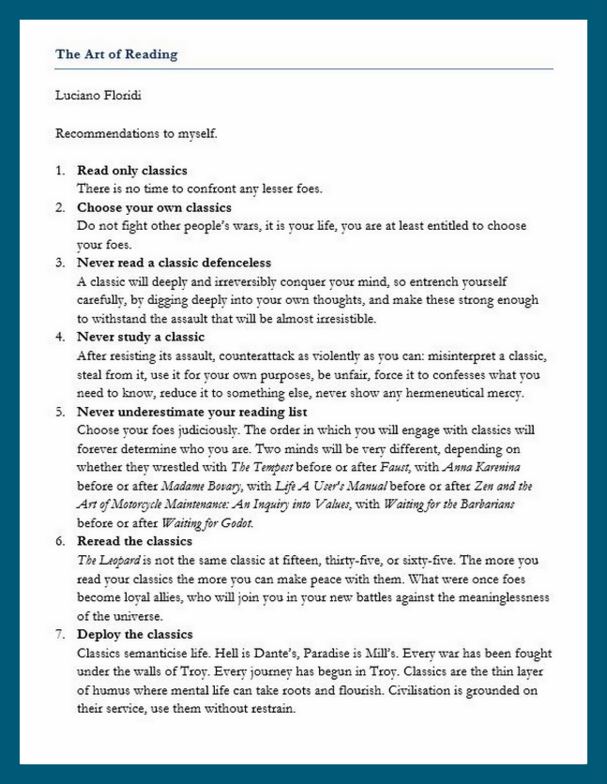
Luciano Floridi – on the Art of Reading

I dig this!  Find document here

Floridi_The_Art_of_Reading

Regurgitating Language

smoke

Voicing Smoke

(click image or text to read)

Recycling…in retrospect

Two variations of older, longer works…trying to remember possibilities…

Words Gestures Order

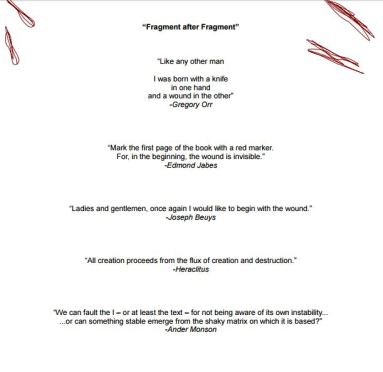
Fragments

Words & Gestures


A Far Story – Samuel Beckett

I wait for me afar for my story to begin, to end, and again this voice cannot be mine.  That’s where I’d go, if I could go, that’s who I’d be, if I could be.

– Samuel Beckett

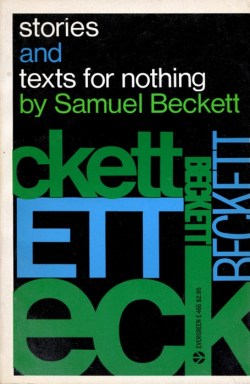
Beckett - Stories Texts Nothing

Nos. 3 & 4, Texts for Nothing by Samuel Beckett

it doesn’t get better than this…unless it’s more of beckett