The Absence of Center

“poetic language directs us not towards what gathers together but rather towards what disperses, not towards what connects but rather towards what disjoins, not towards work but rather towards the absence of work […], so that the central point towards which we seem to be pulled as we write is nothing but the absence of center, the lack of origin…”

-Francoise Collin on Blanchot

maurice-blanchot-4

Click to access Peter%20Pal%20Perbart.pdf

Click to access Peter%20Pal%20Perbart.pdf

Click to access Peter%20Pal%20Perbart.pdf

Click to access Peter%20Pal%20Perbart.pdf

Meaning

From an email conversation I am involved in regarding human relation to technology…seemed to expose a who-I-am via what-I-concern-myself-with moment in my life worth sharing… and would love any/all comments, ideas, perspectives, regarding:

“I like that inference of thought…influence of larger and smaller systems interacting in our particular (as Lemke refers to them – “focal levels”) living.  I think from Heidegger onward that attention to the reciprocal or interactive influence of what we devise/make and who we are and what makes us continuously reshaping/constructing/constituting us IS a fundamental challenge/question Humanity is within.  This is why I am drawn to technesis as a human activity.  There is no difference from developing domiciles and agriculture, accounting and writing, language and representation in its holistic alteration of the species as there is with what we are within with the devotion to the “digital” – an oddly ubiquitous remediation of experienced matter-ridden-media into this ONE SORT OF ORGANIZATION/CODING.  A strange phenomena.  I think the nearest relative is “writing” and this is where Hansen (“Embodying Technesis”) and Hayles (“How We Think”) as well as Hodder & Ingold’s anthropological works help elicit perspective (& Kittler) on how ALL technological development (craft, architecture, invention, production) so foundationally EDIT us as a species… akin to geophysical change for all forms of biological life.  I suppose what I hope for is some small increase in awareness &/or experiment of capability for Human-kind to discern what amount of agency we may (or may not) have in relation to what we evolve and construct.  Is the system too vast – the biological motive too strong – to continue exploitation and networking (also increasingly representative of our fundamental relationality) – or are we a kind of thing that can affect larger systems in such a way that is transformative?  How small of a part are we, what are our limits of capability, do we have ANY genuine (actual) capacity to discern telos of larger systems… or not (trickles all the way down to personal behavior and ‘psychology’) – can we ever determine our AGENCY (collectively / personally / speci-ally)?  Or is it airy imagination and the activity of abstraction?

Sigh.  This is where I’m at…”

The Dual Activity of the Properties of Erosion

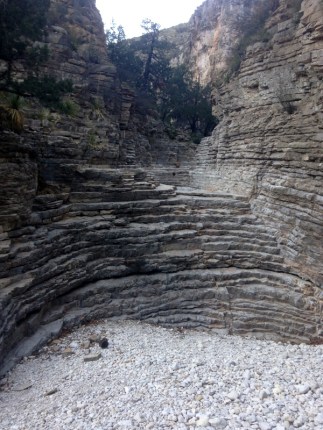
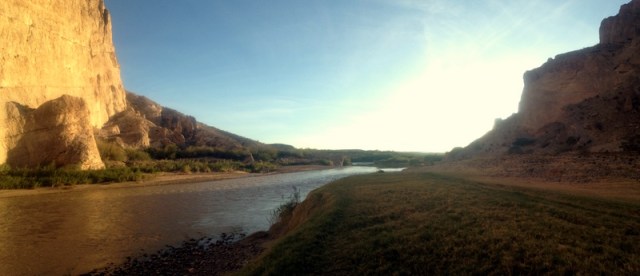
Having traveled 2000 miles: Wichita – to – Carlsbad, NM – to – Guadalupe Mountains Nat’l Park – to – Presidio, TX – to – Big Bend National Park – to – Wichita in the past few days, I was privy to the glories of erosion.  What it builds, what it wears away.

My 10-year-old is studying erosion in 4th grade and reminds me that the current definition is simply the movement of material.  What dwindles somewhere accretes in another…

IMG_0896

and leaves or creates (absence or presence of absence?) some glorious ruins (or productions)…

IMG_0911

In an accidental synchrony, we traveled the paths of a favorite album of mine – This Will Destroy You – This Will Destroy You, and the following clip has long moved me, perhaps as much as any music ever has…

…ever reminding me of how I’d like my living dying to go…the movements and decaying – its constructions – the thickened gradual swelling of the deep good of being alive, punctuated by weighty whiles of thriving and ecstasy, momentous significants of loss or gain, as materials move and their relations alter / evolve / generate and decompose.  Its insistence and tocking inevitability.  The (hopefully) delta-like depositing of the full lot, spreading throughout, in its end…

Here’s to our living-dying onlyness…and wishes toward beautiful erosion.


The Need for Help

“I am affected not just by this one other or a set of others, but by a world in which humans, institutions, and organic and inorganic processes all impress themselves upon this me who is, at the outset, susceptible in ways that are radically involuntary.  The condition of the possibility of my exploitation presupposes that I am a being in need of support, dependent, given over to an infrastructural world in order to act, requiring an emotional infrastructure to survive.  I am not only already in the hands of someone else before I start to work with my own hands, but I am also, as it were, in the ‘hands’ of institutions, discourses, environments, including technologies and life processes, handled by an organic and inorganic object field that exceeds the human”
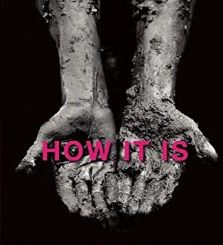
  • – Judith Butler –

Howitis - Beckett

“Help!?”

He cried, it cried, I cried.  But help, it will not come, for me.  And why should it?  Who could owe me assistance, and why?  And what would it benefit another? Even how might the crying become?  Often silent, unheard; a gesture or tone; a constant “I am unable to do this alone.”  There’s no reason.  No reason that someone might help me.

Help has come.  Many times, and that greatly.  Otherwise I would not be alive.  Irrational, inconceivable, as ‘last measure,’ – the cry’s been expressed, even shouted or posted: “I need help or we will not survive!”  And it’s come.  Never “I.”  The yelp always weighted with “we.”  In deep over my head as a man, as a father, a worker and thinker as well – always “help!?”  Needing contact or touch or attention.  Needing hearing or care or advice.  Needing teaching, protection, support.  Needing money or sitters or transport.  Needing food.  Needing shelter.  Such needs.

I need help.  “I.”

Whatever effects or affects, I believe that I do try to help.  To have food for my children, and beds.  To respond to emotional traumas, disturbs – to hear and attend and comply.  To love others embodied and minded.  Within (my) reason, I do what I can to assist, especially those gathered about me.  I experience my’self’ as RESPONSE-able – once engaged there’s a sense that I must.  Some say that we choose to do good – but I question.  Many insist we always have  choice, yet I seem unable to abandon or neglect, unless, perhaps, my “self” or theoretically.  I am prone to the “people are people” – shaped by time and engagements – to behave in the world as they are, and continue the way that they be (in small measure).  The issues of scale and of time.  We do what we can to survive.  Some prone to survival of others, some not.  Depends on the value of “self,” so it seems.  I help, which develops that value (I hope).  To think I might matter, be dependable/depended on, be important – to someone, somewhere, at some time. Survive.

And I notice myself ever howling for help.  Help!?   As I age, I distinguish the needs.  Need for contact and talk – to think and to feel; needing help with evolving demands.  “Man,” “parent,” “student,” “professional,” – all extensions of what I once was – just a “human.”  I can’t even survive being that, let alone all these complex designations.  Artificial “helps” like alcohol or nicotine, religious belief or “self-help” seem to do as much harm as relief.  As babies and aged we are weakened…our “primes” occasioned by a nexus of supports.  In our weakness, we comprehend need(s).

I need.  “Help!?”

Without knowing what it is or might look like.  I know that I’m drowning.  I age.  I know no one owes it, the benefits would have to be rationalized.  I fail.  I can’t go on.  I must go on.  I go on.


You must go on, that’s all I know. 

            They’re going to stop, I know that well:  I can feel it.  They’re going to abandon me. It will be the silence, for a moment (a good few moments). Or it will be mine? The lasting one, that didn’t last, that still lasts?  It will be I? 

            You must go on. 

            I can’t go on.          

            You must go on. 

            I’ll go on. You must say words, as long as there are any – until they find me, until they say me. (Strange pain, strange sin!) You must go on. Perhaps it’s done already. Perhaps they have said me already. Perhaps they have carried me to the threshold of my story, before the door that opens on my story. (That would surprise me, if it opens.) 

            It will be I? It will be the silence, where I am? I don’t know, I’ll never know: in the silence you don’t know. 

            You must go on.          

            I can’t go on. 

            I’ll go on.

–Samuel Beckett, The Unnameable
 

Needing the Other

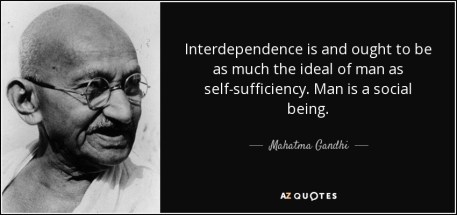
Ghandi - Interdependence

Sometimes we weep, “I need you so much.”


Do we grieve from the weight of the need?

Or the needing of differing things?

Do we weep that our need’s not provided?


We need.

And need differing things.

And need other than can be provided.


As long as the grief is not shame.

For what harm in need?

Like anything else,

we depend

-in truth-

on a world

made of so many

things –

to exist, to alive,

to continue.


And why not one another?


I am and you are

Without which we are not


That is need,

that is all,

that is fact.


Without air, food or water

the body declines.

Without commerce,

event,

the mind will not thrive.

Without you

what is I

will diminish.


That is nature.


There’s no shame in the needing.

No recall in the fail.

The “meeting” is all –

the approach and response,

the expression of need

and its answer.


Insufficient and varied,

incomplete and alloyed,

is never the fault of the need –

only moment.


“I need you,” I weep,

and I do, it is true,

and the you that is current

needs me.

That is all.

It is fact.

It’s the case.

We can change it, okay.

We can do.


But the need will remain,

because that’s how we are

dependent by nature

on nature, on world,

on persons and places and things –

on each other.


We’re human, you see?

Altogether because

We BE from the CAUSE

of each other.

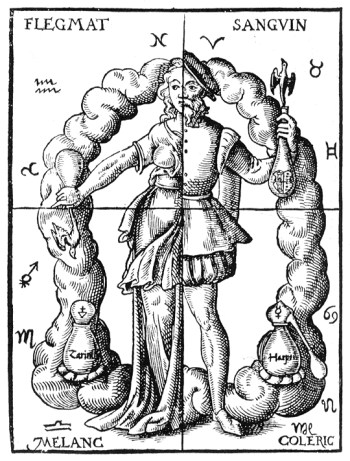
Anatomy & Physiology

Burton - Anatomy of melancholy frontispiece

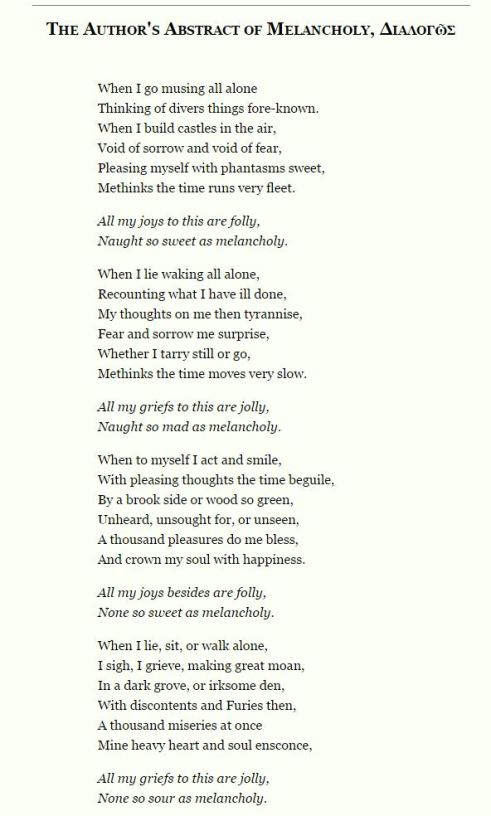
Burton - Abstract1

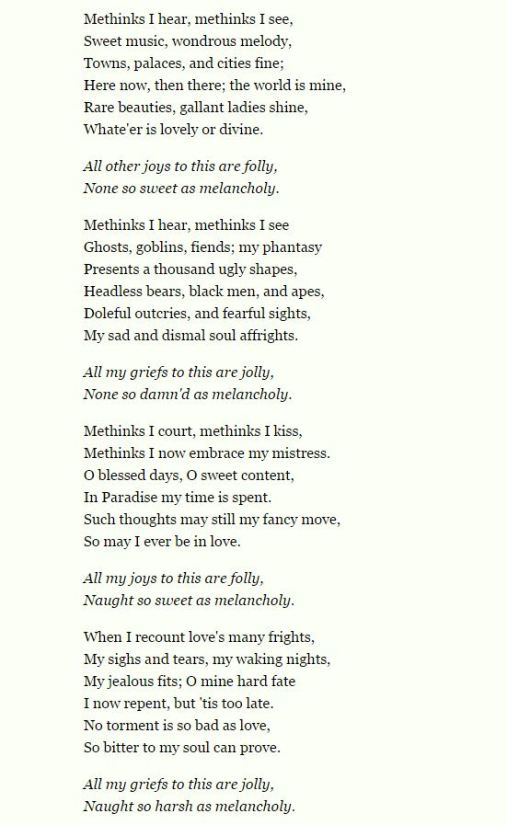
Burton - Abstract2

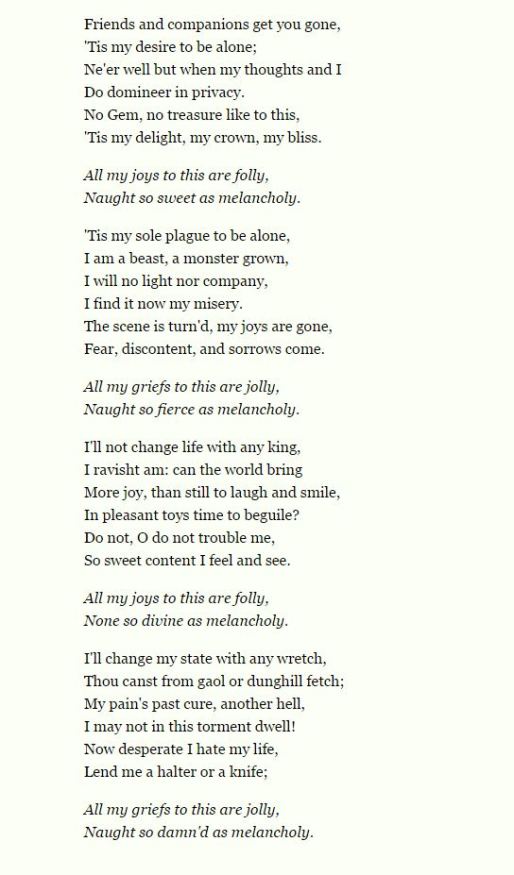
Burton - Abstract3

-Robert Burton, The Anatomy of Melancholy –

Burton - Moods

Something Becoming…Shaking a rattle

SHAKING THE RATTLE

“our fear: this is what we are made of: our weakness”

– Helene Cixous

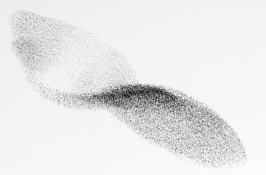
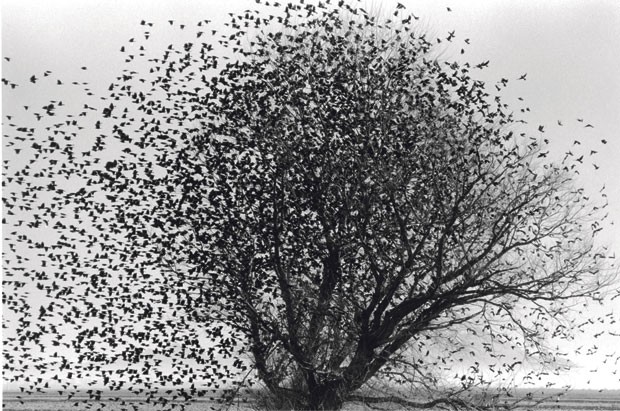
“A flock of birds turning in the sky is doing something that people don’t know how to do: moving together, beautifully, without a leader or choreographer…I study ant colonies, and how they get things done without any central control.”

– Deborah M. Gordon in Lukas Felzmann’s Swarm

lead_manuel-prestl-der-vogelschwarm

“Let us agree to apply the word ‘talk’ to all ways of experiencing sensations, actions, and ideas in signs of any kinds, and also to all ways of interpreting signs, and [let us] apply this word ‘sign’ to everything recognizable whether to our outward senses or to our inward feeling or imagination, provided only it calls up some feeling, effort, or thought…Nothing does speak for itself, strictly nothing, speaking strictly.  One cannot bid his neighbor good morning, really, effectually, unless that neighbor supplies the needed commentary on the syntax.  If he does not, I might as well shake a rattle.”

– Charles S. Peirce

(click anywhere to enter)

Borrowing: James

Felzmann - Swarm

“In the pulse of inner life immediately present now in each of us is a little past, a little future, a little awareness of our own body, of each other’s persons, of these sublimities we are trying to talk about, of the earth’s geography and the direction of history, of truth and error, of good and bad, and of who knows how much more?”

-William James-

Pursuing what Eludes…Borrowing : Blanchot / Bataille

“Perhaps dread is always the more powerful; 

perhaps the joy granted to the only animal that knows it is not eternal is poisoned from the very beginning.”

Philippe Lacoue-Labarthe – Ending & Unending Agony: On Maurice Blanchot

reading dead profile

“Indeed, man is always in pursuit of an authentic sovereignty…We shall see that in a number of ways he continued to pursue what forever eluded him.  The essential thing is that one cannot attain it consciously and seek it, because seeking distances it.  And yet I can believe that nothing is given us that is not given in that equivocal manner…”

“Thus, at all costs, man must live at the moment that he really dies, or he must live with the impression of really dying.”

“INDEED, NOTHING IS LESS ANIMAL THAN FICTION…”

Profile

“It is not Hegel alone, it is all of humanity which everywhere always sought, obliquely, to seize what death both gave and took away from humanity”
“In order for a person to reveal himself ultimately to himself, he would have to die, but he would have to do it while living – watching himself ceasing to be…”

government-logo-US-Library-0018-1383-brand

“Man does not live by bread alone, but also by the comedies with which he willingly deceives himself.

In Man it is the animal, it is the natural being, which eats.  But Man takes part in rites and performances.

OR ELSE HE CAN READ:

to the extent that it is sovereign – authentic – LITERATURE prolongs in him the haunting magic of performances, tragic or comic.”

Georges Bataille – Hegel, Death & Sacrifice

Borrowing

“We are at the bottom of a ditch and there is just a parcel of air to be found, a parcel and when it is done, we push at the space, and another little space of air presents itself.  Who can talk of love?  There is only air – or none, and if there is none then there is nothing at all.”

“All of a sudden, he thought, all of a sudden, nothing is enough for me.”

“But if life is just that, just being reasonable, then there is nothing in it – nothing worthwhile.  So, the yearning that we have to keep dead things living – or to make unreasonable things reasonable.  That is why a person should live.

— Is it a paradox?

— I don’t think it is.  I think the whole thought makes sense together.  Neither side is complete.”

“I am alive, he thought, and now I am capable of living.”

–Jesse Ball, A Cure for Suicide

Ball - Gerard - Suicide