The Loving(?) [dis]Organization of Fire

for lispector

“and it came, with its long passageways without end”

-Clarice Lispector, Soulstorm

and then again, the words, the words they came, presently, fluently, astonishingly as miracles, your body, the languid haunches – temptations, always – your breasts – these letters, formed in the hands…you, you, you, all of you, and I want/ed, I want, I am wanting to grapple, devour and subsume, consume (no, never!) you, but utterly – to the end – to everything – a swallow and fire and drowning and drought – to eviscerate, desiccate, absorb – to thorough you. I want to thorough.  I want to you, thoroughly.  Yes, that is what.  That is the who what am I?  The always when and every how – I want you thoroughly, but not you as realized by or digested in or taken or given or experienced thoroughly (without remainder) but rather

What I am saying (without remainder) What I mean is, what I am saying, shouting, quite silently shrieving, shrieking, screeing, WHAT I CRAVE REVEALING ENTIRELY BY RAVAGING TO END…

I WANT TO YOU.

And I want you to want to me, as mad, as madly, as terribly and

I am ravenous now, each instant and you for starving for me (I’d like that – have me)

but yes and I am having taking giving receiving AND YOU.

I do not understand.

It maddens, controls,

frees.

And this is what I mean.

In hopes that I was born for this…

for Hallie

The Living Dead: a Reflection

“Dad, are you living or dead..ing?” son asks at dinner (aged 9).

Characteristic pause…”Well, both,” I reply.

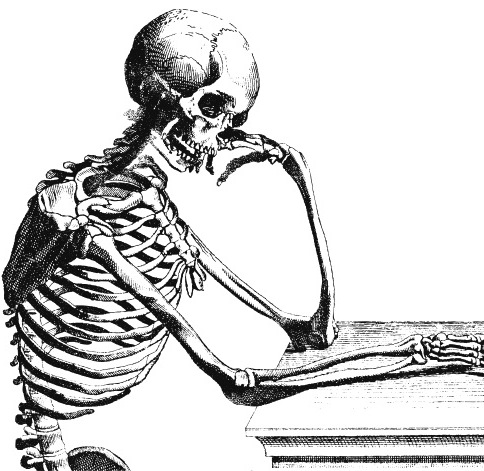
sad skeleton

How could it be otherwise?  I’ve stayed the course, exercised my body, prepared a meal, feeling fine, alone, aware…and comes the call:  “Living or dead..ing?”  Parental response – stop.  [Why is he asking?  What is he thinking?  How is he feeling?  Bodily signs?   Follow the language – “living or dead…dead..ing…dying.”  What is called for here?]  He thinks the living dead a lot,  so I respond directly:  “Well, both, and how could it be otherwise?  I couldn’t very well be dying if I wasn’t alive, no?  And the process of dying is constructed of living, yes?  So it’s all in one moment I s’pose.”

We move on.

But I don’t.  Not so much.  It’s a good question.

It reminds me why I’m a philosopher, a poet.  Why we tend toward the same, differently.  We watch for the shared, the communal in our experience, anywhere.  We work the same queries.  In a living ruled by science, by probabilities and hypothetical cause, by vague notions of what-might-happen-next given conditions and dynamically complex systems…philosophers, poets and artists tend to seek out what’s certain – what is nevertheless the case: we feel, we think, we live, we die, a world is there – the details change with the order of the day.  Or night.  The language or discipline.  The methods or culture, practice or beliefs.  Depending on the questions.  Who’s asking and how.

We happen – become – and unhappen.

Because my dad, almost 80, evinces this.  Because I’ll be half-90 in 48 hours.  What I asked for is called Cosmic Pessimism, which says something.  I happen…vary…and stop happening that way.  How that occurs, what and who and when and why change nearly as quickly as we do.  Should I say, what we think or believe occurs?  Rationalization of experience.

Reminds me of this, of the action of writing.

I still can’t do it “live.”  Can’t inscribe it as a “post” or a “tweet” or a “message.”  I’ve got to get some static.  IN-scribe is a physical act of scratching, digging, carving in clay.  ON-scribing is more what we do – laying down ink, pounding down letters, playing with light.  Writing with materials like paper and ink relatively makes something stay put for awhile.  So we can revise.  Perhaps that’s all Rilke meant – give yourself the opportunity to edit, erase, respond to your action before you present it.  Is revision revivification?  Stay something, pause.  Apply yourself to your living and choose an occurrence.  Does this wrinkle the union of living and dying?

At work I’m struggling with teaching the methods of multi-disciplinary research.  How to template a strategy of awareness to potentially everything?  We’re living and dying and attempting to know, understand, RATIONALIZE something about that.  Literally ANYthing applies, or may nourish, correct, influence or direct that essential inquiry (and DOES!).  How does one know where to look?  How does one know how to live it?  How does one know what one needs?  To synthesize rationalizations from multiple fields and methods and practices.  To compare all the answers or theories or thoughts?  To differentiate results and observations coming from various humans and schools and materials and tools and contexts and set-ups and the myriad messiness of living/dying organisms in relations beyond our control?

“You must revise your life” (Rainer Maria Rilke).

Revising your dying.  Is it possible to live moments in such a way that they outstrip the correlative dying?  To live more than die?  Once in awhile?  I think we have experiences, moments, in which we feel more alive than in others.  “Are you living or dead…ing” he asks.  Well, waking into a maze to traverse every day – cleaning and feeding and playing the roles (father, lover, employee, friend, son, writer, scholar, blogger, house-owner, house-keeper, cook, playmate, librarian, instructor, male, man, person, reader, and so on), shopping and feeding and listening and nourishing and working and running to tire – feels a bit more like “dead…ing.”  But there are moments!  Times.  “Events,” we call them (I guess).  Twistings and turnings and something like gathered occurrences, Being + Well-Being, Whitehead might say.  A more spectacular death I suppose.  Perhaps elevated experiences of living just heighten the jouissance of death?

I don’t know.

We happen – become/unbecome – and unhappen.

The marks left from that – our inscriptions, palimpsests and paths.  Veined.  Seared-in.  Scored.  In some cases, welded – some cases cancelled, erased, blotted out.  Living-dead…ing.  Vice versa?

To edit, revise, pause – is it possible?  What did he mean?  What might it mean?    Curving back doesn’t alter the time.  Going over is still going forth.  We wend and wind and whirl and reveal we are living and dying.

Wind and Bone

found in Liu Hsieh, Chamberlain for the Surrogate Secretary in the Easter Palace, in his book The Literary Mind and the Carving of Dragons, represented here by Eliot Weinberger…

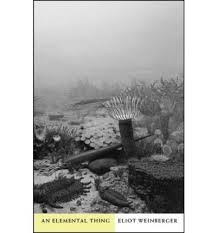
Weinberger - Elemental Thing

“The twenty-eighth of the fifty chapters in his book is called “WIND BONE,” wind and bone, and is the most mysterious.  To express emotions one must begin with WIND; to organize the words, one must have BONE.  He whose bone structure is well-exercised will be well-versed in rhetoric; he who is deep of wind will articulate well his feelings.  It would seem that WIND is sentiment and ideas, and BONE is language, but Liu also says that to be thin in ideas and fat in words, confused and disorganized, is a sign of the lack of BONE.  And yet when ideas are incomplete, lifeless and without vitality, it is also a sign of the lack of WIND.  What is WIND and what is BONE have never been conclusively determined by generations of Chinese critics, but what is certain, according to Liu Hsieh, is that the perfect combination or balance of WIND and BONE, the metaphor for the ideal poem, is a bird.”

–Eliot Weinberger, An Elemental Thing

birdsinflight

Short essay on Venice Biennale experience – Summer 2015

Glimpse of Lightness : Venice Biennale 2015
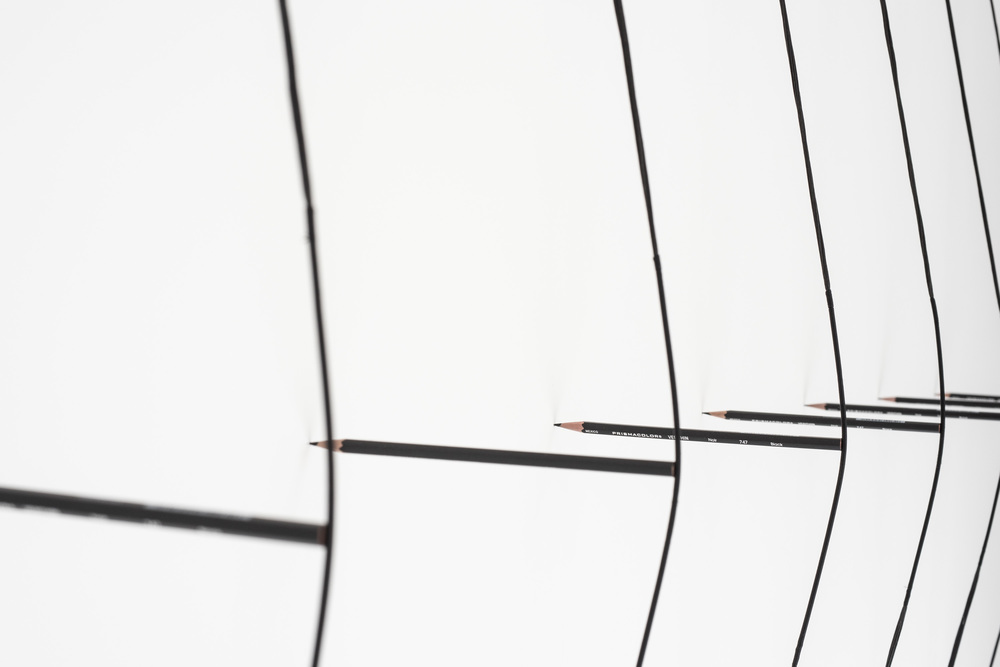
Maggi - Drawing Machine

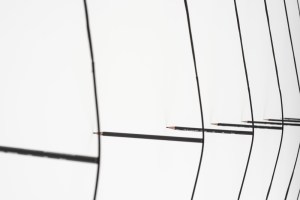
Marco Maggi – “Drawing Machine” – Uruguay Pavilion, Venice 2015

            How does art “happen”?  What is a work of art in an age of reproduction?  Who, where, what, and how are we in relation to composition, construction, collage, creation, craft… encountering “art” as a strange “zone of indistinction”, an “undecidable”[1], perhaps an interference, or intervention – at the renowned Venice Biennale 2015?  What lightness might we glimpse in such immersion, inundation, veritable floundering and bewilderment among “works of art” – the touted greats within the most prestigious cultural institution in the world.[2]

In a deep cleft of Agamben and Heidegger, physical and mental exhaustion, a set of European Graduate School students (which gratefully included myself) set out to engage “art” in the context of the famed Venice Biennale Exposition, assigned to look for “glimpses of lightness” – something “having little weight…alleviating…demonstrating ease or agility…mirth, levity…and a graceful slenderness”[3] OR – “lit brightly, illuminated, illuminating”.[4]  The day began hefty and hot with prospects of 89 national participations, 44 collateral events in the Giardina della Biennale plus an additional “more than 136 artists from 53 countries” at the Arsenale.[5]  We set out.

The 2015 Biennale was filled with many ambiguous / ambivalent / open works that, depending on the perspective of the observer, might be engaged with levity, mirth and playfulness or burdened by art-extraneous political, moral and conceptual communiqués and paraphernalia.  I found myself wondering if art was happening in such a context – a deluge and glut of politics, morality and economy.  I began looking at things curious if messages could be untangled, read past and through, passed by: emotional, commercial, personal, national, site-specific – querying – “what here is ‘being raised, set forth, set up’? (Heidegger).  ARTing: can we come to art through artists and artworks and exhibitions?[6]

Considering art as Riss – rift – an outline, sketch, drawing and marking setting into relief a “moment” or “space,” a new relation hard to distinguish, perhaps undecidable, opportunities of encounter with encountering-itself, being – itself – being, in relation to.  A passage.  Something beyond good and evil (ethics); beyond division, calculation and measure of perception (subject/object, this/that, here/there) (ontology); beyond narcissism (me/you, us/them, him/her) (epistemology); beyond laws and institutions and individuality (ours/theirs, who/what, when/where) and so on… Toward activation – activity + occurrence, an awareness, a-tension at/of/with/in NOW? [ultimate zone of indistinction and undecidability].  Play?  Lightness?  Resisting the urge to pronounce, proclaim, propose; swerving past strife, through strife – holding open? – Art…as Being…an open question?  Some undoing in its doing, some common toggling call to a present, re-present, encounter?  Are we able to tear up a world in an activity of mending, assembling and combining it (rift)?  To set up a world in an activity of revealing (veiling/unveiling) as a poet might do (oscillating signs) with a semiotic semantic, ex-hibit-ing, exposing, en-light-ening – making lines instead of following them, opening spaces rather than closing, becoming in difference to became?  I wondered what might result if we scrambled the sites/sights on some randomizing algorithm of names/nations/pavilions or scrambled the labels and ‘statements’ according to same.  To undo in order to Art.

So what rends?  What can tear through the amalgams and overlays we bring to each encounter with one another, with the world?  What might cause a rift to occur in my own perceptions, predispositions, cares, concerns, propensities?  Where do the potentialities lie?  What will bring me to the open?  Below are a few works I encountered in the heat and dust and exhaustion of 2015’s 56th La Biennale di Venezia that re-oriented me, turned me into at least two sides of a chasm, illuminated a seeing-space, a being-space for me – provided me with glimpses of lightness.

Blind Spot.”[7] The first work that woke me, intervened, destabilized and shifted my course was Blind Spot by Mykola Ridnyi (Ukraine) located in the Arsenale.  Working from the ophthalmologic  analysis of scotomas – areas of partial alterations or degenerated acuity in our normal fields of vision that are surrounded by normative and well-preserved views.  We all have them, aspects we never see clearly – biologically, culturally, psychologically and personally.  Scotoma is not a condition to be overcome, but to be aware of.  As I engaged the Biennale, I recognized that artists, nations, participants and audiences all live their existences with “Blind Spots.”  The effortful work to account for them only serves to expose further areas where “things disappear on us.”[8]  Accompanied by C-prints painted with various exemplars of scotomic affect, Ridnyi’s installation ripped an awareness into me that opened my emotional reactivity to nation-state pavilions and exhibits, artists compromises to culture and fame, my own dear lack of self-critique and clear-sightedness, and the ever open question of how and what we engage in our being-alive, relating, and “reading”/”seeing” the world.

Not far beyond “Blind Spot” resided Ricardo Brey’s “Every life is a fire (2009-ongoing,.”[9] intricate, redolent boxes opening out in glass cases – the layers, complex details and labyrinthine qualities of our coagulating, webbing construction of idiosyncratic interpretations of the world.  “The box is our head,” he notes, “the box is the cave… is the attic… is the memory and the world.” The boxes are an attempt to represent the intensifications of internal modes and their relationships in spatial terms; and what results is a “hermeneutics of the soul” that creates “a topography of the mind.” Articulated like a labyrinth or mandala, Brey considers the box-mind compound the “most metaphysical project” he has attempted, nothing less than “a workshop to produce the invisible” or “the countless” that is also “the way out and the jail.”[10]  The attempt to articulate the inarticulable, visualize the unseen, expose blind spots through elaborate archiving and representation and obsessive care and attention also ripped into my own desperate strivings for self-awareness, knowledge and authenticity.

And finally, yet in retrospect to my Biennale’d day, an early return…Marco Maggi’s Global Myopia (Pencil + Paper) (Uruguay Pavilion) and, particularly, his piece at the entrance to the show: “Drawing Machine (nine possible starting points)” (image above).  Options.  Beginnings.  Openings.  In what direction will the “drawing” move?  From what emphases and characteristics?  What intricacies of our histories and culture, memories and desires, experiences and imaginations will direct the ensuing mark of us in relation to our world, ourselves, our perception, one another?  Maggi reports, powerfully, that “ the only subject of Global Myopia is drawing.”[11]  Lines begun – a movement, a glance, a word, a new distinction.  Rifts and rendings, gaps and site-specificities, we inscribe – blindly, collectively, collaboratively, actively and in elaborate idiosyncratic ways both laden and illuminating – glimpses of lightness outlining our crossings, traversals and conduct through All the World’s Futures.[12]

References

Agamben, G. (1993). The coming community. Minneapolis : Minneapolis :

Agamben, G. (1998). Homo sacer. Sovereign power and bare life. Stanford, Calif. : Stanford, Calif. :

Agamben, G. (1999a). Potentialities : collected essays in philosophy. Stanford, Calif. : Stanford, Calif. :

Agamben, G. (1999b). The man without content. Stanford, Calif. : Stanford University Press, 1999.

Agamben, G. (2004). The open man and animal. Stanford, Calif. : Stanford, Calif. :

Blind spot – Mykola Ridnyi. (2015). Retrieved August 30, 2015, from http://www.mykolaridnyi.com/works/blind-spot

Every life is a fire. (2015). Retrieved August 30, 2015, from http://www.ricardobrey.com/every-life-is-a-fire.html

Every life is a fire. (n.d.). Retrieved August 30, 2015, from http://www.ricardobrey.com/every-life-is-a-fire.html

Heidegger, M., & Heidegger, M. (1977). Basic writings from Being and time (1927) to The task of thinking (1964) (1st ed). New York: Harper & Row.

Heimo Zobernig at the Austrian Pavilion, Venice Biennale / MOUSSE CONTEMPORARY ART MAGAZINE. (2015, May 13). Retrieved August 30, 2015, from http://moussemagazine.it/zobernig-austrian-venice-2015/

La Biennale di Venezia – Biennale Arte 2015: All The World’s Futures. (2015). Retrieved August 30, 2015, from http://www.labiennale.org/en/art/news/05-03.html

La Biennale di Venezia – History of the Venice Biennale. (2015). Retrieved August 30, 2015, from http://www.labiennale.org/en/biennale/history/

La Biennale di Venezia – Home. (2015). Retrieved August 30, 2015, from http://www.labiennale.org/en/Home.html

lightness, n.1. (2015). OED Online. Oxford University Press. Retrieved from http://www.oed.com.proxy.wichita.edu/view/Entry/108230

lightness, n.2. (2015). OED Online. Oxford University Press. Retrieved from http://www.oed.com.proxy.wichita.edu/view/Entry/108231

Welcome. (2015). Retrieved August 30, 2015, from http://www.marcomaggi.org/welcome/


[1] (Agamben, 1993, 1999a, 1999b)

[2] (“La Biennale di Venezia – History of the Venice Biennale,” 2015)

[3] (“lightness, n.1,” 2015)

[4] (“lightness, n.2,” 2015)

[5] (“La Biennale di Venezia – Biennale Arte 2015: All The World’s Futures,” 2015)

[6] (Heidegger & Heidegger, 1977)

[7] (“Blind spot – Mykola Ridnyi,” 2015)

[8] (“Blind spot – Mykola Ridnyi,” 2015)

[9] (“Welcome,” 2015)

[10] (“Every life is a fire,” 2015)

[11] (“Welcome,” 2015)

[12] (“La Biennale di Venezia – Biennale Arte 2015: All The World’s Futures,” 2015)
Librarian & Litterateur…

Makeover Day

I am not a scholar.  I know that now.

I am middle-aged.

I have pursued no discipline, field, or “area of knowledge” to its limits.

“Core literature.”

Librarian.  “Litterateur” (awful sound).  These.

Exploring fields: science, literature, philosophy, history, critical thought – through the “core literature” – the Canons of the Field.

Only so far.

Not to the ends.

What a novelist needs.  Knowledge a little beyond average, a little obsessive, a little “never satisfied.”

A librarian: able to discourse with “Scholars” in any field – enough terminology, vocabulary, “core knowledge.”

“Jack of all trades, king of none.”

Yes, that.

Librarian.  Litterateur.  (I don’t know what else to call it).

Me.

Degrees in Classical Music, Theology, Philosophy, Information Science, Art & Critical Thought.

It’s something.

But not “scholarship”.

Core Knowledge.

Trying to be human.

Trying to know what I need to know to be that.

Trying to be.

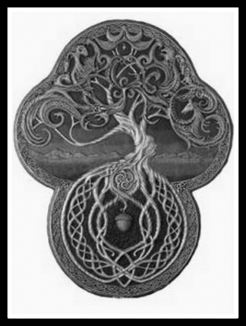
Eros – acorn/oak – Identity – Desire

It occurs to me.  Occurs to me that vocation / personal / public / private / occupation / romance / family / profession are not separate elements of some proposed “self” I might emerge with in day-to-day interactions / responsibilities / obligations / choices, but rather tangled and woven threads of the unitary multiplicity (singular-plural) that is “me”, or some continuously occurring/re-curring cursive/re-cursive individuated co-construction of living human life in the world.

So that: when I compose an essay, poem, article, research, letter, note, list, diary entry, story, etc…I am not precisely operative as one or another individuated-circumstance of my “self”, but rather a that oneindividuated occurrence/happening/event – evincing/emerging via this vehicle/form/instance in this case.

Composing a letter to my beloved today, I found “I” was also addressing my own feeling for the circumstances of my living, perception and reflection of my beliefs and attitudes within it, and aims or desires associated with my experience.  So I make it an “open letter” – a public enunciation – of my experience being such-that-I-am.

tree-of-life-cast-paper-by-kevin-dyer

I love you, Hallie.

I love you in ways that are very difficult for me to express.

*

Each aspect, experience, element of my reality – loving you/relation with you – always seems just out of reach of conveying, communicating.  Beyond.

*

My appreciation, joy, anticipation, lust, desire, want, ache, gratitude, reception, pleasure, pain, fear, confidence, courage, adventure, dread, need, fondness, appreciation, hurt, etc… all seem diminished by, or unequal to, somehow MISSED, INACCURATE to my attempts at expressing, representing, sharing…

*

Wishes, dreams, philosophy and poetry all live in this realm: ruled by the “well, NOT like THAT!”  Or…always followed by a “what I MEAN is…”

*

Ambiguity, inexactitude, shortcoming, outstripping, seemingly hopeless and impossible – yet ALWAYS generating hope, desire, energy in the STRIVING and BELIEF.

*

Hopes, wishes, illusions, truth, reality, dreams, love, art, religion… all seem to depend on this strange commerce of energy.

*

discovered negatively, or via an absence or lack…Utopia – we only ever KNOW that “utopia”, “paradise”, is a sensed “longing”, a KNOWING-THAT-THIS-IS-NOT-IT.

*

Perfection.  If perfection is experienced (instances of ecstasy? Joy?) we appear unable to express/share/tell it!

*

Utopia, perfection, hope and desire – are each revealed by their “lack” or “absence” – their “NOT-IS”

*

Everything “ultimate”, “perfect”, “totalizing”, “whole” or “outstanding” we experience as UNIQUE, DIFFERENT, distinct and incapable of analogy or metaphor.
*

UNLIKE.  We know it negatively, according to what-it-is-not, and feel it positively – as something unprecedented, unexpected, novel, unique.  Anything comparable we realize – IT IS NOT THAT.  It is unknown, incomparable, we recognize it by it NOT being ANYthing else we have experienced – or only partially, tangentially, and contrastively (negatively)

THIS IS NOT THAT!

*

Which leaves us, then, in a realm unspeakable, unreferenceable, undrawable – a pure IS realm.

*

You, my beloved, ARE.  And ARE the occurrence or happening, the experience of, the REALITY (signified, significant) of a realm, experience, event, relation that is EXPERIENCABLE but not EXPRESSIBLE.

*

An exquisite sort of heartache for one devoted to the crafts of “expressing the inexpressible”, “saying the unsayable”, and so on.

*

Philosophy, poetry, hopes, dreams – ALL draw their CONTENT from what we KNOW “it” is NOT.  Attempt to use action, behavior, language, movement, thought and speech to draft original arrangements that might allow the unspeakably unique, unsayably novel, incomparably total or inexpressibly replete –

into the realm of expression, sayability, hint, token, trace, Reality, occurrence, activity, appearance or happening…

 and yet it is defiant, recalcitrant, resistant and intractable.

*

You provide me a life of exertion and effort, a LIVING of ATTEMPT – impossible possibilities – or their interaction – irretrievable, unrepresentable happenings and events, experiences

*

BEYOND…full, total, whole Real Experiences…

…LOVE, HOPE, FAITH, INTIMACY, RELATION, DESIRE…

*

NEED for a mad trust in Reality that never equals recognition, cognition, reflection or thought.  Intransigent to language – ever DOES NOT EQUAL,

and THAT is how we know it –

*

that it is Beyond-experience experiencing

Beyond-saying expressibility

Beyond-comparison analogy & metaphor

IN ITSELF OF ITSELF BY ITSELF

AN IS EXPERIENCE

*

You ARE.

*

It is amazing to/for me.  Unsettling, novel, inexpressible, unrepeatable, impossibly in-possible,

something total, whole and real

in ways that action / language / emotion and response can never be.

*

Such is my lot.  Happily?  Momentarily joyous, ecstatic, HOPE-fully…

so much “better” than all it readily-apparently is NOT.

*

And why I seek/work into poetics, philosophy, wishes and dreams…where experiencing surpasses expressibility…Reality surpasses its processing…love its ability to confess…

I love you beyond-this.

In some other-ing language.

I am.  Yours.

“Nathan”

Hallie thrift Love

p.s.  this is also a reason that these forms (philosophy, poetry, art, dreams, etc.) often read as “nonsense” or irrational – each an effort at translating totalities of experience versus “rational” expression or analogical/metaphorical transcriptions of experience.  Dreams combinate Reality…converge and reproduce whole happenings as “veritable” mash-ups; philosophy and poetry ache to stretch language affordances, or mate expressibility to totality…quite possibly irrational, even an impossible urge, but compulsive/erotic/desirous and humanly nature-al nonetheless.

In other words – if you “know what we mean” without knowing the meanings…we are coming nearer “it.”

Prologue

writing instruments

Even if it’s only a prologue, it is necessary to begin.  To start with the starting itself.  Some origins are good at that: a bang, a blast, a whisper.

My starts tend to happen with fits.  Inconsistent and occasional, not inceptions, revelations, events.

Supposing it begins in a “mood” and emerges at pen.  Or simply pass by.  Aborted, forgotten.  The pen is what matters, not me.

Swerving from mood to mood, idea / experience, relation / response, passaging effect to affect to effect.  Hardly recognizable.  Yet if the pen is involved, or some other artifact-creator, symbol-maker, discretionary device, a remnant emerges, a record, a trace.

Never the mood itself, not even the experience, but some marker of it, a token or emblem, remains.

Starting with the loss then.  Beginning at the bones.

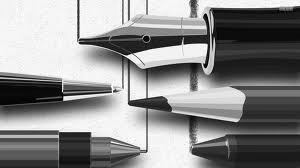
There’s a boon to that, you see.  It ceases to be important: what the where.  Beginning with the pen, it doesn’t matter.  Memory, emotion or event.  Past, presence or future.  All of those – NO MATTER.  But the instrument – the tools ready-to-hand – typewriter, pencil, keyboard or pen = matter.  Some thing happens then: it begins.

Now it’s started.  Starting with the starting also leads (you must perceive).  If the aim is the action itself, the rest does follow.  Hand leading eye, leading ink, following line, copying language, searching the words, shaping the letters, changing ideas (using different terms), evoking a thought, altering memory, writing a process: a process called “writing.”  A particular animal scraping at paper with ink.

It happens.

Begins.

Follows, outstrips, and results.  Always something greater and lesser, more-than / deprived, exactly inaccurate.

Ambiguous and real.  Using language.

“A ‘beginning’ is something other than a ‘commencement’.  A new weather pattern, for example, begins with a storm.  Its commencement, however, is the complete change of air conditions that brings it about in advance.  A beginning is the onset of something; a commencement is that from which something arises or springs forth…

…Whoever begins many things often never attains a commencement.”

–Martin Heidegger, “Holderlin’s Hymns”

Heidegger - Holderlins Hymns

In a word…

Emporia profile

Someone (some voice in my head) recently asked me this question:  “If you had only one word to describe human existence, from your experience, knowledge, and present perspective: what would that word be?”

I heard livingbeingsurvival…I thought – “What I think (I think, at least presently) is that you will never know, or be able to imagine, how you will survive.”  The jobs you will have, the people you will grow close to or far from, the ‘successes’ or ‘failures’ your path will exhibit, struggles or ecstasies you will sustain, what you will achieve or create or ignore or forget…you cannot predict, cannot forecast, how it will actually play out.  Loves, griefs, happinesses, sorrows, places, events, connections, schisms, likes/dislikes, preferences/abhorrences, and so on…

Looking back…one day…attempting to recount, account for, surmise or shape what happened!? in your life/lifetime/process – it will be surprising.  Unpredictable, unaccountable, unREcountable – a lot of “who would have imagined that!?”  Or that that would lead to that with her or him or them, and then that – who could have known?

SURPRISE!

Sure there are tendencies, “natural draws” as it were.  I’ve continually been uncomfortable with authority, laws, sunlight, loud noises and hot weather.  I’ve been consistently upset by imbalances of power, by crowds, by presuppositions and arbitrary assertions.  I’ve always been a touch distressed by the power of emotions and the weakness of will/intentions.  There are characteristics that appear contiguous – I’ve long been drawn to classical music / melodic / spare & melancholic sounds; I’ve always been invigorated by the rain; I’ve noticed a penchant for solitary spaces and human-less environments; a taste for progressive/reflective/informed/ intelligent culture (recognizing each of those as highly contested terms, i.e. – a fascination with communication – language, words, expressions, conventional meanings and gestures; a distaste for popularity & fame / ‘pop culture’/ mass effects; a distrust of temporary desire; an emaciated self-esteem and expansive self-concern; a craving for passion / romance / intensity of human encounter; and so on.  I’ve always moved toward cool colors, particularly in the fields of grey, stormy blue, dusty browns and pine-needle green; always distrusted people who shout, yell or preach – drama, makeup, surface effects.  Hell when we search for things consistent from birth to death, our lists could run quite long…and yet…

How’d we get here?  What if we look at the events, the people, the places, the feelings, interactions and all the ways we recall them (at specific instances, in particular situations)?

What if we look at what we do?  Whether we drink or smoke or not, get angry more or less, the ways we engage strangers / friends / family?  What we read, listen to, pay attention, are distracted by (same thing), are pulled to observe, think about, and why?  How much we touch?  When no one needs us?  When we’re alone?  Or falling to sleep?  Or have slipped out of the stream, have “free time,” traveling, assumed to be otherwise engaged?

If Mormons came to your door and asked “Do you believe in God?”  And you, after shuffling your feet, considering your day, pondering whether you wanted to spend part of it talking with religious strangers, checking in with your dependents (in this case, 4 children that are your human charge & devotion), zipping the past through your education, upbringing, familial ties & traditions, behaviors, relationships, responsibilities, concerns, and so forth, responded “No, no, I do not find myself believing in God.”  And then these polite young men said – “Well then, what do you believe in, if you don’t mind us asking?”

SURPRISE!

More shuffling, pondering, internal argument and gentleness, patience, consideration, critical inquiry…(i.e. politeness)…and “hmmmm!  I haven’t been asked that directly in quite some time!”  (Is it that no one wants to hear?  Know?  That I divert it?  Don’t know? Is “care” involved?).  I said something in the order of Meaning.  Something to the tune of – “Well, pardon me, but I guess I must believe/think (in Wittgenstein these are inseparable), that from our atoms & cells to our bodies, relationships, labor, behaviors, emotions, environment, world, ‘cosmos’ – trying to know as much as I can about each aspect of my being a human being – I think/believe that perhaps we each try to assemble, account for, respond, act, engage, construct experiences that give a shape to, a confluence, a medium, rationale, tone that feels satisfactory to our breathing, being, seeing, feeling, happening…making meaning, I guess.  Including, but oddly outstripping, simply surviving.  Much that seems unnecessary (tastes, preferences, selections, refusals).  Religions, philosophies, teams, employment, families, nations, entertainments, cultures and interests – all these might provide some larger structuring for our shaping, and all, no doubt, influence how we piece it together, make a kind of sense, provide potential “fits” for our choices, responses, activities and emotions…but we each also fashion all this living, this experiencing, this acting and being in apparently very idiosyncratic ways…”

“I guess I believe that this is the sort of thing we do.  I guess I think/believe that…at this moment.”

???

I think when these considerate young men return, and to the voice in my head that constantly interviews me…next time I might just respond:

SURPRISE!

I believe that life is surprising.  Unbelievable, astonishing, revelatory, frightening, sometimes shocking and amazing, astounding, uncanny and a pain/joy/ache/pleasure/exhaustion/stimulus to be wondered at.

My answer today, in one word…

Life is – surprise.

happy profile

From Laszlo Krasznahorkai: “Like a ninja.”

“In this system, nothing is more dangerous for an artist than success”

Laszlo

“Who made artists believe that art can be practiced only ‘successfully’?  Who made them believe that for a book to reach its goal and its readers, the ‘taste-makers’ are absolutely necessary?  How could they have allowed the critics, the editors, the owners of the chain bookstores, and so on, have so much power?  And who made them believe that they are truly artists?  Artists have come to believe that they, too, just like other people, need money and fame, money and fame for everyday life, moreover for being able to lead a lifestyle; and that these two repugnant things are seen as necessary for everything is not only tragic but ridiculous as well.  What kind of artist or writer lives like that?  Who is going to believe even a single line written?  What kind of esteem can the art of our age garner for itself after even one such bout of deal-making?  No, the artist’s needs are few: let there be something for him to eat and a place to live, and then every day he should circumambulate the city and country, like mendicants of old.  Nothing whatever can be more important for him than his own personal dignity, and this is exactly what he loses forever after the very first deal-making transaction…And so what do I recommend?  The taste of failure in place of success, poverty instead of wealth, anonymity in place of renown.  For now, utter concealment as opposed to publicity, perfect camouflage to the point of invisibility, because what the artist who lives in personal freedom and independence finds himself confronting today is unbelievably strong, and seems invincible…above all else, an artist must be cautious.  Like a ninja.”

LK

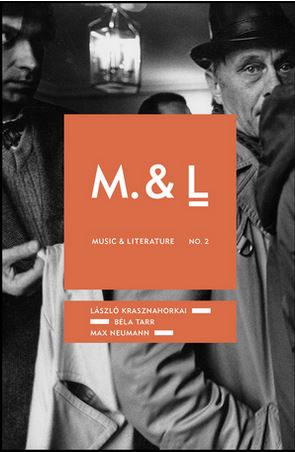
all excerpts taken from a powerful volume of Music & Literature:

MandL-Kraz

On Articulating Experience

“The more ways of articulating human experience one knows the better.”

– Eugene Gendlin

I would like very much to say/write something today.  Something resonant and broad, something that would stimulate empathy, reflection, acute sensations, self-awareness and some renewed purposiveness toward what any reader might consider their own “good” and the larger “good” of the “world.”  That would motivate us to be more fully, attentive to what we most value, what we most wish to value; that would tickle, trigger and activate that within each of our experiencings whatever it is in us that occurs in those sweet, heartbreaking and perception-exploding moments in which we feel like WE matter, that the WORLD we participate in matters, that meaning is worth, well, Life…and that Life as we are living it, we live together.

But I haven’t the first idea, concept or “hook” to know how to do that.  I have nothing to say.  I have urges, wishes, passions, dreams and a kind of crushing, yearning hope – that we might focus a little, shape ourselves, choose something for ourselves and one another and act with and toward ourselves, one another and the world in ways and fashions that could soothe, nourish, calm, comfort, extend and enhance our collective experience of being humans in a world full of so many other things we depend and inter-depend and co-depend on and with.  Rather than our easy, disruptive, erratic, dissatisfying instinctual and common practice of reactingresponding, self-protecting, guarding, distancing, lashing out, closing in…separating, hurting and harming, frightened, cowardly and weak.

I don’t know where to start with that.  I would that I could write the experience of others, could find synchrony and sympatico with my friends, family and acquaintances, could articulate the complexity and depth, mystery and reticulated implicit intricacies of their experiencings: their pains, joys, desires, griefs, knowings & doubts, wonderings and certainties, histories and prognoses, lusts and woundings… that I might be so much more tender to them, embracing, receptive, unthreatened and inclusive, gentle and comprehending.

I would like so desperately to be able to articulate the human experience of the world accurately…yet I am always wrong when I speak another, always deficient even when I speak myself…

other things articulate as well…

sciences, arts, histories, events, activities, gestures, accidents, philosophies, medicines, practices, rituals and religions

here are a few sounds (and in this order!) that have articulated my experience, today:

and

remarkable “accidental” or “fortuitous” articulations…

along with The Jerusalem Address by Laszlo Krasznahorkai

the sorrow and struggle of my love

the energy and delight of local biology professors to their craft and instruction

the events and experiencings of a day….

Here’s to us all