Ways of Naysaying

It was funny how she, how I, refused, declining enticing invitations of love.  Once.

Then again.  Or not.

Still, it happens, rejected or otherwise.  Naysaying, that is.

Negotiations.

Strange relations.  Using yes for no, and their returns and variations.

She says no though.  I did.

It eventuates, seemingly regardless of our answers.

Check boxes.  Lists.  Identities.  Likert-scales of experiencing.

Mouths inclining.  Decline.  A trajectory of eyes.  Reclining seduction.

I decided not to go along.  (Where do we go instead?  Who goes?  When?).  Each denial an assent.

What did the trees refuse?  What was the grass fighting, then?  The clouds?  I watched… she observed birds.

The dancers’ bodies.  A dismissal of space.  The removal of sound.  Absent silences.

Where was she?  I?

We said no.

Do words incline or recline for us?  What of the ear, the eye?

Still I smelled her.

“I love,” I thought, “I cannot love.  I can not.”  She declines.

These are the ways of naysaying, all our doubled negatives, equaling… what, exactly?

I love her.  I can not.  She won’t.  Will not.  Negativity in a vacuum.  Apparatus.

The squirrel upside down, above the lawn, on the long tree limb.  What is it denying?  And where is the use of speech?

We cried out, decrying.  (What could that mean?  That seems always in question).

I asked Beckett and Blanchot.  They each said that she said “no.”

Apparently, she says “no.”  “I’d really like to, but can not, must not,” i.e. “no.”

It rings out, like bells – so radiant, so silent, such dissipation.  Such temporal hazard and warning.

Something refuses the air.

I remember.  She traces back.  What means “over”?

Sound refusing silence.  The first.  The second.  The next.

What is “last”?

She says no.

I recall dreams from time to time.  Unable.

Something may have been said.

A Conversation of Humanity

A man stumbles into a bar… (perhaps you’ve heard this one before)… truly more of a sauntering in seeming need of assistance… must be no stranger here, his drinks await him wherever he finds or chooses or results in sitting: a something-with-vodka, large glass of water, and occasionally a cup filled with coffee.

“You’re the one that always has books,” some say, “you some kind of writer or something?”

“I don’t know what I’m doing,” he mumbles.  “I’m always tired, I feel ugly and old, I don’t like my body but don’t desire doing anything about it, perhaps I should, I’m sure to lose it someday…” (he isn’t talking to anyone).  “Thank you, always, you’re ever so kind,” he says.

He says “My children seem to remember me,” shifting in his chair as if to leave, or relocate tables, “my children they seem to remember, and they hurt me, they have hurt me, my body hurts, mostly in sport, and what they do and don’t remember.”  He opens a book, looks as if he’s reading, another round of drinks appears.

He writes and marks in many colors.  He is dirty.  He wears overalls and moccasins.  He never seems cold.  It is cold.

“I decided to shower today,” he mutters.  “Some ladies still talk to me,” something-and-vodka drips through his beard, “some will even hug or hold me yet, even this way” (patting his belly, grimacing) “I guess I didn’t like my smell or simply thought it might change me, it’s awful hard to be alone with my body.”  He moves, his drinks are waiting at another table, both fresh fills and half-drunks, and a sandwich of some kind.  The cook passes and pats him on the shoulder, smiles, asks of how he’s doing.  They hug.  The man praises him and his eyes are moist.  The man isn’t anyone in particular.  He isn’t anyone.

“What you doing with all those books?” she asks, he thinks.  Pretends that someone’s interested.  “Not the young ones much anymore,” he says, “they are needing something else, they can tell I’m aged and tired, carrying the trouble of experiences, but a few, a few older ones will let me hug them, touch, perhaps a kiss, perhaps an accidental overnight, that strange collapse.”

“I have them to read,” he replies, “there’s always more to read,” he whimpers, “so much, so many, to read,” he sighs and smiles like a boy receiving toys, “if only people, my children, if, if they felt read this way by me, some women, some wonderful women, if I could delve, could attend, if others felt read this way, these books, I love them, I love and need them, their words, I love and need and want them…if others felt that way, I’d like to feel that way – loved, wanted, needed… sometimes my children…”

“Another?” she says so warmly with her tight and fast-moving body, lithe and breasted, friendly with its clothes.  She has a fresh vodka-with-something, he says “no I shouldn’t, but sure, I guess, you’re so kind to me, why  not?  I will, yes” (wanting, loving, needing.. books scattered over the tabletop, all closed).  He drinks.

“My children, my friends – so smart, so beautiful, with verve… so helpful… I did shower today,” he thinks, “maybe I’ll be useful to one or some of them, but probably not, what could they need or want of me,” he drinks.  “Not the young ones, though, not anymore,” he thinks, “what could I offer – these worn experiences, these words and doubts, these lacks of memories, confusions, waking dreams, these wonders.”

“You’ll need to go soon,” she chides, “you can’t be staying here.”  “But he’s the writer,” a boisterous drinker shouts, “he oughta tell a story, oughta earn his keep!”  Drunk old friendly at two in the morning (bar time – it’s actually 1:35).

“Tell us something,” they gather, they prompt.  “Say some of those words,” they prod.

So he opens his notebook and begins to write…


“…the contradiction which awaits the writer is great.  There is no mission, he cannot undertake it and nobody has sent him on it, that is to say he will have to become nobody to accept it; a contradiction which he cannot survive.  That is why no writer can hope to preserve his life’s freedom for the benefit of the work… everything takes place between the artist and himself; no one else can do anything about it; it is a mystery like love that no extraneous authority may judge or understand.”

– Maurice Blanchot-
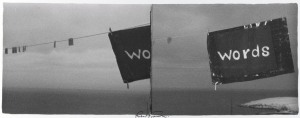
Expectation

“Whether it makes any difference what you say – whether there is any point in it anyway; whether there is any point in saying anything anyway.”

– Rush Rhees, Wittgenstein & the possibility of discourse

It was the mystery that found us, all the unknown buried beneath and beyond.

She said to me, or rather she offered her hand, or rather we made eye contact, well, she greeted me and held out her hand and we looked at or into one another’s faces.  Just the surface of the ocean.  Seas and skies are larger than our imagining.

Say skin, language, thought, or feeling are flexible bordering insides and outsides, contained and beyond.  Something like that I thought, unknowingly.

He spoke to me, then hugged me, with an asking.  I couldn’t know the question, but I understood the words.  We seemed friendly and respectfully embraced, hesitant and expressive at once.  There’s a cliff at the end of the trail.  Sometimes I don’t remember.

Sharp curves on roads in mountainous terrain.  That sort of thing, voids that look empty but allow plummet.

And whether it makes any difference, she said.

Difference is made, apparently.

Mother used to tell me, what was it?  Her voices are clear, kind of, almost, but the words are lost in others.  Deep waves are like that, it seems; hard to follow or find, prominent and obvious while rocking the boat, regardless the size.  Clouds.  Wind makes little sense of skies.  Everything is out there.

Inside, it’s raining.

I was asked for a cigarette and large trees moved above rooftops.  She offered her hand the way he hugs me, my son playing music on the piano while a cat escapes and someone’s doing homework.  They say the ground goes deeply down beneath us, compiled by potential millennia.  Nobody knows, though we have tools to measure by.  Whatever those tools measure.

I remember first times.  Every time.  Only it’s perplexing that they’re exactly the same.

Does anything repeat?

Father got on me again about irresponsibilities, my dreaminess.  If only I’d been military I’d be disciplined.  Different.  She offered her hand plus an ankle, a hip, a breast, a womb.  I’d have values. The crook of a knee, a neckline.  Take responsibility.  He wanted it in my mouth – that feels best, he said.

What do I know?

Surfaces of oceans.

She stops and reads books.  I do.  There is music and a din of dialogue.  Raucous.  Discomfort.  Anxiety is familiar, always the first time again.

I am afraid.  Usually.  Deep water disturbs me.  No one knows.  Many are afraid of flying.

Crying is its own thing.  How is an ocean made?  I won’t succeed.

Whether it makes any difference – saying anything anyway.  Someone speaks at me.  Eyes meet.  A brush of lips.  A grasp of hand.  What is the question?  Skies and oceans.  Earth’s depths.  What do I understand?  Always ending begins, beginnings.  What ends.  What has no end?  It begins.  Again.  Always first times.  Nothing.

Her breath tastes good, inhaled.  His muscle.  Seawater burn.  Heartloss.  So much fresh air.  The turn is sharp.

Saying anything anyway: the point is whether, weather, difference…its repetition.

The how and why of her.  Of him.  Of it and other.

There I must have been when I saw her or felt it or once again the beginnings.  Once again the first time.  Always again.  Begin.  While ending.  While ends.

He said so – whether there is any point in saying anything.  He said what felt best when he hugged me, kindly.

She offered.  Someone asked for something.  Like surfaces on oceans.  Horizon lines.  The ground beneath our feet, beneath that.  Differences.  The above.  I cut my skin.


Guilty: or, How Things End Beginning

(this is the last thing I find I’ve had time to attempt in writing for many weeks…)

after Bataille, Of Montreal

It began.  It begins.

Damage.

What opens what humans call ‘the heart.’

.

Who is the author?

Where?

.

In the loss.  Lessness.

What is…always expressed / exposed by what

CAN be taken…

What is stripped back, laid bare, stolen,

raped…

.

Then you know.

Both ‘you’ and a very strange sort of ‘knowing.’

.

THAT POINT:

[the werewolf]

that place, space, moment, experience:

HATE.

LOVE.

(=)

(equals)

.

The expansion.

Additive.

Infinite.

A mad undoing.

A ‘one’ coupled by LOVE-HATE (possible ferocities)

– angry peace –

– gentle tearing –

.

Avarice.  Grace.  Hunger.  Gifts.

.

We get born.

We most certainly die.

(even if we never learn what ‘being born’ or ‘to die’ might be / mean)

.

Damage: how we…die with/it

: how we…end in it

.

We most certainly die.

.

This we know [somehow] without experiencing it.

Or even being able…

.

Death.

Always next.

Always next.

Always next.

(Regardless – truly regard-less)

of anything IN-between

I AM ALL WAYS DYING MY DEATH

(what might ‘living one’s life’ seem?)

I happen to be singing imagined limits

(All I do not know)

.

Questions and conundrums

NOTHING.

Ends and means:

DEATH.

-easily a kind of glory…

…inevitable

…insatiable

DECAY.

.

Guilty.

BIRTH (whatever could be meant by that) = DEATH. DECAY.

(It began.  It begins).

-What opens, happens, what humans call ‘the heart.’

We most certainly die.

  • Hello cancer
  • Hello age
  • Hello war and disease
  • Welcome other
  • ‘Time’
  • Fact, fiction
  • Truth, theory
  • “Hello, human!”

DEATH.

(Most certain)

(The wonder : : : : something is born)

always

                                                      all ways

                                                                 in order to…

…DIE.

Irascible, inevitable, indivisible, ineradicable ends.

Cheers Death

‘you’ (nothing)

always win.

If ‘winning’ could ever look like that, this…

…end(s).

once its begun, it began, it begins…

…endings, ends, the end.

– always already there –

always                                                 already                                                here

“between appear and disappear”


Playing Writing: a Repetition

(alas, the notebooks keep filling…but the time to type does not avail)

Deviser

If I.  If something stirred, was stirring.  The dying.  Any of us.  Were something stirring.  For me.  If I.  The lonely.  Any of us.  The longing.  The longing lonely.  Were something stirring.  Were I.  If I.

If only.  Could be any.  If one.  If only.  If I.  For me.  An other.  Any of us.  A stirring.  I, only dying lonely longing one.  If.  A stirring.  An other.  Someone to speak “we.”  To say “you.”  A whispered “us.”  For me.

If I.

What would I (if I, if other) say, if something stirred, if stirring an other, some other who, who might say “you,” “we,” whisper “us,” something stirring then, what would I say.  If I.  If you or we, I whisper “us,” stirring still, what would I say?

When might a story begin?  Who could start the unknown?  Only language.  Perhaps only language knows what can’t be said.  What is yet to exist.  Or may not.  Ever.  What is that to me?  If I.  If indeed that is what I do.

Touching other to make us.  If I.  If other.  Then a voice, a touch, an extra, an excess, we.  If you.  If I.  What is story to that?  How so?

From anywhere: impermanence.  If an other.  If I.  Some story’s beginning, how begun.  If there were a sound, as it were, so to speak.

10/30/2017

Brief Entry

On my Deathbed


I told language:

Thanks for having my children


The language had names,

As did the children:


They were all words.


I dreamt of a door

The kind without windows


That always stands open.

I remembered some more


So I said the unspoken:

I gave them my want.


It declined.

How in the world

The world is a weighted haunting –

– some complex surround –

to be dreamt and/or measured, and felt

with-in time

I amended the ‘haunting’ to be –

not the thick and illegible “world,”

but the compulsion of ‘figuring-out’ –

for with-out

the ‘figuring out,’

an ‘haunting’ is ghost –

and only just happens:

a nexting,

a breathing,

relation;

a missing,

a moving,

a touching,

a feel:

in convulsion.


Within which is conceived a convergence –

event

(some humanish word for ‘what’s happened’).

This ‘we’ –

what is it?

what part does it play

in the muddle?

And ‘what happens’

what means?:

That-which-is

(for us)

some occurring.


So diverge,

and tri-verge,

multiply in the mess –

the ‘world,’

as you feel it

and think it

and be –


how it wholly

might be

with itself.

Fragment: Brief Conversation

“How come language (or drinking) makes the pain of language (or drinking, or relationships) go away, recede, soothe…and then becomes language (drinking, relation) and its pain…again?” he asks.

I smoke.  I look at him.  He is examining (with obvious pretend furtivity) my pale, smoothe legs, coming out of my singular light dress.  At my arms, my skin, my cheek and throat, my hair.  Lasciviously thoughtful, he.  Almost curious.  Almost authentic in his desire.

He is trying to daydream.

I am trying to be.

We are drinking now.

I am young, he less so.

Or neither.  We do not know.  Anyone can be so near their end.

So the story goes…

“The world smells good,” he says, and the delectability to the nostrils clearly depended on death: burning wood, smoking pig, a nostalgia of forests…

I knew not what I felt.  Mixtures.  Pleasures and sorrow.  Excitement and fear.  Doubt.  I did not respond, just masked placidly.  Pleasantly, I hoped.  Ambiguous.  And what does he sense?

Rough Draft: “Compatible Solitudes”

Let’s do it this way:

in silence

near, breathfeeling

as if we knew

.

everything

there is to know

without

accumulating

the decay

shared knowing

becomes

.

Let’s be together –

in quiet

this time

without

plugging our ears

with talk

.

the more we know

the less,

and more

we wish we didn’t

.

as if intimacy

were a relation

we have with mirrors

loving everything close

the ways we love ourselves –

not much.

A Letter in Employ

I am performing a task for my employer.  I am writing a professional letter.  I am letting you know that I labor.  I am here to be useful, and used.  I submit.  My actions indicate that I accept structure and system as representative of survival.  I will do what you ask.  I recognize organization as power.  In fact, any kind of organizing indicates a position of imaginative power and control.  To differentiate, to specify, to label, name, assign – all are a fiat of power and authority or authorship – a claiming of superiority over things named, situated, recognized.  Supposedly if I comply dutifully – bow and behave in ways that signify structure as something larger (or more important) than me – I will have internet access, some food, air-conditioning, coverings, a car, and someplace to live (in certain mountainous areas, none of these are beneficial).  “Teamwork” is misnomer.

My philosophy is simple:

  • The mind or brain is an intermittent trickle of the rivers of the body which are hardly discernible in the waves of the world.
  • “I” am No one, Nowhere, which is to say Everyone, right Here. A poet wrote of presenting his face as a smashed window baring open sky – I thought that was me – No one Nowhere = Everyone right Here (whenever/wherever that happens to be).
  • Experience is what happens. What happens is what is.  If criticized as “for us” (whichever ‘experiencer’) I ask – what else could it be?
  • Knowing limits. If “for-this” is all my experience can be, then those are my limits.  Once I sense my limits I can attempt to challenge, question, and extend them, for alternate experiencing.
  • Ideas/Thoughts/Concepts/Theories [abstractions/imaginings] (like structure, perception, systems, organization, self, number, truth, etc.) are compelling because the limits of their effects are unknown to us. Ideas (ideologies) allow us to ‘experience’ power and control and compliance of the world around us (apparently), even though the dripping-trickle-stream-river-ocean of our limited participation in world flows always and is unalterably changing and miniscule.  Bodies die.  Each every/no-one where/when-ever.
  • The propensity or lust for belief – in ‘observation,’ ‘experiment,’ ‘objectivity,’ ‘analysis,’ ‘deduction,’ ‘ideas,’ numbers or language or effects of imagined power and control (technicity) – are wishes against the body, against dying, against limitation, against what happens, anyway.
  • Thoughts and effects do not make experience longer.
  • Experience is living, is limited.
  • Living is the extremely limited experience of dying.

Admitting or confessing that I exist to meet needs, that this is my employment, may be a Credo of Little Import.  A submission of insignificance in accepting others’ systems, structures, and arbitrary claims to power.  Compliance.  Resignation.  Complaisance.  Dependence. [Co-dependence – opting out of experience/living exits the submission-religion].

My voice dribbles, a hardly perceptible microorganism in the ocean of world.  My experience a parenthetical waving particle.  My living its effective dying.

In a beginning that never began, the ending already comes.

World is an intermittent trickle of the rivers of living, barely and scarcely discerned.

We are Here Now, how would we like our fleet experiencing of dying to be?